




Apple seeded iOS 27.2 RC to registered developers on October 19, bringing the next operating system update for iPhone closer to its public debut. The build arrives one week after the fourth beta and lets registered testers evaluate system changes before final rollout. It adds new Siri AI languages and updates core applications ahead of an expected public release before the end of October [1].
Installation Steps for Developers
Registered developers can install the test build directly by opening Settings, choosing General, tapping Software Update, and opting into the iOS 27 developer beta channel on supported iPhone hardware. Apple also seeded iPadOS 27.2 RC for iPad testers [1].
Juli Clover of MacRumors reported that Apple previously promised to introduce additional Siri AI language options in October, which strongly points toward a public launch before the end of the month. If ongoing evaluations over the coming days uncover no unexpected software failures that demand a replacement build, this test version will become the official software update delivered to everyday users worldwide. Testers spend this brief window confirming that third-party applications still operate properly and checking that core device functions run smoothly without sudden battery drain. It’s a quick turnaround for developers, but that fast timetable matches Apple’s regular autumn release pattern [1].
Zac Hall of 9to5Mac noted that Apple is applying finishing touches after multiple beta cycles, meaning engineers won’t issue another test release unless someone discovers a severe regression. If testing continues without discovering major bugs, this build will ship to customer devices next week [2].
iOS 27.2 Update Features
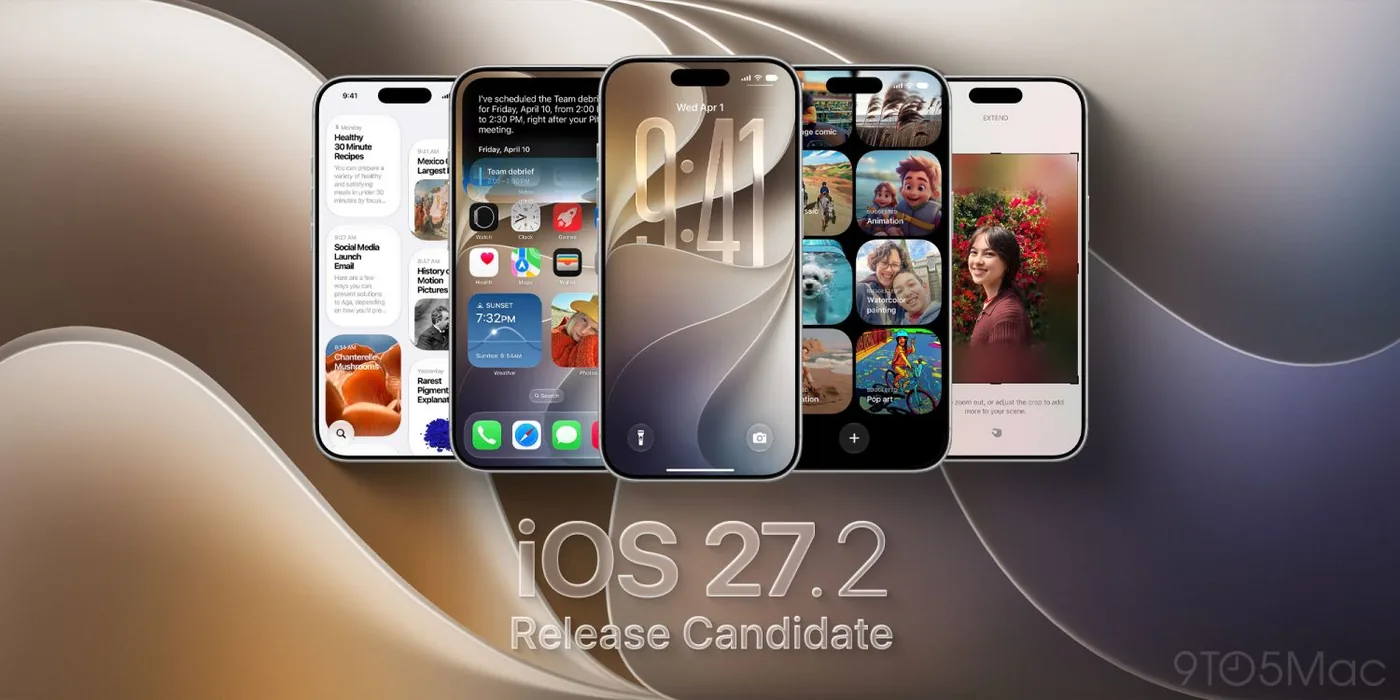
The most prominent upgrade in iOS 27.2 is expanding Siri AI into five languages, broadening access to the assistant’s upgraded conversational tools for millions of iPhone owners around the world. Users can speak with Siri in French, Japanese, Korean, Portuguese, and Spanish, building on the foundation laid when Siri AI features rolled out with iOS 27. This rollout fulfills commitments Apple announced earlier in the year when detailing its machine learning schedule. Beyond voice tools, Apple TV gains separate user profiles so individual family members can keep their own watchlists and personal viewing history distinct on shared living room hardware [1].
Call Context now supports anniversary alerts, helping users remember special dates when speaking with phone contacts during daily calls. It’s a practical addition that presents key family dates right on the active call screen [1].
Media playback tools also show visual updates. Apple Music adopts a monochrome black-and-white icon in place of the standard red artwork, and blue accent coloring highlights whichever tab is selected. The beta cycle also introduced Group FaceTime Dual Capture, which lets callers broadcast two camera angles simultaneously during video chats. In addition, Apple Podcasts refines how it arranges episodes to help listeners navigate long backlogs [2].



The Postponed Health Redesign
While iOS 27.2 delivers several welcome improvements, its most heavily tested tool didn’t make the final cut. Apple used earlier test versions to trial an overhauled Health app with developers. However, engineers removed the new design in beta 4 and restored the earlier layout instead. The upgrade was delayed [1].
That reversal surprised testers who had spent weeks evaluating the revamped interface and exploring its reorganized wellness metrics. Apple still plans to deliver the redesigned Health app in a separate update later this year, but it couldn’t get the interface ready in time for this autumn cycle. Removing a headline feature during testing isn’t unusual when stability questions arise, yet it fundamentally shifts how people view the overall update. Without the health redesign, the remaining updates focus on smaller utility features and interface tweaks rather than a complete overhaul. Apple chose to delay the tool rather than ship an unfinished experience to millions of customers [2].
Community reactions showed that disappointment once the test cycle neared its end. On 9to5Mac, a reader named Nutmac commented: “Without the redesigned Health app, 27.2 isn’t particularly interesting.” That reaction matches how early adopters view the candidate build. Still, the update does add an alternative expanded prompt for App Tracking Transparency in the European Union, giving users clearer details when apps request permission to track them [1].

Targeted iPhone 18 Pro Fixes
Parallel to the 27.2 testing effort, Apple has been working on urgent fixes for current phone owners. Analytics logs reviewed by MacRumors show that the company is actively testing a separate iOS 27.0.1 release designed to address minor operational bugs discovered right after recent phone models reached everyday global consumers [1].
One specific bug involves the biometric authentication system on the company’s newest premium phone models. Apple told 9to5Mac reporter Benjamin Mayo that engineers prepared a software update scheduled for early next week to resolve Face ID authentication failures on iPhone 18 Pro handsets. It isn’t unusual for newly launched phones to hit minor software problems once devices reach everyday consumers around the world, and engineers moved fast to resolve the authentication glitch before it caused broader frustration. The targeted fix will roll out as a quick point update to restore reliable facial unlocking for affected customers [1]. Face ID testing continues.
Software rollout plans also connect to network capabilities like iPhone Handoff, which debuted in iOS 27 to let people switch between two iPhones using a single phone number. T-Mobile and Deutsche Telekom are the first carriers to offer the service, while Verizon and EE will add support later this year. However, AT&T hasn’t committed yet, with a spokesperson telling CNET that the carrier is still studying how people might use the feature [1].
The iOS 27.2 RC Software Lifecycle
To see why Apple seeds a release candidate build, it helps to understand the formal software release life cycle documented on Wikipedia that guides operating system development. In traditional software engineering, an operating system moves through several distinct phases: pre-alpha, alpha, beta, and release candidate, before reaching final gold status. Pre-alpha refers to all early design work, requirements analysis, software design, and unit testing that happens before formal testing begins, with pre-alpha builds incorporating specific function sets as modules finish. Alpha testing serves as the initial formal evaluation phase (alpha borrows its name from the first letter of the Greek alphabet), where programmers use white-box checks to review code internally. That phase can be unstable and ends when the build reaches a feature-complete state, meaning all primary functions are in place [3].
Beta testing follows alpha, taking its name from the second Greek letter. At this stage, software goes to testers outside the engineering group for the first time. The focus centers on usability testing and reducing bugs that could cause crashes or data loss before public rollout [3].
The release candidate sits at the very end of this testing pipeline as a potential final build. At this stage, new features are frozen and engineers focus only on verifying stability. If no severe bugs emerge during developer testing, iOS 27.2 RC is the exact version that will ship to millions of customer devices. Following this structured path helps make sure that regular iPhone owners receive a dependable update when public rollout begins [3].
- ONLINE NEWS Clover, J. (2026, October 19). Apple Releases iOS 27.2 Release Candidate. MacRumors. [Article Link]
- ONLINE NEWS Hall, Z. (2026, October 19). Apple releases iOS 27.2 RC for iPhone. 9to5Mac. [Article Link]
- WEBSITE Software release life cycle. (n.d.). In Wikipedia. [Article Link]


