





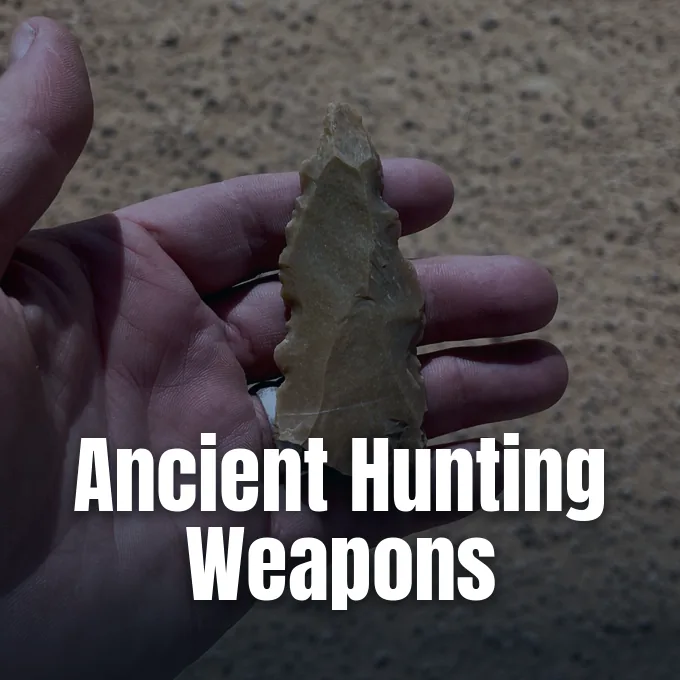
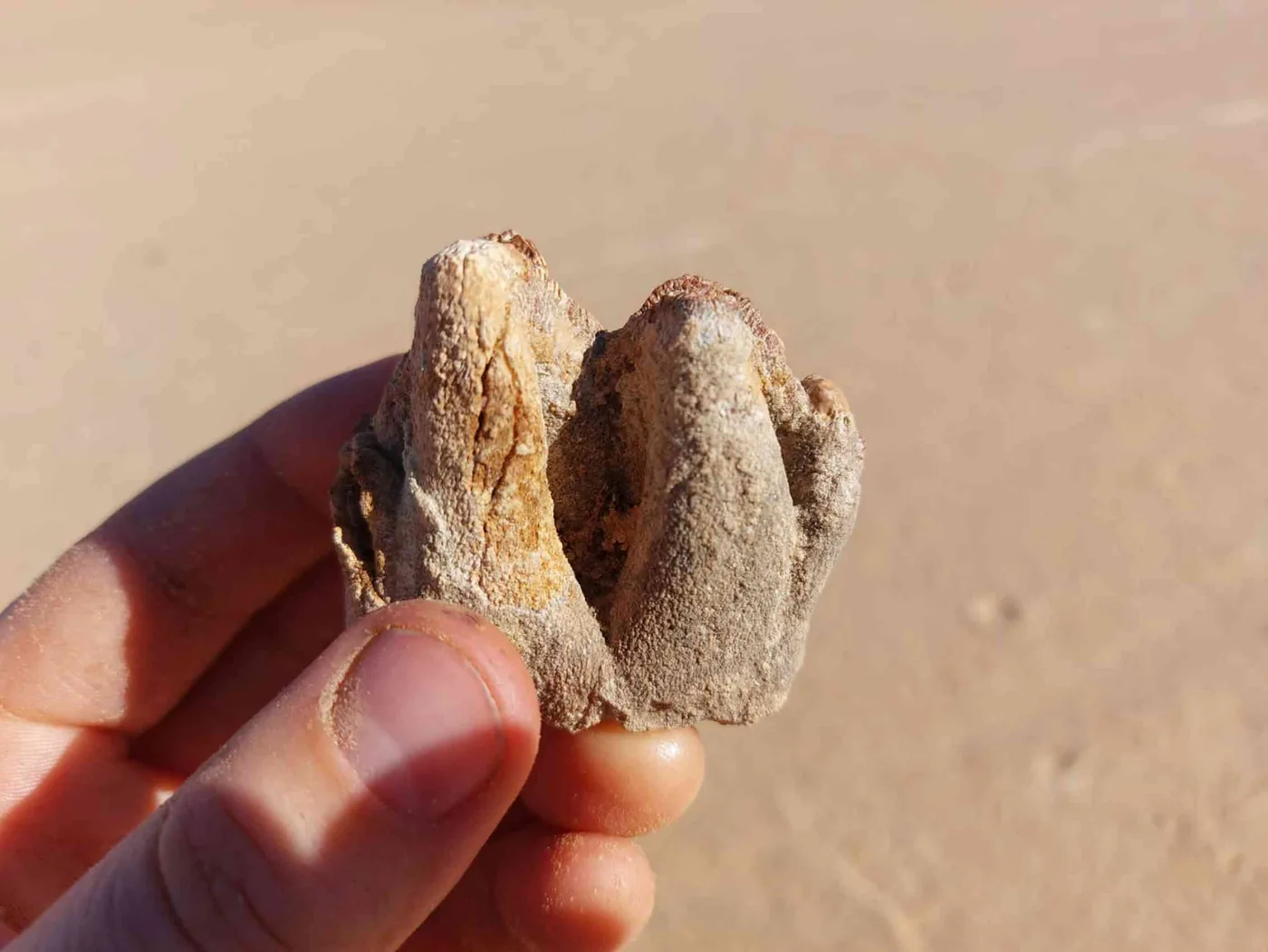
A fossil hippopotamus tooth uncovered from desert sands in southern Saudi Arabia has led researchers to the shores of a vanished freshwater lake that existed 125,000 years ago. Archaeologists led by Chris Clarkson and Michael Petraglia investigated the dry Mundafan basin, reporting in Science the discovery of thousands of stone artifacts, butchered animal bones, and microscopic chemical residues on sharpened stone tips. These organic residues suggest that Middle Paleolithic foragers manufactured poisoned hunting weapons tens of thousands of years before the earliest confirmed examples in South Africa. While the Empty Quarter stretches today as an arid expanse of shifting dunes, recurring wet intervals once transformed the peninsula into a mosaic of wetlands and savannas. These findings show that early human groups crossed into Southwest Asia with flexible toolmaking strategies, combining stone points with toxic plant extracts and fibrous wood to exploit inland game [1].
Excavations at Mundafan Paleolake
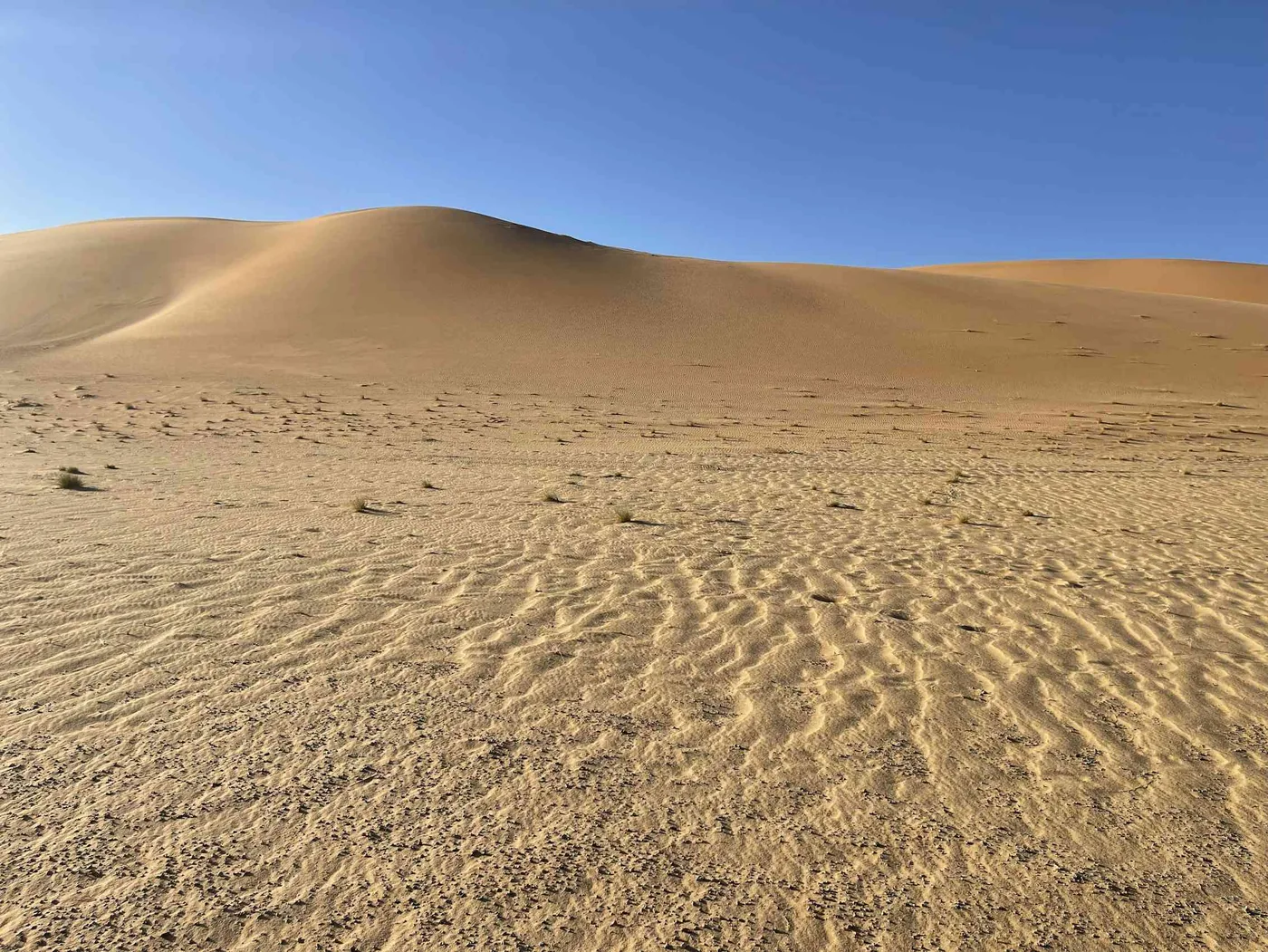
The archaeological site of “Uruq Aljelibah sits in the southern Empty Quarter, or Rub” al Khali, an arid sand sea spanning Saudi Arabia, Oman, Yemen, and the United Arab Emirates. The site name translates to “sand dunes of a watering hole,” a description verified by sediment beds buried beneath modern dunes. Frans van Buchem and Laurence Hapiot, geologists at King Abdullah University of Science and Technology, said the basin once contained an expansive body of fresh water that covered 340 square kilometers (about 130 square miles) with water depths reaching 29 meters (95 feet) [3]. Today the landscape is dry, hot, and surrounded by massive dunes, but during the last interglacial period the lake supported aquatic plants, large mammals, and freshwater fauna [1].
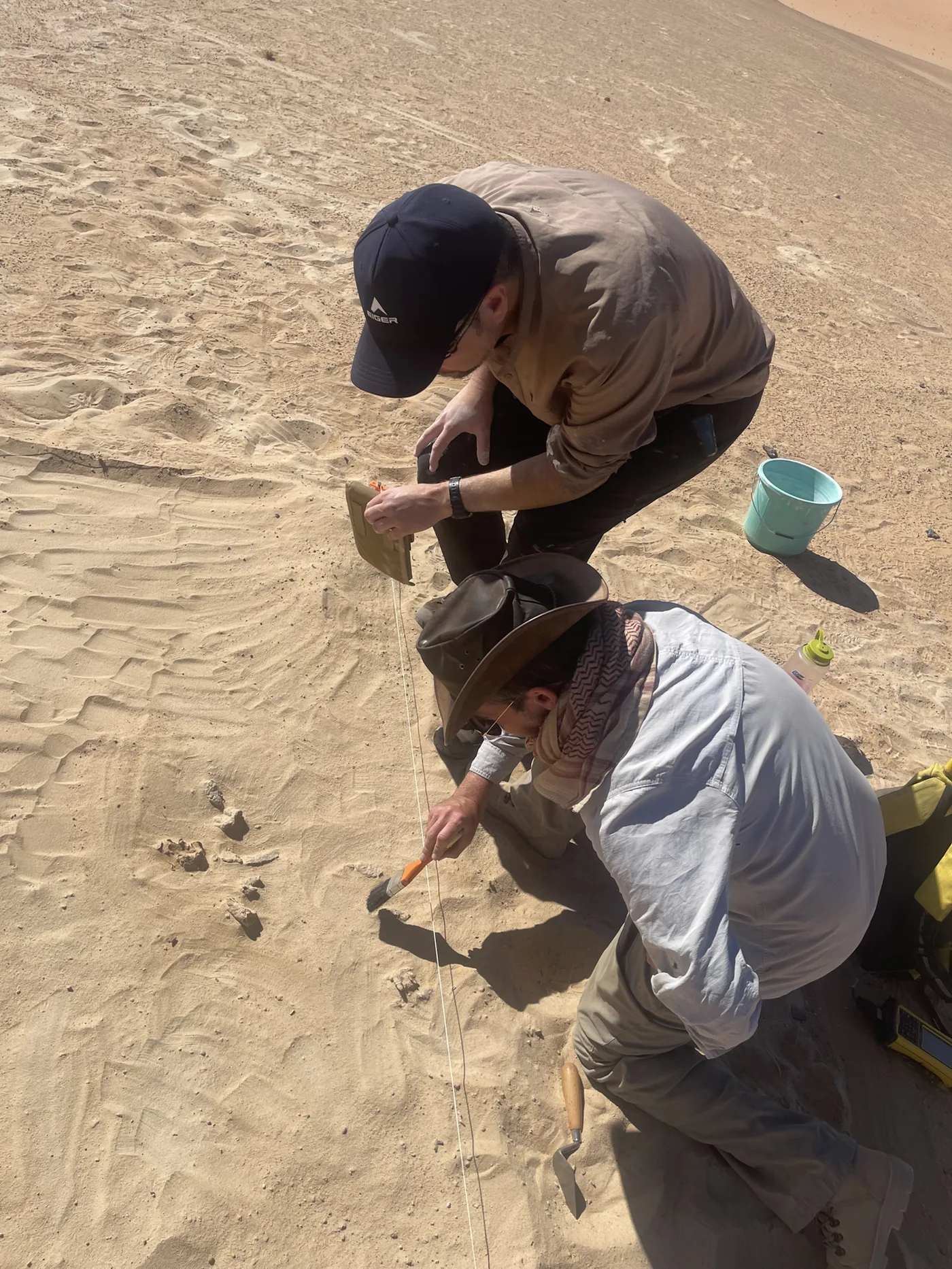
An international team including Faisal Al-Jibreen from the Saudi Heritage Commission, Abdullah Alsharekh from King Saud University, and Chris Clarkson from Griffith University and the Max Planck Institute of Geoanthropology surveyed the lakeshore and gathered more than 5,500 stone artifacts. The researchers used luminescence dating on quartz sand grains to measure when sunlight last touched the buried sediments, showing that the shoreline deposits date to roughly 125,000 years ago during marine isotope stage 5e. Excavators found that several stone flakes fit back together on the ancient ground, proving that hunters knapped flint tools right beside the water. Clusters of butchered animal bones lay scattered among the discarded tools [1].
Traces of Poisoned Hunting Weapons
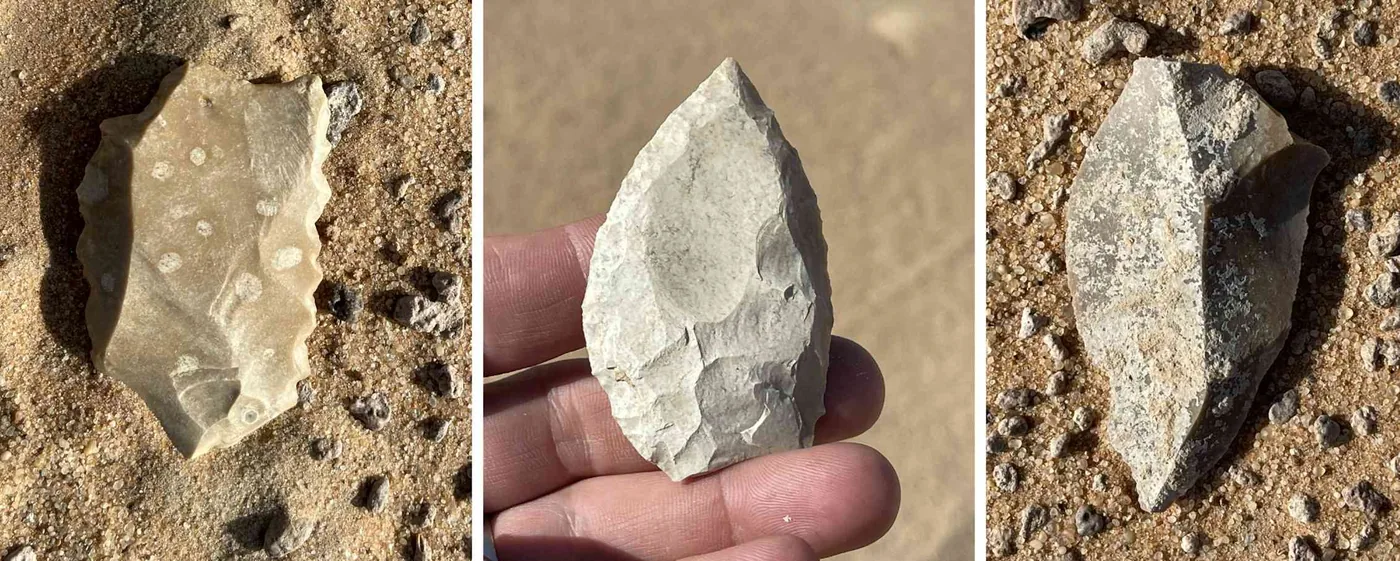
Microscopic examinations of the stone points from ‘Uruq Aljelibah revealed fractured tips with step terminations and crush marks produced by violent contact. These impact fractures indicate that hunters mounted the sharpened stone flakes onto spear shafts to bring down large animals. Near the base of one retouched point, researchers detected traces of plant resin and wood fibers, showing how prehistoric hunters glued and tied stone tips into composite hunting spears. Near the pointed tip, researchers identified dried animal proteins and fatty residues from processed meat [2].
Chemical spectrometry on the stone points detected toxic compounds matching the arrow poison tree, known as Acokanthera schimperi. This plant grows in eastern Africa and southern Arabia, and known hunting communities often boiled its wood and bark to extract lethal cardenolides that disrupt heart function in wounded quarry. Surviving residues on the Arabian artifacts suggest that hunters applied toxic plant latex right behind the stone tips to help pierced game succumb quickly from shallow puncture wounds [1].
The discovery pushes back the timeline for poisoned hunting weapons by tens of thousands of years compared to previous finds. “At 125,000 years old, these would be substantially older than the poisoned arrowheads recently identified in South Africa, which date to around 60,000 years ago,” Clarkson said. He cautioned that questions linger about how hunters refined the concoction: “But we haven’t demonstrated exactly how the poison was prepared or whether it was effective. So I’d describe these as potentially the oldest evidence for poisoned hunting weapons, rather than an unequivocally established first [3].”
Plant Technology and Woodworking
Beyond hunting points, the excavations yielded stone tools designed for gathering and cutting vegetation along the marshy lakeshore. Several flakes featured saw-toothed denticulate edges with micro-wear polishes caused by sawing fibrous reeds, tubers, and palm fronds. Stone tools also preserved microscopic tissue fragments from tree bark, woody stems, and aquatic reeds, showing that wetland plants provided common raw materials for daily camp life [1].
Organic materials like wood, cordage, and plant resins almost always decay at open desert sites, leaving an incomplete picture of prehistoric life. The micro-residues from Mundafan show that these early populations possessed sophisticated woodworking crafts, shaping wooden shafts and twisting plant fibers into cords or carrying containers. Research into ancient diets featuring freshwater plants elsewhere shows that hunter-gatherers consistently depended on wetland flora to balance seasonal fluctuations in big game availability. Clarkson said that these people were not merely striking flakes from stone cores, but combining stone with wood, fibers, and resins into versatile compound equipment [3].


Grassland Fauna in the Empty Quarter
Fossil animal bones collected from the Mundafan deposits paint a striking picture of an Arabian wilderness teeming with large African mammals. Excavators recovered teeth and skeletal elements belonging to hippopotamuses, water buffalo, gazelles, oryx, ostriches, and camels. Gilbert Price from the University of Queensland and Paul Breeze from King’s College London excavated the bones of a large hippopotamus from the paleolake shoreline deposits, confirming that stable, deep freshwater persisted long enough to sustain herds of semi-aquatic herbivores [2].
The presence of giant buffalo and grazing antelope indicates that open grasslands stretched far beyond the lake margin across areas that are now waterless sand dunes. Clarkson said the find shows how regional environments shifted over geological time. “The idea of hippopotamuses and enormous buffalo living around a lake in what is now the Empty Quarter really brings home just how dramatically these landscapes, and global climates, have changed,” he said [3].
Spatial mapping showed that animal bones clustered within dense concentrations of stone tools. This association indicates that early humans killed, butchered, and processed game right along the lake margins. Eleanor Scerri, an archaeologist at the Max Planck Institute of Geoanthropology who was not involved in the excavation, said the discovery provides rare evidence connecting butchery tools with prey carcasses. Scerri praised the convincing spatial relationship between hunting weapons and megafauna bones [3].
Debates Over Poisoned Hunting Weapons
Despite the rich evidence, some independent researchers urge caution about the absolute age of the stone tools. Jeffrey Rose, a Paleolithic archaeologist at the University of Algarve who was not part of the study team, pointed out that all the stone points were recovered from the surface and not excavated from sealed lake beds. Rose said: “Not one was excavated from the layers that were dated. The 125,000-year date belongs to the lake, not to the tools. For the tools, it is only a maximum age [3].”
Surface scatters are common across Arabia, where persistent desert winds scour away fine sediment and leave artifacts lying exposed on ancient surfaces. Archaeologists often debate the chronological connection between surface artifacts and dated landforms, an interpretive challenge also central to investigations into claims of controversial ancient structures elsewhere in prehistoric studies. Because the tools fit back together and match the distribution of the fossilized bones, the excavators argue that wind did not wash them in from elsewhere, but future work will focus on locating artifacts embedded directly in undisturbed sediments [3].
Another lingering puzzle centers on how prehistoric hunters handled poisoned game without sickening themselves. Present-day African hunters who coat spears with toxic tree extracts often cut away the flesh surrounding the entry wound before cooking the carcass. Clarkson explained that poison introduced into the bloodstream acts differently from ingested plant compounds, but further chemical tests are needed to clarify how early people prepared and handled these lethal mixtures [3].
Early Dispersals Beyond Africa
The discoveries at Mundafan provide new context for understanding early human expansions into Southwest Asia. Archaeological work across Saudi Arabia, including studies in the Nefud Desert at Khall Amayshan 4 and Jubbah, has shown that hominins entered the Arabian interior during at least five separate wet phases over the past 400,000 years, matching intervals of reduced aridity roughly 400,000, 300,000, 200,000, and 55,000 years ago [5]. Although no human skeletal remains were recovered from ‘Uruq Aljelibah, the tool types and chronology align closely with early populations of Homo sapiens. Human fossils from Mount Carmel in Israel show that our ancestors reached southwestern Asia by at least 177,000 years ago [6], while an 85,000-year-old fossil finger bone confirms their presence in northern Arabia [2].
Instead of an impassable barrier of dry sand dunes, early human travelers found productive grassland corridors anchored by permanent freshwater lakes. The evidence shows that these populations did not simply wander across Arabia, but adapted to local ecosystems by exploiting big game, processing wetland plants, and making poisoned hunting weapons. When arid conditions returned and Mundafan dried up, these communities moved on toward wider regions of Asia, leaving behind a technological record that reveals the adaptability of early human lifeways beyond Africa [2].
- ACADEMIC JOURNAL Clarkson, C., Price, G. J., Kalifi, A., Losi, G., Matheson, C., Al-Jibreen, F., Alsharekh, A. M., Armitage, S. J., Blilou, I., Boivin, N., Breeze, P. S., Drake, N., Duval, M., Gradwell, S., Groucutt, H. S., Guagnin, M., Guzmán, J., Hapiot, L., Martínez-Pillado, V., & Petraglia, M. D. (2026). Poisoned hunting weapons, megafauna, and plant use at a 125,000-year-old Arabian paleolakeshore. Science, 394(6825), 746–751. [Article Link]
- ONLINE NEWS Matheson, C. D., Clarkson, C., Price, G., & Petraglia, M. (2026). Discoveries from a 125,000-year-old lakeshore reveal life in a greener Arabia. The Conversation. [Article Link]
- ONLINE NEWS Choi, C. Q. (2026). 125,000-year-old stone points discovered in Saudi Arabia may be world’s oldest poisoned weapons. Live Science. [Article Link]
- ACADEMIC JOURNAL Bradfield, J., Dubery, I. A., & Steenkamp, P. A. (2024). A 7,000-year-old multi-component arrow poison from Kruger Cave, South Africa. iScience, 27(12), 111438. [Article Link]
- ACADEMIC JOURNAL Groucutt, H. S., White, T. S., Scerri, E. M. L., Andrieux, E., Clark-Wilson, R., Breeze, P. S., Armitage, S. J., Stewart, M., Drake, N., Louys, J., Price, G. J., Duval, M., Parton, A., Candy, I., Carleton, W. C., Shipton, C., Jennings, R. P., Zahir, M., Blinkhorn, J., & Petraglia, M. D. (2021). Multiple hominin dispersals into Southwest Asia over the past 400,000 years. Nature, 597(7876), 376–380. [Article Link]
- ACADEMIC JOURNAL Hershkovitz, I., Weber, G. W., Quam, R., Duval, M., Grün, R., Kinsley, L., Ayalon, A., Bar-Matthews, M., Valladas, H., Mercier, N., Arsuaga, J. L., Martinón-Torres, M., Bermúdez de Castro, J. M., Fornai, C., Martín-Francés, L., Sarig, R., May, H., Krenn, V. A., Slon, V., & Shahack-Gross, R. (2018). The earliest modern humans outside Africa. Science, 359(6374), 456–459. [Article Link]
APA 7: PerEXP Teamworks. (2026, November 13). Mundafan Paleolake Yields 125,000-Year-Old Poisoned Weapons. PerEXP Teamworks. https://perexpteamworks.com/en/poisoned-hunting-weapons-ancient-arabia/


