




Can smaller European nations provide meaningful contributions to humanity’s ambitious return to deep space? The Croatia Artemis Accords signing answers that question by formally integrating the Republic of Croatia into the United States-led coalition for peaceful lunar and planetary exploration [1]. During an official diplomatic ceremony conducted in Zagreb on Wednesday, September 23, 2026, Croatian leaders joined 73 partner nations committed to transparent scientific discovery [5]. Zagreb hosted the event. This landmark accession connects domestic researchers directly to international Moon initiatives while expanding regional technology transfer [7].
- Why Did Croatia Join the Artemis Accords?
- What Are the Artemis Accords Principles?
- Croatian Satellite CroCube and Domestic Space Capabilities
- European Space Agency Partnerships and Commercial Funding
- How Croatia Artemis Accords Accession Deepens Global Coalitions
- Lunar Exploration Timeline Toward the 2028 Landing
Why Did Croatia Join the Artemis Accords?
Croatia joined the Artemis Accords to integrate domestic scientific institutions into multilateral lunar exploration and expand its high-technology economy under established international legal standards [5]. The formal signing ceremony took place in the capital city of Zagreb on September 23, 2026, with senior diplomatic and space agency officials in attendance [1]. Minister of Science, Education, and Youth Radovan Fuchs signed the agreement on behalf of the Croatian Government. United States Ambassador Nicole McGraw and NASA Europe representative Gregory Mann attended in person [5].
Unlike earlier analytical efforts focused primarily on sharing lunar scientific data through multilateral Artemis workshops, Croatia’s accession directly integrates Zagreb’s domestic engineering programs into international exploration architectures [1]. The diplomatic momentum behind the Croatia Artemis Accords reflects growing regional interest in commercial lunar development [5]. NASA Deputy Administrator Matt Anderson welcomed the partnership through pre-recorded remarks presented during the ceremony. Anderson praised the partnership. He emphasized that joining the accords opens an expanding chapter of bilateral collaboration beyond Earth, noting that opportunities across space remain limitless [1].
Minister Radovan Fuchs explained that Croatian scientists and technology enterprises have demonstrated accelerating interest in the commercial space sector. Fuchs stated that joining the pact creates a vital opportunity for developing Croatia’s scientific community, introducing advanced digital methods, and strengthening the national economy [1]. The Adriatic Aerospace Association welcomed the accession as a transformative milestone for regional engineering. Fuchs affirmed that the decision broadens international research alliances while solidifying Croatia’s adherence to international space law [7].
What Are the Artemis Accords Principles?
The Artemis Accords represent a non-binding multilateral framework that establishes practical operational principles for civil exploration across the Moon, Mars, comets, and asteroids based upon the 1967 Outer Space Treaty [8]. The principles do not grant participating nations sovereign property claims or ownership rights over celestial territory [5]. Instead, the framework establishes transparent operational standards, mandatory emergency assistance for astronauts in distress, and system interoperability [1]. Open science remains mandatory. Signatories agree to mitigate orbital debris and avoid harmful interference with active missions [7].
During the Zagreb ceremony, NASA Europe representative Gregory Mann delivered a comprehensive summary of the multilateral commitments shared by signatory nations. Mann stated that signing the accords requires countries to explore peacefully and transparently, render mutual assistance, protect historical artifacts, and guarantee free scientific data access from which all humanity can learn. Mann described the accession as an incremental yet momentous milestone, observing that the agreement represents an essential step forward toward a shared multilateral future in deep space exploration [5].
Signatory governments also commit to preserving historically significant landing sites, developing mutual safety zones around active lunar hardware, and providing timely public registration of spacecraft deployments [8]. These cooperative guidelines prevent costly operational misunderstandings between rival national space agencies operating in proximity [7]. By establishing transparent norms before surface infrastructure proliferates, member states protect fragile scientific regions across the lunar South Pole from unintentional physical disruption or orbital radio frequency contamination [8].
Croatian Satellite CroCube and Domestic Space Capabilities
Croatia entered modern orbital spaceflight on December 21, 2024, when its first satellite successfully reached orbit. CroCube launched aboard a Falcon 9. It demonstrated domestic engineering competence [1].
Minister Radovan Fuchs outlined Croatia’s specialized technical profile, observing that domestic research institutions possess distinct advantages in computer science, software architecture, and the analytical processing of data obtained through satellites. Fuchs acknowledged that while Croatia does not specialize in manufacturing heavy aerospace rocket equipment or propulsion hardware, its software engineers excel at processing complex orbital datasets. United States Ambassador Nicole McGraw echoed this assessment during the Zagreb proceedings, explaining that the Artemis program requires agile international partners who contribute cutting-edge analytical technologies and fresh scientific perspectives. Ambassador McGraw affirmed that bilateral cooperation has entered a productive phase [5].

These domestic analytical capabilities align with multilateral technology initiatives outlined in Emerging Technologies for Astrophysics Missions, a technical summary report that has not yet been peer-reviewed [9]. Under the Croatia Artemis Accords framework, domestic researchers can connect software algorithms directly to international orbital pipelines [1]. Ambassador McGraw noted that bilateral cooperation between Croatia and the United States has entered an exceptional period driven by shared investments in scientific innovation. Gregory Mann emphasized that Croatia’s technical accession reflects genuine institutional commitment rather than mere political symbolism [5].


European Space Agency Partnerships and Commercial Funding
Croatia has actively pursued European aerospace integration in coordination with its growing bilateral ties with Washington. The nation achieved a milestone in 2023 by securing formal status as an ESA European Cooperating State with the European Space Agency, enabling Croatian research institutes and commercial enterprises to compete directly for specialized space science development tenders. Hrvoje Meštrić, Director of the Directorate for Science and Technology at the Ministry of Science, Education, and Youth, confirmed that Croatian organizations have secured approval for more than 70 projects worth over nine million euros through ESA collaboration. To support this sustained growth, the Croatian Government has invested over ten million euros into ESA cooperative programs [5].
Although full ESA membership remains a future objective, existing project pipelines demonstrate that Croatian academic researchers and private software firms already handle complex space-based data processing [5]. The bilateral Croatia space accords partnership with the United States broadens these commercial avenues by connecting Croatian laboratories directly with NASA researchers [7]. Minister Fuchs noted that participating in lunar science initiatives enables domestic scientists to work with top international teams [5]. Adriatic Aerospace Association officials reiterated that continuous participation in multinational working groups ensures that young engineers remain within Croatia rather than migrating abroad for high-technology careers [7].

How Croatia Artemis Accords Accession Deepens Global Coalitions
The addition of Croatia elevates the Artemis Accords coalition to 74 signatory nations spanning six continents. When NASA and the United States Department of State established the accords on October 13, 2020, only eight founding countries signed the original agreement: Australia, Canada, Italy, Japan, Luxembourg, the United Arab Emirates, the United Kingdom, and the United States. Europe now represents the largest geographic contingent within the alliance, encompassing 34 sovereign states. Asia accounts for 17 signatory nations, while South America and Africa each include eight participating countries. North America counts five signatory governments, and Oceania includes two [8].
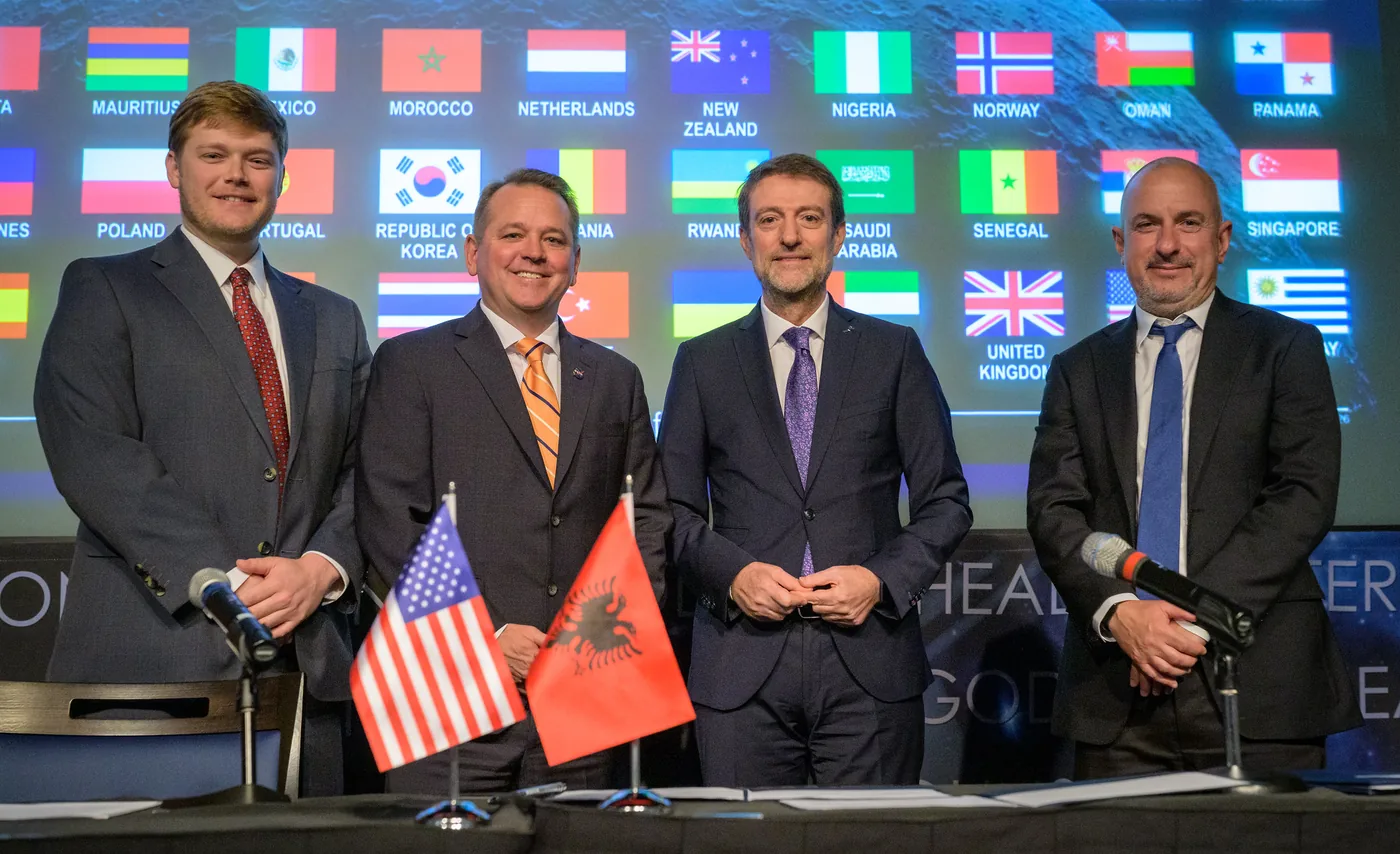
The year 2026 has witnessed rapid diplomatic expansion across Southeastern Europe and neighboring regions. Serbia signed the agreement as the 69th member in July 2026, followed by Turkey joining as the 71st signatory in August [6]. Djibouti signed as the 72nd nation. That milestone marked the accession of the eighth African country during a ceremony at NASA Headquarters in Washington [3]. Albania joined two days earlier. Albania’s Minister for Europe and Foreign Affairs Ferit Hoxha completed accession on September 21, 2026, highlighting Albania’s deployment of the Albania-1 and Albania-2 Earth observation satellites launched aboard a SpaceX Falcon 9 in January 2023 [2].
Croatia followed on September 23, completing a rapid diplomatic sequence that underscores regional interest in lunar science [5]. This multilateral momentum illustrates how mid-sized nations increasingly view space governance as an essential pillar of modern diplomacy [8]. The Croatia Artemis Accords accession demonstrates that scientific transparency and bilateral cooperation remain compelling incentives for emerging space nations [1]. By aligning national legislation with international frameworks, Croatia guarantees that its academic community engages directly in global decision-making regarding space resources [7].
Lunar Exploration Timeline Toward the 2028 Landing
Croatia’s formal accession coincides with intense preparations across NASA centers as the Artemis campaign prepares to return humans to the lunar surface [3]. No astronaut has walked upon the Moon since the Apollo 17 mission concluded in December 1972. Apollo 17 flew in December 1972 [5]. NASA completed its crucial circumlunar test with the Artemis II mission in 2026, sending astronauts Reid Wiseman, Victor Glover, Christina Koch, and Jeremy Hansen around the Moon. At Kennedy Space Center in Florida, technicians began installing four RS-25 engines into the core stage of the Space Launch System (SLS) rocket. These activities support ongoing flight hardware preparations for the Artemis III lunar landing mission scheduled for 2028 [3].
The current exploration architecture projects that international astronauts will touch down on the lunar South Pole in 2028, initiating sustained robotic and crewed investigations [5]. NASA has committed to sharing all lunar samples, scientific datasets, and geological discoveries generated through Artemis missions with the global research community [3]. For Croatian scientists, membership ensures open access to this unprecedented stream of planetary data, enabling local universities to study lunar resources and space weather phenomena [1]. By formalizing these cooperative principles, the Artemis Accords Croatia agreement ensures that domestic institutions contribute meaningfully to humanity’s permanent return to the Moon [7].
- PRESS RELEASE Shaw, E. (2026, September 23). NASA Welcomes Croatia as Newest Artemis Accords Signatory. NASA. [Article Link]
- PRESS RELEASE Shaw, E. (2026, September 21). NASA Welcomes Albania as Newest Artemis Accords Signatory. NASA. [Article Link]
- WEBSITE Daines, G. (2026, August 17). Artemis News. NASA. [Article Link]
- ONLINE NEWS Mirage News. (2026, September 23). Croatia Joins Artemis Accords, Welcomed by NASA. Mirage News. [Article Link]
- ONLINE NEWS Ferenčić, D. (2026, September 23). Croatia Joins the Artemis Accords. Hrvatska radiotelevizija. [Article Link]
- ONLINE NEWS Shuhratov, A. (2026, September 24). Croatia Joins NASA’s Artemis Accords. Zamin.uz. [Article Link]
- ONLINE NEWS Croatia Week. (2026, September 23). Croatia Signs Artemis Accords with US, Joining Global Space Exploration Effort. Croatia Week. [Article Link]
- WEBSITE Wikimedia Foundation. (2026, September 23). Artemis Accords. Wikipedia. [Article Link]
- PREPRINT NASA Astrophysics Division. (2026). Emerging Technologies for Astrophysics Missions: Workshop Summary Report. arXiv. [Article Link]
APA 7: (2026, September 24). How Croatia Artemis Accords Signing Expands Lunar Science.


