





The debate over edge computing vs cloud computing centers on where digital data gets handled. Cloud computing pools storage and server clusters in remote data centers, delivering on-demand tools over web connections. Distance creates delays. While central cloud platforms offer immense capacity for heavy batch jobs, moving massive streams of raw sensor data over wide-area networks introduces transmission lag and backhaul jams. Edge setups solve this bottleneck by running code directly on local nodes near end users. Local compute power closer to phones and factory machines cuts network strain and delivers prompt feedback [1].
Edge Computing vs Cloud Computing: Core Network Design
Central data centers anchor modern cloud systems, concentrating computational power and large disk arrays in remote facilities. Every query, user click, and database lookup travels over public networks to reach remote server racks before returning an answer. Akamai tackled the slowdown. In the late 1990s, early content delivery networks proved that caching web files on local edge servers cut round-trip delays, helping resolve the early internet bottleneck known as the “world wide wait” [1].
In 1997, researcher Brian Noble and his team proved that small mobile devices could achieve acceptable speech recognition performance by offloading compute-heavy tasks to nearby server hardware. Akamai partnered with industry leaders in 2001 to launch Edge Side Includes (ESI), an open standard designed to execute fine-grained business logic on network boundaries rather than inside remote data centers. Akamai assembled content based on customer business logic using an XML framework known as advanced metadata. The firm added Java and .NET tools to its edge nodes in 2002. Apple later built services like Apple Siri, while Google built speech recognition engines that relied on central cloud servers [1].
As connected objects spread, central server topologies faced rising strain. An IEEE survey by K. Cao and colleagues showed that traditional cloud data centers can no longer satisfy the tight latency and bandwidth requirements demanded by modern intelligent environments. Compute nodes placed at the edge offload stress from central facilities. Local gateways handle filtering and small data storage, keeping message flow fast even during traffic peaks [9].
Latency and Response Times
Network distance between client gadgets and cloud centers drives packet lag. Packets passing through multiple network hops pick up hundreds of milliseconds in transit time. Standard office tools tolerate delays above 200 milliseconds, but self-driving cars can’t afford late data. A vehicle at highway speeds travels far in a split second. A pause in obstacle sensing causes crashes [2].
Human senses set a clear benchmark for response speed. A person takes between 370 and 620 milliseconds to recognize a human face. Virtual reality headsets must match that pace, or users notice visual drag. In cloud gaming setups, edge nodes known as gamelets sit within two network hops of players to keep action fluid. In IEEE Computer, M. Satyanarayanan tested edge responsiveness in video trials of 2D Lego model assembly, sketching, and table tennis, confirming that edge nodes placed one hop away deliver low latency [7].
Autonomous vehicle design shows the practical reality of edge computing vs cloud computing under tight deadlines. In a Tesla self-driving car, onboard sensors and video cameras watch the road ahead without pause. If sensors spot a pedestrian or sudden road hazard, the car must brake or swerve in milliseconds to avoid a crash, which makes long-distance cloud processing far too slow for highway driving. Local edge processors run computer vision algorithms directly on vehicle hardware, allowing the car to spot obstacles and apply brakes in milliseconds, keeping riders safe even when mobile web signals vanish completely [2].
Bandwidth Differences in Cloud vs Edge Computing
Raw data sent to remote server farms strains network backbones. Market figures in 2018 showed that global data would rise 61 percent to reach 175 zettabytes by 2025. Technology advisory firm Gartner found that about 10 percent of enterprise data was handled outside standard data centers in 2018, predicting that proportion would climb to 75 percent by 2025 as connected endpoints proliferated [1].
Video cameras and audio tools show how local processing stops bandwidth waste. Dozens of high-resolution security feeds streamed over web links to a central cloud facility burn massive bandwidth and pile up network bills. A local edge server solves this expense by screening video feeds on site, discarding uneventful background frames and sending only brief text alerts and timestamps to cloud storage when it detects movement. Voice tools apply that same method by transcribing speech locally. Text transcripts sent instead of full audio recordings cut bandwidth needs by orders of magnitude, keeping central pipelines clear and slashing data transfer costs for enterprise users [1].
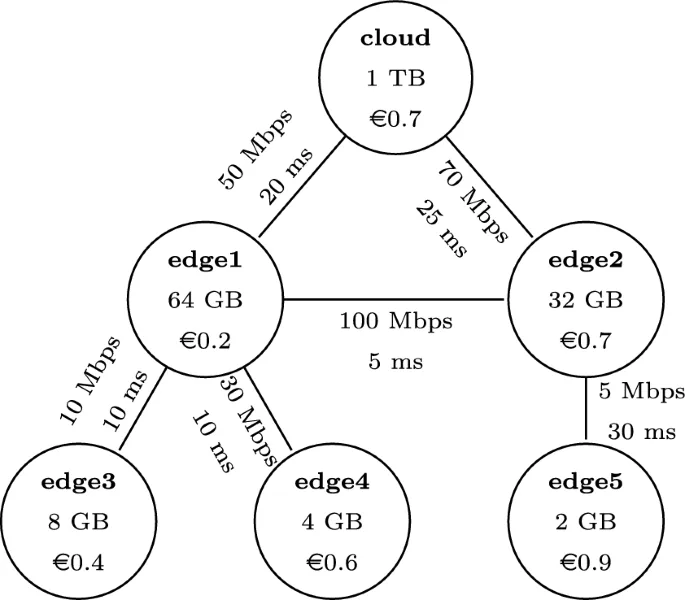
Power grids use distributed filtering to maintain grid stability. Research by W. Yu and fellow investigators in IEEE Access showed that edge nodes balance traffic by absorbing message peaks near substations. Instead of swamping central databases with raw readings, edge gear aggregates telemetry and sends periodic updates upstream [10].
The Intermediate Fog Layer
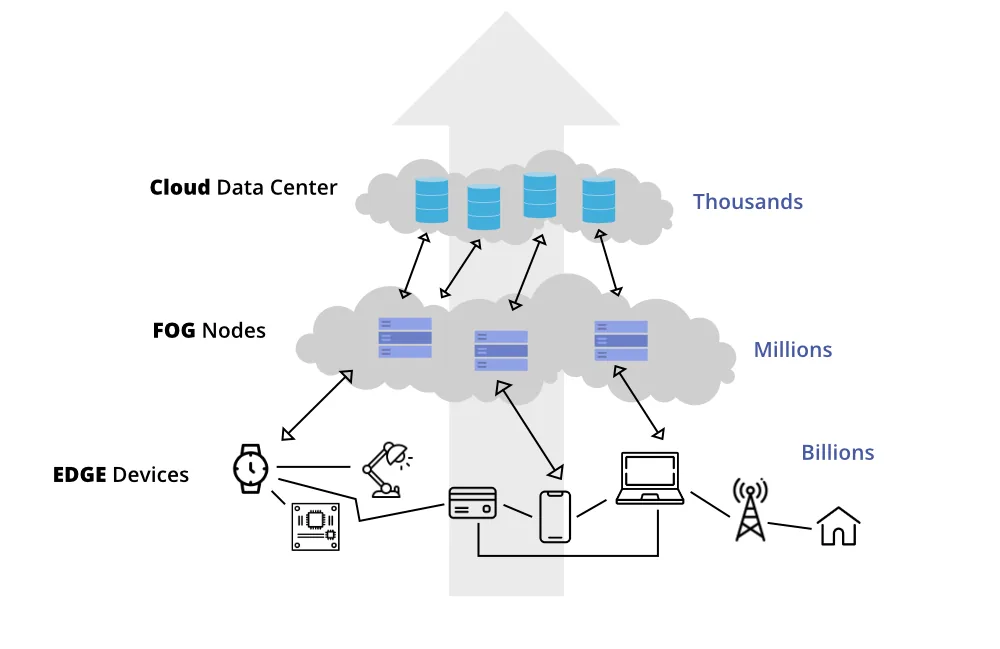
The line between local nodes and cloud hubs often includes a middle layer called fog computing. Tech vendor Cisco coined the term in 2012 to describe an architecture placing compute and storage between client gadgets and data centers. While edge nodes sit directly on sensors, fog nodes run at local gateways, cell towers, and network hubs [4].
Industry partners organized formal standards for this middle tier. On November 19, 2015, Cisco Systems, ARM Holdings, Dell, Intel, Microsoft, and Princeton University formed the OpenFog Consortium. Cisco executive Helder Antunes served as first chairman, while Intel strategist Jeff Fedders served as president. The National Institute of Standards and Technology formalized this tier in March 2018 as NIST Special Publication 500-325, describing fog as a layered system bridging smart devices and cloud centers [4].
University of Melbourne researchers tested this hybrid model in project FogBus 2, combining edge nodes and Oracle Cloud Infrastructure to process camera and ECG medical feeds. International standard ISO/IEC 20248 also defines how automated barcode and RFID data can be verified across fog nodes. Operational comparisons reveal clear boundaries between these layers. Pure edge scales across billions of constrained gadgets where device-by-device software upkeep gets costly. Fog nodes act as regional consolidation hubs, offering higher compute power to filter records from dozens of edge devices before forwarding clean metrics to central cloud databases [2].


Processor Hardware in Local Centers
Software outside central facilities brings distinct hardware hurdles for system administrators. TechTarget reporter Stefani Muñoz wrote that edge facilities lack the uniform, enterprise-grade server racks found in corporate server rooms. Admins must adapt code to run on small appliances with tight power budgets, modest cooling, and spotty internet links. In addition, virtualization tools must operate without the specialized management infrastructure present in primary data centers [3].
Edge facilities split into two main formats. Micro data centers scale enterprise hardware down into on-site racks, running virtual machines and software containers with high reliability to serve local business applications with minimal delay. Nano data centers use rugged boxes built to handle vibration, heat, and freezing winter temperatures outdoors. These nano units host fewer than 100 virtual machines or containers to drive local, low-latency tasks [3].
Processor design marks another divide between cloud servers and local edge units. Central cloud centers rely on complex instruction set computing (CISC) processors. These chips pack billions of transistors to deliver massive throughput for heavy virtual workloads in server rooms. Edge deployments often pick reduced instruction set computing (RISC) processors instead. RISC chips use simplified instruction sets with lower transistor counts, cutting power use and heat while running control tasks reliably. Hypervisors like VMware ESXi and tools like AWS Greengrass IoT and VMware Pulse IoT Center help admins manage workloads on Dell EMC and Lenovo hardware across scattered sites without physical rewiring [3].

How Security Models Differ
Data tasks outside corporate walls alter security perimeters and trust models. Central clouds rely on fortified firewalls, intrusion detection, and full-time security crews. In edge setups, thousands of nodes run on public networks, widening the attack surface. Many edge devices also lack the compute power needed to run heavy encryption algorithms, creating fresh challenges for system architects [1].
Does spreading computing power outward harm privacy? Data kept on local gadgets can actually protect personal privacy by avoiding data transfers to remote servers. When raw files stay on local phones or medical monitors, third parties can’t access personal habits. In tiered setups, fog gateways handle encryption tasks for basic sensors, shielding private records before they touch the public web [2].
Local systems also handle network outages well. The SPAWAR team of the US Navy tested disruption-tolerant mesh networks to protect military assets, allowing machine-control applications on local nodes to take over when internet connections drop. Smart voice hubs and health tools can keep running locally during broad cloud outages. Guidelines like ISO/IEC 20248 set verified rules to read barcode and radio tags at the edge even when internet links drop [4].
Workload Roles in Edge vs Cloud Systems
Enterprise AI and database workloads dictate where code runs. Central cloud server farms excel at training large deep neural networks and storing massive enterprise databases. Edge nodes can’t match that compute scale. But once teams train an AI model in the cloud, deploying it to local edge nodes lets devices run real-time inference without transmission delay [11].
Mobile operators formalize this split through Multi-access Edge Computing (MEC). The European Telecommunications Standards Institute (ETSI) formed an Industry Specification Group in 2014, with Alex Reznik serving as committee chair. Industry leaders including Intel, Cisco, and IBM Europe joined to create open MEC specifications. Telcos deploy MEC application servers directly at cellular base stations. Tools like AWS Wavelength let developers run code at the edge of telco 4G and 5G networks, speeding up mobile gaming and connected vehicle apps without routing packets to distant data centers [5].
Decentralized machine learning shows the expanding role of edge hardware. In an unreviewed preprint hosted on the arXiv platform, researcher Zhi Zhou and co-authors reviewed architectures for running deep learning tasks on edge nodes to bypass central cloud delays [11]. In another unreviewed arXiv paper, Dinh C. Nguyen and colleagues introduced FLchain, an architecture pairing federated learning with blockchain ledgers. Under this design, mobile devices train artificial intelligence models locally without exposing private files, while a blockchain ledger shares model updates across edge nodes without a central server. This setup shields user data and avoids network congestion for smart mobile networks [12].
Can Both Frameworks Coexist?
Can engineers unite both models in one setup? Yes, because edge computing vs cloud computing represents two cooperating parts of a shared compute spectrum. In an IEEE Internet of Things paper, researcher W. Shi and co-authors wrote that edge nodes offload tasks from central hubs rather than replacing cloud facilities entirely [6].
Collaborative architectures let each layer do what it does best. Computer scientists W. Shi and S. Dustdar stated in IEEE Computer that edge processing cuts bandwidth costs and saves battery life on portable gadgets during continuous operation. When local edge hardware suffers an outage or faces sudden traffic surges, workloads can roll over to regional fog gateways or central cloud servers to keep services running [8].
As smart factories, autonomous cars, and connected gadgets expand, digital workloads will spread across every network layer. Central cloud data centers will remain the core backbone of global data storage and large-scale model training. Meanwhile, edge nodes will provide the fast reflexes and local data privacy needed for physical interaction. Both models combined help tech teams build resilient digital services that stay fast, cheap, and reliable in any setting [6].
- WEBSITE Wikipedia. (2026). Edge computing. [Article Link]
- WEBSITE GeeksforGeeks. (2021). Difference Between Edge Computing and Fog Computing. [Article Link]
- ONLINE NEWS Muñoz, S. (2020). Edge virtualization manages the data deluge, but can be complex. TechTarget. [Article Link]
- WEBSITE Wikipedia. (2026). Fog computing. [Article Link]
- WEBSITE Wikipedia. (2026). Multi-access edge computing. [Article Link]
- ACADEMIC JOURNAL Shi, W., Cao, J., Zhang, Q., Li, Y., & Xu, L. (2016). Edge Computing: Vision and Challenges. IEEE Internet of Things Journal, 3(5), 637–646. [Article Link]
- ACADEMIC JOURNAL Satyanarayanan, M. (2017). The Emergence of Edge Computing. Computer, 50(1), 30–39. [Article Link]
- ACADEMIC JOURNAL Shi, W., & Dustdar, S. (2016). The Promise of Edge Computing. Computer, 49(5), 78–81. [Article Link]
- ACADEMIC JOURNAL Cao, K., Liu, Y., Meng, G., & Sun, Q. (2020). An Overview on Edge Computing Research. IEEE Access, 8, 85714–85728. [Article Link]
- ACADEMIC JOURNAL Yu, W., Liang, F., He, X., Hatcher, W. G., Lu, C., Lin, J., & Yang, X. (2017). A Survey on the Edge Computing for the Internet of Things. IEEE Access, 6, 6900–6919. [Article Link]
- PREPRINT Zhou, Z., Chen, X., En, E., Zeng, L., Luo, K., & Zhang, J. (2019). Edge Intelligence: Paving the Last Mile of Artificial Intelligence with Edge Computing. arXiv. [Article Link]
- PREPRINT Nguyen, D. C., Ding, M., Pham, Q. V., Pathirana, P. N., Le, L. B., Seneviratne, A., Li, J., Niyato, D., & Poor, H. V. (2021). Federated Learning Meets Blockchain in Edge Computing: Opportunities and Challenges. arXiv. [Article Link]
Cover image: NASA Johnson Space Center / Megan McArthur / Wikimedia Commons, Public domain


