





A race condition happens when parallel threads access shared data without proper locks, leaving the final outcome dependent on random timing. Developers need race condition explained clearly because timing bugs stay hidden until production traffic surges. When two operations run at once, an operating system scheduler can pause one task right between its read and write steps [3]. A second task steps in, updates the shared value, and finishes before the first task resumes. The delayed task then writes its own stale calculation over the newer data, quietly corrupting records without triggering a visible software crash [4].
- How Signal Delays Spawn Glitches
- How Race Hazard Glitches Emerge in Circuits
- Assembly Instructions in Preempted Memory
- Race Condition Explained Through Check-Then-Act Flaws
- File System TOCTOU Vulnerability Mechanics
- Single-Packet Attacks on Web Endpoints
- Why Deadlocks Differ From Races
- Stopping the Race Hazard With Atomic Architecture
How Signal Delays Spawn Glitches
Having race condition explained from basic principles helps coders spot how electronic switches stumble. The term dates back to 1954, when David A. Huffman examined switching hazards at MIT in his doctoral work on sequential circuits. In digital electronics, signals moving through logic gates travel along wires of varying lengths. These unequal delays cause an AND gate to output a brief false pulse before settling [15].
TechTarget writers Ben Lutkevich and Brien Posey divided these timing bugs into critical and noncritical groups based on whether the final machine state changes. In a noncritical race, overlapping events create transient electrical noise, but the hardware still lands on its intended setting without errors. A critical race condition, by contrast, alters the end state, leaving memory or circuits damaged [4]. Circuit designers used Karnaugh maps to stabilize signal paths, combining gates carefully to avoid false intermediate outputs [15].
When software adopted multithreading, these electronic quirks reappeared inside program memory because tasks share the same address space without isolation. Operating systems run tasks by slicing processor time into tiny windows, switching thread contexts whenever a task uses its allotted slot [2]. If one task writes new bytes while another reads old records, the program produces corrupt output without warning the user [4]. Clocked flip-flops help hardware avoid these timing conflicts, but software needs deliberate locks to protect shared variables [15]. Correctness can’t rely on lucky execution order. When threads run without locks, simple memory reads produce invalid states that break system integrity during long production runs [4]. Testing rarely catches them early.

How Race Hazard Glitches Emerge in Circuits
At the silicon boundary, the race hazard shows how physical chips struggle with twin signals [15]. In embedded microcontroller systems, firmware often coordinates analog sensors and motor drivers across separate tasks. In an ECE353 lab at the University of Wisconsin, a microcontroller task collected 20 samples from an ADC pin every 10 ms before setting a global boolean flag to true, forcing waiting tasks to poll memory continuously [1].
Real danger begins when tasks modify shared values through non-atomic steps [3]. In C++ code on the GeeksforGeeks All-in-One Learning Portal, an increment looks like a single step, but the CPU converts it into three distinct assembly instructions: read, modify, and write [1]. In a test where two threads each incremented a counter 100,000 times without locks, the final count reached only 129331 [5]. Shared updates were lost [3].
Microsoft detailed this low-level clash in knowledge base article KB 317723 for Visual Basic .NET applications. When two threads updated a shared variable called Total, one thread added 50 while the second subtracted 15 from an initial sum of 100. At the assembly level, Thread 1 loaded memory into register eax, added its operand, but got preempted before writing 150 back to memory. Thread 2 then ran completely, calculating and storing 85. When Thread 1 resumed, it wrote 150 over 85, losing the second thread’s entire update [2]. These timing bugs often turn into elusive Heisenbugs that vanish whenever coders attach a debugger or enable verbose diagnostic logs [15]. Tracking them takes hours of careful inspection.
Assembly Instructions in Preempted Memory
To see why unsynchronized writes corrupt data, coders must inspect how CPU schedulers manage threads [2]. Schedulers choose which thread runs based on priority and preemption rules [3]. A thread can pause between any two assembly steps [1]. When multiple threads write to the same memory slot without mutual exclusion, the final value reflects only whichever thread wrote last, dropping earlier updates [2].
At the University of Utah, computer scientist Regehr clarified in 2011 that a data race is distinct from a general race condition. Citing Sebastian Burckhardt of Microsoft Research, Regehr wrote that a data race happens when two concurrent threads access the same memory location, at least one access is a write, and no synchronization locks exist. Yet code can be free of data races and still suffer race bugs if business logic breaks [12].
Consider a bank transfer function split into separate atomic blocks for checking balances, crediting the recipient, and debiting the sender. Even if each memory read and write runs atomically, another thread can inspect the account between those steps and find money missing or duplicated [12]. The formal C++ standard, in draft N4296, and the Java Language Specification warn that unsequenced conflicting actions produce undefined behavior. On modern weak memory chips, unsynchronized writes cause torn reads, where a thread observes half-written bytes from two different operations, creating values that neither thread ever intended to store [15]. Fixing low-level data races is not enough. Teams must also guard multi-step logical invariants across all code paths [12].
Race Condition Explained Through Check-Then-Act Flaws
Seeing race condition explained in real business apps proves that timing bugs are not confined to assembly. The most common flaw in web apps follows the check-then-act pattern [8]. In this flow, code checks whether a user has enough balance or an unused coupon, and then updates the record in a later step. Both requests pass the check before either write finishes [10].
Engineer Billy Okeyo illustrated this issue with a cookie jar analogy, where two people look inside, see one cookie remaining, and reach in at the exact same instant. In banking, if an account holds $100 and receives twin withdrawal requests for $80 and $50, both read the $100 balance. Depending on thread timing, the account finishes with $20, $50, or drops to -$30 [11]. Similar collisions happen when two users withdraw ₹500 at an ATM [5].
E-commerce platforms face identical logic breakdowns during flash sales when thousands of shoppers compete for scarce items. If a web shop offers a single-use coupon to the first 100 buyers, concurrent web calls slip past the validation check before the database marks the promotion as claimed. Systems can easily issue 103, 105, or 110 coupons before the counter locks. Similarly, two airline customers can purchase the last remaining seat on a plane, or an inventory counter can drop to -1, forcing businesses to issue refunds. In an online bank examined in a Snyk tutorial, a hacker named Jordan doubled his funds because a 10 ms delay in balance processing let twin wire transfers succeed [11].



File System TOCTOU Vulnerability Mechanics
In file systems, timing delays between inspection and access form a dangerous security flaw known as a TOCTOU gap, where timing lapses between verification and execution allow attackers to alter data. The industry tracks these flaws under CWE-362, warning that hackers manipulate resources right after software checks them [5]. If a program checks file permissions and opens it moments later, a local attacker can swap the target [6].
Security author David A. Wheeler documented how routine UNIX file actions create exploitable race windows. In the Secure Programs HOWTO, Wheeler warned against calling access() followed by open(), because users can move directories or insert symlinks between the two system calls. The classic DEADJOE symlink flaw in the joe text editor showed how unexpected crashes allowed attackers to append junk data to sensitive system files like /etc/passwd. Wheeler advised opening files directly using narrow permissions [14].
Wheeler also pointed out that system cleanup tools create dangerous timing windows in shared temporary folders. In 2002, researcher Michal Zalewski published an advisory on Bugtraq detailing how tmp cleaner tools like tmpwatch, written by Erik Troan and Preston Brown of Red Hat Software, interfere with active software. Stanislav Shalunov identified similar risks in stmpclean, while Olaf Kirch warned about symlink tampering. Attackers could time the removal of old files to trick administrative tools into deleting or overwriting sensitive data [14]. In the Linux kernel, the Dirty Cow flaw abused memory copy-on-write mechanisms, giving unprivileged users write access to read-only files [4]. Simple advisory locks fail because rogue processes ignore them [5].

Single-Packet Attacks on Web Endpoints
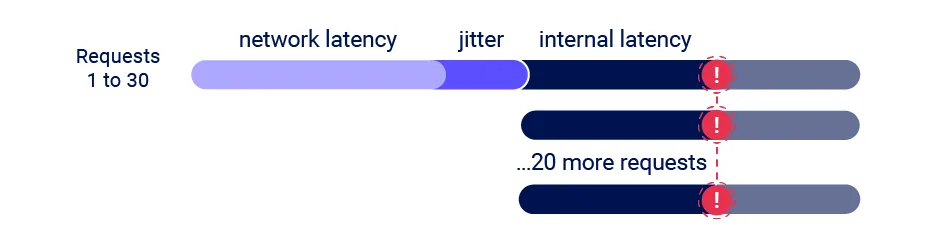
Every modern race condition explained in web security shows how attackers manipulate network packet delivery [7]. Early penetration testers relied on spraying dozens of HTTP calls across connections, hoping network jitter would randomly align two requests inside the vulnerable window [8]. At Black Hat USA 2023, PortSwigger Research introduced the single-packet attack, showing how HTTP/2 multiplexing synchronizes parallel requests inside a single TCP frame [7].
The single-packet attack holds back the final byte of each request until all frames sit in the server’s network buffer [7]. When the client sends the final TCP packet with the closing bytes, the server processes all requests within milliseconds of each other, removing network jitter. In Flask apps studied by Gaurav Singh Bisht at Jsmon, researchers use Burp Suite 2023.9 and Turbo Intruder scripts with Engine.BURP2 to bypass rate limits and gift card rules [8].
Recent academic research shows how transport protocols shape these race windows. In a 2025 study in Computers & Security, researcher F. Loi and colleagues tested six exploit tools across HTTP/1.1 and HTTP/2, while introducing a tool named QUICker to trigger race windows over HTTP/3 [17]. Concurrency risks also threaten enterprise backup systems. In a 2026 paper published via CERN and Zenodo, R. Barron examined ransomware race windows, measuring how agentic tools like T181 SPECTER HOSTAGE exploit Veeam flaws CVE-2023-27532 and CVE-2024-40711 to destroy backups in under 500 ms. Defending systems needs automated state freezes within sub-850-millisecond windows to prevent data loss [16].
Why Deadlocks Differ From Races
Developers often confuse race conditions with deadlocks because both bugs arise in concurrent execution environments [6]. However, the two defects represent opposite failure states. A race condition occurs when unsynchronized threads move too quickly and interleave unpredictably, corrupting data while the program keeps running [10]. A deadlock happens when two or more threads freeze permanently, each waiting for a resource that the other thread holds [6].
Microsoft documented this deadlock trap using two shared objects, LeftVal and RightVal. If Thread 1 locks LeftVal and pauses before acquiring RightVal, Thread 2 starts and locks RightVal. When Thread 2 tries to acquire LeftVal, it stops and waits. Thread 1 resumes and tries to grab RightVal, but gets blocked by Thread 2’s lock. Because neither thread can proceed, the application hangs indefinitely. The whole program freezes [2].

Attempting to fix a race condition by adding naive mutex locks can inadvertently create deadlocks across database transactions. If transaction A updates an account and then a profile, while transaction B updates the profile before the account, both transactions can block each other. Relational engines like PostgreSQL and MySQL automatically detect these circular dependencies, but resolving them takes hundreds of milliseconds and forces the database to abort one transaction. In our related analysis, [What is a Deadlock? Causes, Conditions, and System Solutions](https://perexpteamworks.com/en/what-is-a-deadlock/), we explored how circular lock chains bring system processing to a complete halt. Software teams must design consistent lock ordering so that threads acquire multiple resources in an identical sequence to prevent both data corruption and deadlocks [10].
Stopping the Race Hazard With Atomic Architecture
Stopping the race hazard needs software architects to move away from vulnerable check-then-act logic toward atomic execution. At the database layer, developers can replace separate read and write queries with atomic updates, such as UPDATE accounts SET balance = balance - 80 WHERE id = 1 AND balance >= 80 [8]. Relational databases can also enforce pessimistic locking through SELECT FOR UPDATE to block concurrent transactions [10].
For distributed architectures spanning multiple web servers, teams deploy distributed locks using Redis commands like SETNX with short expirations. However, background garbage collection pauses can cause a lock to expire while a worker is still running, allowing a second worker to acquire the lock. Systems solve this zombie lock problem using monotonically increasing fencing tokens, where storage engines reject stale writes from expired workers [10]. Optimistic locking with version columns provides another reliable defense [11].
Static analysis tools also help developers catch concurrency flaws during compilation. Google and CERT/SEI developed Clang Thread Safety Analysis, which uses annotations like GUARDED_BY and REQUIRES to verify that threads hold necessary Mutex (Mutual Exclusion) capabilities before accessing variables [13]. In a 2026 review in Journal of Computer Virology and Hacking Techniques, researchers K. Makan and M. Ghaziasgar tested 34 automated tools for detecting race flaws, noting that binary analysis remains difficult due to semantic information loss [19]. Monitoring logs and tracing thread schedules sometimes exposes hidden races before users report lost funds [6]. In 2022, M. L. Vousden and colleagues showed in Journal of Parallel and Distributed Computing that an asynchronous simulated annealing algorithm with a race condition solved graph placement problems twice as fast as synchronous methods [18]. Having race condition explained by defensive design allows engineering teams to stop flaws before release [11].
- WEBSITE University of Wisconsin-Madison. (2026). Race Conditions. ECE353: Introduction to Microprocessor Systems. [Article Link]
- WEBSITE Microsoft. (2022). Race conditions and deadlocks – Visual Basic (KB 317723). Microsoft Learn. [Article Link]
- WEBSITE GeeksforGeeks. (2025). Race Condition in Operating Systems. [Article Link]
- ONLINE NEWS Lutkevich, B., & Posey, B. (2021). Race Condition. TechTarget. [Article Link]
- WEBSITE GeeksforGeeks. (2020). Race Condition Vulnerability. [Article Link]
- WEBSITE Huntress. (2025). What Is a Race Condition? Types, Causes & Security Impact. [Article Link]
- WEBSITE PortSwigger. (2026). Race Conditions. Web Security Academy. [Article Link]
- WEBSITE Bisht, G. S. (2026). What is Race Condition? Ways to Exploit, Examples and Impact. Blogs @ Jsmon.sh. [Article Link]
- WEBSITE StackSheriff. (2026). Race Condition — Concurrency Bugs Explained. [Article Link]
- WEBSITE Gazar, E. (2026). Race Conditions: What They Are and How to Handle Them. Gazar.dev. [Article Link]
- WEBSITE Okeyo, B. (2026). Race Conditions Explained: The Concurrency Bug Every Backend Developer Should Understand. Billyokeyo.dev. [Article Link]
- WEBSITE Regehr, J. (2011). Race Condition vs. Data Race. Embedded in Academia. [Article Link]
- WEBSITE LLVM Project. (2026). Thread Safety Analysis. Clang Documentation. [Article Link]
- BOOK Wheeler, D. A. (2002). Avoid Race Conditions. Secure Programming HOWTO. [Article Link]
- WEBSITE Wikipedia Contributors. (2026). Race Condition. Wikipedia, The Free Encyclopedia. [Article Link]
- ACADEMIC JOURNAL Barron, R. (2026). The Ransomware Race Condition. Zenodo. [Article Link]
- ACADEMIC JOURNAL Loi, F., Pisu, L., Regano, L., Maiorca, D., & Giacinto, G. (2025). Race against time: investigating the factors that influence web race condition exploits. Computers & Security, 160, 104740. [Article Link]
- ACADEMIC JOURNAL Vousden, M. L., Bragg, G. M., & Brown, A. D. (2022). Asynchronous simulated annealing on the placement problem: A beneficial race condition. Journal of Parallel and Distributed Computing, 169, 242-251. [Article Link]
- ACADEMIC JOURNAL Makan, K., & Ghaziasgar, M. (2026). A review of automated approaches to race condition detection. Journal of Computer Virology and Hacking Techniques, 22(1). [Article Link]


