





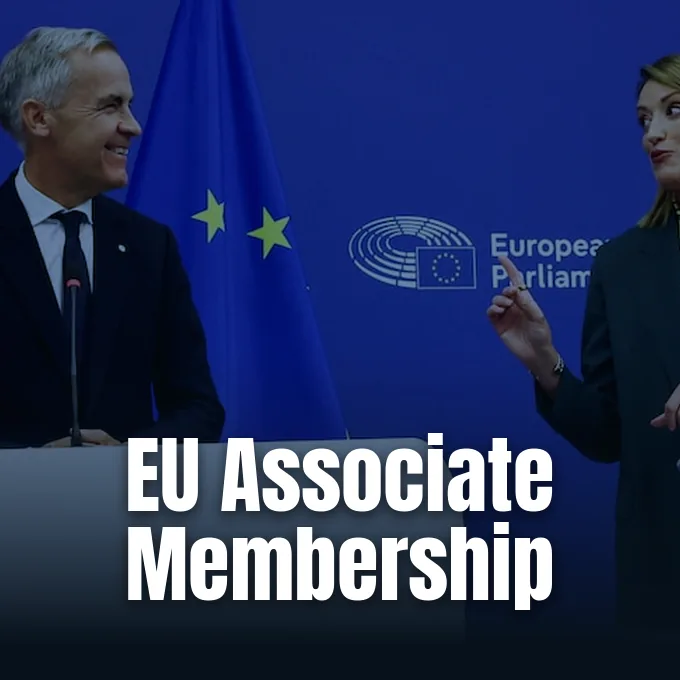
Can a nation located across the Pacific forge a formal institutional partnership with Brussels? When European Commission President Ursula von der Leyen proposed establishing a groundbreaking EU associate membership status for Canada during her September 2026 address in Strasbourg, France, the announcement ignited international curiosity [3]. Observers who once viewed southern participation in European institutions as an entertaining novelty suddenly confronted a substantive diplomatic debate. Australia has competed in the Eurovision Song Contest since 2015, and commercial ties between Canberra and European partners generate substantial annual volume [2].
Defining EU Associate Membership and Canada’s Bid
The concept of associate status emerged in Brussels as a diplomatic bridge rather than an invitation to full political integration. In her State of the European Union address, Ursula von der Leyen outlined the arrangement as a vehicle for third countries to access select segments of the single market while aligning technical standards. This proposed status does not formally exist in European Union treaties, requiring unanimous consent from all 27 member states. Canadian Prime Minister Mark Carney welcomed the proposal in Strasbourg, arguing that deeper bilateral cooperation in critical minerals, artificial intelligence, and space systems enhances collective economic resilience [3].
In an academic preprint paper that has not yet undergone peer review, economist Tim Harcourt examined whether Canberra could replicate Ottawa’s diplomatic engagement with Europe [1]. Harcourt observed that the European Union functions as the world’s second-largest economy, generating $US23 trillion (A$32.3 trillion) annually, an aggregate output exceeding China’s national economy [2]. As transatlantic commerce encounters friction from unilateral tariffs enacted by US President Donald Trump, middle powers actively pursue dependable allies. Carney explicitly rejected the ambition of establishing a third global power bloc with better manners, emphasizing that genuine security requires collective resilience to protect open markets and territorial integrity [3].
European Commission spokesperson Olof Gill underscored that the initial proposal remains in an exploratory phase. Officials in Brussels must first negotiate concrete terms with Ottawa before entertaining any broader institutional framework for other international partners [4]. Gill maintained that strengthening cooperation with Canada serves common stability rather than projecting an adversarial posture toward other global powers [3].

Metsola Signals Openness to Pacific Partners
Speculation regarding a broader southern outreach accelerated following public statements by European Parliament President Roberta Metsola. Speaking to Europe Today, Metsola indicated that third countries demonstrating shared democratic commitments could potentially follow Canada along a similar path. “There are countries with which we want to deepen our relationship,” Metsola declared during the broadcast, observing that in times of uncertainty, maintaining trusted friends matters immensely. She identified Australia and New Zealand as premier candidates for closer collaboration, citing existing dialogues concerning critical minerals, digital platforms, and bilateral commerce [3].
Metsola’s remarks attracted immediate interest across Canberra’s foreign policy establishment. Australian policymakers have sought to diversify export routes beyond traditional Asian partners to protect domestic industries against regional trade disruptions [2]. Australia already maintains productive diplomatic relationships with Western Europe and cooperates extensively in scientific programs. While geographic reality precludes full European Union accession, establishing an EU associate membership framework could grant preferential regulatory consideration without the complete obligations of political union [3].
High-level diplomatic discussions offered an immediate avenue for exploratory dialogue. European Commission President Ursula von der Leyen scheduled a bilateral meeting with Australian Prime Minister Anthony Albanese on the sidelines of the United Nations General Assembly in New York [4]. This scheduled encounter prompted regional observers to evaluate whether preliminary discussions might commence sooner than anticipated.
Commission Spokespersons Label Expansion Pure Speculation
Official responses from the European Commission promptly tempered expectations regarding any immediate expansion toward the Pacific. Commission spokesperson Arianna Podestà addressed journalists in Brussels, making clear that executive authorities are not evaluating arrangements with additional partners while Canadian negotiations remain unresolved. Podestà affirmed that Brussels values an exceptionally robust relationship with Canberra, but firmly characterized suggestions of extending associate membership to Australia as pure speculation. Administrative focus remains dedicated exclusively to developing workable parameters with Canadian negotiators [4].
Spokesperson Olof Gill reinforced this measured stance by reminding international observers that European officials must first put substantive flesh on the bone regarding the Canadian agreement. European Union member states have not yet established baseline criteria, legal boundaries, or regulatory mechanisms for third-country participation. Any prospective dialogue involving Australia or New Zealand remains strictly subsequent to concluding the initial model with Ottawa. The Commission deliberately avoided premature commitments while member governments assess market access and sovereign regulatory boundaries [4].
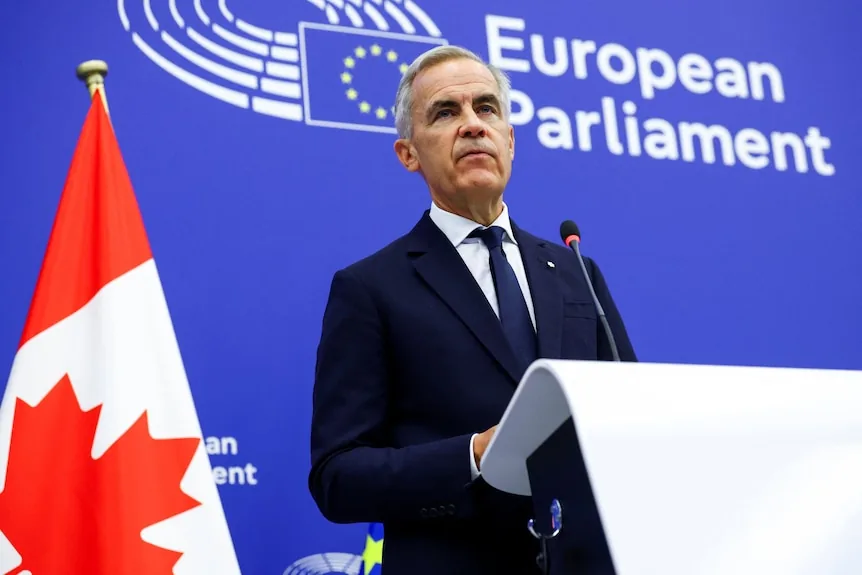
Donald Trump derided the Canadian proposal as laughable. Speaking in North Carolina, Trump threatened that Washington could impose severe tariffs on European commerce if Brussels moves forward [3].


Trade Realities and the Stalled Bilateral Agreement
Before Australia could pursue novel institutional ties, Canberra must finalize its existing commercial compact with Brussels. Australian Trade Minister Don Farrell helped conclude negotiations for the EU-Australia Free Trade Agreement in March 2026, yet the pact awaits ratification on both sides. Farrell remarked in The Sydney Morning Herald that global commerce is dividing between protectionists and free traders. He expressed openness to exploring creative possibilities with Europe, noting that Australian prosperity over the past 50 years stems directly from energetic international engagement [2].
The negotiated agreement offers Australian agricultural exporters preferential European market access for beef, sheep, dairy, and horticulture goods, with expanded opportunities for domestic education and financial service providers. Domestic political hurdles, however, remain considerable. Nationals leader and trade spokesman Matt Canavan denounced the compromise as the worst deal ever, raising the prospect of voting against the pact in the Senate to shield regional producers from agricultural quotas. Significant agricultural subsidies in the European Union (a historical grievance for southern hemisphere producers) continue to provoke political skepticism among regional farming communities [2].

Commercial statistics demonstrate how concentrated existing export channels remain. According to the Australian Bureau of Statistics, over 6,600 Australian exporters sell products to the United Kingdom, exceeding double the volume shipping to Germany and triple the total operating in France. This imbalance reflects what Austrade officials identified as Australians’ Europhobia—a habit among exporters of basing operations exclusively in London without crossing the English Channel. Global supply chain shifts—a pattern similarly visible in recent regulatory scrutiny over networking hardware—continue to reinforce Canberra’s urgent need for trade diversification [2].
Cultural Diplomacy From Eurovision to Brussels
Australian participation in European institutions draws substantial precedent from cultural diplomacy. Australia entered the Eurovision Song Contest in 2015 through associate ties with the European Broadcasting Union (EBU), rapidly evolving into a permanent participant [5]. In May 2026, Australian artist Delta Goodrem achieved second favourite status in Vienna with her performance of Eclipse, attracting an enthusiastic national broadcast audience exceeding one million regular viewers [7]. Journalist Mark Kenny once famously quipped that Australia can enter Eurovision while Europe cannot, illustrating how cultural ties frequently outpace formal political structures [2].
Canada recently initiated a comparable cultural embrace. The European Broadcasting Union and Canadian public broadcaster CBC announced on Canada Day that Canada will make its official Eurovision debut during the 2027 competition in Sofia, Bulgaria. CBC president Marie-Philippe Bouchard celebrated the accession as a historic opportunity to present Canadian talent on a celebrated global stage [5]. Director general Noel Curran highlighted the milestone on behalf of the EBU, emphasizing that Canadian inclusion reinforces the collective strength of the international broadcasting community [8].

Canadian musicians have previously triumphed in Eurovision under European flags. Céline Dion secured victory for Switzerland in 1988 performing Ne Partez Pas Sans Moi, while Natasha St-Pier and La Zarra represented France in 2001 and 2023 [5]. In his 2025 federal budget, Prime Minister Mark Carney included a discrete provision within the 500-page document tasking the CBC with pursuing Eurovision participation, illustrating how cultural integration deliberately complements economic realignment [7].
Global Trade Wars Reshape Strategic Autonomy
Accelerating interest in European alliances reflects structural shifts across the international trading system. Following China’s trade tariffs on Australian wine, barley, and timber in 2023, and Donald Trump’s “Liberation Day” tariffs in 2025, Canberra recognized the hazard of overreliance on major bilateral partners [2]. Expanding economic engagement with Europe offers middle powers enhanced protection against coercive trade actions. Speaking in Davos, Mark Carney articulated his firm conviction that the international order must be rebuilt out of Europe [5].
The evolutionary history of European integration demonstrates that formal partnerships require rigorous administrative discipline. Originating as a customs union created to secure peace between France and Germany, the European Union expanded to encompass single market regulations, the history and adoption of the euro, and common central banking authorities. For Australia, comprehensive political integration remains legally unavailable and practically unworkable due to geographic distance. Resolving the pending bilateral trade treaty remains the most immediate priority for Canberra’s commercial negotiators [2].
Canberra must carefully balance the advantages of international alignment against the necessity of preserving regulatory autonomy. While European Parliament leadership imagines an expanded family of democratic partners, the European Commission remains firmly anchored to resolving practical details with Ottawa [4]. Whether Canberra eventually explores an EU associate membership or concentrates on bilateral trade treaties, shifting geopolitical realities are unmistakably drawing Australia closer to European cooperation [2].
- PREPRINT Harcourt, T. (2026). After the EU’s offer to Canada, could Australia also embrace a ‘Eurovision’? (Preprint). [Article Link]
- ONLINE NEWS Harcourt, T. (2026, September 20). After the EU’s offer to Canada, could Australia also embrace a ‘Eurovision’?. The Conversation. [Article Link]
- ONLINE NEWS Maxwell, R. (2026, September 18). Australia could follow Canada as EU ‘associate member’, parliament president says. ABC News. [Article Link]
- ONLINE NEWS Fortuna, G. (2026, September 18). Australia following Canada as EU associate member is ‘pure speculation,’ says Commission. POLITICO. [Article Link]
- ONLINE NEWS Oltermann, P. (2026, July 1). Canada to join Eurovision song contest from 2027. The Guardian. [Article Link]
- ONLINE NEWS The Irish Times. (2026, July 1). Canada will join Eurovision Song Contest in 2027. The Irish Times. [Article Link]
- ONLINE NEWS Global Post Headline. (2026, May 15). ‘Canada Wants to Embrace Europe’: Eurovision Opens Doors to New Nations as Australia Soars and Boy George Joins the Party. Global Post Headline. [Article Link]
- ONLINE NEWS Grow, K. (2026, July 2). Eurovision Welcomes Canada to Participate in 2027 Song Contest. Rolling Stone. [Article Link]
APA 7: PerEXP Teamworks. (2026, September 21). Could Australia Follow Canada Into EU Associate Membership?. PerEXP Teamworks. https://perexpteamworks.com/en/eu-associate-membership-australia-canada/


