





Australian eucalypt forests have long withstood dry spells and fires through deep evolutionary adaptations. More than 800 known species inhabit landscapes stretching from Central Australia to snowy high country. Yet following the 2019–20 Black Summer bushfires, which burned roughly seven million hectares of eastern forest land, ecological surveys documented unexpected tree mortality. New fieldwork led by Eli R Bendall and Doctor Rachael Helene Nolan shows that eucalypt resprouting has physiological boundaries under coupled drought and fire stress [1]. Tree survival now falters at dry range margins [4].
Buds and Underground Roots
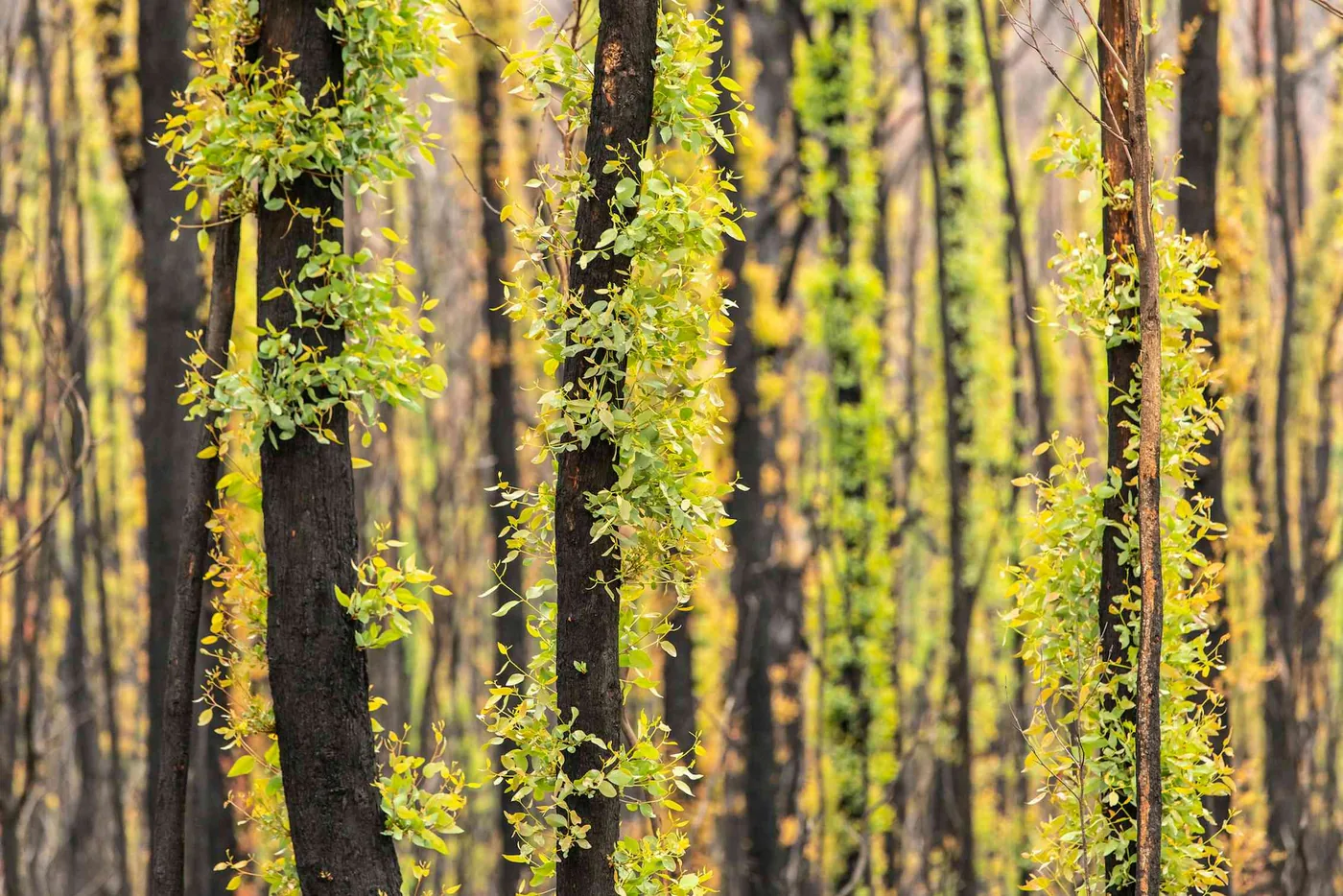
Fossil evidence places eucalypts 34 million years ago as the continent dried out, and over millennia they became the dominant canopy trees across every zone except wet rainforests and extreme sands. Vertical leaves reduce evaporation. Their dry, leathery foliage hangs downward to evade harsh midday sun while locking in scarce water. Hidden epicormic buds lie beneath the bark, bursting into leafy shoots that grow up to 27 centimeters in a single day and six meters in a year [2].
Beyond trunk buds, most eucalypts carry basal swellings called lignotubers, or mallee roots, situated at ground level. Gregory Moore, Senior Research Associate in the School of Ecosystem and Forest Sciences at the University of Melbourne, said that a lignotuber functions like a concentrated mass of dormant buds connected directly to an extensive root network loaded with carbohydrates and water. When flame consumes the main stem, this underground base promptly regrows new shoots. Soil cover shields roots. In poor soils, lateral roots secrete chemical exudates that unlock minerals and feed mycorrhizal fungi in exchange for moisture and nutrients [2].
Eucalypt fruits, widely known as gumnuts, feature in Australian culture through May Gibbs’ classic stories Snugglepot and Cuddlepie. These woody capsules guard tiny seeds against heat and desiccation. After fire scorches the canopy, the capsules dry out and open, sprinkling fine seeds over the ash bed like pepper over dinner. Some species depend on this seed rain for forest regeneration [2].
How Eucalypt Resprouting Functions
The success of eucalypt resprouting after fire depends heavily on outer bark thickness and density [6]. At the University of Wollongong Centre for Environmental Risk Management of Bushfires, doctoral candidate Harriet Simpson-Southward investigated how diverse bark traits influence post-fire persistence after completing her Bachelor of Science at Lancaster University in the UK. She collaborated with principal supervisor Dr Hamish Clarke, creator of the Four Friends of Fire science series, alongside co-supervisors Doctor Rachael Nolan from the Hawkesbury Institute for the Environment at Western Sydney University, Doctor Meaghan Jenkins from the NSW Rural Fire Service, and Emeritus Professor Ross Bradstock [3].
A 2020 study in Forest Ecology and Management co-authored by Simpson-Southward confirmed that bark thickness and density govern fire resistance in resprouting trees [6]. Different gum species develop distinct protective coverings, from fibrous stringybark on messmate trees to thick furrowed plates on ironbark varieties. Fibrous stringybark may singe and turn black on its outer layer, but its porous construction prevents high temperatures from reaching dormant vascular cambium and epicormic bud strands underneath [2].
Simpson-Southward analyzed mean annual temperature, mean annual precipitation, mean annual moisture index, and solar radiation to evaluate how local weather shapes protective bark traits. Climate shapes bark development. In 2021, she received the Valette Williams Scholarship in Botany from the Australian Plants Society NSW to support fieldwork on Sydney native flora, demonstrating how simplistic models overlook site-specific fire survival [3].

The Black Summer Impact
Before the Black Summer bushfires struck in late 2019, southeastern Australia endured three consecutive years of severe moisture deficits termed the Tinderbox drought. Rainfall fell 50 percent below average. Writing in Science Advances, climate researcher A. Devanand and colleagues established that human-induced climate change intensified these precipitation deficits by approximately 18 percent as atmospheric circulations diverted oceanic moisture away [7].
Early in 2019, bushfires in Tasmania killed many of the largest known eucalypts on the island. Months later, the Black Summer blazes spread across eastern Australia, burning roughly seven million hectares of eucalypt forests. Sandstone woodlands burned. Wet sclerophyll forests on fertile soils also ignited [1].
Eli R Bendall and Doctor Rachael Helene Nolan set up field monitoring plots stretching from northern New South Wales south to Victoria’s East Gippsland region. They recorded three key health indicators: seedling recruitment, complete tree mortality, and aboveground topkill [1]. In a 2024 paper in Global Ecology and Biogeography, Bendall and co-authors showed that dry forests on low-fertility soils resisted disturbance surprisingly well, suffering less mortality and retaining more juvenile trees than wet forests on fertile ground [5].

Dry Edges and Eucalypt Resprouting
Forest responses diverged clearly when researchers compared individual species across their broader geographic ranges. In a 2026 paper published in Global Change Biology Communications, Bendall, Nolan, and colleagues evaluated post-fire regeneration across different climatic envelopes. They discovered that two prominent species, Eucalyptus dalrympleana (mountain gum) and Eucalyptus radiata (narrow-leaved peppermint), showed much higher vulnerability at the dry margins of their range. At these low-rainfall borders, tree mortality was up to 16 percent more likely and topkill was up to 19 percent more likely than in core habitats [4].
Seedling recruitment for both species fell by an order of magnitude in these arid boundary zones. In contrast, a third surveyed species, Eucalyptus dives (broad-leaved peppermint), held firm and sustained average damage levels across its distribution, proving resilient regardless of local rainfall [4]. When prolonged drought depletes stored starches and sugars in roots, trees lack the metabolic energy needed to initiate epicormic shoots along their trunks [1]. Under such water deficits, eucalypt resprouting fails to protect crowns from complete topkill [4].
Loss of Large Trees
Large old eucalypts support native wildlife by cycling nutrients, storing carbon, and forming hollows for nesting fauna. Iconic native species like the yellow-bellied glider (Petaurus australis) and the glossy black cockatoo (Calyptorhynchus lathami) rely on mature hollow-bearing trees for breeding and shelter. In early 2019, severe bushfires in Tasmania destroyed many of Australia’s largest known eucalypts, showing how extreme blazes can wipe out ancient forest giants [1].
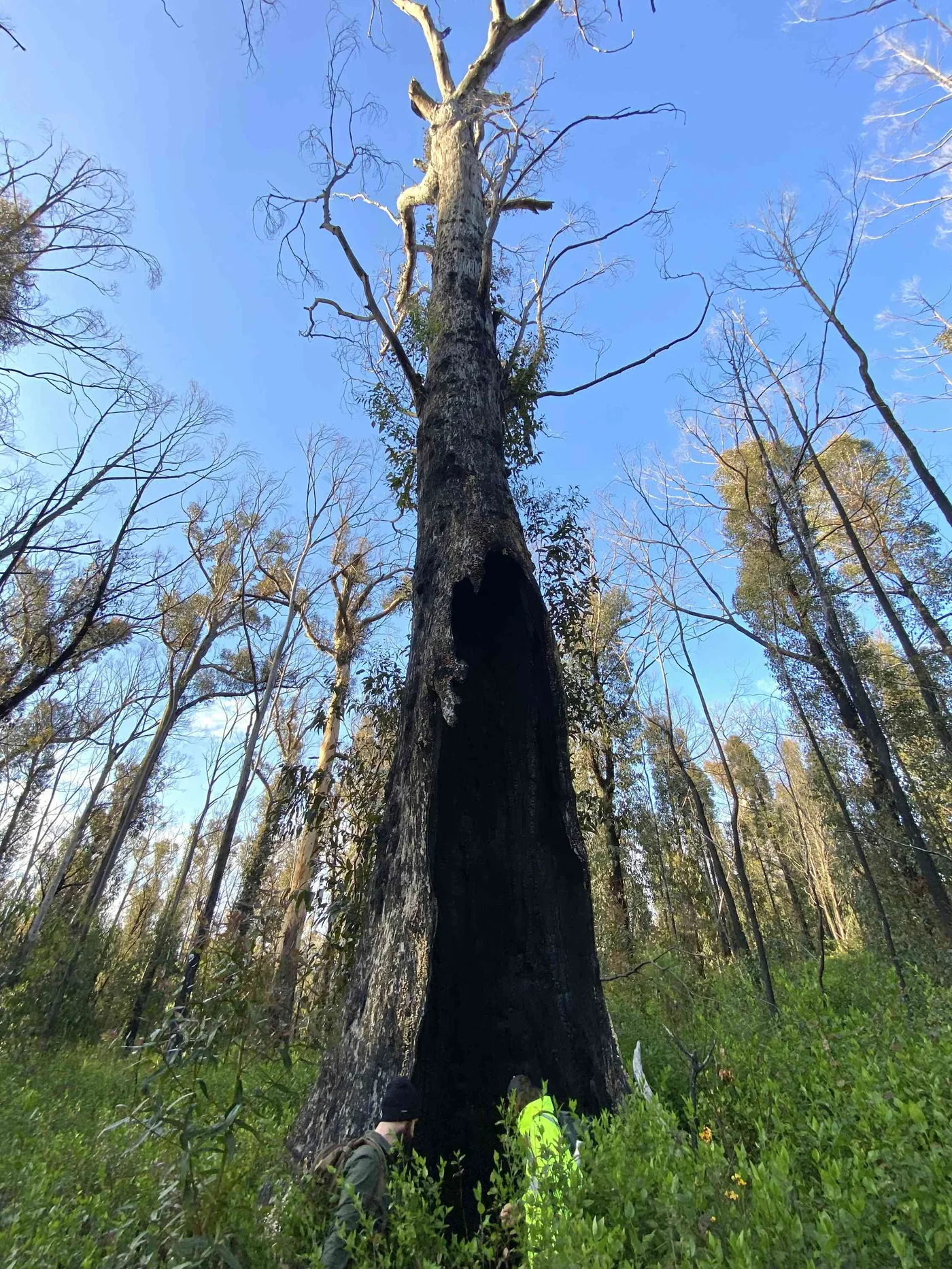
The 2019–20 fires hit big trees in wet forests especially hard. Wet forests lost many of their largest canopy trees through complete mortality or aboveground topkill. Pre-existing fire scars on lower trunks made mature trees unusually vulnerable to flame penetration. These scars breach protective bark, damage water-conducting xylem, and expose inner wood to fungal rot and wood-boring insects [1].
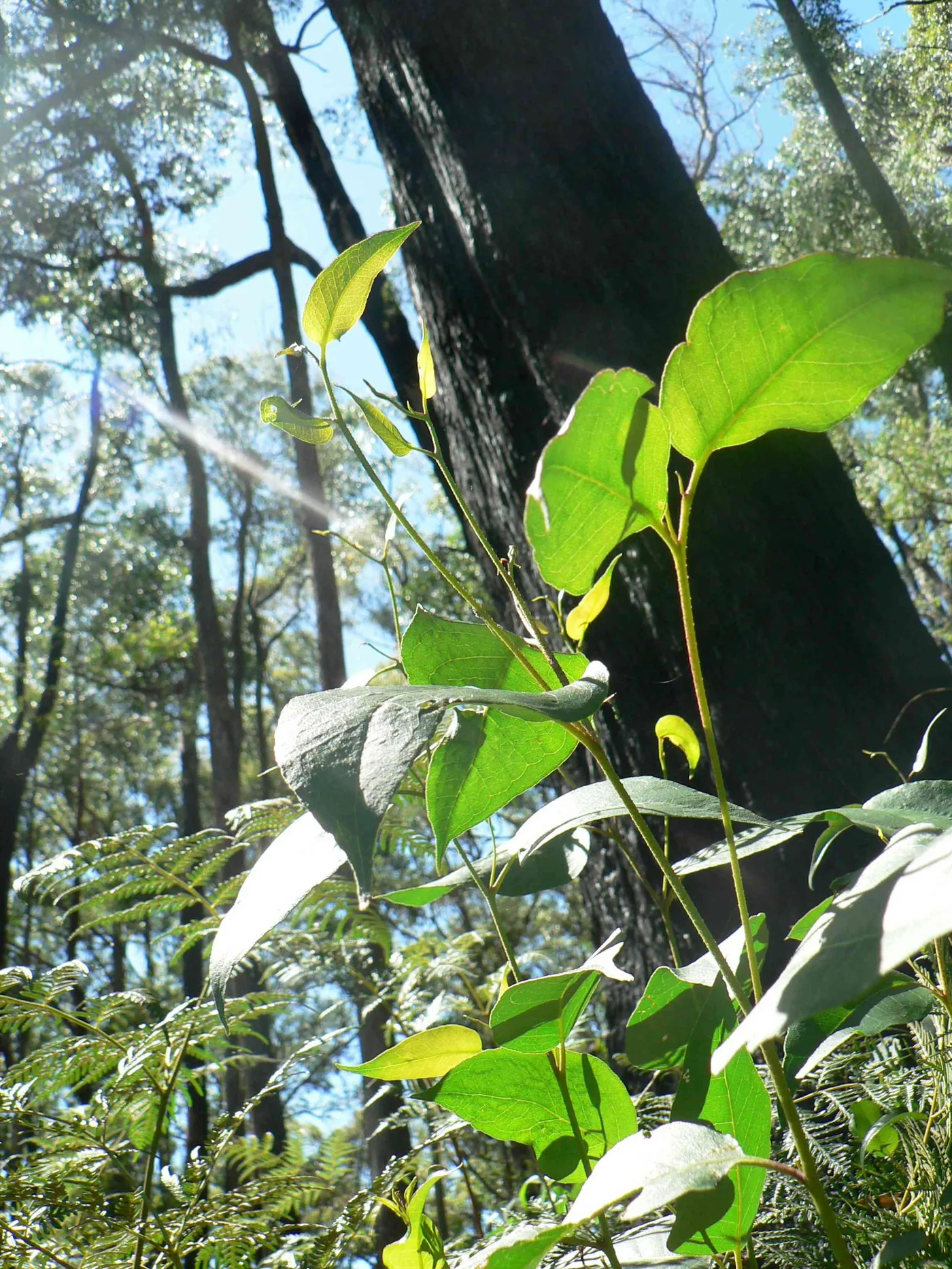
When fire ignites decayed interior wood, hollowed trunks easily collapse or suffer structural failure [1]. Even when scarred giants survive, high heat often kills their upper crowns, forcing trees to regenerate through basal mallee shoots alone. Bendall said that relying solely on basal shoots resets the canopy to a smaller size class, erasing decades of vertical forest architecture. Thus, while eucalypt resprouting keeps individual root systems alive, it cannot preserve the tall canopy structures that dependent fauna require [4].
Managing Fire in the Landscape
Understanding that eucalypts possess differing tolerance limits across climatic gradients helps land managers update fire management strategies. Doctor Rachael Nolan said that identifying vulnerable populations at dry range boundaries allows agencies to plan longer fire return intervals and target lower flame severities near sensitive stands [1]. Certain species, such as alpine snow gums and tall mountain ash, already struggle to survive under combined pressures from logging and shortened wildfire return intervals. When fires occur too close together, trees cannot replenish starch reserves or mature enough seed capsules to replace fallen cohorts [2].
Current forest models frequently classify eucalypts under a single broad resprouting trait, ignoring how tree diameter, fire scars, and regional dryness modulate survival [1]. Harriet Simpson-Southward said that mapping the geographical distribution of bark traits will allow conservation planners to anticipate which forest stands face higher mortality under changing fire regimes [3]. Rather than treating eucalypts as indestructible survivors, conservation efforts must actively protect mature old-growth patches and adjust planned burns to safeguard vulnerable populations [1].
- ONLINE NEWS Bendall, E. R., & Nolan, R. H. (2026, October 25). While some eucalypts are hard to kill, climate change may test the ability of others to survive. The Conversation. [Article Link]
- ONLINE NEWS Moore, G. (2024, February 21). Hard to kill: here’s why eucalypts are survival experts. The Conversation. [Article Link]
- WEBSITE University of Wollongong. (2022, February 21). Climate change, eucalypt bark and bushfires: Why do some trees die and others survive? UOW The Stand. [Article Link]
- ACADEMIC JOURNAL Bendall, E. R., Collins, L., Bedward, M., Boer, M. M., Choat, B., Gallagher, R. V., Medlyn, B. E., Bradstock, R. A., & Nolan, R. H. (2026). Tree Species Vulnerability to Fire Increases at Dry Range Edge. Global Change Biology Communications, 1(4). [Article Link]
- ACADEMIC JOURNAL Bendall, E. R., Collins, L. C., Milner, K. V., Bedward, M., Boer, M. M., Choat, B., Gallagher, R. V., Medlyn, B. E., & Nolan, R. H. (2024). Demographic change and loss of big trees in resprouting eucalypt forests exposed to megadisturbance. Global Ecology and Biogeography, 33(7). [Article Link]
- ACADEMIC JOURNAL Nolan, R. H., Rahmani, S., Samson, S. A., Simpson-Southward, H. M., Boer, M. M., & Bradstock, R. A. (2020). Bark attributes determine variation in fire resistance in resprouting tree species. Forest Ecology and Management, 474, 118385. [Article Link]
- ACADEMIC JOURNAL Devanand, A., Falster, G. M., Gillett, Z. E., Hobeichi, S., Holgate, C. M., Jin, C., Mu, M., Parker, T., Rifai, S. W., Rome, K. S., Stojanovic, M., Vogel, E., Abram, N. J., Abramowitz, G., Coats, S., Evans, J. P., Gallant, A. J. E., Pitman, A. J., Power, S. B., & Ukkola, A. M. (2024). Australia’s Tinderbox Drought: An extreme natural event likely worsened by human-caused climate change. Science Advances, 10(10). [Article Link]
APA 7: PerEXP Teamworks. (2026, October 26). Australian Forests Show Why Eucalypt Resprouting Has Limits. PerEXP Teamworks. https://perexpteamworks.com/en/eucalypt-resprouting-fire-climate-limits/


