






How did violent collisions in the early cosmos create extreme debris disks around young stars in distant planetary systems? These short-lived circumstellar structures (zones of warm dust encircling young stars close to their terrestrial habitable perimeter) provide astronomers with direct observational evidence of catastrophic planetary impacts across twenty-one stellar systems. A research team led by astronomer Kate Su of the Space Science Institute in Boulder published mid-infrared observations of these violent environments in The Astrophysical Journal, confirming that one-third of surveyed disks stem from catastrophic planetary collisions [1].
What Are Extreme Debris Disks?
Extreme debris disks are rare evolutionary circumstellar environments where young planetary systems harbor extraordinary concentrations of warm dust in the terrestrial zone where rocky planets assemble [3]. Unlike classic cold debris disks located dozens of astronomical units from their host stars, these extreme structures produce prominent mid-infrared emission originating near the terrestrial perimeter. While earlier infrared observations explored the dusty Cat’s Tail structure in Beta Pictoris, extreme debris disks occupy an entirely distinct evolutionary category marked by energetic collisions. Webb observed sixteen of these systems [1].
Spectroscopic measurements compiled by NASA’s Spitzer Space Telescope and the James Webb Space Telescope define three unmistakable physical criteria [4]. First, dust particles within extreme debris disks are significantly smaller than macroscopic grains found in conventional debris belts or juvenile circumstellar disks. Second, the pulverized dust maintains elevated temperatures due to its tight proximity to the central star [1]. Third, the systems display unpredictable fluctuations in mid-infrared luminosity over intervals spanning months to years [4]. Spitzer discovered five archival candidate disks [1].
Astronomers previously struggled to classify these turbulent environments because earlier space observatories lacked the spectral sensitivity to isolate faint emission peaks. Lead investigator Kate Su noted that earlier space missions cataloged these systems as intriguing anomalies without determining their physical mechanisms [3]. “This is the first time we have gathered enough systems to truly understand this subclass that we call extreme debris disks,” said Su in the report [1]. Before Webb provided high-resolution mid-infrared spectra, researchers were largely restricted to surveying cold outer debris reservoirs encircling celebrated nearby stars such as Vega and Fomalhaut [4].

How Protoplanetary Disks Disperse Primordial Gas
Planetary systems emerge inside massive disks composed of gas and dust surrounding newborn stars across early star-forming stellar nurseries. During these juvenile epochs, circumstellar disks contain approximately one hundred times more volatile gas than solid dust grains, supplying the raw ingredients required to construct massive planetary atmospheres [2]. If primordial gas dissipates before rocky planetary embryos reach critical mass thresholds, developing worlds cannot accrete vast envelopes comparable to giant planets like Jupiter or Saturn. The Sun is 4.5 billion years old [5].
To determine how infant disks shed their volatile gas before entering the extreme debris disk regime, an astronomical team examined seventy-two young, Sun-like stars with Webb. Principal investigator Naman Bajaj of the University of Arizona collaborated with Ilaria Pascucci of the Lunar and Planetary Laboratory and SETI Institute scientist Uma Gorti using the Mid-Infrared Instrument [2]. Their team detected extended emissions across sixty-six of the seventy-two disks, identifying conical molecular hydrogen winds in forty-six systems and energetic neon jets in forty systems. Forty systems exhibited fast neon jets [5].
As magnetic field lines weaken and material accretion ceases, energetic stellar photons drive photoevaporation (the dispersal of disk gas heated by stellar ultraviolet and X-ray radiation) [2]. SETI Institute researcher Uma Gorti emphasized that disk dispersal establishes an unyielding evolutionary clock for every emergent planetary architecture. “Disk dispersal sets a fundamental clock for planet formation: once the gas is gone, the opportunity to build gas-rich planets is essentially over,” said Gorti [5]. Once volatile gas clears, solid planetary embryos interact gravitationally without hydrodynamic gas damping, initiating the collision-dominated phase that creates extreme debris disks [2].
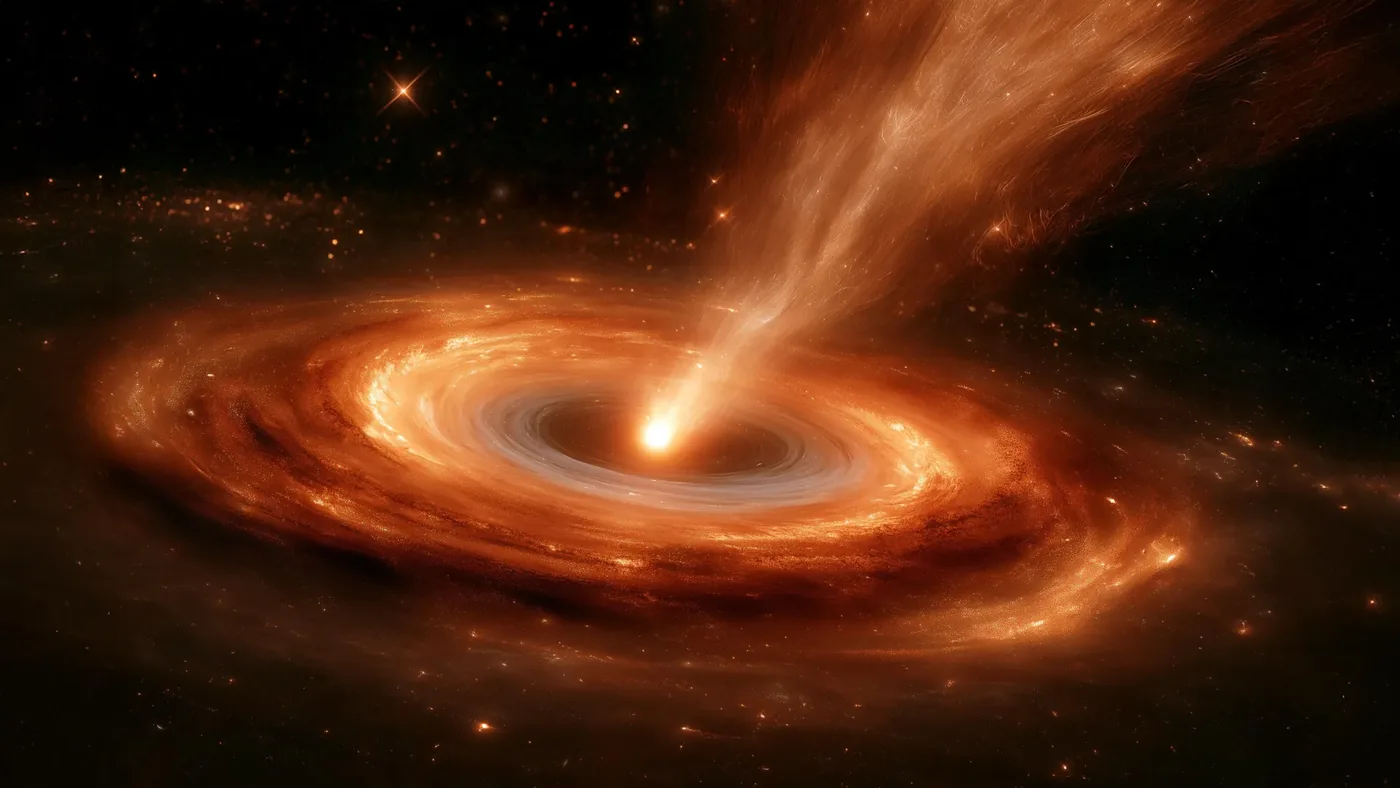
How Mineral Chemistry Defines Extreme Debris Disks
Mineral composition provides direct diagnostic clues regarding the physical severity and kinetic energy of collisions occurring inside extreme debris disks. By analyzing mid-infrared spectra obtained with Webb and Spitzer, Su’s team discovered that extreme debris systems separate cleanly into two distinct compositional groups: silica-rich and silica-poor disks [3]. Obsidian represents terrestrial volcanic glass [4]. Hawaii beaches feature green forsterite sand [3]. These contrasting natural analogs illustrate how high temperatures and shock vaporization alter the chemical signatures preserved in circumstellar dust clouds [4].
Approximately one-third of the sampled extreme debris disks are silica-rich, displaying prominent spectroscopic absorption features that indicate catastrophic impacts between massive Mars-sized planetary bodies. In these hypervelocity impacts, tremendous kinetic energy vaporizes significant fractions of rocky crustal material into incandescent vapor plumes before the silicates condense into fine glass spherules [3]. Conversely, the remaining two-thirds of the sample exhibit silica-poor mineralogy characterized by crystalline forsterite, indicating gentler grazing encounters between Moon-sized bodies where kinetic heating remains insufficient to induce large-scale rock vaporization [1]. Spectroscopic monitoring confirms that these contrasting mineral inventories directly reflect the impact velocities and mass distributions of colliding protoplanetary bodies across developing stellar systems [4].
Observing these subtle mineral signatures resolved longstanding theoretical questions regarding the unobservable stages of rocky planet formation. Coauthor Agnes Kospal of Konkoly Observatory in Budapest explained that mid-infrared spectroscopy allows astronomers to bypass direct spatial resolution limits. “To just see their mid-infrared emission and beautiful spectral features with Webb, which allowed us to identify their compositions, was the most exciting thing for me,” said Kospal. Kospal noted that researchers have no alternative observational method to examine developing planetary embryos directly [1].


Why Are Warm Debris Disks Rare?
Warm debris disks are extraordinarily rare because the dense dust generated by catastrophic impacts clears rapidly through orbital evolution and stellar radiation pressure. While theoretical models suggested that astronomers should routinely detect warm debris rings around youthful stars, observational surveys indicate that roughly one percent of young stars display detectable infrared signatures [3]. Spitzer cataloged five candidate disks during its cryogenic mission, while Webb confirmed sixteen active systems to establish a unified cohort of twenty-one extreme debris disks. Twenty-one systems formed the statistical sample [1].
Catastrophic collisions between protoplanets produce expanding debris clouds that disperse rapidly across orbital space within brief astronomical timescales. Twelve new disks were identified with Webb [1].
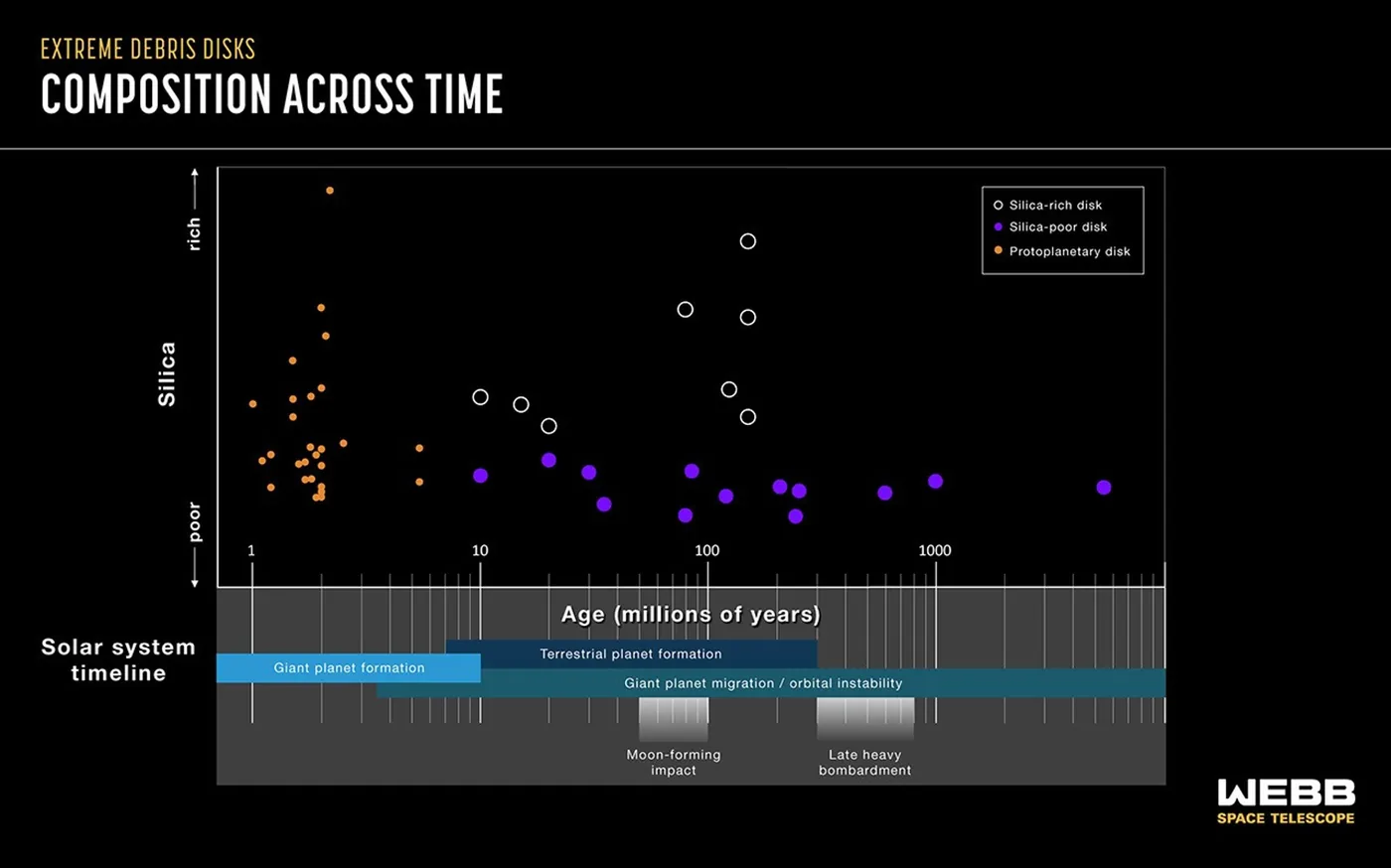
Temporal analysis indicates that silica-rich disks occur exclusively around host stars younger than three hundred million years. In contrast, silica-poor disks appear across a broader spectrum of stellar ages and exhibit significantly higher variability in infrared luminosity [4]. Su’s team deduced that fresh debris clouds experience rapid structural dispersion as newly generated fragments collide repeatedly, grinding themselves down until radiation sweeps them into interstellar space [1]. Astronomers conclude that the rarity of extreme debris disks reflects the ephemeral lifespan of collision clouds rather than an absence of impacts [3].
How Ancient Planetary Impacts Shaped the Solar System
Numerical simulations of our early solar system indicate that terrestrial planets coalesced through violent collisions within their first few hundred million years. Planetary scientists theorize that approximately one hundred million years after the Sun formed, a Mars-sized protoplanet named Theia collided directly with the infant Earth. The catastrophic impact vaporized substantial amounts of silicate crust and blasted molten debris into orbit, which rapidly coalesced to produce the Moon [3]. That ancient terrestrial upheaval mirrors the energetic, silica-rich extreme debris disks observed around young stars in the new James Webb Space Telescope survey [1].
Older silica-poor systems observed by Webb provide compelling physical analogs for the subsequent epoch known as the Late Heavy Bombardment. In that historical scenario, migrating gas giant planets gravitationally disrupted stable asteroid belts, flinging icy and rocky planetesimals inward toward the vulnerable terrestrial worlds. Just as multi-wavelength infrared instruments mapped shattered remnants in the celestial Green Monster within a star’s debris, Webb’s spectroscopy isolates the mineral fingerprints left behind by pulverized protoplanets across distant systems. Theia collided with the infant Earth [3].

Linking terrestrial planet formation to giant planet migration demonstrates that planetary evolution operates as an interconnected cosmic sequence across developing systems. Kate Su summarized this overarching perspective while discussing how individual collision events build larger planetary architectures across cosmic history [3]. “How rocky planets formed and giant planets evolved are part of the broader story of the solar system’s formation. It’s all one story,” said Su. Observations of distant extreme debris disks confirm that chaotic collisions remain essential for constructing stable solar systems like our own [1].
What Will Webb Observe in Older Systems?
Webb will target mature stellar candidates to test whether silica-rich extreme debris disks genuinely vanish as planetary systems age beyond three hundred million years [1]. Attila Moor of Konkoly Observatory in Budapest noted that confirming the absence of silica-rich material around older stars requires expanding current astronomical cohorts [3]. “We expect no silica-rich systems among older extreme debris disks,” said Moor, a coauthor of the investigation. “We only have three disks in our sample that fit that age criteria, so it’ll be nice to observe more of these systems to confirm our hypothesis.” Attila Moor highlighted this observational objective [1].
Future spectroscopic cycles will also probe circumstellar gas dispersal across older systems to determine precisely how long volatile reservoirs survive around evolving stars [2]. By measuring the physical boundaries where escaping winds originate, researchers aim to clarify how rocky planetary embryos avoid premature disruption during disk evolution [5]. Just as cosmic surveys revealed how early elongated galactic structures evolved over cosmic dawn, Webb’s mid-infrared instrumentation continues to illuminate the chaotic transition between primordial circumstellar gas and mature planetary architectures. Astronomers at NASA, ESA, and CSA will leverage upcoming observing cycles to uncover whether catastrophic impacts remain a universal prerequisite for habitable terrestrial worlds [3].
- ACADEMIC JOURNAL Su, K. Y. L., Moór, A., Kóspál, Á., Rieke, G. H., Sefilian, A. A., Malhotra, R., Pascucci, I., Jackson, A. P., Ábrahám, P., & Ballering, N. P. (2026). Extreme Debris Disks: Insights into Violent Collisions in Planet Formation and Destruction. The Astrophysical Journal, 1010(1), 1. [Article Link]
- ACADEMIC JOURNAL Bajaj, N. S., Pascucci, I., Cabrit, S., Edwards, S., Cugno, G., Sellek, A. D., Najita, J. R., Zhang, K., Alexander, R., Herczeg, G. J., Gorti, U., Clark, S. C., & Beck, T. L. (2026). JWST/MIRI Reveals the Evolution from Molecular to Atomic Disk Winds. The Astronomical Journal, 172(3), 161. [Article Link]
- PRESS RELEASE McCoy, M., & NASA Webb Mission Team. (2026). NASA’s Webb Provides Crash Course on Planet-Shattering Collisions. NASA Science. [Article Link]
- ONLINE NEWS Clark, G., & Egan, R. (2026). Webb Provides Crash Course on Planet-Shattering Collisions. Phys.org. [Article Link]
- ONLINE NEWS SETI Institute. (2026). James Webb Reveals Why Planet Formation Is a Race Against Time. ScienceDaily. [Article Link]
- ONLINE NEWS Mirage News. (2026). Webb Offers Crash Course on Planet-Shattering Collisions. Mirage News. [Article Link]
APA 7: PerEXP Teamworks. (2026). NASA’s Webb Examines Extreme Debris Disks Around Young Stars. PerEXP Teamworks. https://perexpteamworks.com/en/extreme-debris-disks-planetary-collisions/


