






Robotics researchers have long faced a fundamental speed limit when designing machines out of soft materials without rigid motors or silicon microchips. At the University of California San Diego, engineers led by Yichen Zhai and M. T. Tolley have cleared that hurdle by building a six-legged machine that moves at 15 feet per second [1]. That pace makes it the fastest soft robot constructed to date, outpacing earlier electronics-free designs by a factor of 100 [2]. Instead of relying on conventional circuit boards or electric wiring, the desktop-fabricated hexapod uses a double-expansion pneumatic oscillator inspired by compound steam engines to route high-pressure air through its flexible limbs. The resulting UC San Diego system runs over rough ground, navigates sand and concrete, and functions underwater while running on pressurized gas or simple tap water [1].
Speed Jump from 2022 Predecessor
The new robot represents a major speed increase over earlier iterations of fluid-driven locomotion. In 2022, the UC San Diego team fabricated an early air-powered soft robot capable of scuttling across flat surfaces at just 1.5 inches per second [2]. That crawler proved the concept [1]. However, its low power output restricted real-world usefulness, forcing Zhai and Tolley to find a way to move pressurized air much faster through soft conduits. “Our first walking robot demonstrated what was possible, but it was too slow. We hoped to overcome this limitation, and we were fortunate to find a solution to make the new robot 100 times faster,” Zhai said in a statement [2].
Engineers bridged that performance gap by replacing older low-pressure logic gates with valves that capture much greater mechanical energy. Early additive soft robots operated with modest flow rates that could not produce the rapid leg cycling needed for running. By redesigning the air channels, Zhai and Tolley achieved an estimated mechanical power output of 169 watts while keeping the entire body compliant. The hexapod reached a top speed of 4.72 meters per second, proving that fully soft bodies can produce high-speed locomotion without a single rigid metal actuator [1].
How the Fastest Soft Robot Mimics Steam Engines
To propel the hexapod at record velocity, the UC San Diego engineers looked back at nineteenth-century steam power [2]. Zhai and Tolley based the fastest soft robot on a double-expansion pneumatic oscillator inspired by the compound steam engine [1]. In a classic compound engine, high-pressure steam expands in a small cylinder before passing into a larger low-pressure cylinder to extract extra work from the expanding gas. The UC San Diego team adapted this thermodynamic principle to soft elastomers by routing pressurized gas through a network of integrated valves, allowing the air to expand first through control valves and then recirculate through wider chambers in the legs [2].
The secondary expansion cycle solves a core bottleneck in pneumatic soft robotics. Standard pneumatic oscillators dump exhaust gas right after actuation, which wastes most of the input energy. In contrast, the double-expansion mechanism captures residual pressure to drive the return stroke of each limb. The oscillator converts a steady stream of high-pressure gas into four-phase pressure signals at high frequency without requiring electrical switches or computerized timers. It coordinates the alternating gait of all six legs through fluid mechanics alone [1].
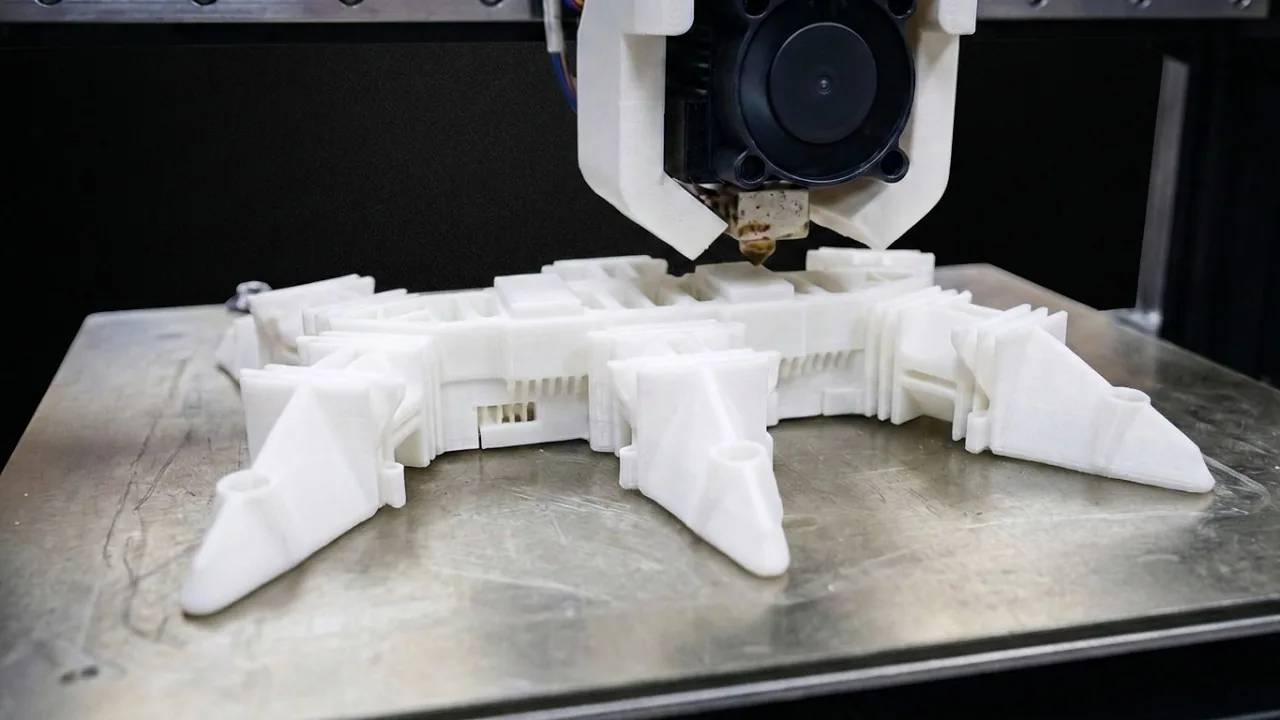
A single manufacturing run eliminates another common failure point in soft machines. Many flexible robots require technicians to glue tiny silicone tubes, valves, and actuators together by hand. The desktop printer finishes the UC San Diego hexapod in one run [1]. “The key challenge was to implement a time-tested solution (the compound steam engine) in a soft running robot that can be printed in a single piece out of a single material,” Zhai said [2].
Locomotion Across Diverse Terrains
High running speeds often cause lightweight machines to lose traction or tumble when surfaces become uneven, but the UC San Diego walker kept stable forward movement over several outdoor environments during field evaluations published in Science Robotics [1]. It sprinted over concrete, gravel paths, lawn grass, mulch beds, and loose sand dunes without stalling [2]. The legs deform naturally. Because the compliant chassis cushions unexpected bumps without complex balance sensors, the hexapod maintains steady footing across rugged obstacles [1]. Unlike rigid motorized quadrupeds such as KAIST RAIBO2 that run on heavy battery packs and algorithmic motor controls, the pneumatic hexapod derives its stability from material compliance.
Traction tests showed that the alternating tripod gait keeps the chassis steady even on loose pebbles. When the legs strike gravel or sand, the flexible polymer bends around small obstacles rather than skidding off them [1]. This passive feedback allows the robot to sprint forward at roughly 10 miles per hour while enduring repeated ground impacts that would break plastic gears in rigid miniature drones [2]. In comparison, morphing soft-armed drones reported by Interesting Engineering squeeze through narrow gaps at 4.5 miles per hour using spring-loaded cam joints [3]. The UC San Diego hexapod doubles that velocity on open ground by relying on continuous pneumatic oscillations [1].



Movement in Water and Liquid Media
The pneumatic architecture functions effectively on dry land and in aquatic settings [1]. Because the robot contains no open electrical circuits or battery contacts that could short out, water poses no hazard to its valves and channels [2]. Researchers placed the hexapod in shallow water basins and flooded outdoor trenches, where its rhythmic limb motions propelled it through the fluid while its sealed hollow chambers kept the main chassis afloat [1].
The double-expansion oscillator can also run on liquids. In laboratory trials, Zhai and Tolley pumped ordinary tap water through the valve network instead of compressed gas. This hydraulic pressure drove the four-phase oscillator at lower frequencies, allowing the hexapod to crawl under high hydrostatic resistance. Tap water opens potential uses in marine exploration and underground pipe inspection where compressible air is difficult to manage under external fluid pressure [1].
Fastest Soft Robot Durability Without Electronics
The absence of silicon microchips, copper wiring, and onboard batteries provides the hexapod with unique durability. Electronic components are notoriously fragile when subjected to heavy shock, moisture, or ionizing radiation. In extreme operational settings, electromagnetic interference can scramble robotic computers or fry circuit traces [2]. The UC San Diego robot avoids those vulnerabilities because its logic, timing, and actuation are built directly into the geometric contours of its 3D-printed elastomer body, functioning as a purely fluidic automaton guided by air pressure alone [1].
Similar priorities guide machines built for extreme exploration. Conventional planetary explorers like the Perseverance rover require bulky titanium shielding, thermal heaters, and radiation-hardened microprocessors to survive severe environments. In contrast, an electronics-free soft machine can withstand heavy gamma radiation, magnetic fields, and corrosive atmospheres that would render computerized explorers inoperable [2]. The elastic body springs back after heavy compression [1].

Future Portable Power and Space Exploration
Despite its sprinting speed, the prototype remains tethered. A flexible tube connects the internal oscillator to an external laboratory compressor that supplies a steady stream of high-pressure gas, restricting the hexapod’s operating range to controlled testbeds and indoor evaluation zones. Untethering the machine is the primary goal for Zhai and Tolley [2].
To achieve complete mobility, the UC San Diego engineers are designing refined valve geometries that consume significantly less gas per stride. A lower flow rate would allow Zhai and Tolley to mount a compact compressed air cartridge directly onto the chassis, enabling the hexapod to sprint freely across open terrain without dragging supply lines behind it. Later versions will add steering valves. These directional controls could guide the machine around field obstacles or carry out automated pathfinding through built-in pneumatic logic loops [2].
The UC San Diego team views its desktop-printable architecture as a practical blueprint for low-cost, disposable automation [1]. Writing in Popular Science, Andrew Paul noted that similar electronics-free machines could operate in outer space or disaster zones where silicon electronics degrade. “We see this as a step towards complex and powerful robots that can be printed on the desktop using inexpensive materials,” Zhai said. If future iterations can operate untethered in contaminated areas or extraterrestrial caves, soft robotics could transition from laboratory curiosities into helpful tools for extreme exploration [2].
- ACADEMIC JOURNAL Zhai, Y., & Tolley, M. T. (2026). Printing powerful soft robots on a desktop. Science Robotics, 11(120). [Article Link]
- ONLINE NEWS Paul, A. (2026, November 23). World’s fastest soft robot sprints 15 feet per second. Popular Science. [Article Link]
- ONLINE NEWS Interesting Engineering. (2026, November 24). AI and robotics archives. Interesting Engineering. [Article Link]
APA 7: PerEXP Teamworks. (2026, November 25). UC San Diego Hexapod Sprints as Fastest Soft Robot. PerEXP Teamworks. https://perexpteamworks.com/en/fastest-soft-robot-uc-san-diego/


