



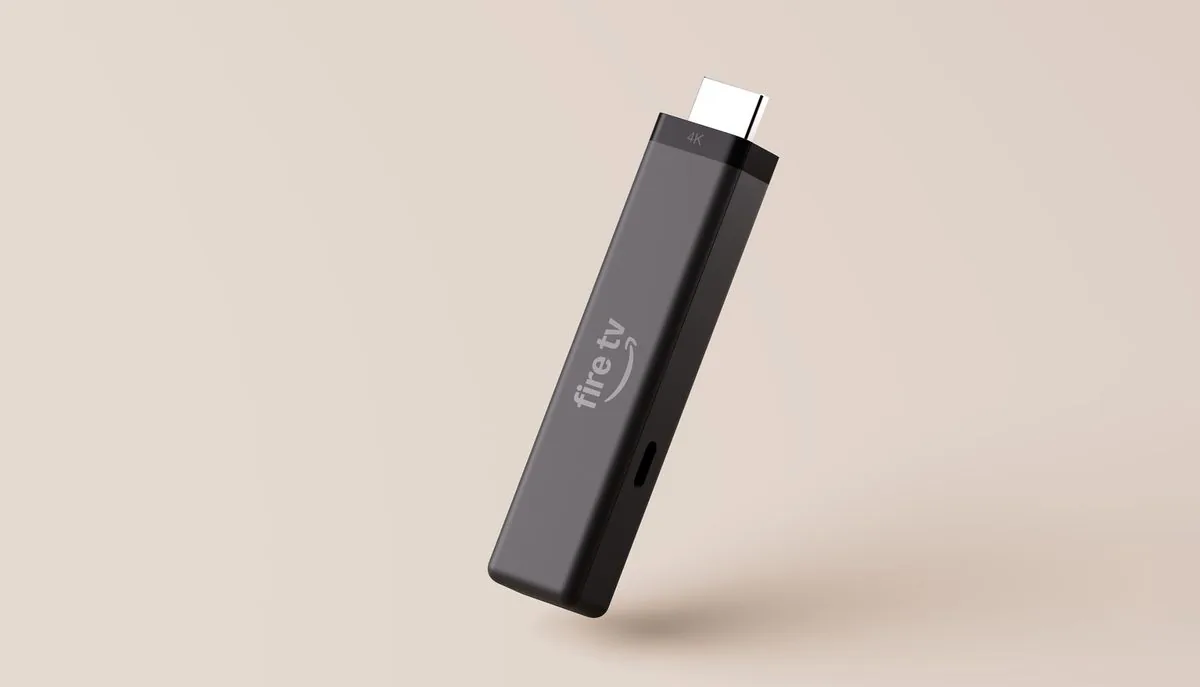
Amazon introduced its redesigned Fire TV Stick 4K to resolve the persistent nuisance of entertainment center wire clutter. Can a compact streaming dongle eliminate bulky wall bricks while outperforming rival hardware? The media streamer draws operating power directly from a television USB port using an included USB-C cable [3]. Amazon confirmed the hardware begins shipping immediately across twelve international markets at a baseline retail price of $59.99 [5].
Fire TV Stick 4K Hardware Upgrades
The refreshed Fire TV Stick 4K adopts a slimmer chassis that echoes the Fire TV Stick HD launched in April [6]. Paul Lilly of HotHardware highlighted that the device draws electrical power directly from a television USB port through an included USB-C cable under a feature dubbed Direct Power [3]. The dongle ditches dedicated power bricks. While owners can still plug the unit into a wall outlet, eliminating trailing cords simplifies mounted installations [6].
Under the hood, the streaming stick houses a quad-core 1.7GHz processor and 8GB of internal storage [1]. Wireless connectivity relies on dual-band Wi-Fi 6 combined with Bluetooth 5.3 and Bluetooth Low Energy standards to maintain remarkably stable playback across crowded home network environments [5]. On the visual front, the hardware handles output resolutions of 720p, 1080p, and 2160p at up to 60 frames per second [6]. Video decoding encompasses HDR10, HDR10+, HLG, H.264, H.265, VP9, and the open AV1 format [1]. Spatial audio pass-through supports Dolby Atmos paired with Dolby Vision visual processing, ensuring high-fidelity delivery when connected to compatible home theater sound systems [3].
Amazon claims the Fire TV Stick 4K operates 20% to 40% faster from boot to playback than a comparable rival stick, with application launch speeds jumping 35% [4]. During internal benchmark tests measuring the three most popular streaming platforms, Amazon reported that the stick initiated playback faster than built-in operating systems on three leading 4K smart televisions [3]. However, Carrie Marshall at TechRadar urged healthy skepticism regarding internal vendor metrics, observing that manufacturers rarely design tests that leave their own hardware behind [4]. While consumers monitor Roku OLED television retail discounts when planning full living room overhauls, inexpensive dongles serve users seeking speed boosts on existing screens.
Vega OS Replaces Android on Fire TV 4K
The most consequential architectural change is the permanent transition from the traditional Android base to Amazon’s proprietary Vega OS [2]. Mike Prospero at Tom’s Guide noted that this marks the third commercial streamer to adopt the platform following the Fire TV Stick HD [7]. Sideloading is completely gone. By abandoning Android application packages, Amazon secures tighter ecosystem control while shutting down third-party APK installations that enthusiasts relied on for years [2].
To reassure customers worried about software availability, Amazon revealed that developers ported more than 2,000 native applications to Vega OS over the past year. Adamya Sharma of Android Authority documented that essential entertainment portals like Netflix, Disney+, Prime Video, and YouTube operate natively on the hardware. Furthermore, specialized software including the Xbox cloud gaming client, Spotify, the VLC media player, and multiple virtual private network utilities have arrived on the store [5]. Ben Schoon at 9to5Google emphasized that while legitimate streaming catalogs continue expanding rapidly, losing arbitrary installation methods permanently alters the appeal of Amazon streaming hardware for hobbyists seeking custom media software [2].
Amazon argues that the lightweight software stack delivers smoother interface transitions than the bloated operating systems powering cheap smart displays. Shoppers tracking major Best Buy television retail sales often discover that entry-level panels ship with sluggish navigation menus that stutter under continuous daily use. Replacing sluggish factory software with a streamlined Fire TV Stick 4K provides responsive channel browsing without demanding a full home theater upgrade [1].

Tactile Navigation and Asymmetric Remote Design
Beyond the streaming dongle itself, the Fire TV Stick 4K arrives with an ergonomic overhaul for the bundled Fire TV Remote [5]. The controller features an asymmetric profile defined by a squared-off top edge and a curved, weighted base [6]. Viewers holding the accessory in a dark room instantly discern orientation without glancing down. The Home key uses solid metal. Complementing the metallic finish, the volume, mute, and playback keys feature tactile indentations that facilitate quick navigation through muscle memory [1].
The Star button is remappable. Users can assign this dedicated key to launch favorite services or toggle accessibility tools like closed captioning [6].

The remote incorporates infrared transmitters to regulate volume and power on connected televisions, receivers, and soundbars [5]. Amazon confirmed backwards compatibility with all Amazon Ember TVs and streaming players released since 2019 [4]. For existing setup owners, the refreshed controller sells separately for $14.99 with shipments commencing in late October [5]. Meanwhile, Cherlynn Low at Engadget reported that an aluminum Fire TV Remote Plus will debut in early 2027 to replace the Alexa Voice Remote Pro. That upcoming premium controller will incorporate backlit buttons paired with acoustic finding capabilities triggered by Alexa voice commands [6].
How Does Alexa+ Change Content Discovery?
How does artificial intelligence reshape daily entertainment browsing? Rather than limiting voice input to simple title searches, Amazon infused the interface with an upgraded Alexa+ assistant [4]. The system processes contextual prompts by cross-referencing user subscriptions, personal viewing history, industry awards, and cultural events. Viewers can ask for Marvel cinematic universe films in chronological timeline order or locate Emmy nominees that were snubbed during ceremonies [7].
To streamline voice interactions across hardware, Amazon introduced a dedicated Alexa+ hub directly within the Fire TV navigation environment [4]. This on-screen dashboard consolidates recent prompts and ongoing conversational threads initiated on companion hardware like Echo smart speakers, Echo Show displays, or the mobile application. Viewers can start researching program recommendations on a smartphone during evening commutes and resume that identical dialogue on their television without repeating search parameters [6]. Mike Prospero of Tom’s Guide observed in Tom’s Streaming Guide that while extensive programming libraries often overwhelm viewers, evaluating curated recommendations through conversational assistants represents an ambitious attempt to simplify media discovery across fragmented streaming platforms [7].

The software rollout follows an unconventional phased schedule across Amazon hardware lines. Advanced Alexa+ features arrive first in the United States this November for the second-generation Fire TV Stick 4K Max, the Fire TV Cube, Amazon Ember TVs, and partner displays manufactured by TCL and Hisense. International users and owners of the newly launched Fire TV Stick 4K must wait until early 2027 before receiving the full conversational interface update [7].
Streamlined Lineup and Global Launch Pricing
In tandem with hardware revisions, Amazon simplified its retail portfolio by retiring the confusing Select and Plus branding in favor of three distinct tiers [3]. The entry tier costs $39.99. That baseline Fire TV Stick HD anchors budget streaming, while the newly introduced Fire TV Stick 4K fills the middle tier at $59.99 [5]. Power users and gamers retain the Fire TV Stick 4K Max at $84.99, while the $199 Fire TV Cube remains the flagship device for hands-free control [7]. Retailers will continue clearing existing legacy stock until warehouse supplies are depleted [5].
The streaming stick launched immediately across North America, Europe, Asia, and Australasia. Shipments start today across twelve countries. Buyers in the United States, Canada, Japan, Mexico, the United Kingdom, Ireland, Germany, France, Italy, Spain, Switzerland, Australia, and New Zealand can place direct orders immediately [5]. Standard British pricing settles at £69.99, with Amazon planning regional rollouts for additional international territories toward the end of October [4].
Prospective buyers eyeing an upgrade face a straightforward pricing window ahead of the holiday season [7]. While the standard retail price remains $59.99, Amazon confirmed that introductory coupons and Prime Big Deal Days promotions will slash the cost down to $29.99 in the United States and £32.99 in Britain [4]. Current owners must weigh that substantial initial discount against the permanent removal of Android sideloading capabilities [2]. Those who depend on third-party media software will likely keep older hardware running, while mainstream viewers seeking faster boot times and clutter-free USB power can order the Fire TV Stick 4K before promotional pricing concludes [1].
- ONLINE NEWS Knight, S. (2026, September 30). Amazon launches faster 4K Fire TV Stick with an all-new remote. TechSpot. [Article Link]
- ONLINE NEWS Schoon, B. (2026, September 30). Amazon’s new Fire TV Stick 4K ditches Android & sideloading for $59.99. 9to5Google. [Article Link]
- ONLINE NEWS Lilly, P. (2026, September 30). Amazon’s New Fire TV Stick 4K Is Faster And Ditches The Power Brick. HotHardware. [Article Link]
- ONLINE NEWS Marshall, C. (2026, September 30). Amazon unveils a new Fire TV Stick 4K, a new remote design and updates for Alexa+. TechRadar. [Article Link]
- ONLINE NEWS Sharma, A. (2026, September 30). Amazon unveils a new Fire TV Stick 4K and a remote you can navigate by feel. Android Authority. [Article Link]
- ONLINE NEWS Low, C. (2026, September 30). Amazon unveils a thinner and faster Fire TV Stick 4K, plus a new remote. Engadget. [Article Link]
- ONLINE NEWS Prospero, M. (2026, September 30). Amazon announces a new $59 Fire TV Stick and — finally — a remote you can find with Alexa. Tom’s Guide. [Article Link]


