





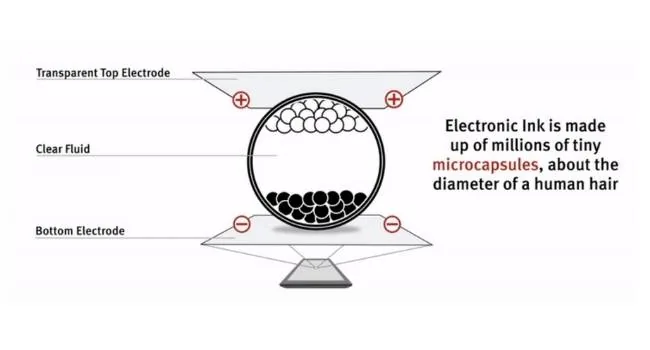
E-ink displays form text and pictures by moving tiny pigment grains with small electric charges instead of beaming light into human eyes. The system relies on electrophoresis, an effect where charged black and white grains float in clear fluid inside microcapsules about the width of a human hair. Because this screen reflects daylight like ink on paper, it stays readable under bright sun and holds a page without draining battery power [6].
How Electrophoresis Moves Ink
Electrophoresis was first recorded in 1807 to describe how charged matter moves through fluid under an electric field [17]. Inside e-ink displays, millions of sealed microcapsules laminated on plastic hold these moving pigments in a thin sheet so that crisp letters take shape under controlled voltage. Each sphere contains clear hydrocarbon oil packed with white titanium dioxide and black carbon grains [18].
Researchers at the MIT Media Lab turned this laboratory discovery into practical digital paper during the late 1990s. In 1997, Joseph Jacobson, Barrett Comiskey, J.D. Albert, Jeremy Rubin, and Russ Wilcox founded E Ink Corporation to commercialize microencapsulated ink described in Nature [5]. Jacobson joined the National Inventors Hall of Fame in 2016 for pioneering digital paper [15]. By packaging the ink inside tiny shells between 10 and 100 micrometers wide, the engineering team prevented fluid leaks, maintained uniform cell spacing, and made roll-to-roll printing on flexible plastic sheets possible [18]. When a circuit applies a negative voltage to the top electrode, white titanium dioxide grains rise to the surface while black carbon grains sink out of sight [6].
Screens do not stop at stark black and white. By timing the duration of electric pulses, driver circuits halt pigments midway through the capsule to create subtle gray tones. Current monochrome panels render 16 levels of grayscale [15]. This stepped positioning allows font anti-aliasing, which softens letter curves and recreates the visual quality of ink printed on book paper [9].
Why E-Ink Displays Never Need a Backlight
Standard computer screens use a backlight that shines through liquid crystals, as explained in our guide to how a computer’s screen works in modern devices. In contrast, e-ink displays emit no native glow and instead reflect ambient room light from the pigment layer [11]. Sunlight that washes out a glossy glass monitor makes an electrophoretic panel sharper, because extra ambient photons bounce straight off the titanium dioxide grains [6]. The page reads like paper.
Because ambient light bounces off the pigments rather than shining into the retina, readers report less eye fatigue during long reading sessions. For reading at night, manufacturers illuminate the panel using an edge-mounted front-light guide rather than a backlight [6]. Tiny LEDs placed along the outer bezel direct light through a thin transparent baffle over the front of the screen, which diffuses downward and bounces back out toward the reader [9]. E Ink Corporation markets this lighting system as ComfortGaze, tuning the LED spectrum to cut blue light reflections and keep bedtime reading comfortable [15].
Self-emissive pixels generate their own illumination and vivid saturation, a mechanism detailed in our comparison of OLED and QLED panel contrast in consumer electronics. While emissive panels excel at fast video, their directional rays lose clarity at off angles. Electrophoretic microparticles scatter light in all directions, producing a wide viewing surface that stays legible from extreme vantage points [18].
How Bistable Pixels Save Power
The core reason e-readers run for weeks on a tiny charge is a trait known as bistability [10]. Once electric charges push ink grains into position, fluid friction and surface forces hold them stationary without any continued voltage [11]. The panel draws zero power while showing an unchanging page [15].
Engineering benchmarks from Pervasive Displays demonstrate these power savings in retail shelf tags and industrial internet-of-things hardware. A 2.66-inch bistable display draws about 2.459 milliamps during a 0.61-second image refresh and drops to 0.001 milliamps in sleep mode. Over a full year of periodic retail price updates, that electronic paper module consumes only 1.6% of a single CR2450 coin-cell battery. In sharp contrast, a standard 2.4-inch thin-film panel with a backlight draws continuous electricity, consuming the equivalent of 138 CR2450 batteries over the exact same operating period [10]. E-paper displays consume up to 99% less power than equivalent liquid-crystal screens in identical environments [15].

Because static text consumes no power, e-ink displays fit outdoor locations where running wire grids is impractical. Solar-powered bus stop timetables built by MyGica gather daylight to refresh transit schedules a few times per day without grid connections [12]. Handheld RFID and NFC wands also supply enough harvested radio-frequency power to update batteryless parcel tags [10].
Layers Inside Electronic Paper Displays
Every panel bonds an electronic ink film onto a thin-film transistor (TFT) backplane, pairing fluid-filled capsules with a circuit grid that routes voltage pulses to pixel coordinates across the display [15]. Underneath, transparent glass or plastic substrates support the conductive circuitry while keeping the total laminate around 80 micrometers thick, about twice the gauge of normal paper [18].
While e-readers initially relied on rigid glass backplanes, manufacturers now build screens on flexible plastic films branded as Mobius. A 13.3-inch plastic display module matches the weight of 15 sheets of standard A4 paper and equals the thickness of seven sheets. A 13.3-inch slate with a plastic backplane scales down to 349 grams, whereas an LCD competitor measuring 12.9 inches hits 713 grams on the scale [15]. Plastic substrates resist shattering when dropped, making large-format digital notepads practical for classrooms, industrial warehouses, and outdoor fieldwork [11].
To handle touch input and handwriting without disturbing the capsule fluid, hardware makers place separate sensor grids over the panel. Capacitive glass tracks finger taps on Amazon Kindle and Kobo e-readers, while note-taking tablets like the reMarkable incorporate specialized electromagnetic resonance digitizers developed by Wacom to track pen nibs wirelessly. Newer hardware like the reMarkable Paper Pro adopts Active Pen technology based on Universal Stylus Initiative (USI) standards [9].

Waveforms and Ghosting
Driving e-ink displays needs far more control than switching an LCD pixel. Because microscopic ink grains possess mass, inertia, and fluid drag inside viscous oil, display controllers must deliver precise voltage pulse trains known as a waveform to shape each letter correctly. These electrical signals run near ±15 volts to push pigments, arrest their motion, and settle them at exact capsule depths [15].
When a screen updates in a hurry, stray particles fail to finish their transit through the oil, leaving faint outlines of previous text across the background. Engineers refer to this visual defect as ghosting [15]. A full screen refresh clears these artifacts by blinking the display black and white, returning every microcapsule to a clean baseline state [9]. Display firmware balances speed by using fast partial refreshes during text typing, saving full flashes for turning book chapters [15].
The display system coordinates these pulses using dedicated silicon known as an Electronic Paper Display (EPD) controller. In 2024, E Ink Corporation partnered with Himax Technologies to release the T2000 controller, replacing the older T1000 chip introduced in 2019. The T2000 processes color algorithms more than ten times faster than previous silicon and integrates an on-chip handwriting processing unit that handles stylus strokes without burdening the host processor. It also applies temperature compensation, dynamically lengthening drive pulses when cold weather thickens the capsule fluid and slows down particle transit [15].
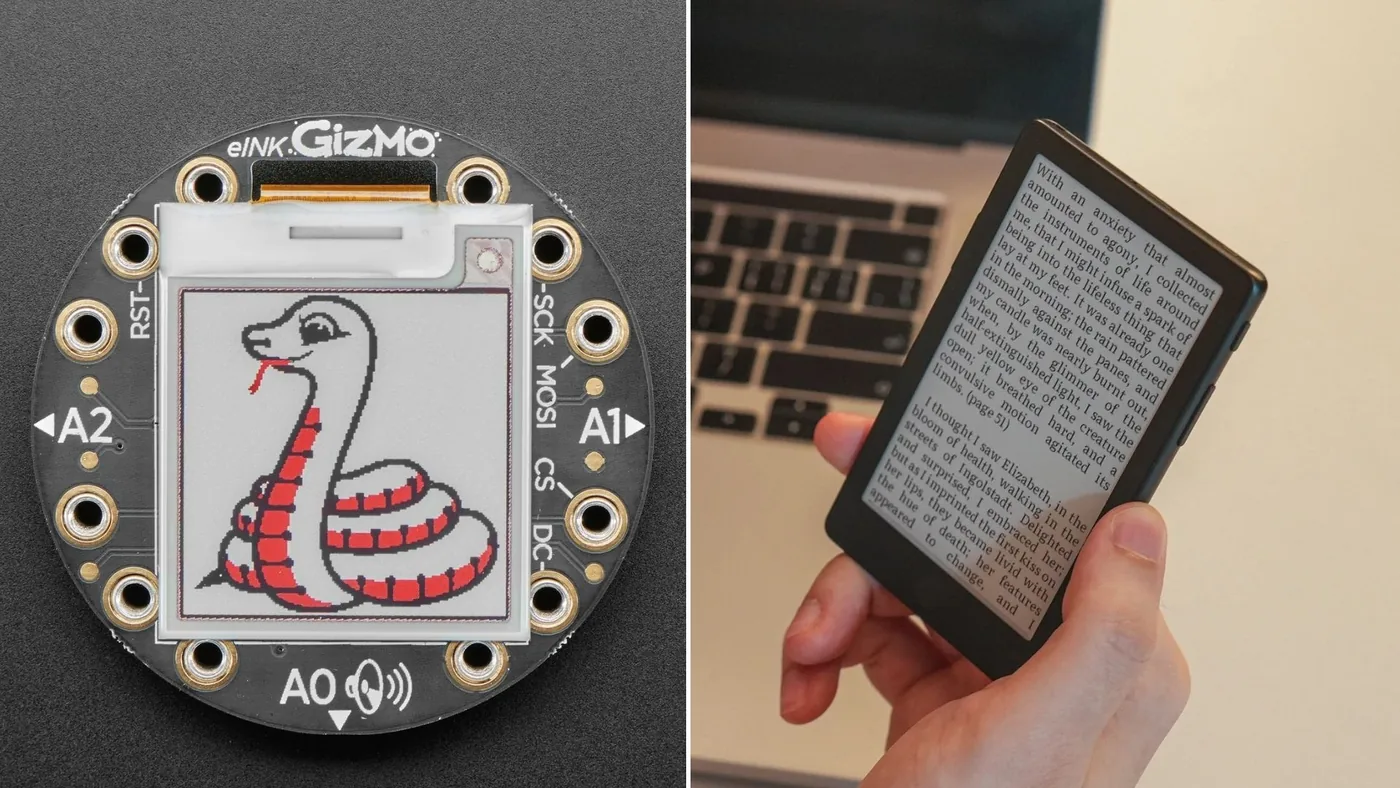
Color Screen Types
Engineers took several distinct paths to bring color to unlit paper. The most widespread approach, commercialized in E Ink Kaleido 3, places a printed color filter array on top of a monochrome microcapsule layer. This filter divides reflected light into red, green, and blue subpixels, producing 4,096 distinct colors along with 16 levels of grayscale. While black-and-white text stays crisp at 300 pixels per inch, the passive filter cuts color resolution to 150 pixels per inch and dims white reflectance [15].
To eliminate the light loss caused by color filters, E Ink Corporation developed its Advanced Color ePaper (ACeP) platform, marketed as Gallery 3 [15]. Instead of using filters, each microcapsule or Microcup contains four separate pigment types: cyan, magenta, yellow, and white [14]. By manipulating multiple voltage steps, the driver arranges these pigments into subtractive color combinations at a full 300 pixels per inch across the entire screen. Shifting four pigment sets through fluid takes between 500 and 1,500 milliseconds, which makes Gallery 3 rich for book artwork but too sluggish for rapid page skimming [15].
A third platform, branded as E Ink Spectra 6, serves retail signage and digital grocery posters [14]. Spectra 6 employs four pigment types—white, red, yellow, and blue—to generate six primary hues through advanced dithering algorithms that simulate full-color promotional artwork on department store shelves. With a 30:1 contrast ratio and resolution reaching 200 pixels per inch, the panel replaces printed cardboard ads in retail aisles. The hardware also supports Sparkle flash animations to attract shoppers [15].
Gyricon and Early Rivals
Capsules were not the first route to reusable paper. In 1974, Nicholas K. Sheridon invented the Gyricon display at Xerox PARC to cure the dimness of cathode-ray tubes used by the Alto personal computer [16]. A Gyricon sheet contained millions of microscopic polyethylene spheres between 75 and 106 micrometers wide, each suspended inside an individual oil cavity within a flexible sheet of silicone rubber. Each sphere was an electrically bichromal Janus particle, with a black hemisphere carrying negative charge and a white hemisphere carrying positive charge [18]. Voltage rotated the beads to form text. Xerox eventually closed its Gyricon division in December 2005 due to financial losses [16].
Another reflective technique is electrowetting, which adjusts fluid surface tension with electrical voltage rather than moving solid pigments [11]. At the University of Cincinnati Nanoelectronics Laboratory, Professor Andrew Steckl and Dr. Han You built vertical-stack electrowetting prototypes using colored oil and water layers. A negative 10-volt charge forces colored oil droplets to contract into tight beads in 10 milliseconds, exposing an underlying white reflective base. This 10-millisecond response speed allows reflective screens to display full color video at high frame rates, reaching speeds that electrophoretic ink capsules cannot achieve due to fluid viscosity [7].

For low-cost smart labels, Ynvisible manufactures electrochromic displays using roll-to-roll screen printing. These panels change color through chemical oxidation and reduction when subjected to electrical current. While they provide semi-bistability—retaining images for 15 minutes before requiring a refresh pulse—a single coin cell can power them for up to 50 years [11].
Where E-Ink Displays Work Best
Dedicated e-readers from Amazon, Kobo, and Barnes & Noble remain the most common consumer showcase for e-ink displays, freeing readers from screen glare and extending battery life to weeks on a single charge [13]. The technology has also entered secondary desktop monitors, interactive meeting-room whiteboards, and digital photo frames that hold pictures indefinitely without power [12]. Early wearables like the Pebble smartwatch used reflective screens to guarantee daylight readability [8].
Beyond personal tablets, electronic shelf labels represent the fastest-growing market for bistable electronic paper [11]. Early systems offered by National Cash Register (NCR) in 1997 paved the way for wireless retail tags, which now use Texas Instruments MSP432 microcontrollers and CC2500 radio chips to receive price changes from central servers over distances up to 30 meters (98 feet). Because these price tags draw energy only when changing numbers, supermarkets can update thousands of shelf tags overnight without replacing batteries for five to seven years. Automated shelf tags eliminate paper waste, reduce pricing errors, and allow store managers to synchronize retail prices with online promotions in real time [19].
Can electronic paper replace liquid-crystal and OLED screens for every computing task? Electrophoretic panels excel at presenting static text under sunlight with minimal energy, but their slow particle migration cannot match the millisecond refresh speeds demanded by competitive gaming and high-definition video. By knowing when not to glow, electronic paper preserves an indispensable role in modern technology [6].
- ACADEMIC JOURNAL Heikenfeld, J. C., Drzaic, P. S., Yeo, J., & Koch, T. (2011). Review Paper: A critical review of the present and future prospects for electronic paper. Journal of the Society for Information Display, 19(2), 129-156. [Article Link]
- ACADEMIC JOURNAL Shui, L., Hayes, R. A., Jin, M., Zhang, X., Bai, P., Berg, A. v. d., & Zhou, G. (2014). Microfluidics for electronic paper-like displays. Lab on a Chip, 14(14), 2374-2384. [Article Link]
- ACADEMIC JOURNAL Xiong, K., Emilsson, G., Maziz, A., Yang, X., Shao, L., Jager, E. W. H., & Dahlin, A. (2016). Plasmonic Metasurfaces with Conjugated Polymers for Flexible Electronic Paper in Color. Advanced Materials, 28(45), 9956-9960. [Article Link]
- ACADEMIC JOURNAL Meng, X., Li, Q., Wei, J., & Shi, H. (2014). Preparation of Electrophoretic Nanoparticles for Electronic Paper. Journal of Nanoscience and Nanotechnology, 14(2), 1617-1630. [Article Link]
- WEBSITE Massachusetts Institute of Technology Media Lab. (n.d.). Electronic Paper project. [Article Link]
- ONLINE NEWS Shaikh, K. (2026, October 4). How do e-ink displays work? The science behind digital paper. Interesting Engineering. [Article Link]
- ONLINE NEWS Zyga, L. (2010, July 26). Oil-based color pixels could let you watch videos on e-paper. Phys.org. [Article Link]
- ONLINE NEWS Liszewski, A. (2015, January 6). Color-Changing E Ink Is Here, But Not In eBook Readers. Gizmodo. [Article Link]
- WEBSITE Mandal, S. (2026, July 10). How E Ink Displays Work: The Science Behind Electronic Paper. Einkopedia. [Article Link]
- WEBSITE Pervasive Displays. (2026, October 11). How E-Paper Displays Work. [Article Link]
- WEBSITE Ynvisible. (2022, February 18). What is E-Paper Display Technology & How Does It Work? [Article Link]
- WEBSITE MyGica. (2026, October 26). What Is E-Paper? Electronic Paper Display Technology Explained. [Article Link]
- ONLINE NEWS Vicente, V. (2021, October 18). What Is E-Ink, and How Does It Work? How-To Geek. [Article Link]
- WEBSITE E Ink Corporation. (2022, December 21). Electronic Ink | E Ink Technology. [Article Link]
- WEBSITE Hu, B. (2026, July 14). How Do E Ink Displays Work? JicTech. [Article Link]
- ONLINE NEWS Genuth, I. (2007, October 15). The Future of Electronic Paper. The Future of Things. [Article Link]
- WEBSITE E-Ink-Info. (2023, March 6). Introduction – What is E Ink and E-Paper? [Article Link]
- WEBSITE Wikipedia. (n.d.). Electronic paper. [Article Link]
- WEBSITE Wikipedia. (n.d.). Electronic shelf label. [Article Link]


