





In machine learning, how attention mechanisms work centers on calculating numerical weights that score token relevance in an input sequence. Early recurrent neural networks processed language one word at a time, but this sequential bottleneck compressed long texts into a single vector and lost early context [2]. Newer models replace that step-by-step memory with direct mathematical alignments between all positions at once [3]. Instead of forcing a network to hold every prior phrase in a small hidden state, attention provides direct paths to any part of the context window [1].
- Foundations of Machine Attention
- How Attention Mechanisms Work in Sequence Models
- Mathematics of Scaled Dot-Product Computation
- Multi-Head Transformations and Causal Masking
- Adapting How Attention Mechanisms Work to Visual Tasks
- What Does Self-Attention Capture in Language?
- Linear Scalability and Fast Weight Formulations
- Applying How Attention Mechanisms Work to Sensor Data
Foundations of Machine Attention
Understanding how attention mechanisms work begins with biological vision and early cognitive models of perceptual selection. In 1953, British scientist Colin Cherry studied selective auditory attention through the cocktail party effect, testing how listeners follow a single voice among competing background conversations. Five years later, in 1958, Donald Broadbent formulated the filter model of attention, proposing that sensory pathways route signals through an early bottleneck based on physical cues. During the 1960s, George Sperling evaluated sensory storage limits with his partial report paradigm, confirming that human memory holds brief sensory traces before focused attention selects specific items for cognitive processing [2].
Visual attention studies also revealed that human eyes do not take in an image with uniform clarity. David Noton and Lawrence Stark reported in 1971 that saccadic eye movements trace deliberate scanpaths over salient image regions to make up for the small size of the fovea [1].
In biological nervous systems, sensory processing relies on recurrent feedback loops; research on the primary visual cortex and its mechanisms of recurrent activity shows how cortical pathways guide focus between successive fixations. Computer scientists drew inspiration from these biological systems when building early artificial networks. Kunihiko Fukushima introduced the Neocognitron in 1980 and expanded it in 1987 and 1993 with visual selection circuits. Subutai Ahmad built the VISIT model of covert visual attention in 1991, and Ethem Alpaydın used visual scanning for handwritten digit recognition in 1995 [1].
How Attention Mechanisms Work in Sequence Models
Before attention took hold in machine learning, sequence translation relied on recurrent neural networks. In models proposed by I. Sutskever, O. Vinyals, and Q. Le in 2014, an encoder network read an input sentence token by token and compressed its meaning into a single hidden vector. A decoder network then attempted to reconstruct the target sentence from that lone vector. When input sentences grew beyond a few words, this fixed vector lost early context, causing translation quality to degrade on longer text passages [2].
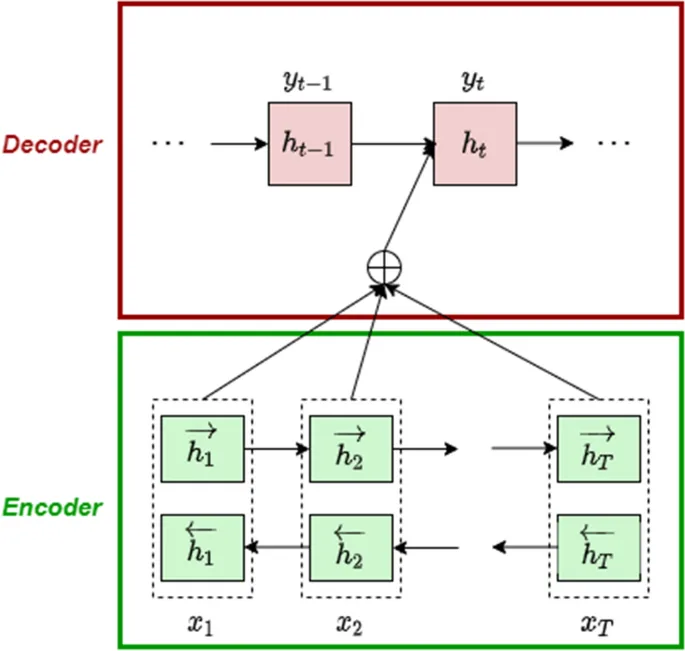
To solve this bottleneck, Dzmitry Bahdanau, Kyunghyun Cho, and Yoshua Bengio introduced additive attention in late 2014 [1]. Their method kept all intermediate hidden states produced by the encoder instead of discarding them after reading the input sequence. At each decoding step, the model scores alignment between the current decoder state and every encoder hidden state using a small feedforward layer: z_ij = tanh(q_i W_Q + k_j W_K) w^T. A softmax function turns these alignment scores into dynamic weights that sum to one. The decoder then builds a weighted sum of the encoder states, creating a context vector tailored to the specific word being produced [2].

In 2015, M. T. Luong and C. Manning evaluated alternative alignment functions for machine translation. They compared additive scoring with dot-product functions, finding that simple dot products between decoder queries and encoder keys matched translation quality while speeding up matrix math [1]. This structural shift showed how attention mechanisms work to bridge distant words without passing through intermediate recurrent steps [2].
Mathematics of Scaled Dot-Product Computation
The 2017 research paper “Attention Is All You Need” formalized attention as a mapping from a query and a set of key-value pairs to an output vector. Written by Ashish Vaswani, Noam Shazeer, Niki Parmar, Jakob Uszkoreit, Llion Jones, Aidan Gomez, Łukasz Kaiser, and Illia Polosukhin at Google, the architecture dropped recurrence in favor of scaled dot-product attention [3]. For an input matrix, each token is projected into a query vector, a key vector, and a value vector [2].
The mathematical formula calculates attention weights by computing dot products between query vectors and all transposed key vectors, dividing by a scaling factor, and taking the softmax: Attention(Q, K, V) = softmax(Q K^T / sqrt(d_k)) V. The scaling factor uses the square root of the key dimension d_k, which was set to 64 in the paper. In high-dimensional spaces, dot products can grow large in magnitude, pushing the softmax function into regions with tiny gradients during training. The division by the square root of 64 counteracts this score growth and stabilizes gradient updates through deep networks [3].
The softmax function normalizes raw affinity scores along each row into valid probability distributions that sum to one. Multiplying these normalized weights by the value matrix produces output rows that lie inside the convex hull of the value vectors. Because dot products depend only on vector angles and lengths, basic attention is permutation-invariant [2]. Positional encodings are added to the input embeddings so the network can track word order [3].
Multi-Head Transformations and Causal Masking
Rather than computing a single attention distribution, the transformer architecture uses multi-head attention to capture diverse relationships. Multi-head designs illustrate how attention mechanisms work across distinct subspaces to extract complementary sentence features. Ashish Vaswani and his team projected queries, keys, and values h times with learned parameter matrices: W_i^Q, W_i^K, and W_i^V. Each head computes attention in parallel on its own subspace. The individual outputs are concatenated together and multiplied by an output matrix W^O to form the final layer state [3].
Parallel heads enable the network to track grammatical agreement in one channel while monitoring semantic themes in another. Transformers implement two main configurations of attention: self-attention and cross-attention [3]. In encoder self-attention, queries, keys, and values all come from the prior encoder layer, letting every word link with every other word in the sequence [2]. In cross-attention, queries come from the decoder layer while keys and values come from the encoder. This setup lets target words look back at source representations during translation without confusing the two vocabularies [3].
When generating text step by step, a decoder must not look ahead at future words. To enforce this rule, models apply causal masking by adding an upper-triangular mask matrix M with negative infinity values before softmax: Attention(Q, K, V) = softmax(Q K^T / sqrt(d_k) + M) V. Because the exponential of negative infinity is zero, future token weights become zero, keeping the generation causal [2].


Adapting How Attention Mechanisms Work to Visual Tasks
Computer vision models clarify how attention mechanisms work when processing two-dimensional pixel arrays instead of linear text. In a 2015 study in PMLR Volume 37, Kelvin Xu, Jimmy Ba, Ryan Kiros, Kyunghyun Cho, Aaron Courville, Ruslan Salakhudinov, Rich Zemel, and Yoshua Bengio built visual attention for image captioning. Testing on Flickr8k, Flickr30k, and MS COCO datasets, their model learned to place attention weights on salient objects as it generated words [4].
Kelvin Xu and his coauthors tested two operational regimes: soft attention and hard attention. Soft attention computes a smooth weighted average over spatial feature maps and trains with backpropagation. Hard attention samples a discrete location at each step, which needs reinforcement learning or a variational lower bound because discrete sampling blocks gradients [4].
Other vision systems verified these principles in game playing and character reading. In an unreviewed 2014 arXiv preprint, Jimmy Ba, Volodymyr Mnih, and Koray Kavukcuoglu presented a recurrent visual attention model that localized house numbers from Google Street View images using fewer weights than standard convolutional networks [6]. In an unreviewed 2015 preprint, I. Sorokin, A. Seleznev, M. Pavlov, A. Fedorov, and A. Ignateva introduced the DARQN algorithm for Atari 2600 games, showing that attention maps let operators observe which screen zones guided decisions [7]. Cross-attention layers also guide image synthesis when diffusion models turn random noise into detailed images from text prompts.
What Does Self-Attention Capture in Language?
Probing experiments show that self-attention heads learn specific grammar rules rather than diffuse statistical associations. In an unreviewed 2019 preprint, K. Clark, U. Khandelwal, O. Levy, and C. D. Manning analyzed the attention heads of pre-trained BERT models. The authors observed that heads in the same layer often display correlated behavior, with individual heads systematically focusing on delimiter tokens, fixed positional offsets, or sentence-wide context [9].
K. Clark and his coauthors found that specific attention heads correspond to traditional syntactic relations. Certain heads linked verbs to direct objects, while others matched nouns with determiners or prepositions with dependent objects. The researchers also identified heads dedicated to coreference resolution, connecting pronouns to antecedent nouns in earlier clauses. Probing classifiers confirmed that substantial syntactic structure is captured in these attention distributions without explicit tree supervision [9].
Attention mechanisms also allow a single model to handle multiple tasks concurrently. In an unreviewed 2017 preprint, Łukasz Kaiser, Aidan Gomez, Noam Shazeer, Ashish Vaswani, Niki Parmar, Llion Jones, and Jakob Uszkoreit developed the “One Model To Learn Them All” network. By combining attention layers with convolutions and mixture-of-experts gating, their model trained on ImageNet, translation tasks, image captioning on the COCO dataset, speech recognition, and English parsing. Adding attention blocks never degraded performance and improved results on smaller datasets [8]. This foundational paper, “Attention Is All You Need”, surpassed 150,000 citations by 2026 [3].
Linear Scalability and Fast Weight Formulations
Standard scaled dot-product attention scales quadratically with sequence length. For an input sequence of length L, evaluating all token pairs takes O(L^2) time and memory. Research into long sequences revealed how attention mechanisms work under memory constraints, leading to linear formulations. When removing the softmax operator, matrix associativity lets keys and values accumulate into a running memory matrix: M_t = M_{t-1} + k_t^T v_t. Computing each new output token then needs only O(1) time and memory, matching the speed of a recurrent network [2].
To approximate softmax attention while keeping linear speed, models use kernel methods in a Hilbert space. The Performer model introduced in 2020 used positive orthogonal random features to avoid negative weights. Other systems, such as DeltaNet, introduce controlled forgetting using delta-rule updates: M_t = M_{t-1} + eta_t k_t^T (v_t – k_t M_{t-1}) [2].
These linear designs connect to neural network concepts developed in the 1980s and 1990s. In PMLR Volume 139, Imanol Schlag, Kazuki Irie, and Jürgen Schmidhuber proved the formal equivalence between linearized self-attention and fast weight programmers. In a fast weight controller, a slow network trained by gradient descent generates keys and values that update the fast weights of a second network. Christoph von der Malsburg described dynamic links in 1981, and Schlag showed that replacing additive updates with delta rules lets networks correct key-value associations dynamically during retrieval and language tasks [5].
Applying How Attention Mechanisms Work to Sensor Data
Industrial deployments demonstrate how attention mechanisms work in cyber-physical systems that monitor complex telemetry. In IEEE Transactions on Industrial Electronics, Z. Chen, M. Wu, R. Zhao, F. Guretno, R. Yan, and X. Li combined LSTM networks with attention to predict the remaining useful life of machinery from sensor streams. The attention layer assigned larger weights to the most informative time steps and features [11]. In energy systems, W. H. Chung, Y. H. Gu, and S. J. Yoo built the PCLA model combining parallel CNNs and LSTMs with attention. Published in Energy, their model predicted district heater loads with an R-squared score of 0.942, outperforming twelve competing architectures [12].
Attention also assists environmental and agricultural forecasting. In Toxins, J. M. Ahn, J. Kim, H. Kim, and K. Kim paired attention-based CNN-LSTM models with gradient boosting algorithms to forecast harmful algal blooms [13]. For remote sensing, R. Vankudoth, V. Sivani, N. M. Bindu, R. Sravani, P. Praveena, and E. Varnika6 built the SCAML model using Potter wasp optimization, reaching an error of 0.312 tons per hectare on grain crops [15].
In cognitive neuroscience, T. de Taillez, B. Kollmeier, and B. T. Meyer used neural networks to decode auditory attention from continuous electroencephalography signals. Their model identified salient neural responses 170 milliseconds after sound stimuli, improving on linear baselines sevenfold [14]. This auditory research links with broader questions about how we understand speech through the function of certain neurons that respond to acoustic signals. As Derya Soydaner reviewed in Neural Computing and Applications, attention has expanded from an inspired biological heuristic into a core computational method across machine learning [1].
- ACADEMIC JOURNAL Soydaner, D. (2022). Attention mechanism in neural networks: where it comes and where it goes. Neural Computing and Applications, 34(16), 13371-13385. [Article Link]
- WEBSITE Wikipedia contributors. (2026). Attention (machine learning). Wikipedia, The Free Encyclopedia. [Article Link]
- WEBSITE Wikipedia contributors. (2026). Attention Is All You Need. Wikipedia, The Free Encyclopedia. [Article Link]
- CONFERENCE PAPER Xu, K., Ba, J., Kiros, R., Cho, K., Courville, A., Salakhudinov, R., Zemel, R., & Bengio, Y. (2015). Show, Attend and Tell: Neural Image Caption Generation with Visual Attention. Proceedings of the 32nd International Conference on Machine Learning, PMLR 37:2048-2057. [Article Link]
- CONFERENCE PAPER Schlag, I., Irie, K., & Schmidhuber, J. (2021). Linear Transformers Are Secretly Fast Weight Programmers. Proceedings of the 38th International Conference on Machine Learning, PMLR 139:9355-9366. [Article Link]
- PREPRINT Ba, J., Mnih, V., & Kavukcuoglu, K. (2014). Multiple Object Recognition with Visual Attention. arXiv:1412.7755. [Article Link]
- PREPRINT Sorokin, I., Seleznev, A., Pavlov, M., Fedorov, A., & Ignateva, A. (2015). Deep Attention Recurrent Q-Network. arXiv:1512.01693. [Article Link]
- PREPRINT Kaiser, L., Gomez, A. N., Shazeer, N., Vaswani, A., Parmar, N., Jones, L., & Uszkoreit, J. (2017). One Model To Learn Them All. arXiv:1706.05137. [Article Link]
- PREPRINT Clark, K., Khandelwal, U., Levy, O., & Manning, C. D. (2019). What Does BERT Look At? An Analysis of BERT’s Attention. arXiv:1906.04341. [Article Link]
- ACADEMIC JOURNAL Lindsay, G. W. (2020). Attention in Psychology, Neuroscience, and Machine Learning. Frontiers in Computational Neuroscience, 14, 29-29. [Article Link]
- ACADEMIC JOURNAL Chen, Z., Wu, M., Zhao, R., Guretno, F., Yan, R., & Li, X. (2020). Machine Remaining Useful Life Prediction via an Attention-Based Deep Learning Approach. IEEE Transactions on Industrial Electronics, 68(3), 2521-2531. [Article Link]
- ACADEMIC JOURNAL Chung, W. H., Gu, Y. H., & Yoo, S. J. (2021). District Heater Load Forecasting Based on Machine Learning and Parallel CNN-LSTM Attention. Energy, 246, 123350-123350. [Article Link]
- ACADEMIC JOURNAL Ahn, J. M., Kim, J., Kim, H., & Kim, K. (2023). Ensemble Machine Learning of Gradient Boosting (XGBoost, LightGBM, CatBoost) and Attention-Based CNN-LSTM for Harmful Algal Blooms Forecasting. Toxins, 15(10), 608-608. [Article Link]
- ACADEMIC JOURNAL Taillez, T. d., Kollmeier, B., & Meyer, B. T. (2018). Machine learning for decoding listeners’ attention from electroencephalography evoked by continuous speech. European Journal of Neuroscience, 51(5), 1234-1241. [Article Link]
- ACADEMIC JOURNAL Vankudoth, R., Sivani, V., Bindu, N. M., Sravani, R., Praveena, P., & Varnika6, E. (2026). Crop Yield Prediction Using Remote Sensing Space Convolutional Attention Machine Learning with Potter Optimisation Algorithm for Independent Variable Selection. DMPedia Lecture Notes in Computer Science & Engineering, 419-429. [Article Link]


