






Every day, millions of internet users access web pages without knowing that a vast shield sits between their browsers and origin web hosts. A technical analysis of how Cloudflare works explains how this global reverse proxy system inspects incoming web traffic to filter attacks and accelerate page delivery. Today, Cloudflare, Inc. manages roughly a fifth of web requests worldwide [4]. Instead of connecting straight to an origin server, visitors communicate with distributed edge proxy nodes. These edge nodes halt malicious activity before packets reach host hardware.
- Origins of the Cloud-Based Security Model
- How Cloudflare Works to Filter Incoming Traffic
- Anycast Routing Behind Authoritative DNS Resolution
- DDoS Defense Against Record Attack Volumes
- Edge Caching: How Cloudflare Works for Speed
- Bot Management and Decoy Defense Systems
- Serverless Execution on the Distributed Network
- Outage Risks: How Cloudflare Works Under Strain
Origins of the Cloud-Based Security Model
The service originated from Project Honey Pot, an antispam tool created in 2004 [3]. Matthew Prince teamed up with programmer Lee Holloway after meeting him through UC Santa Cruz computer science professor Arthur Keller. Prince established Unspam Technologies in Park City, Utah, where Holloway wrote software [1]. In 2009, the United States Department of Homeland Security offered $20,000 for Project Honey Pot threat data. Michelle Zatlyn, a Harvard Business School classmate of Prince, convinced him to build an active cloud defense system that blocked threats instead of a passive monitoring tool [3].
Prince, Holloway, and Zatlyn co-founded Cloudflare, Inc. in 2009 [4]. Their initial blueprint carried the internal name Project WebWall. They evaluated placeholder names like CloudWall and FireCloud before a friend named Emily suggested Cloudflare. Prince contacted graphic designer Lindon Leader in Park City, Utah, who had created branding for FedEx, Ryder Trucks, and Hawaiian Airlines. Leader agreed to design the orange cloud emblem [2]. Holloway, who grew up in Cupertino, California, and attended Monte Vista High School, served as chief software architect and wrote the core routing software for early proxy clusters [1].
The founders debuted their working prototype at TechCrunch Disrupt in 2010 [4]. Holloway stayed behind the scenes in San Jose, focusing entirely on system engineering. The business expanded steadily, accumulating 83,000 paying clients and managing over 10 percent of web requests by 2019. Holloway stepped down in 2015 due to frontotemporal dementia, but his architecture endured when Cloudflare filed its S-1 registration under the Securities Act with the Securities and Exchange Commission and listed on the New York Stock Exchange under ticker NET in September 2019 [1].
How Cloudflare Works to Filter Incoming Traffic
At its foundation, how Cloudflare works depends on reverse proxy mechanics. A conventional forward proxy acts on behalf of browsing clients. In contrast, a reverse proxy sits directly in front of origin web hosts to inspect incoming connections. When an administrator registers a domain, authoritative nameservers point to Cloudflare edge nodes instead of exposing the origin server’s private Internet Protocol address [4].
This reverse architecture shields backend servers from attackers attempting volumetric floods. Edge servers inspect transport layer protocols such as Transmission Control Protocol and User Datagram Protocol, dropping malformed packets before they consume critical bandwidth or origin server resources [4]. Independent engineering trials show that combining proxy filtering with web application firewalls stops automated injection attempts by validating HTTP headers and filtering malicious IP reputations before payloads penetrate backend ports [8]. Traffic confidentiality remains protected throughout this inspection, enhancing client privacy where the Cloudflare OHTTP Gateway Debuts as a Managed Privacy Add-On for secure client applications. The network verifies packets in edge memory, preventing unauthenticated requests from reaching origin databases.
To generate encryption keys for HTTPS connections, Cloudflare harvests physical entropy in its global offices. The San Francisco headquarters features a wall of lava lamps using the Lavarand technique, where cameras capture fluid shapes to generate unpredictable random numbers. Facilities in London and Singapore track swinging double pendulums and Geiger counters [4].
Anycast Routing Behind Authoritative DNS Resolution
The network directs traffic across physical locations using Anycast routing architecture. Unicast routes traffic to a single destination facility. In contrast, Anycast assigns the identical IP address to hundreds of data centers worldwide, directing packets to whichever facility is topologically closest across Border Gateway Protocol pathways [5].
Cloudflare owns and operates more than 275 data centers worldwide, establishing over 11,500 network interconnects with regional internet service providers and telecommunications carriers. Direct peering with local carriers keeps web packets inside domestic exchange points instead of routing them across long transoceanic cables. Every server host runs the full software stack. Any machine can process any request. When traffic spikes in a specific city, neighboring facilities absorb the surge collaboratively without overwhelming a single facility [5]. Telemetry analyzed by David Belson, Head of Data Insight at Cloudflare, demonstrated this resilience during the major Verizon outage on mobile network AS6167 CELLCO across Los Angeles, Chicago, Omaha, and Phoenix [4].

Anycast routing powers domain name system resolution for millions of websites alongside the 1.1.1.1 public DNS resolver. Queries resolve in milliseconds from local caches. Under an official contract with the Cybersecurity and Infrastructure Security Agency, Cloudflare operates authoritative DNS infrastructure protecting the .gov top-level domain [4]. Edge servers deployed in 2024 rely on 96-core AMD EPYC 9684X processors with 1,152 megabytes of L3 cache, giving edge machines the throughput required to resolve billions of DNS queries without latency bottlenecks [7].
DDoS Defense Against Record Attack Volumes
Denial of service attacks aim to overwhelm web servers with floods of coordinated junk traffic. In March 2013, Cloudflare protected The Spamhaus Project against a 300-gigabit-per-second attack that Akamai executive Patrick Gilmore called the largest announced DDoS event in internet history [4]. Earlier in June 2011, hacking collective LulzSec utilized Cloudflare proxy services, and in May 2013 the company successfully defended the official Eurovision Song Contest voting platform [3]. In 2014, an NTP reflection attack against a European customer reached 400 gigabits per second. A July 2021 assault peaked at 1.2 terabits per second [4].
Recent volumetric assaults have reached unprecedented scales across global networks. In August 2025, Cloudflare absorbed a flood peaking at 11.5 terabits per second. Four months later, an attack by the Aisuru botnet hit telecommunications providers during an assault dubbed The Night Before Christmas. That attack surpassed 31.4 terabits per second and generated over 200 million requests per second [4]. The distributed Anycast architecture explains why Cloudflare works effectively against volumetric assaults, absorbing attack streams across hundreds of data centers simultaneously rather than letting floods saturate origin uplinks. Empirical security research confirms that combining cloud proxy filtering with web application firewalls successfully absorbs millions of attack packets while keeping origin web servers fully operational [8].
Through Project Galileo, launched in 2014, Cloudflare provides free cyber defense to journalists, activists, and human rights organizations, protecting over 2,900 groups by 2025. The Athenian Project, started in 2017, shields election websites across 31 American states [4].



Edge Caching: How Cloudflare Works for Speed
As a content delivery network, Cloudflare caches static assets to accelerate browsing performance. When a visitor requests a webpage, the nearest edge server inspects solid-state drives for stored copies of images, stylesheets, and scripts. If requested assets exist in local cache, the edge node returns them in milliseconds without querying the distant origin web server or consuming origin network transit [9].
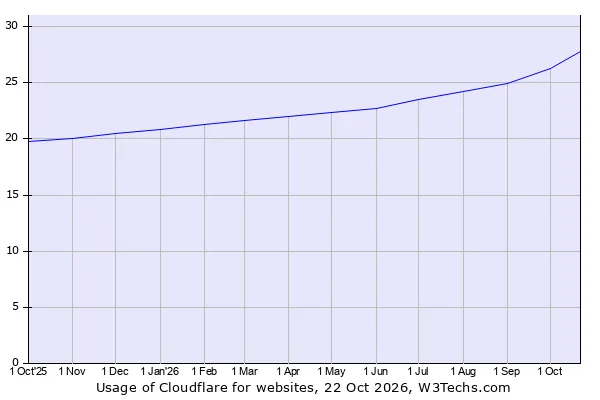
Field studies provide empirical proof of these performance gains. A 2024 academic study on WordPress websites demonstrated that Cloudflare caching reduced origin bandwidth use by 60 percent and cut page loading times in half [9]. An earlier study on export trading platforms found that edge hosting reduced loading delays by 50 percent and stopped spam traffic [10]. Telemetry from W3Techs shows that Cloudflare is used by 85.9 percent of all websites using a known reverse proxy service, representing 27.8 percent of all web domains worldwide [6]. Local caching frees origin servers to dedicate internal compute capacity and processing memory to dynamic database queries and application backend logic [10].
Edge servers rely on custom hardware to sustain high cache throughput. In 2024, Cloudflare transitioned edge machines to AMD EPYC 9684X Genoa-X processors equipped with dual Samsung PM9A3 or Micron 7450 Pro 7.68TB solid-state drives. Benchmarks revealed a 145 percent performance increase and a 63 percent boost in power efficiency compared to older Milan hardware. Direct storage of cache indexes inside 1,152 megabytes of L3 cache eliminates trips to system memory, allowing edge nodes to deliver cached files without delay [7].

Bot Management and Decoy Defense Systems
Cloudflare Radar tracks automated crawlers to protect websites from credential stuffing, content theft, and automated scraping. Telemetry shows that the network monitors over 50 billion crawler requests each day, analyzing request patterns to distinguish search engines from malicious crawlers [11]. In September 2022, Cloudflare introduced Turnstile to replace visual CAPTCHA puzzles, using background browser verification to confirm human visitors without user disruption [4].
Aggressive scraping by AI developers accelerated defensive countermeasures across the industry. Major media organizations, including The New York Times, CNN, Reuters, and the Chicago Tribune, blocked OpenAI GPTBot from crawling their reporting [12]. In March 2025, Cloudflare launched AI Labyrinth, an opt-in tool that redirects unauthorized AI crawlers into decoy link webs. Decoy pages display real scientific text on unrelated topics, forcing automated crawlers to waste bandwidth and computing resources without harvesting proprietary site data or private text [11]. The system extracts bot fingerprints while keeping decoy links invisible to human visitors, addressing automated scraping risks documented where the Cloudflare Founders Letter Warns AI Bots Surpass Human Traffic on publisher networks.
To give publishers commercial control, Cloudflare launched AI Audit in September 2024, allowing site owners to charge model developers based on crawling rates [12]. In January 2026, Cloudflare acquired Human Native, a British startup that operates a marketplace where AI developers pay creators for content [4]. Cloudflare CEO Matthew Prince said supporting content creators represents a necessary step in maintaining an open web [12].
Serverless Execution on the Distributed Network
Cloudflare Workers transforms the network into an edge compute platform by executing code near end users. Launched in 2017, Cloudflare Workers lets programmers run JavaScript and WebAssembly across hundreds of data centers without managing operating system containers. Code executes inside V8 isolates in milliseconds, eliminating the cold start latency typical of traditional serverless environments. Developers use Workers to rewrite headers, generate dynamic HTML, and authenticate users near their physical locations [4].
Edge capabilities expanded with stateful services like Workers KV for key-value storage and D1, a serverless relational database built on SQLite [4]. In November 2025, Cloudflare agreed to acquire Replicate, an AI platform with over 50,000 models, enabling developers to run open-source machine learning pipelines on Workers with one line of code [13]. Replicate CEO Ben Firshman said combining Replicate’s model catalog with Cloudflare’s global network removes infrastructure friction, advancing machine reasoning as documented in Cloudflare Launches Clef Decision Models for Agentic AI to provide autonomous agents with distributed execution tooling. The company also acquired observability startup Baselime and network vendor Nefeli Networks to expand its developer suite [4].

In April 2026, Cloudflare debuted EmDash, an open-source CMS written in TypeScript and Astro for distributed networks. Unlike WordPress, where third-party plugins often introduce security vulnerabilities, EmDash isolates extensions within sandboxes and features built-in Model Context Protocol servers for AI agents. It uses passkey authentication by default, eliminating password databases [14].
Outage Risks: How Cloudflare Works Under Strain
Because Cloudflare fronts a large portion of the internet, any systemic error causes immediate fallout. On November 18, 2025, an automatically generated configuration file managing threat traffic grew beyond expected memory limits, triggering software crashes across routing systems. Shopify, X, Indeed, and OpenAI’s ChatGPT and Sora applications suffered disruption before engineers deployed a fix. Cloudflare restored service within hours, confirming that the failure stemmed from internal configuration rather than a cyberattack. The disruption mirrored earlier incidents across Amazon Web Services and Microsoft Azure [15].
Content neutrality policies have also faced scrutiny. While Cloudflare long maintained that infrastructure providers should not censor web content, public pressure prompted it to terminate services for hate sites like The Daily Stormer, 8chan, and Kiwi Farms [4]. In November 2025, the Tokyo District Court ruled Cloudflare liable for copyright infringement for caching pirated manga, ordering it to pay 500 million yen to publishers Kadokawa, Kodansha, Shueisha, and Shogakukan. The court emphasized that Cloudflare’s lack of customer verification provided anonymity for pirate site operators. The ruling established financial liability for caching third-party infringements without identity verification [16].
The balance between distributed proxy performance and central infrastructure resilience defines the ongoing evolution of the internet. Distributing proxy defenses across hundreds of edge locations shields millions of websites from massive cyberattacks and accelerates asset delivery. Yet this deep concentration also means that software configuration errors ripple through the global economy in seconds. As edge computing and artificial intelligence continue to evolve, the operational design behind how Cloudflare works will remain central to the architecture of the open internet.
- ONLINE NEWS Upson, S. (2020, April 15). The Devastating Decline of a Brilliant Young Coder. WIRED. [Article Link]
- WEBSITE Cloudflare Blog. (2010, March 1). What’s in a name? [Article Link]
- ONLINE NEWS Kleinman, Z. (2016, September 25). The firm that protects both banks and the Eurovision Song contest. BBC News. [Article Link]
- WEBSITE Wikipedia. Cloudflare. [Article Link]
- ONLINE NEWS Poffringa. (2023, February 24). Cloudflare (NET) Q4 2022 Earnings Review. Software Stack Investing. [Article Link]
- REPORT W3Techs. (2026, September 4). Usage statistics and market share of Cloudflare. [Article Link]
- ONLINE NEWS Klotz, A. (2024, September 25). Cloudflare switches to EPYC 9684X Genoa-X CPUs with 3D V-Cache — 145% faster than previous-gen Milan servers. Tom’s Hardware. [Article Link]
- ACADEMIC JOURNAL John, J., Okonkwo, O. R., Akawuku, G. I., & Onyagu, C. L. (2023). Detecting and Preventing of DDoS Attack in Cloud Computing Environment Based on Hybrid Technique (Cloudflare and WAF). Newport International Journal of Engineering and Physical Sciences, 3(3), 28-40. [Article Link]
- ACADEMIC JOURNAL Bajrami, E., Idrizi, F., & Rushiti, A. (2024). Enhancing Website Speed and Security with Cloudflare CDN: A Case Study on WordPress Websites. Journal of Natural Sciences and Mathematics of UT, 9(17-18), 294-304. [Article Link]
- ACADEMIC JOURNAL Jayanti, D. E., Umar, R., & Riadi, I. (2020). Implementation of Cloudflare Hosting for Access Speed on Trading Websites. SISFOTENIKA, 10(2), 227-227. [Article Link]
- ONLINE NEWS Davis, W. (2025, March 22). Cloudflare is luring web-scraping bots into an ‘AI Labyrinth’. The Verge. [Article Link]
- ONLINE NEWS Wheatley, M. (2024, September 23). Cloudflare debuts tools for website owners to charge AI companies that scrape their content. SiliconANGLE. [Article Link]
- PRESS RELEASE Cloudflare. (2025, November 17). Cloudflare to Acquire Replicate to Build the Most Seamless AI Cloud for Developers. [Article Link]
- ONLINE NEWS Riley, D. (2026, April 2). Cloudflare debuts EmDash to challenge aging WordPress with AI-native CMS. SiliconANGLE. [Article Link]
- ONLINE NEWS Palmer, A. (2025, November 18). Cloudflare says outage that hit X, ChatGPT and other sites is resolved. CNBC. [Article Link]
- ONLINE NEWS Ebata, N. (2026, January 23). Don’t Aid pirates; The Court Found Cloudflare Liable for Aiding and Abetting Copyright Infringement of One Piece. AIPPI. [Article Link]


