






Web services exchange real-time updates through automated HTTP callbacks known as webhooks. Understanding how webhooks work begins with recognizing that modern software no longer needs to query remote servers for updates on a rigid schedule. When an event takes place in an origin application, the platform packages the event data into a JSON payload and sends an HTTP POST request to a preconfigured destination URL. Computer programmer Jeff Lindsay coined the term webhook in 2007 by adapting the programming concept of a hook to describe event-driven communication between web applications. His idea turned passive receivers into reactive endpoints that process events the moment they occur [1].
- How Webhooks Work in Modern Systems
- Comparing How Webhooks Work With Polling
- Event Payloads and Message Structure
- Verifying How Webhooks Work Using HMAC Signatures
- Mutual TLS Transport Defenses
- Delivery Failures and Retry Handling
- Enterprise Integrations in Developer Platforms
- Why Modern Event Architectures Use Webhooks
How Webhooks Work in Modern Systems
Every webhook workflow depends on two distinct participants: an event source that publishes alerts and a receiver server that consumes them. A developer registers a webhook by providing a destination endpoint URL to the source platform, specifying the exact actions that should trigger a delivery across the network [3]. In 2025 survey data from API development teams, half of respondents reported using webhooks to complement standard REST setups alongside modern technologies such as GraphQL and real-time WebSockets. Origin services listen for designated triggers, such as a user updating an account, a Git branch receiving a commit, or a payment clearing an external bank before constructing an outbound JSON payload. Once that action occurs, the originating system opens an outbound HTTP POST request and dispatches the event data to the designated receiver route without human delay [1].
Standard HTTP POST requests carry event information over TLS connections. By relying on universal web protocols and open standards, providers eliminate the requirement for proprietary messaging hardware or specialized client tools on the receiving server [1]. Receivers inspect incoming headers, parse the request body, and return an HTTP 200 response to confirm delivery.
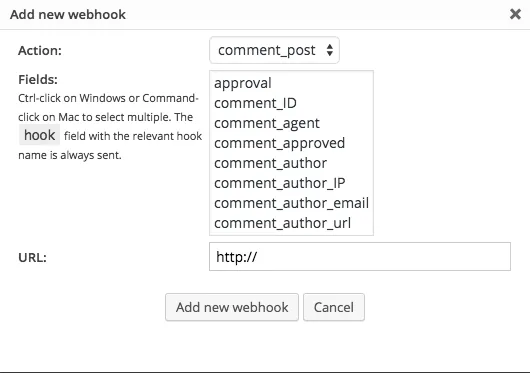
Settings screens in web tools allow teams to scope alerts down to specific resources. In WordPress.com, site admins register webhook URLs through the options-general menu to capture events such as comment_post, publish_post, or publish_page without adding third-party plugins [5]. The payload includes contextual metadata, including comment_author, comment_content, and post status fields. Selective filtering prevents receiver servers from drowning in unwanted traffic. Endpoints wake up only when relevant actions take place.

Comparing How Webhooks Work With Polling
Traditional client-server communication depends on periodic API polling, where a client queries a server at fixed intervals to check for state updates. Computer scientists D. Mahadik, A. Konale, D. Kadam, and O. Auti evaluated this dynamic in 2025, describing webhooks as reverse APIs that invert conventional request-response patterns. Constant polling wastes network bandwidth and server computation, because most polling queries return empty replies indicating no data has changed on the origin server. Furthermore, polling introduces data latency because updates sit unnoticed until the client runs its next scheduled check. Production telemetry explains how webhooks work in live systems by pushing fresh state data the millisecond an origin system records a transaction or modifies a database row [2].
Can high-frequency polling ever match the efficiency of event-driven callbacks? In practice, shortening polling intervals to cut delay quickly overwhelms server infrastructure and exhausts developer rate limits across public API services. GitHub Docs notes that monitoring repositories through repeated REST calls rapidly consumes API rate quotas. Webhooks resolve this scaling hurdle by adopting a push architecture where packets travel only when new data exists. A single registration statement replaces millions of redundant polling requests over the network, preserving vital server processing capacity for meaningful user interactions across connected services [3].
Resource efficiency makes push events ideal for mobile devices and embedded networks. Researchers T. Istiana, R. I. A, G. B. Dharmawan, and B. Prakoso studied weather dissemination through the BMKG @BMKGbot Telegram service, recording delivery times of 2.54 seconds for forecasts and 7.28 seconds for satellite imagery [13]. Webhooks delivered updates only when BMKG generated fresh reports.
Event Payloads and Message Structure
Payload structures vary between platforms, but they generally balance descriptive metadata with actionable resource identifiers. Payment provider Stripe offers developers two distinct payload formats: thin events and snapshot events. Thin events deliver minimal identifiers that prompt receivers to fetch detailed records through the Stripe API, keeping payloads lightweight and avoiding stale data. Snapshot events provide complete entity models representing the entire state of an object at the moment an event occurred. Developers evaluate different payload formats to understand how webhooks work with contrasting architectural needs, choosing thin payloads for lean operations or snapshot payloads when downstream services need full context without executing follow-up API queries [6].
Enterprise issue tracking platforms demonstrate how detailed payload structures can become during complex business workflows. In Jira Data Center 10.0.0, Atlassian moved webhook processing to an asynchronous thread pool so callbacks never slow down user web requests on production instances. Payloads deliver rich JSON trees containing issue keys, project details, worklogs, and changelog items that record old and new field values for every ticket. For example, when user Bryan Rollins updates an issue, the payload includes his user key, avatar URLs, and field changes alongside an event timestamp [4].

Filtering rules embedded in webhook configurations help teams prevent payload bloat before transmissions leave the source platform. In Jira, administrators use Jira Query Language expressions to restrict callbacks to specific projects, avoiding unnecessary network traffic when unrelated tickets change status. Starting with Jira 10, URL variable substitution dropped the dollar sign prefix, requiring expressions like {issue.key} instead of ${issue.key} to prevent URL parsing errors [4].
Verifying How Webhooks Work Using HMAC Signatures
Because public webhook endpoints accept traffic from the open internet, verifying sender authenticity is essential for system security. Documentation from Svix explains that an unauthenticated webhook route is vulnerable to forged HTTP POST requests from hostile parties. Threat models show how webhooks work under hostile network conditions, demonstrating why providers use Hash-based Message Authentication Codes to sign every outgoing payload [8]. The sender and receiver share a secret key, such as GitHub’s WEBHOOK_SECRET or Stripe’s signing secret prefixed with whsec_ [6]. The dispatching platform hashes the raw request body with the shared secret using SHA-256 and attaches the resulting hex digest to a custom request header to verify message integrity before parsing begins [9].
Receivers compute their own HMAC hash from the raw payload body and compare it with the signature header sent by the provider. GitHub transmits this digest in the X-Hub-Signature-256 header, expecting receivers to validate signatures using constant-time string comparisons to stop side-channel eavesdropping. Standard equality operators like == expose applications to timing attacks in JIT-optimized runtimes. Cryptographic functions such as Python’s hmac.compare_digest or Node.js crypto.timingSafeEqual prevent these side-channel attacks by taking identical processing time regardless of character positions [9]. Handlers must also process the payload as raw UTF-8 bytes to ensure hash calculations match the provider’s signature.
Signatures verify payload integrity, but they cannot stop replay attacks where an eavesdropper re-transmits an intercepted message. The Standard Webhooks specification co-created by Svix defends against this vulnerability by adding a timestamp header to every delivery attempt over the network. Receiver libraries automatically reject webhooks whose timestamps differ by more than five minutes from the local server clock [8].



Mutual TLS Transport Defenses
While payload signatures operate at the application layer, transport security establishes sender identity during the initial network handshake. Docusign developer advocate Larry Kluger explained how mutual TLS authenticates client identities before HTTP data crosses the wire. Standard Transport Layer Security authenticates the server to the client, encrypting the channel but leaving the receiving server unaware of who initiated the connection. Mutual TLS solves this gap by having the server request an X.509 certificate from the client during the TLS handshake before accepting incoming data. Certificate authentication shows how webhooks work at the transport layer, establishing cryptographic proof of identity before any sensitive application payload travels across the network [10].
Enabling mutual TLS requires installing the client’s root certificate on the web server that terminates incoming connections. For Docusign Connect listeners, administrators configure the DigiCert Global Root G2 certificate, a 2048-bit root certificate that validates Docusign traffic. On an Apache 2.4 server, configuration directives include SSLVerifyClient require, SSLVerifyDepth 10, and SSLCACertificateFile pointing to the certificate file [10]. The web server automatically rejects connections from clients that fail to present a valid certificate.
Why would an engineering team select HMAC signatures instead of mutual TLS? Kluger noted that mutual TLS demands ongoing server maintenance, requiring administrators to inspect client certificate Common Name fields such as connect.docusign.net to enforce access control rules [10]. Application signatures provide equivalent message verification with substantially less operational overhead.

Delivery Failures and Retry Handling
Network drops, server reboots, and traffic spikes inevitably interrupt webhook deliveries in production environments. Payment gateway Stripe manages transient network outages by retrying failed webhook deliveries for up to three days in live mode. Stripe uses an exponential backoff schedule that spaces out retry attempts to allow recovering endpoints time to stabilize. If a destination URL returns an HTTP 302 redirect, Stripe records the attempt as a failure rather than following the redirect. Network telemetry during outages highlights how webhooks work under stress, showing why receivers must return an immediate HTTP 200 status code before running slow background jobs that could trigger sender timeouts [6].
Because retry policies produce duplicate deliveries, production webhook consumers cannot assume every notification arrives only once. An engineering whitepaper from Endurance Softwares outlines essential strategies for building reliable Node.js webhook receivers. The guide advises engineering teams to separate ingress from processing by returning an immediate HTTP 200 and queuing payloads for background execution in a durable message store [11]. Handlers should never rely on payload arrival sequence, because network jitter can cause newer events to arrive ahead of older ones.
Database constraints enable idempotent processing to prevent duplicate records or accidental double charges. Receivers record each unique event identifier in an inbox table inside a database transaction. When a duplicate webhook arrives from an unacknowledged retry, the database detects the existing ID and ignores the repeated event safely without repeating actions [11].
Enterprise Integrations in Developer Platforms
Enterprise platforms use webhook subscriptions to automate document lifecycles and business workflows. In SignNow, administrators configure event subscriptions across user, document, and document group entity types. When signers complete paperwork or decline signatures, SignNow triggers callbacks like document.complete or fieldinvite.signed to update external records. These automated notifications enable organizations to synchronize document repositories, alert legal departments, and trigger downstream approval chains without manual oversight. Teams configure these automated event subscriptions using an API free trial, an active developer subscription, or an enterprise Site License to connect e-signature events directly with internal business applications [7].
In developer platforms, GitHub webhooks automate build and deployment pipelines the moment engineers push code to repositories. Teams configure webhooks to trigger continuous integration builds in Jenkins or CircleCI, or send commit alerts to team chat channels on Slack and Discord [3]. Similarly, Atlassian Jira connects to external developer tools by attaching webhooks to workflow transitions when issues move between states on tracking boards [4]. Automated webhook pipelines eliminate manual status checks between engineering tools.
Academic researchers have adapted webhook architectures to solve domain-specific data dissemination challenges. S. Sulasno, R. Saleh, and I. Savitri integrated Zabbix server monitoring with Telegram bots using the Cisco PPDIOO lifecycle methodology at the National Nuclear Energy Agency [12]. In computer education, C. U. Betrand and colleagues connected Dialogflow conversational agents to backend tutoring systems using JavaScript webhooks [14]. In healthcare systems, K. K. Trivedi and V. Gedam developed multi-agent triage architectures that coordinate symptom evaluations across emergency and mental health categories using webhook notifications [15].
Why Modern Event Architectures Use Webhooks
Modern software architectures increasingly adopt event-driven designs because decoupled services scale more effectively than tightly coupled monoliths. Webhooks serve as the standard integration glue for this paradigm, allowing independent microservices to react to domain events without database coupling. Instead of keeping persistent TCP connections open with WebSockets or running repetitive polling jobs, applications expose simple HTTP endpoints that sleep until triggered. As cloud infrastructure shifts toward serverless functions on platforms like AWS and Azure, webhooks provide the ideal activation trigger for ephemeral compute instances that bill only for active execution time. Software systems scale down to zero when idle, consuming computing resources only when genuine user activity occurs [2].
Deploying webhook dispatchers introduces security responsibilities that software teams must address. Because origin platforms permit users to supply arbitrary callback URLs, the OWASP Foundation classifies webhook dispatchers as common vectors for server-side request forgery. Malicious users can specify destination URLs targeting internal network IP addresses or private cloud metadata services. To protect private infrastructure, dispatchers should re-resolve and validate destination IP addresses before every HTTP delivery attempt rather than checking addresses only during endpoint setup [1].
Developer tooling has matured to make webhook testing straightforward before deploying code to live environments. Stripe provides the Stripe CLI, allowing developers to execute commands like stripe listen to forward remote test events directly to a local development port such as localhost:4242 [6]. Tunnelling tools like ngrok similarly expose local endpoints to external services during debugging sessions. By combining local simulation utilities with cryptographic HMAC signatures and replay defenses, developers build event-driven integrations that operate reliably under production conditions.
- WEBSITE Wikipedia contributors. (n.d.). Webhook. Wikipedia, The Free Encyclopedia. [Article Link]
- ACADEMIC JOURNAL Mahadik, D., Mahadik, D., Konale, A., Kadam, D., & Auti, O. (2025). To Study Webhooks for an Event-Driven Integration Mechanism. Zenodo. [Article Link]
- WEBSITE GitHub. (2026). About Webhooks. GitHub Docs. [Article Link]
- WEBSITE Atlassian. (2009). Webhooks. Atlassian Developer Documentation. [Article Link]
- WEBSITE WordPress.com. (2010). Use WordPress.com Webhooks. WordPress.com Support. [Article Link]
- WEBSITE Stripe. (2026). Receive Stripe Events in Your Webhook Endpoint. Stripe Documentation. [Article Link]
- WEBSITE SignNow. (1996). Webhooks. SignNow API Documentation. [Article Link]
- WEBSITE Svix. (2026). Why Verify Webhooks. Svix Documentation. [Article Link]
- WEBSITE GitHub. (2026). Validating Webhook Deliveries. GitHub Docs. [Article Link]
- WEBSITE Kluger, L. (2020). Mutual TLS: Stuff You Should Know. Docusign Developer Blog. [Article Link]
- ACADEMIC JOURNAL Softwares, E. (2026). Production Webhooks in Node.js: Reliability & Security Guide. Zenodo. [Article Link]
- ACADEMIC JOURNAL Sulasno, S., Saleh, R., & Savitri, I. (2021). Developing Integrated Smartphones Notification of Server Resource Monitoring System Using Zabbix, Webhook, and Telegram. JUITA Jurnal Informatika, 9(2), 191-191. [Article Link]
- ACADEMIC JOURNAL Istiana, T., A, R. I., Dharmawan, G. B., & Prakoso, B. (2020). Pengembangan Sistem Diseminasi Prakiraan Cuaca Menggunakan Aplikasi Bot Telegram dengan Metode Webhook. Elektron Jurnal Ilmiah, 12(1), 41-47. [Article Link]
- ACADEMIC JOURNAL Betrand, C. U., Onyema, C. J., Benson-Emenike, M. E., Onukwugha, C. G., Onyemauche, U. C., & Kelechi, D. A. (2023). Intelligent Learning System Using Interactive Dialogflow and Webhooks. International Journal of Intelligent Information Systems. [Article Link]
- ACADEMIC JOURNAL Trivedi, K. K., & Gedam, V. (2026). Multi-AI Agent System for Healthcare using Webhooks. Zenodo. [Article Link]


