





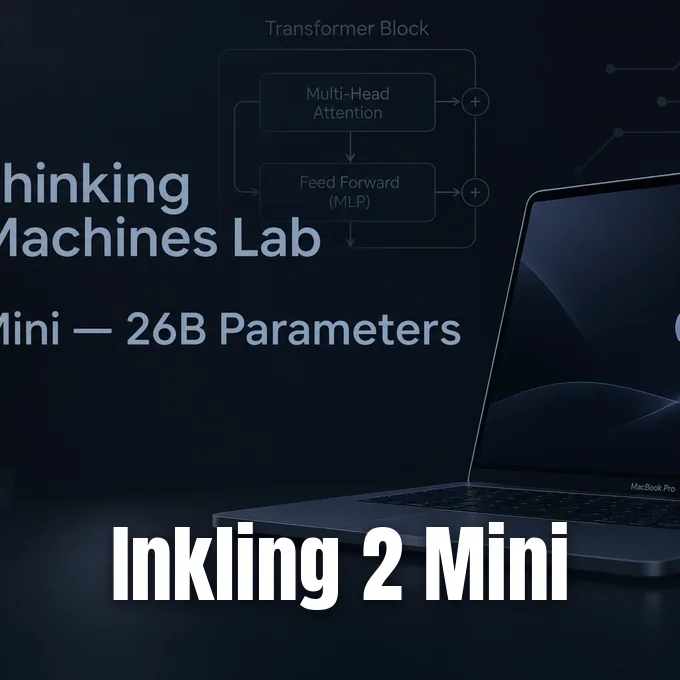
Thinking Machines Lab unveiled Inkling 2 Mini on November 20, 2026, introducing an open-weight artificial intelligence model designed for offline programming and agentic workflows on personal computers. The release follows Inkling 2 Small, a 594-billion-parameter system that debuted on November 5. Sebastian Castellanos reported for Wccftech that Inkling 2 Mini fits into a 20GB checkpoint suitable for Apple MacBooks with 32GB of unified memory [1]. Rather than expanding physical memory requirements by adding billions of new parameters, the architecture loops its middle layers to solve difficult reasoning problems [2].
How Inkling 2 Mini Reuses Core Layers
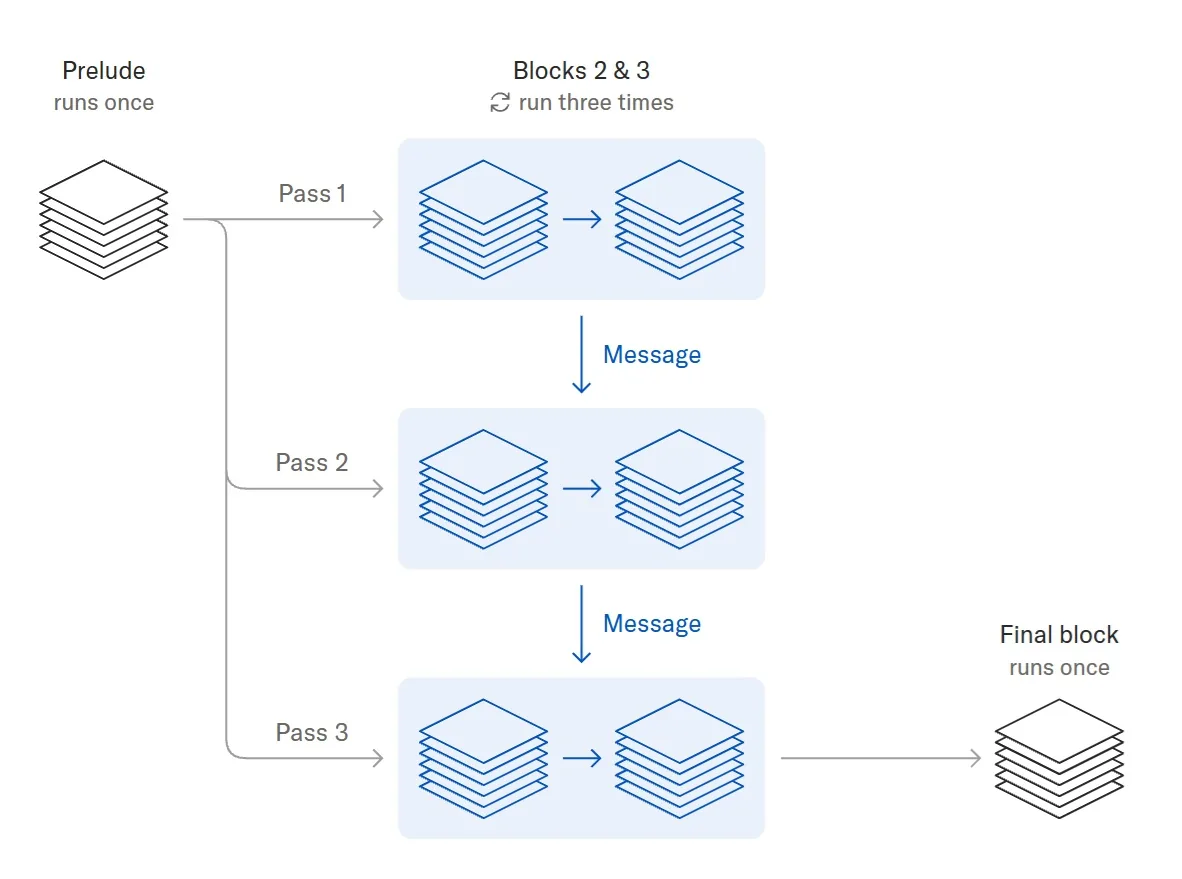
The network stores 24 transformer layers arranged into four blocks of six layers each. The first block runs once, and the final block runs once. But the two middle blocks run three times using shared weights. This layout gives the system 48 layer applications per token while storing weights for only 24 layers in memory [2]. In simple terms, each token passes through core transformer stages multiple times so that the model computes deeper intermediate solutions before it emits a response [1].
At its core, the architecture relies on a 24-layer Mixture of Experts MoE layout containing 26.4 billion total parameters and 3.4 billion active parameters per token. Looped execution pushes effective active parameters to 5.4 billion per token during generation [1]. Each subsequent pass receives a state message passed through Attention Residuals and a learned gate. Feed-forward layers direct input across 128 experts, activating eight experts on every token step [2].
The research team tested several loop positions during development to evaluate overall efficiency gains. Loops placed in the middle blocks yielded a 1.51x to 1.91x compute-equivalent gain, whereas looping final blocks yielded only a 1.24x to 1.36x return, allowing the middle-block setup to win 27 of 28 evaluation runs. The release connects with industry work on edge systems, where Liquid AI launches LFM2.5-24B-A2B for on-device AI agents to run local reasoning steps on constrained client hardware. An unlooped baseline used 7.5% less training compute. Yet matching that performance on extended 512k-token evaluations forced the standard setup to consume 140% greater processing resources during generation [2].
Expert Pruning and Distillation
Early training began with 384 experts per layer, routing eight pathways per token. Midway through the run, the engineering team pruned two-thirds of those experts. Pruning preserved the 128 most-used pathways to stabilize execution [2].
To restore capability after pruning, Thinking Machines completed a 1-trillion-token distillation phase using a larger internal Inkling teacher model before post-training combined supervised fine-tuning with reinforcement learning over 2.2 trillion tokens in 2,000 steps and on-policy distillation [2]. The lab trained the model on the NVIDIA GB300 Grace Blackwell Ultra platform. The hardware provided native NVFP4 acceleration to speed up computation. Most expert layers were trained and deployed in 4-bit NVFP4 precision, but the final four layers used 8-bit MXFP8 precision. Because weights remain in their native numerical format, Thinking Machines said the architecture avoids accuracy losses that often accompany post-training quantization [1].
Researchers also trained an experimental model designated TML-d24-varloop-research using one to five passes to inspect loop scaling behaviors [2]. The variable model allowed the engineering team to study loop dynamics before finalizing weights for public release [1].

Software Benchmark Scores
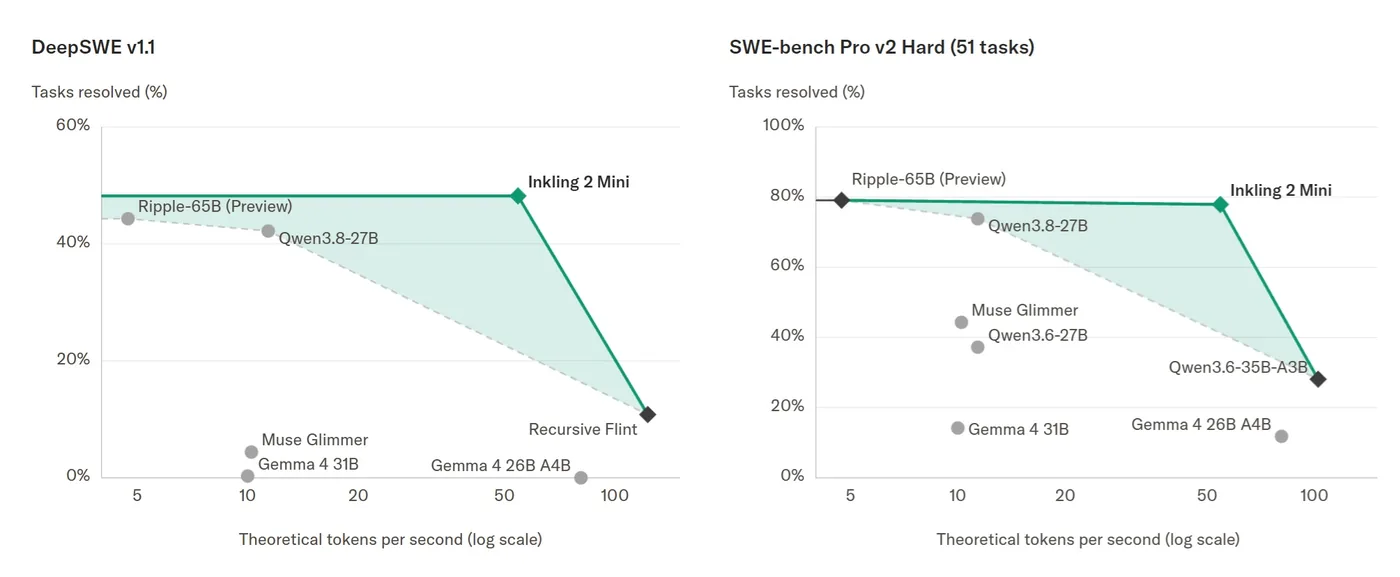
Coding evaluations proved to be the strongest domain for the new model. In company evaluations, the system scored 79.2% on SWE-bench Verified in bash-only mode and reached 77.9% on SWE-bench Pro v2 Hard, passing Qwen3.8-27B at 73.8% [2]. On DeepSWE v1.1, the model reached 48.2% against 42.2% for Qwen3.8-27B. It scored 46.5% on the Vals Index v2.2. Thinking Machines cautioned that testing differences across vendors mean evaluation gaps should be seen as directional indicators [1].
In agentic web tests, the model scored 79.0% on BrowseComp with compaction and 82.7% on MCP Atlas. Document tests showed 92.8% on OmniDocBench v1.6 and 74.9% on MMMU Pro. On reasoning tasks, the model scored 86.6% on GPQA Diamond and 49.3% on ARC-AGI-2. It reached 71.6% on Terminal Bench v2.1, where Qwen3.8-27B posted 73.0% [2].
Hardware efficiency showed notable gains during benchmark tests. Evaluated on a single NVIDIA DGX Spark desktop AI computer, the model achieved 0.703 on Stanford’s Intelligence per Watt metric, surpassing Qwen3.6-35B-A3B at 0.430 and Gemma-4-26B-A4B at 0.159 under identical test procedures [2]. On the Artificial Analysis Intelligence Index, Inkling 2 Mini tied Qwen3.8-27B with a score of 20.1. The evaluation confirms that the compact architecture delivers strong reasoning without demanding high-end server clusters [1].
Local Hardware Requirements
The checkpoint file takes up roughly 20GB in Safetensors format. The small footprint enables local execution on Apple silicon Macs equipped with at least 32GB of unified memory through Ollama, vLLM, or llama.cpp. Unsloth provides quantized GGUF packages for constrained setups. The architecture handles text and image inputs while returning text responses in context windows extending up to one million tokens, offering broad flexibility for developers who analyze large document sets on personal machines [2].
Beyond Apple silicon laptops, Thinking Machines officially supports single NVIDIA DGX Spark units and desktop GPU systems equipped with 32GB or more of VRAM. Hardware comparisons regularly analyze how an Apple Mac Studio tackles local AI benchmarks against DGX Spark setups to measure memory bandwidth between desktop platforms. Serving support also extends to SGLang, NVIDIA Dynamo, and TokenSpeed, while hosted inference and fine-tune routines run on Thinking Machines’ Tinker platform [2].
To show real-world offline reliability during air travel, Thinking Machines tested the software using an Apple laptop that paired an M5 Pro processor with 48GB of unified RAM. In airplane mode with all wireless networking disabled, the model generated a playable 3D flight simulator in a few minutes. The project ships under the Apache 2.0 open-source license with downloadable weights accessible on Hugging Face [1].

Research on Inkling 2 Mini Safety
The looped architecture raises transparency questions because processing loops execute without generating visible text tokens. In standard systems, safety tools inspect explicit reasoning traces. In looped models, computation occurs within hidden layers before token generation begins. Thinking Machines investigated this dynamic using its variable-loop research model. The team discovered that additional passes boosted problem solving without producing an explicit chain of thought. Evaluators found that the measured no-chain-of-thought task horizon expanded from 16 seconds on a single pass to 37 seconds with three passes, reaching 41 seconds on experimental builds [1].
Lab evaluators noted that generated explanations stayed clear during routine testing. Monitorability showed no meaningful drop at 26 billion parameters, though safety assessments continue for deeper loop configurations [1].
Thinking Machines also highlighted architectural limitations where the smaller model fell short during rigorous stress tests. Knowledge benchmarks depend heavily on raw parameter counts, and looping could not overcome that physical limit. Inkling 2 Mini posted a score of -8.6 on the AA-Omniscience benchmark with a 63.4% non-hallucination rate. It also scored 50.0% on MultiChallenge and 33.4% on ComplexConstraints v1.1, while trailing on HLE-Diamond at 15.2%. Those benchmark results show that complex multi-turn conversations and instructions involving numerous strict constraints remain difficult for compact models without larger parameter counts [2].
- ONLINE NEWS Castellanos, S. (2026, November 21). Thinking Machines Unveils Inkling 2 Mini, A Powerful 26B Parameter AI Model That Runs Locally On MacBooks With Just 32GB RAM. Wccftech. [Article Link]
- ONLINE NEWS MarkTechPost. (2026, November 21). Meet Thinking Machines Inkling 2 Mini: 26B Looped MoE Runs on a 32GB Mac. MarkTechPost. [Article Link]


