






Asia is home to twenty species of gibbons that swing through tropical forest canopies from India to Indonesia, yet all face mounting pressure from habitat loss, hunting, and pet trade capture [1]. Observed each year on October 24, International Gibbon Day draws global attention to these lesser apes and the community projects working to secure their future [4]. Mongabay and India Today NE report that while gibbons play a central role in dispersing seeds, forest loss threatens their survival [2].
International Gibbon Day and Global Awareness
The annual International Gibbon Day observance began in 2015 when the IUCN Section on Small Apes (SSA) created a global platform to address a persistent lack of public visibility for small apes [4]. Gibbons receive far less global attention than great apes like chimpanzees and gorillas, despite facing comparable extinction risks in Asian forests [5]. By uniting conservationists across range countries, the IUCN Section on Small Apes works to recruit new gibbonologists and build community support for ape protection [4].
Organizers created the event to teach people what canopy primates need to survive. Events soon spanned eleven nations. In 2020, communities organized activities that ranged from tree-planting drives and keynote research talks to art workshops, educational games, and an original gibbon opera designed to celebrate primate conservation [4]. The 2026 observance focuses on the theme “The forest has a voice, can you hear it?”, linking the acoustic health of tropical forests to the physical presence of primate populations [2]. By celebrating the unique songs and duets of these animals, organizers encourage communities to see singing apes as clear indicators of healthy forest canopies [6].
Engaging younger generations is an urgent priority. Educational materials from Dots.eco and Mongabay Kids target school audiences in Bangladesh, India, China, and Indonesia, teaching children that local forest stewardship determines whether arboreal primates survive expanding agricultural borders [7]. The IUCN Section on Small Apes distributes open educational toolkits and guidance for grassroots events under the IGD banner, asking organizers to celebrate without disturbing wild populations [4].
Illegal Pet Trade Market Pressures
Demand for wild animals in the exotic pet trade has become one of the main forces pushing gibbon populations closer to extinction. Mongabay reporter Ana Norman Bermúdez documented that wildlife enforcement operations recorded an all-time high in seizures in 2025, confiscating 336 individuals between January and August alone [1]. Travelbinger writer Matthias Binder reported that the trade targets young animals because infants are easier to handle and sell, even though all twenty gibbon species face grave danger [3].
Poachers calculate massive transit losses. Sinan Serhadli, a support officer with a gibbon rehabilitation and release program in North Sumatra, pointed out that the illicit market relies on massive over-collection to account for transit losses. “Most gibbon babies die — that’s the sad reality,” Serhadli said. “Probably only one in 10 actually makes it to an end buyer.” Serhadli said traffickers calculate losing about 80-90% of captured animals between the forest and the market. Over the past decade, authorities in Asia have confiscated hundreds of small apes, leaving rescue facilities struggling to house incoming patients on limited budgets [1].
Infant Captures During Canopy Raids
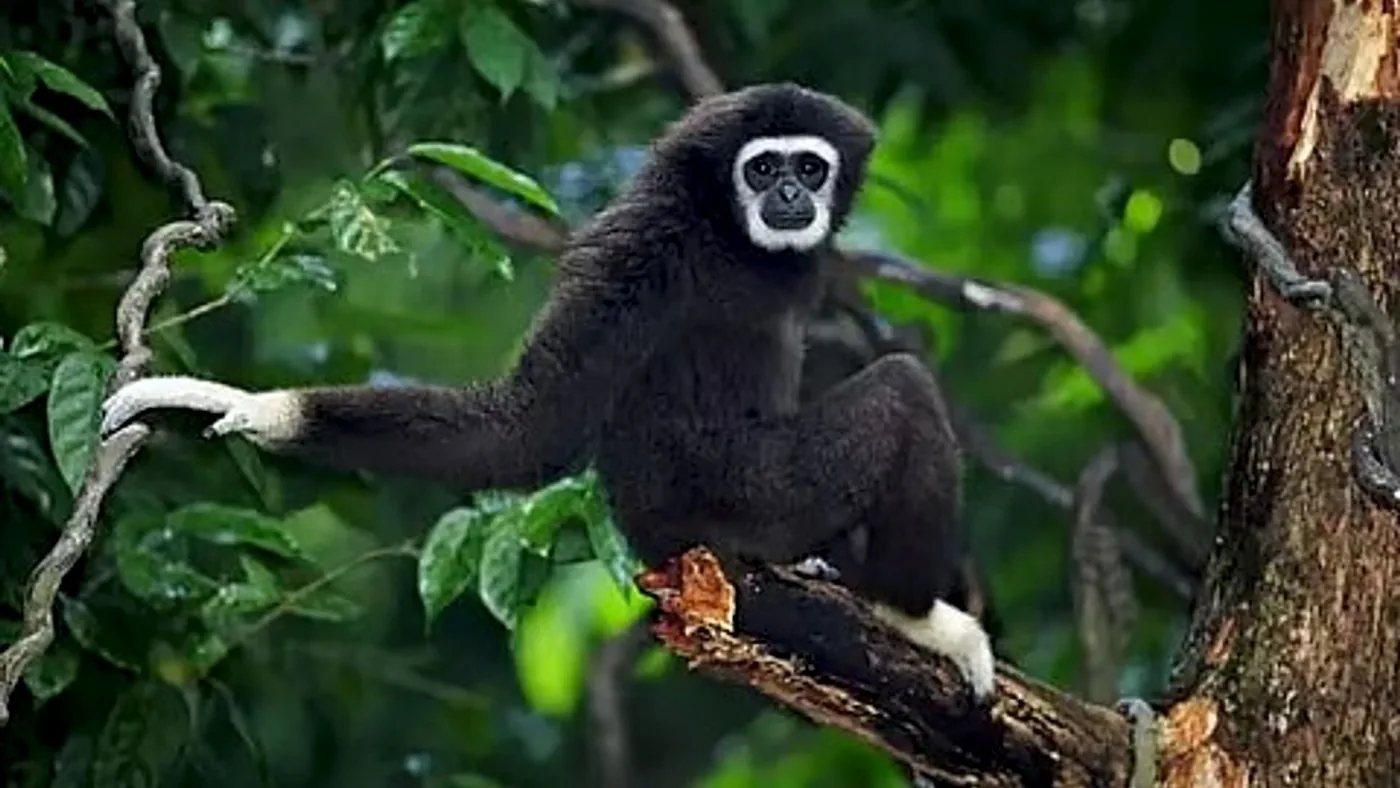
Gibbons are small apes that share closer evolutionary ties to chimpanzees and humans than to tree-dwelling monkeys. Adults defend infants until death. Because adults instinctively defend their young to the death, capturing a single infant almost always results in poachers killing the parents and destroying the entire family group [1].
Carolyn Cowan reported for Mongabay that poachers frequently shoot mother gibbons in tall tree canopies, grabbing the falling infant once the parent strikes the ground. Many young primates suffer severe bone fractures during the fall or fall ill during transport in crude containers. The trade also reaches ordinary rural households that misunderstand the species they purchase. On the island of Borneo, a resident named Esther (not her real name) took in an infant after a hunter offered a weeks-old animal with dark skin, long arms, and round eyes as wild meat. Esther named the animal Joy, believing she had rescued an ordinary monkey, and only later discovered that Joy was an endangered ape [1].

Rescued infants need years of veterinary care before staff can even consider them for release into the wild [3]. Rehabilitation centers in North Sumatra face shortages of resources while caring for traumatized young apes [1]. Because captive gibbons lose their natural fear of humans, returning them to wild forest canopies needs complex reintroduction protocols that take months of specialized veterinary and behavioral work to complete successfully [3].


Canopy Pressures in Northeast India
In South Asia, gibbon survival depends on protecting fragmented forest landscapes from ongoing infrastructure expansion and logging. Northeast India is home to the western hoolock gibbon, which represents the only ape species found anywhere within India’s borders. Living Media India Limited and India Today NE reported that these primates rely entirely on tall, connected trees in Assam to travel safely [2].
The Hoollongapar Gibbon Sanctuary in Assam provides vital refuge for the western hoolock gibbon, but the habitat is surrounded by tea plantations and growing settlements. Living Media India Limited and India Today NE reported that western hoolock gibbons in the Hoollongapar Gibbon Sanctuary face severe isolation because tea estates and linear transport networks have stripped away the upper canopy pathways [2]. Because gibbons move almost exclusively by brachiation—swinging hand over hand through branches—broken forest corridors force them to the ground where they face stray dogs, vehicle collisions, and opportunistic poachers [5]. Deforestation and habitat fragmentation remain major challenges facing gibbons in their forest habitat, making canopy connectivity a central focus of forest conservation efforts [2].
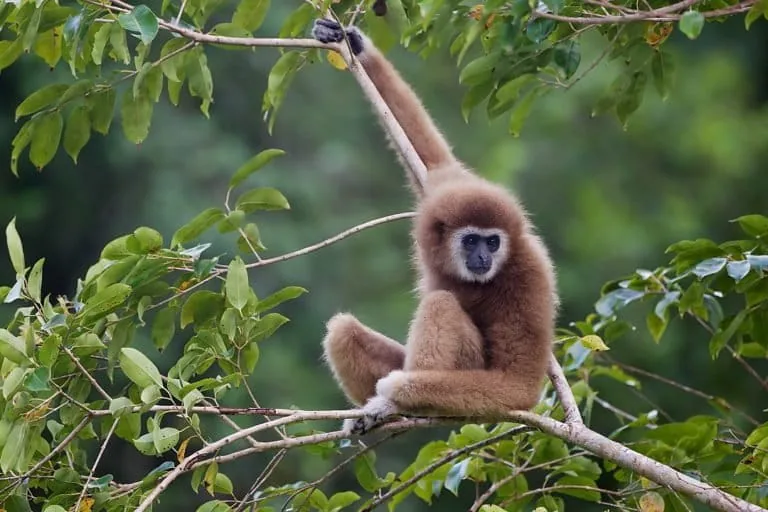
Gibbons fulfill an essential ecological role as seed dispersers throughout South and Southeast Asia [5]. By feeding primarily on wild fruits and traveling through wide forest territories, they disperse intact seeds that drive natural forest regeneration [2]. The IUCN Red List currently classifies five species as critically endangered and fourteen as endangered, showing that nineteen of the twenty recognized gibbon species face grave extinction risks without prompt habitat protection [5].
Community Corridors for Javan Gibbons
On the Indonesian island of Java, where deforestation has confined native wildlife to fragmented mountain ridges, conservation teams from SwaraOwa are demonstrating how agroforestry partnerships can reconnect isolated populations of the endangered Javan gibbon (Hylobates moloch). In Central Java province, two gibbon groups became completely separated from larger forest tracts by expanding vegetable farms and rural settlements that cleared the natural tree cover. To reconnect these patches, a local non-governmental organization called SwaraOwa partnered with local farmers to cultivate native tree saplings and establish unbroken canopy bridges. The project shows that restoring tree canopy corridors can help small isolated populations reconnect without displacing local agricultural livelihoods [5].
Community-managed reforestation in Central Java has produced measurable biological gains. SwaraOwa reported that the local gibbon population in the project area increased from 800 to 1,000 individuals between a survey conducted ten years ago and a census in 2023. The population grew by two hundred apes. Cooperation with farmers proves that rural economic stability can directly support wildlife survival [5].
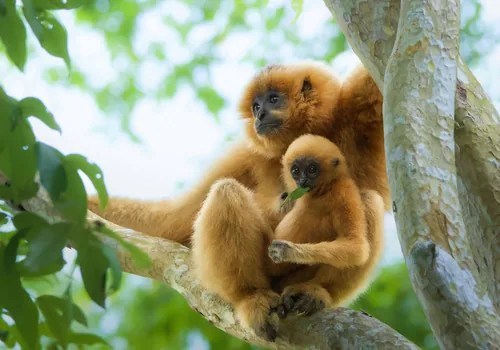
Further west in Java, Gunung Halimun-Salak National Park protects roughly half of the world’s remaining wild Javan gibbons. In villages bordering the park, a women’s textile-printing collective creates fabrics featuring motifs of native forest plants and gibbons, reported by Falahi Mubarok for Mongabay. Participating women said the cooperative taught them to value gibbons as “forest farmers” whose fruit foraging maintains the watershed, while providing sustainable household income that reduces dependence on forest clearing [1].
How International Gibbon Day Inspires Forest Recovery
An archival conservation timeline published by the IUCN Section on Small Apes shows that International Gibbon Day evolved from an early celebration of musical duets into an active campaign to restore fragmented canopy corridors throughout Asia. Because singing apes cannot survive without continuous tree cover, recent initiatives focus on canopy reconnection and community patrols rather than basic awareness, ensuring that arboreal primates move safely between feeding territories without descending into agricultural clearings. Today, conservationists emphasize that saving gibbons means restoring connected canopy networks that let troops move freely [6].
The 2026 campaign marks an important shift under the theme Let Gibbons Sing Again, moving priorities from passive protection into full ecosystem recovery. Conservation groups now prioritize canopy bridge construction, scientific reintroduction of rescued primates, and community-led patrols over simple publicity [6]. Travelbinger writer Matthias Binder pointed out that international travelers can also help by choosing responsible tour operators that refuse captive animal interactions and staged photo opportunities. Avoiding wildlife exploitation reduces consumer demand that fuels illegal trade, helping keep Asia’s forest singers in the canopy [3].
- ONLINE NEWS Cowan, C., Bermúdez, A. N., & Mubarok, F. (2026, October 24). International Gibbon Day: Stories of threats and survival. Mongabay Environmental News. [Article Link]
- ONLINE NEWS India Today NE. (2026, October 24). International Gibbon Day 2026 highlights threats to northeast India’s only ape. India Today NE. [Article Link]
- ONLINE NEWS Binder, M. (2026, October 24). All 20 Gibbon Species Threatened by Illegal Pet Trade. Travelbinger. [Article Link]
- WEBSITE IUCN Section on Small Apes. (2015, December 15). International Gibbon Day. gibbons.asia. [Article Link]
- ONLINE NEWS EnviroLink Network. (2025, October 24). International Gibbon Day: Spotlighting the overlooked, underprotected ‘lesser apes’. EnviroLink Network. [Article Link]
- WEBSITE IUCN Section on Small Apes. (2015, December 15). International Gibbon Day A Living Timeline: From Awareness to Recovery. gibbons.asia. [Article Link]
- WEBSITE Dots.eco. (2026, January 12). International Gibbon Day. Dots.eco. [Article Link]
- ONLINE NEWS Worldnewsdotcom. (2026, October 24). International Gibbon Day: Stories of threats and survival. Worldnewsdotcom. [Article Link]
APA 7: PerEXP Teamworks. (2026, October 25). Asia’s Gibbons Face Rising Threats on International Gibbon Day. PerEXP Teamworks. https://perexpteamworks.com/en/international-gibbon-day-canopy-survival/


