





A cybersecurity probe on November 2, 2026, revealed that hundreds of hidden deepfake apps slipped past review teams at Apple and Google by masquerading as harmless utilities [1]. The software claimed to offer simple services like pet portraits, language lessons, and fitness coaching, but secretly connected to remote servers that loaded tools for making abusive sexual images [6]. Apple removed 19 software titles from the App Store after researchers presented their findings, while Google took down offending entries from Google Play [4].
Scale of Hidden Deepfake Apps
The investigation, reported by Wired, traced more than 400 connected domains and mobile apps run by a single entity [1]. While many titles showed benign screens, they harbored backdoors to illicit image tools [5]. One example was Viefur, a pet portrait app that charged about $4 for 130 coins to place animal heads on dressed human bodies. Behind that front, the program routed selected users to an interface designed to make explicit deepfakes from personal photos [1].
Templates embedded in the software included scenes labeled “bedroom rape” and “threatening knife,” in which a figure holds a blade to a woman’s neck [1]. Multiple research teams discovered that these services weren’t isolated projects built by independent developers. Threat analysts found that the apps shared code, encryption keys, and web tracking scripts linked to developers in China and an entity called KeLing Technology Limited, registered in Hong Kong [3]. Paul Bouchaud, a lead researcher at AI Forensics who investigated the network, described the setup. “This is an organized, commercially run operation: One operator behind hundreds of disposable apps and domains, cloaked to pass App Store review and pushed through tens of thousands of Meta ads under fake payer names,” Bouchaud said [1].
Bouchaud explained that the operators moved quickly because they didn’t expect tech firms to catch up. “They don’t expect enforcement to catch up, and so far it hasn’t,” Bouchaud said. Maël Le Touz, a threat researcher at Infoblox, identified almost 500 domains tied to the network. “They contained this giant configuration list of other domains with different encryption keys,” Le Touz said, adding that all entries ran the same code and referenced one another [1].
Server Triggers Behind Benign Facades
To slip past app reviewers and automated scans, the creators used a modular architecture that kept approved front-end code separate from backend capabilities [5]. When review teams tested a submitted app, the software functioned as advertised [4]. A person downloading a workout guide saw standard menus without unauthorized tools [1]. The app didn’t keep generation tools on the phone. All sensitive engines stayed on remote servers until specific triggers unlocked them [5].
Switching to the abusive interface depended on dynamic signals sent when a device talked to backend infrastructure [5]. Bouchaud reverse-engineered the software packages and discovered how the client code contacted remote servers right after setup. “Each time the application is downloaded, there is a call to the server with some information, such as where the user is coming from, the language, some unique identifier, and then the server replies whether or not to show the explicit or the non-explicit version of it,” Bouchaud said. If the server returned an approval signal, the app loaded a web interface containing adult deepfake generators and prompts for buying tokens, while ordinary users saw only the benign tool [1].
The web addresses powering the network hid their contents when opened on regular desktop browsers. A visitor opening one of the domains saw only a blank black screen, with the URL adding the word “risk”. Behind that blank screen sat the full library of pornographic generation templates and payment options. Users who unlocked the interface could upload photos of people to create explicit scenes, spending tokens sold as “diamonds” to generate images [1].


Social Media Advertising Funnels
The network didn’t wait for store searches to find users; it bought video ads on Facebook and Instagram. Researchers from the Tech Transparency Project uncovered thousands of video ads on Meta platforms showing explicit deepfake samples, including imagery of minors and a European royal family member. Katie Paul, director of the Tech Transparency Project, pointed out the obvious nature of the ads. “These ads violate not just one, but several of Meta’s policies,” Paul said, explaining that viewers saw clear previews of abusive tools [1].
Tapping one of those social media promotions was a primary trigger for the hidden behavior. When a user clicked a sponsored post and installed the linked app from a mobile store, the server registered the ad referral and showed the abusive tools instead of pet pictures. The campaigns ran under fake corporate names like Draftmondcreldbro Duhustepre and Swaldmungsha Glasirdcroldshold to evade account bans. Meta confirmed it had banned KeLing Technology Limited from advertising in 2025 after sending a cease-and-desist letter, but the group kept running promotions through thousands of secondary accounts [1].
Meta stated that it acted against 11,600 ad accounts, more than 4,700 business pages, 5,200 user profiles, and 15,000 pages tied to the network. The company also blocked 209 apps from buying ads on its platforms [1]. 9To5Mac reported that the campaign had compromised more than 10,000 ad profiles before safety teams intervened [2]. Meta noted that creators hid behind benign creatives and linked to Apple and Google stores, making detection hard before ads circulated [1].
Store Reviews and Hidden Deepfake Apps
Mobile marketplaces failed to catch the software during initial review because standard evaluation relied on static code checks [5]. Testers at Apple and Google reviewed incoming submissions against safety rules, but the software displayed only clean tools like fitness logs. Once approved, the developers changed the server endpoints to deliver pornographic content [4]. The company had previously revised rules when Apple banned AI nudify apps from the marketplace after similar abusive behaviors surfaced.
Deceptive titles on Google Play reached large download counts before safety teams acted. In September 2026, researchers tracked 27 active apps tied to the network on Google Play, with more than 350,000 combined downloads. Many listings carried ratings declaring them suitable for all age groups, even though they concealed adult generators. One app, titled DiffAI, launched in December 2025 and passed 100,000 downloads on its own. A user review on Google Play had warned that DiffAI offered templates for abusive material without checking user ages, but the software stayed live until shortly before investigators contacted Google [1].
Technical reviews showed that the network grew steadily through 2026 [1]. Bouchaud found that registrations began in late 2025, reaching a peak where about 30 nudify apps and websites appeared every week [3]. In late September, users received a notification promoting a new model named Veyra, with the tagline “More real. More natural. More wild.”. The homepage for Veyra AI listed contact email addresses tied to KeLing Technology Limited, confirming connections to the Hong Kong company [1].
Enforcement Actions by Tech Companies
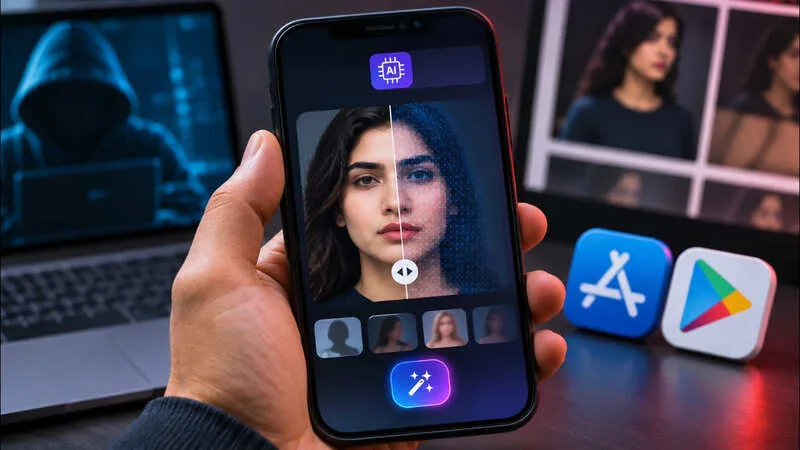
Following findings shared by Wired, Apple removed 19 apps tied to the network, including Viefur. Apple spokesperson Adam Dema explained the bait-and-switch tactics used by the developers. “We review every app before it’s published, and these apps complied with our rules when we reviewed them,” Dema said. “After approval, their developers changed the website the app pulls its content from, replacing what we approved with pornographic content, and promoted it through pornographic ads hosted on a third-party platform,” Dema added, stating that nudification software is prohibited under App Store rules [1].
Apple noted that deceptive tactics remain a persistent challenge, stating that it suspended tens of thousands of apps over the past year for similar evasions [1]. On October 16, 2026, Apple updated its App Review Guidelines to stop these abuses. The update strengthened Section 1.2 to ban nonconsensual intimate imagery, including AI generations, while requiring developers to block harmful outputs [4]. Apple also revised Section 2.5.19 to penalize apps that conceal or fail to document features during review [3]. Under the rules, developers using bait-and-switch updates lose access to the Apple Developer Program [4].
Market figures shared by Apple show that the company blocked more than 150,000 risky apps from reaching users during the previous year. Apple also banned more than 193,000 developer profiles for fraud and abuse over the same period. Google similarly removed most flagged network titles, including DiffAI, before reporters reached out [4]. When researchers contacted KeLing Technology Limited about the findings, the operators didn’t reply, but they quickly removed contact addresses and renamed social channels to hide visible connections [1].
- ONLINE NEWS Burgess, M. (2026, November 2). Hundreds of Mundane AI Apps Are Hiding Sexually Abusive Deepfake Features. Wired. [Article Link]
- ONLINE NEWS Lovejoy, B. (2026, November 2). AI apps with hidden sexual and violent deepfake features made it into the App Store. 9To5Mac. [Article Link]
- ONLINE NEWS Dufresne, A. (2026, November 2). WIRED traces 400+ AI apps hiding abusive deepfake tools. AI Weekly. [Article Link]
- ONLINE NEWS Raj, P. (2026, November 2). Apple Removes 19 Apps Linked To Hidden AI Deepfake Tools. Gadgets Now. [Article Link]
- ONLINE NEWS Butler, E. (2026, November 2). Hundreds of AI Apps Hide Deepfake Abuse Tools Behind Legit. Emergent. [Article Link]
- ONLINE NEWS AppleInsider. (2026, November 2). Hundreds of AI apps were part of a network hiding sexually abusive deepfake tools. [Article Link]


