




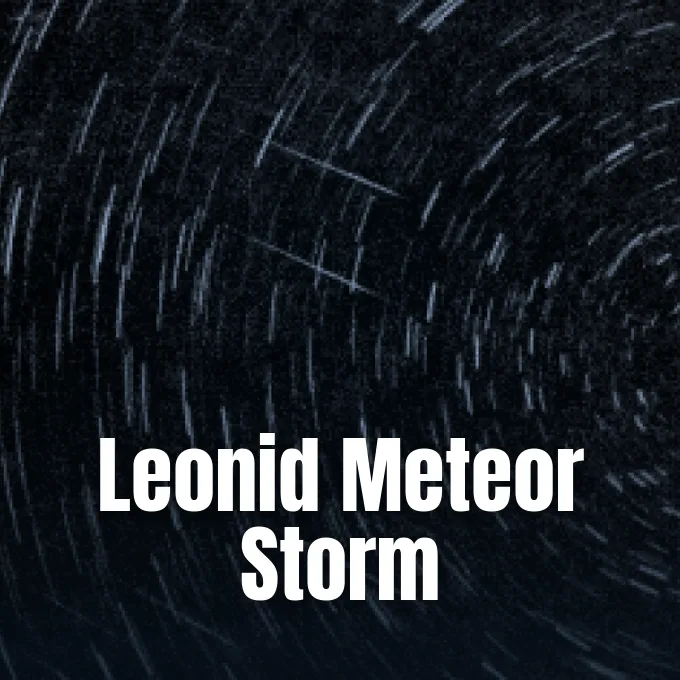
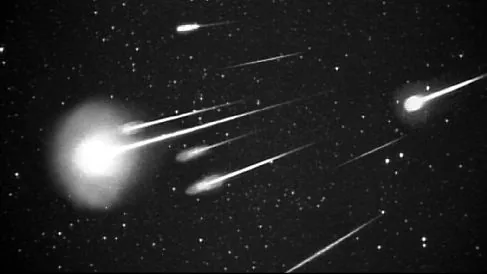
Overnight between November 17 and 18 in 1966, stargazers in North America watched a rare celestial spectacle as the Leonid meteor storm filled the darkness with thousands of shooting stars every minute [1]. Normal annual returns offer only modest rates. At Kitt Peak National Observatory in Arizona, this encounter produced an estimated 40 meteors each second at its height as Earth crossed a dense ribbon of comet dust [2]. Sixty years later, eyewitnesses still treasure the night the sky seemed to fall in fire, while astronomers use those counts to refine orbital models [1].
Peak Rates at Kitt Peak
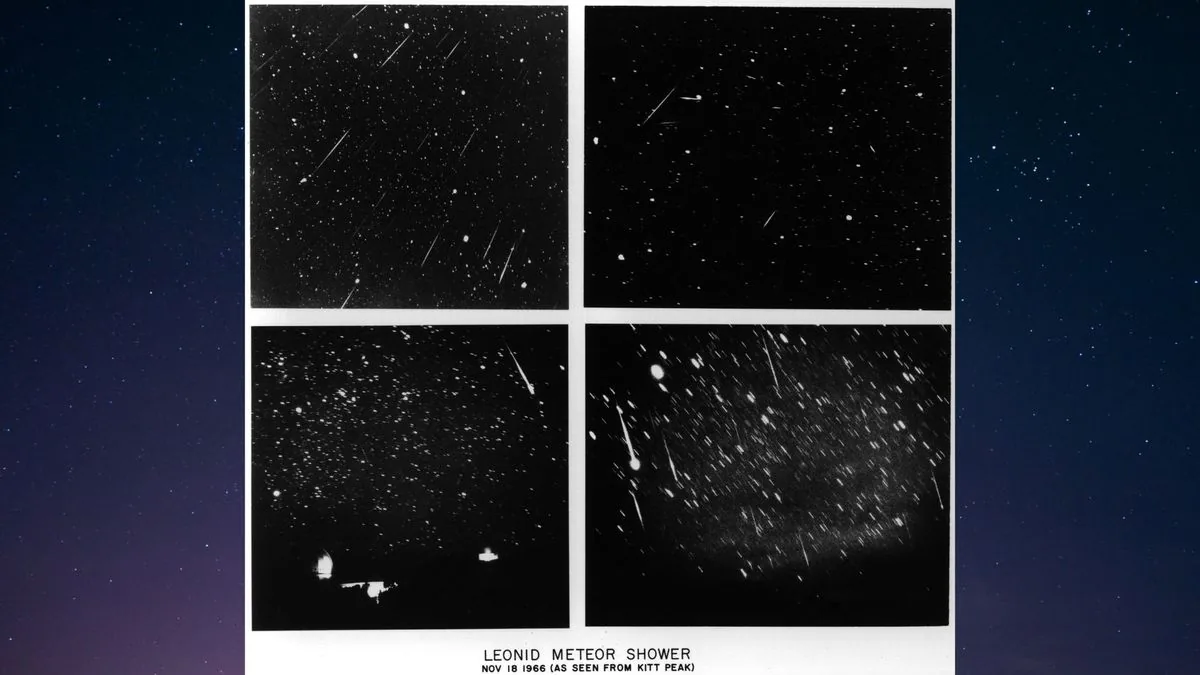
As Space.com writer Daisy Dobrijevic reported in an anniversary retrospective, observers stationed at Kitt Peak National Observatory near Tucson, Arizona, recorded one of the most intense meteor displays in modern astronomy during the early morning hours of November 17, 1966 [1]. Activity surged rapidly around 12:00 Universal Time [2]. Watching the clear desert sky, astronomers estimated an astounding rate of 40 meteors per second, which corresponds to 2,400 shooting stars every minute or roughly 144,000 meteors per hour [1]. That peak lasted roughly 15 to 20 minutes [2]. Observers reported that streaks dropped like glowing rain, illuminating desert terrain near Tucson with bursts of white and green light before dawn twilight arrived [1].
Astronomers define a true meteor storm as any event exceeding 1,000 meteors per hour. Elisa Neckar, senior production editor of Astronomy magazine, said the 1966 event didn’t just meet this requisite threshold but superseded it dozens of times over as the constellation Leo climbed high above Arizona [2]. Because the intense surge unfolded over a narrow window of 20 minutes, observers situated just a few time zones away missed the primary burst entirely [1].
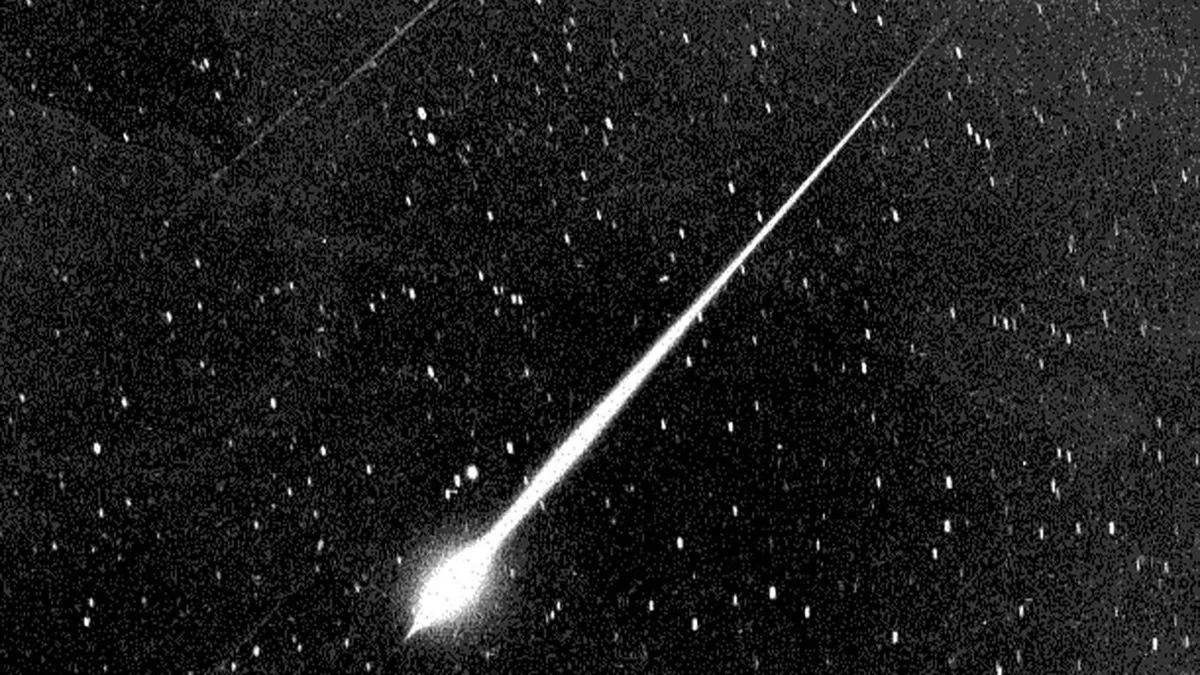
Under ordinary autumn conditions, the annual shower yields only 10 to 15 meteors per hour as Earth brushes diffuse outer fringes of comet debris. When the planet plows straight through a concentrated ribbon of particles, thousands of dust grains strike atmospheric gas at 44 miles per second and burn up in brilliant flashes. The 1966 encounter proved how rapid that transition can be [1].
What Eyewitnesses Saw
Sensory details extended beyond visual streaks for viewers in dark rural locations. Rodney Leist was 9 years old and living east of Roxie, Mississippi, staying up late with his cousins in an area with almost zero outside light. Walking along a road, Leist heard whistling and zipping sounds overhead. He said the sounds resembled burning droplets falling from a lit nylon rope, accompanied by a faint sulphur-like odor as space dust vaporized in the air. Leist is now nearly 70 years old. He described the display as one of the most memorable nights of his life [1].
At Southwestern College in Winfield, Kansas, physics student Nancy V. Parker joined faculty and neighbors lying on an open lawn to watch what felt like a humongous fireworks show lasting until dawn. Further south in El Paso, Texas, 18-year-old Dee Nyhan watched from his backyard. Nyhan later recalled, “It looked like every star in the sky was falling”. In the western mountains of California, 9-year-old Ed Schnurbusch camped outdoors with his father, staying awake all night as meteors streaked past their campsite [1].
Other observers across different states shared similar vivid impressions. In Brooklyn Center, Minnesota, 14-year-old Bruce Allan Haley watched from his front yard as meteors covered the sky in a display that took his breath away. In Troy, Alabama, 3-year-old Stephen H. Haynes lay on the warm hood of a car with his father, watching bright meteors whose glowing wakes hung in the chilly night for seconds. They left before the main surge because his father taught morning psychology classes at the local university [1].
Overcast Skies in the Bronx
Cloudy skies spoiled the night for other stargazers along the East Coast. Space.com columnist Joe Rao was 10 years old at the time, living in the Throggs Neck section of The Bronx in New York City. Rao had eagerly anticipated the sky show ever since attending a lecture at the Hayden Planetarium, where astronomer Fred C. Hess encouraged visitors to watch for what could become a spectacular display. But local weather did not cooperate in New York, and when Rao walked into his backyard with his grandfather, dense clouds “covered the midnight sky like a fresh coat of plaster,” completely smearing his view of the stars [1].
While his family stayed asleep inside, Rao and his grandfather spent the dark hours staring up at a uniform, charcoal-gray ceiling of unbroken cloud cover that hid every single star from view. Rao sobbed as he looked at the overcast, protesting that weather forecasters had promised partly cloudy skies for New York. His grandfather shook his head with two words: “Too bad”. After staring into the empty gray fog for several more minutes, the older man turned toward the house and said, “I guess the party is over” [1].
Comet 55P/Tempel-Tuttle Debris
The annual Leonid display occurs every November as Earth crosses the orbital debris stream shed by comet 55P/Tempel-Tuttle, which circles the sun approximately once every 33 years. As tiny comet particles plunge into Earth’s upper atmosphere at velocities of roughly 44 miles (71 kilometers) per second, friction against atmospheric gas molecules rapidly vaporizes the debris, creating shooting stars that leave persistent ionization trails. Even particles no larger than a grain of sand release enough kinetic energy to outshine the brightest stars in the night sky as they burn up at high altitude [1].
Because the comet’s dust disperses broadly along its vast elliptical path over centuries, Earth usually crosses diffuse, low-density regions of the stream that yield no more than 10 to 15 meteors per hour. When the planet intersects a narrow, concentrated ribbon shed during recent perihelion passages, hourly rates multiply by thousands and generate a true Leonid meteor storm [1].
Because these dense filaments are narrow, the maximum storm phase spanned only 15 to 20 minutes above North America as Earth crossed the richest part of the stream. That brief duration explains why observers in western states witnessed thousands of meteors while European and Asian skywatchers saw far lower activity before rotating into the stream [2].
Historical Returns of the Leonid Storm
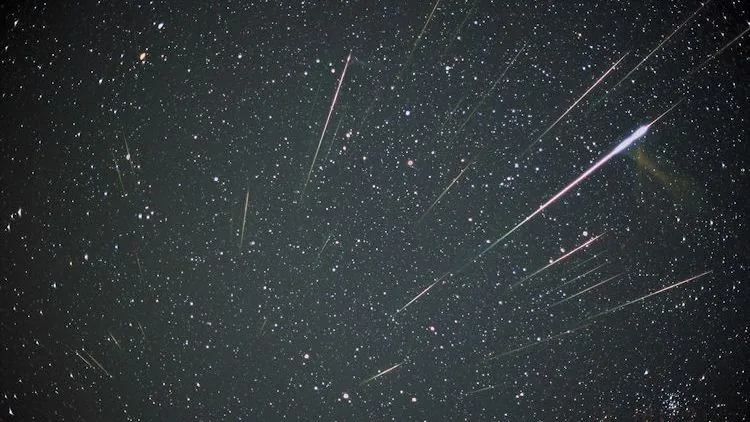
Major storms documented in November 1833 and 1866 helped establish modern meteor science as observers across eastern states tracked the radiant point in Leo. Long before photographic surveys tracked comet debris, historical celestial observations like ancient solar eclipse records in China helped astronomers calculate changes in orbital cycles over centuries. Each historic return proved that comet 55P/Tempel-Tuttle leaves discrete dust trails that drift under planetary gravitational perturbations for centuries before crossing Earth’s orbital path again [1].
Stargazers experienced renewed storm displays in 1999, 2001, and 2002, when peak rates reached thousands of meteors per hour and illuminated night skies over multiple continents. Historic photographs from Wrightwood, California, and Kitt Peak in Arizona documented brilliant fireballs cutting through the darkness. NASA launched airborne research flights during the 1999 return under the Leonid Multi-Instrument Aircraft Campaign. When bright fragments detonate as bolides high above ground stations, orbital sensors and satellites track atmospheric fireballs to measure kinetic impact energies and map fragmentation pathways in real time. Modern optical networks continue monitoring these high-velocity particles to record how cometary dust interacts with upper atmospheric layers [1].
Forecasting the Next Leonid Meteor Storm
With comet 55P/Tempel-Tuttle scheduled to reach perihelion again in 2031, an August 2026 preprint paper by S. Abe on the arXiv repository (arXiv:2608.25456), which has not undergone formal peer review, evaluated dust-trail generation to predict returns between 2031 and 2035. Early trajectory modeling previously suffered large spatial offsets for ejections before 1700. By anchoring ejection sites to the JPL Horizons ephemeris, Abe’s model successfully matched the timing of the 2001 and 2002 storms within minutes, providing fresh insight into older filaments [3].
Applying the calibrated dust-trail model to upcoming returns, the author projected potentially active encounters in 2033 and 2034, pointing to two comparable maxima in November 2034 with peak rates over 1,000 meteors per hour [1]. But completeness audits revealed significant modeling caveats, including an eighteenfold over-prediction for the 1932 trail that shows how sensitive particle encounters remain to subtle gravitational shifts over centuries [3].
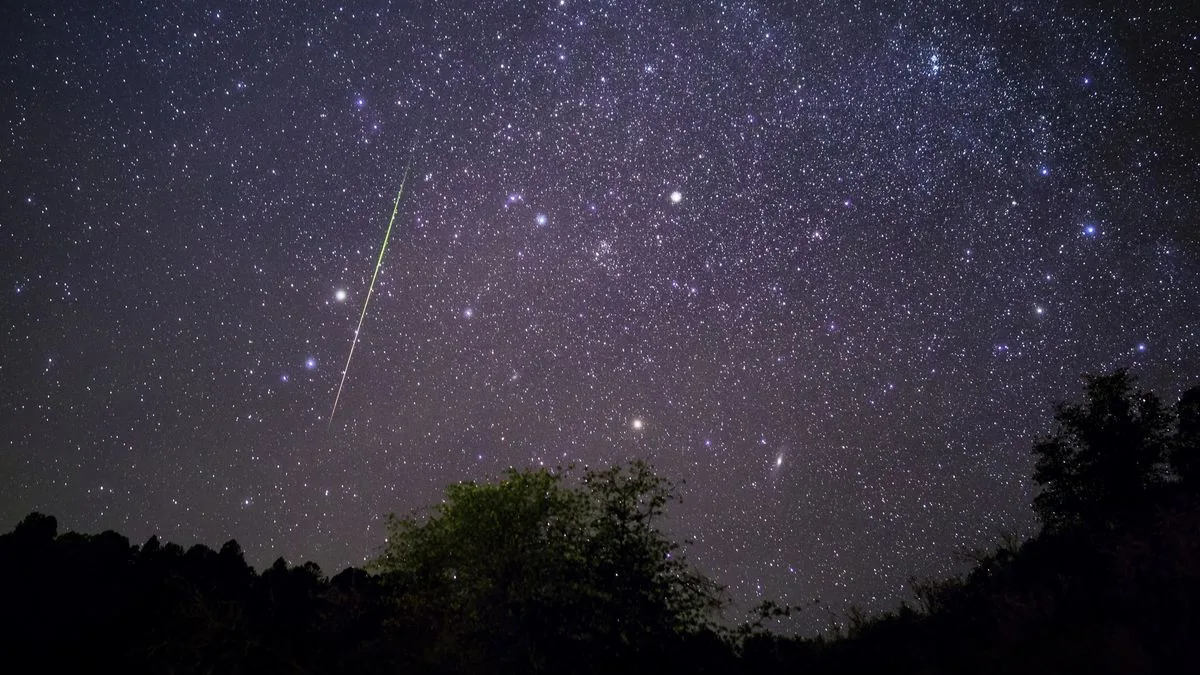
While numerical simulations offer valuable guidance on when debris filaments will cross Earth’s path, a repeat of the 1966 display remains uncertain because the exact particle density inside each stream can’t be predicted. Stargazers will have to wait until the 2030s to see whether comet 55P/Tempel-Tuttle delivers another quiet showing or unleashes a sky full of falling stars over dark horizons [1].
- ONLINE NEWS Dobrijevic, D. (2026, November 17). ‘It looked like every star in the sky was falling’: Eyewitnesses remember the great Leonid meteor storm of 1966. Space.com. [Article Link]
- ONLINE NEWS Neckar, E. (2026, November 17). Nov. 17, 1966: A phenomenal Leonid meteor storm. Astronomy Magazine. [Article Link]
- PREPRINT Abe, S. (2026). A calibrated dust-trail model of the Leonid meteoroid stream and forecasts of the 2031-2035 encounters. arXiv. [Article Link]
APA 7: PerEXP Teamworks. (2026, November 18). Leonid Meteor Storm of 1966 Rained 2,400 Meteors a Minute. PerEXP Teamworks. https://perexpteamworks.com/en/leonid-meteor-storm-1966-eyewitnesses/


