






The Norwegian longship Draken Harald Hårfagre, which portrayed Odysseus’ vessel in Christopher Nolan’s film The Odyssey, is preparing for major maintenance work in Norway. Owners of the clinker-built wooden craft opened an international call for volunteers to help restore the hull before future sailing expeditions begin. The work takes place in the spring of 2027, bringing woodworkers together with enthusiasts to fix weathered oak planks and scrape off marine grime. Organizers plan five separate week-long sessions to keep the ship seaworthy for coming voyages [1].
Spring Maintenance Plans in Norway
The maintenance window opens on April 10, 2027, and runs through May 15, offering five one-week blocks for recruited helpers. Volunteers can register for a single week or choose to remain on site for the full five-week run. The ship organization provides daily meals and local lodging for all accepted workers during their stay in Norway. Applicants must be at least 18 years old, and organizers give preference to people who bring prior woodworking or boat repair experience to the yard [1].
The work focuses on restoring the ship after demanding ocean conditions and heavy filming duties in open salt water. Crews will scrape ocean grime from the hull exterior, apply fresh coats of paint, and treat the oak timbers with pine tar. The heaviest task involves clinking the hull, an established technique where workers inspect every overlapping plank, remove weakened oak sections, and fasten sound timber in place. Organizers said volunteer support helps keep the large wooden ship operational [1].
“A project like Draken depends not only on a professional crew and sailing deckhands, but also on dedicated volunteers who help support the life of the ship,” reads the announcement on the project website. The team said volunteering offers a hands-on way to learn about the vessel while helping the community that keeps it moving forward [1].
How Draken Harald Hårfagre Was Built
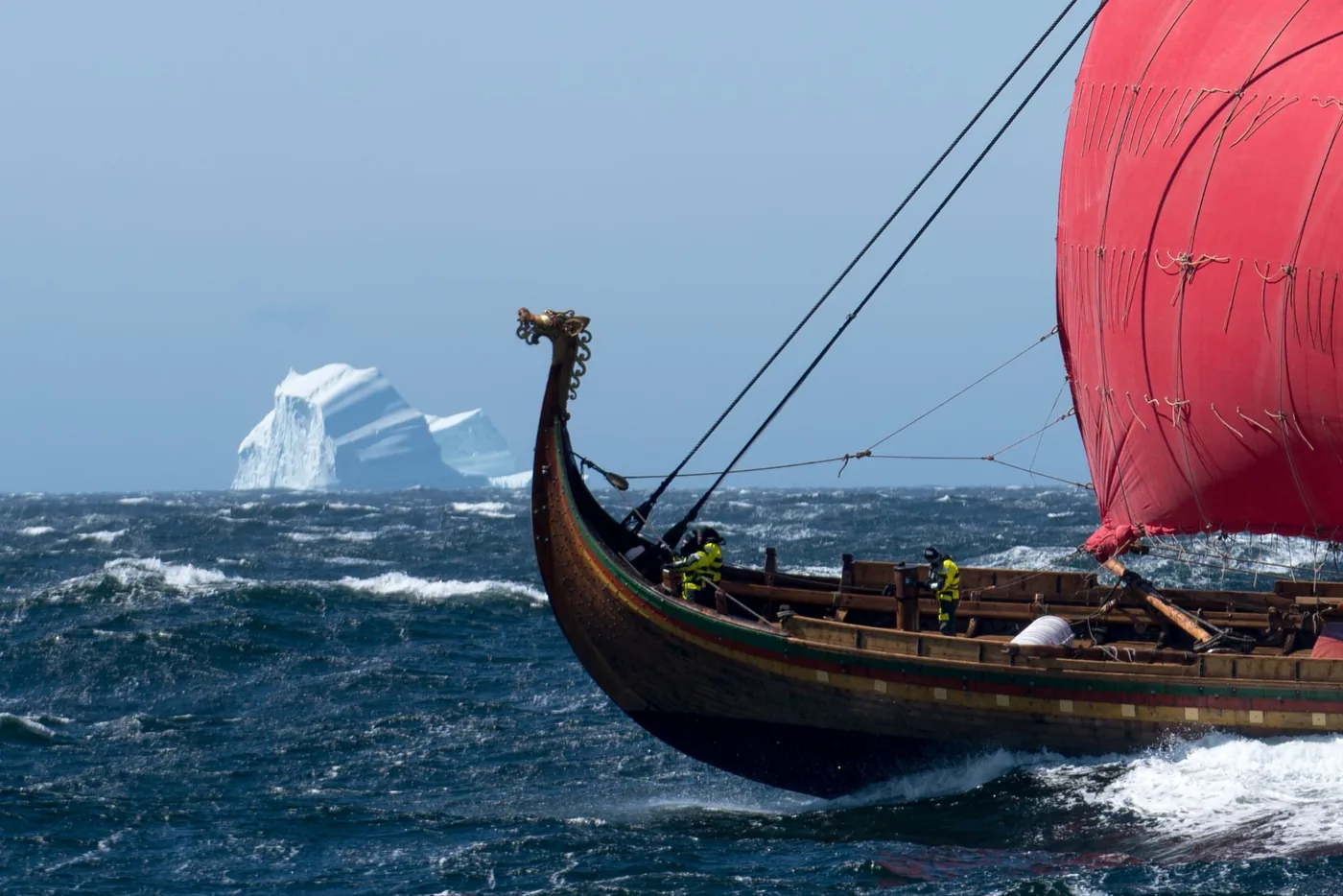
Work on Draken Harald Hårfagre began in March 2010 in the western Norwegian town of Haugesund [2]. Norwegian oil and gas magnate Sigurd Aase funded the build to investigate how large Viking vessels mentioned in Norse saga literature behaved on open oceans [1], [2]. Designers drew inspiration from archaeological remains of the Gokstad ship, which was built around 890 CE. The completed craft measures 114 feet (35 metres) long and 26 feet (8 metres) wide, carrying a single wooden mast that rises 79 feet (24 metres) into the air [1],. The sheer scale makes it the largest Viking ship sailing in modern times [2].
The hull uses overlapping oak planks fastened with iron rivets in the Scandinavian clinker style. Builders combined oak timber, tar, hemp cordage, iron rivets, and silk to complete the hull and rigging. The vessel carries a square sail covering around 260 square metres of cloth, balanced by 25 pairs of oars [2]. Because two rowers pull on each oar handle, moving the craft without wind takes a full crew of 100 people [1], [2].
Is the vessel an exact copy of an archaeological find? The project team explains that Draken is an interpretation rather than a precise reconstruction of a single discovered hull. Because no complete royal saga ship survived underground, shipwrights merged saga accounts with traditional crafts and sea testing. Builders launched the wooden craft in June 2012, beginning trials in coastal waters [2].
Transatlantic Expeditions and Sea Trials
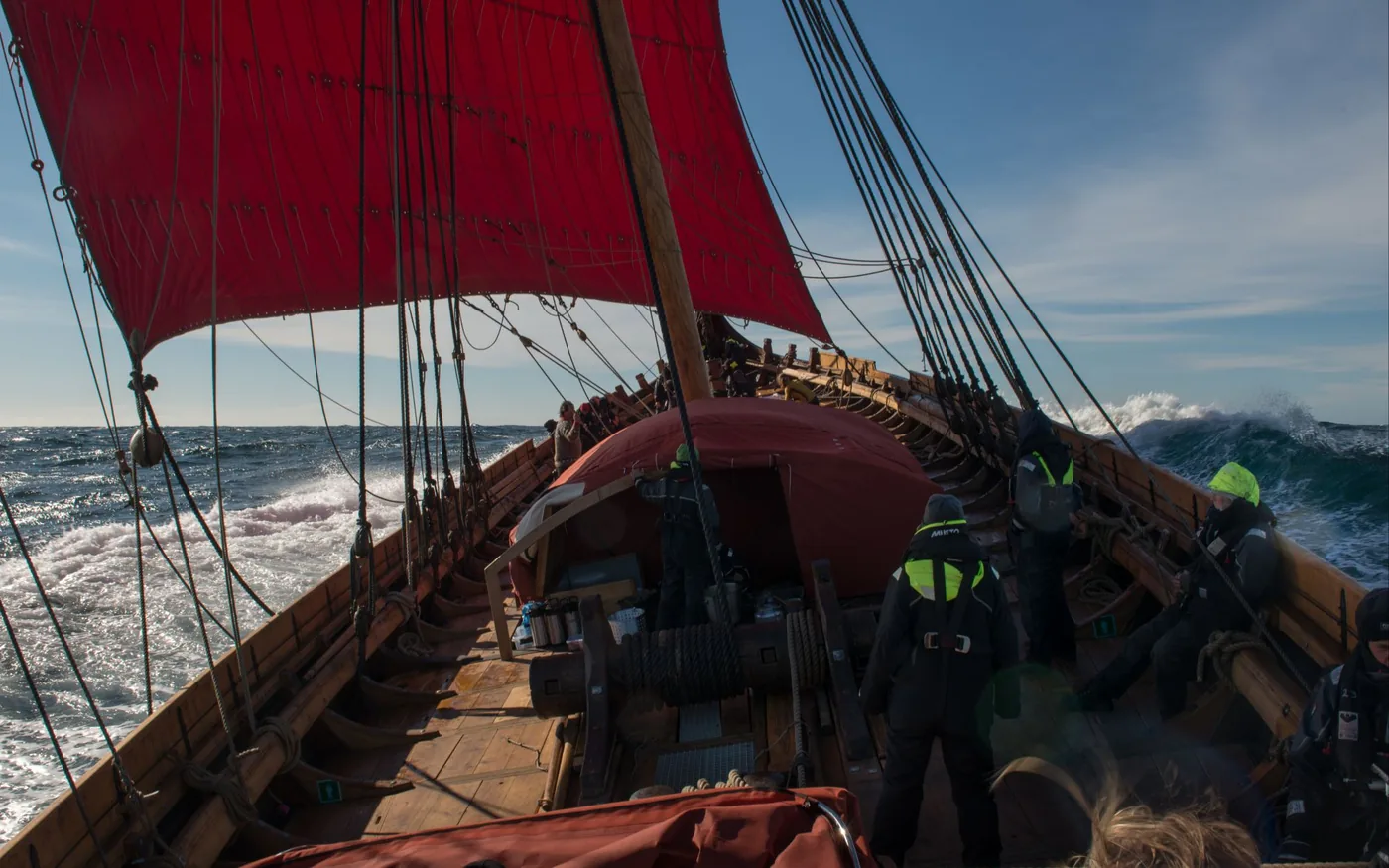
Draken proved its strength through demanding sea voyages during its first decade afloat. In 2014, the vessel finished its first major open-water journey by sailing from Norway to Liverpool and back [2]. In 2016, the ship undertook a transatlantic voyage that retraced Norse sailing paths [1],. Operated by a core crew of 32 sailors, the longship traveled through northern waters toward Iceland, Greenland, and Canada before reaching ports in the United States [2].
The transatlantic crossing showed that a clinker-built wooden hull could manage heavy ocean waves over thousands of nautical miles. The vessel served as a working laboratory where sailors saw how oak planks flexed in rough seas. That accumulated experience gave the crew deep insight into handling sails and lines under hard weather conditions, creating practical skills that Hollywood set designers could never replicate on a studio lot [2].
Emanuel Persson, the project chief executive and expedition director, described Draken as a “living system” where every part relies on the others. “There is something on board that cannot easily be faked,” Persson said in an interview with Artnet, citing “the weight of the oak, the sound of the rigging, the movement of the sail, the crew working together in real wind and water” [2]. These qualities convinced Christopher Nolan to use the Norwegian craft [1], [2].


Filming The Odyssey in Open Waters
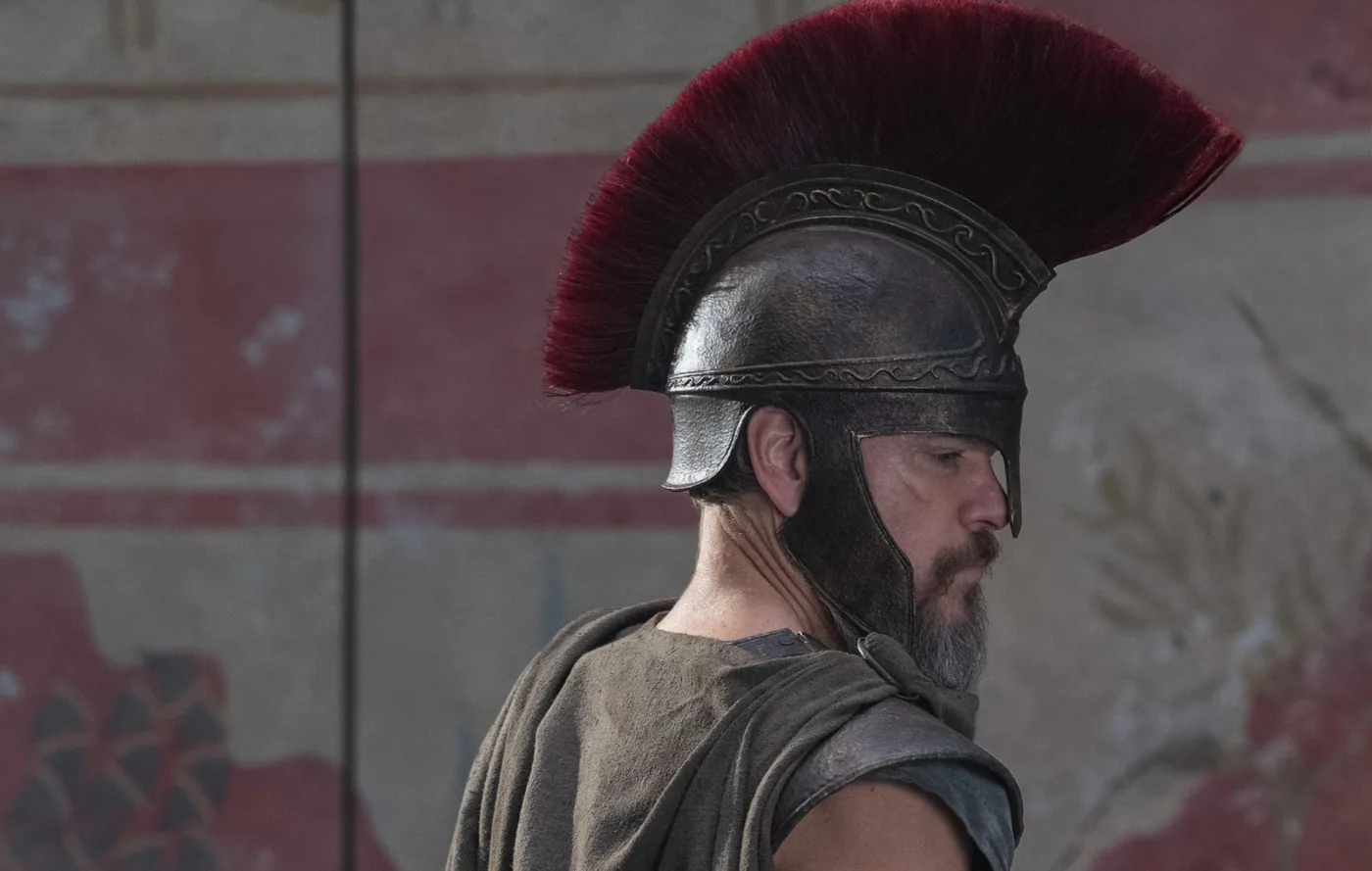
When director Christopher Nolan adapted Homer’s epic poem The Odyssey, he avoided digital water and soundstages in favor of physical environments. The story follows Odysseus trying to return to Ithaca after the Trojan War, facing storms, monsters, and hostile gods over a ten-year voyage. Nolan chose to shoot scenes aboard real vessels in open water so wind, weather, and ocean motion became part of the cast performance [2]. Crew members dressed the Norwegian longship to play Odysseus’ galley, taking down modern tents and expedition fittings while keeping its open deck and oak hull intact [1],. Filming took place in waters around Greek and Italian islands, as well as locations in Scotland and Iceland [2].
Swedish captain Björn Ahlander guided the vessel during production, working with the film crew to protect the ship and actors in big swells. Moving a craft that weighs close to 100 tonnes required real teamwork rather than acting gestures. Matt Damon and other cast members attended a rowing camp before cameras rolled, learning how to handle the heavy oars alongside veteran sailors. For Damon, rowing became part of the work needed to keep his character’s vessel on course [2].
The physical labor seen in the film was done for the ship as well as the camera. Sailors from the Draken crew worked alongside the actors, keeping the vessel safe during filming. Nolan said in an interview with the Los Angeles Times: “We needed something wooden-hulled, built with ancient technology that could be out there in open ocean water, in giant swells. And the Draken has crossed the Atlantic” [2].

Why Draken Harald Hårfagre Fitted Nolan’s Vision
The world of Homer’s heroes predates the Viking Age by roughly two millennia, placing the Trojan War around 1200 BCE [1], [2]. A medieval Scandinavian longship is not a replica of a Late Bronze Age Greek galley [1], [2]. Even so, Nolan sought material authenticity rather than an exact museum copy, choosing Draken Harald Hårfagre because it could sail safely in heavy seas where lighter prop boats might fail [1],. Greek vessels and Norse ships shared key features, including long wooden hulls, open decks, rowing oars, and a solitary square sail [2].
The choice reflects Nolan’s preference for physical effects over computer images, seen earlier with the rotating corridor in Inception and real aircraft in Dunkirk. Placing actors on a working ship in real wind and waves brought visual weight that digital tools cannot produce. Draken crew members managed ropes, lines, and canvas throughout the shoot, keeping maritime maneuvers believable on screen while preventing accidents during unpredictable ocean swells [2].
Filming ran for months across multiple European waters, subject to wind and wave conditions rather than studio schedules [2]. The wooden ship handled the strain of movie production while carrying cast, heavy cameras, and film equipment through open salt water [1], [2]. After filming wrapped, Draken returned to port to resume educational tours, and it is now set for spring repairs in Norway [1].
The Repair Dispute Over Glad av Gillberga
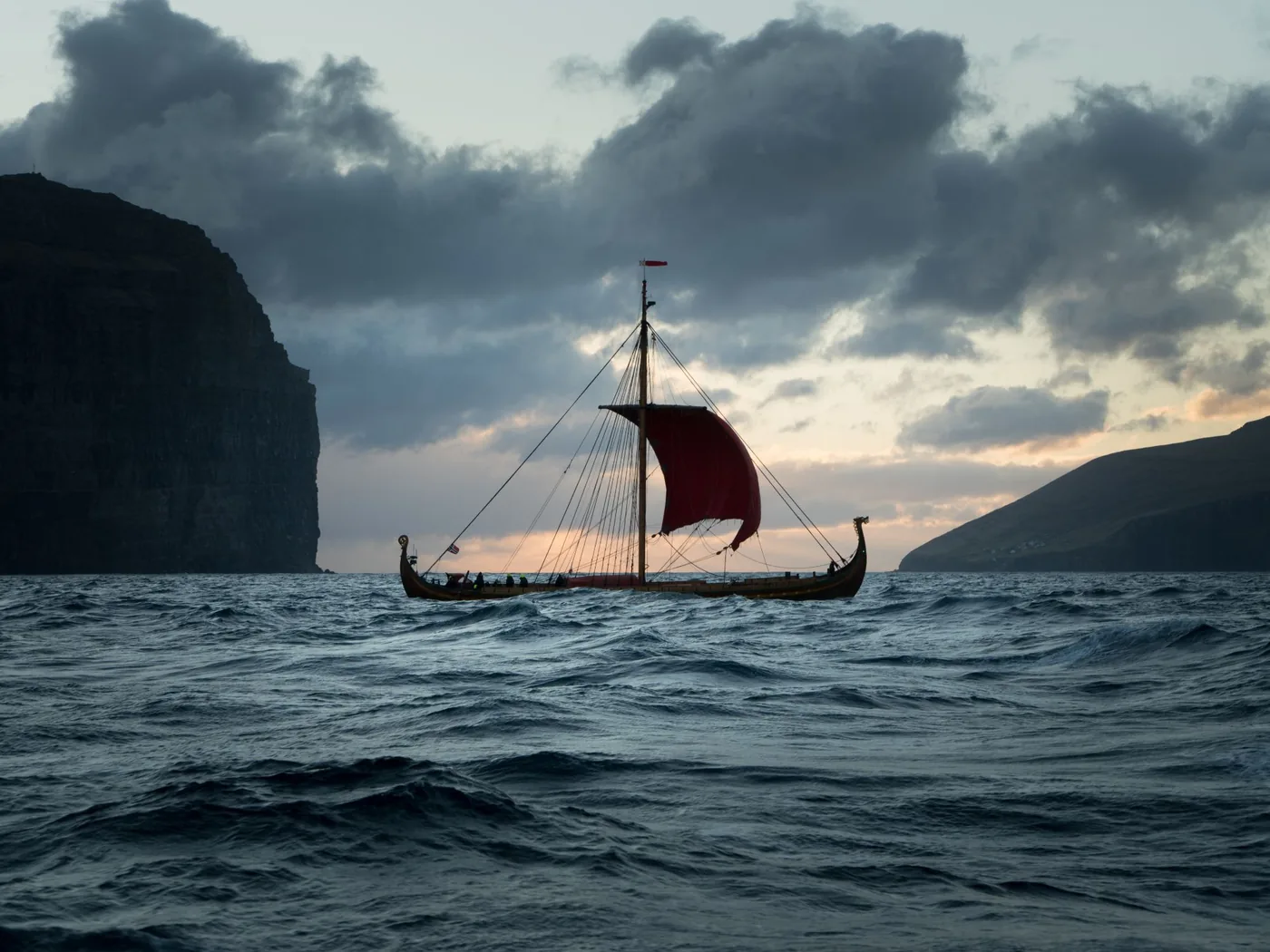
Draken was not the only Scandinavian vessel used for Christopher Nolan’s production. The film also featured Glad av Gillberga, a Swedish replica warship owned by the non-profit association Vikingaleden. While the movie enjoyed the largest live-action opening weekend of the year and earned Rotten Tomatoes scores of 94 per cent from critics and 97 per cent from audiences, the Swedish boat owners claimed that damage during filming went unpaid. Vikingaleden stated that studio Universal Pictures did not answer an invoice for $6,000 (£4,500) covering materials used to repair the boat. Peter Olausson said the group felt forgotten after completing the boat repairs [3].
Peter Olausson, chairman of Vikingaleden, told The Guardian that the group billed only for supplies. “We are only charging for the material cost, not the labour. Of course Universal can afford this $6,000. We feel forgotten,” Olausson said. He stated that the agreement called for Vikingaleden to fix the boat and receive reimbursement. The warship returned to the water, but the unpaid invoice remained an unresolved dispute for the association [3].
Universal Pictures responded that all agreed bills had been paid. “Our records show that all invoices relating to the Glad av Gillberga were paid in full, including repairs,” a Universal spokesperson said. The studio stated that production staff contacted the association to clear up any misunderstanding [3]. While Vikingaleden sought resolution for its Swedish craft, the team behind Draken Harald Hårfagre turned its attention to volunteer recruitment in Norway, preparing the larger ship for its 2027 maintenance season [1], [3].
- ONLINE NEWS Paul, A. (2026, November 6). Matt Damon’s ship from ‘The Odyssey’ needs your help. Popular Science. [Article Link]
- ONLINE NEWS ATN All Things Nordic. (2026, July 26). The Norwegian Viking Ship Carrying Odysseus Through Christopher Nolan’s The Odyssey. All Things Nordic. [Article Link]
- ONLINE NEWS Luxford, V. (2026, July 24). ‘The Odyssey’ crew damaged replica Viking ship and hasn’t paid for repair, owner claims. NME. [Article Link]
APA 7: PerEXP Teamworks. (2026, November 7). Draken Harald Hårfagre Recruits Volunteers for Norway Repairs. PerEXP Teamworks. https://perexpteamworks.com/en/draken-harald-harfagre-repairs/


