






OpenAI announced that it is doubling usage allowances for subscribers on paid tiers while testing a setup that brings ChatGPT Work tools into the standard Chat interface. The update raises caps on Pro 100, Pro 500, and Business Premium accounts, and it cancels a planned cut for the $200 tier. It also combines ChatGPT and Codex quotas into a single bucket. These updated ChatGPT Pro limits took effect on October 29 after pushback from developers, according to an email confirmed by BleepingComputer [1].
Testing Work Tools Inside Chat
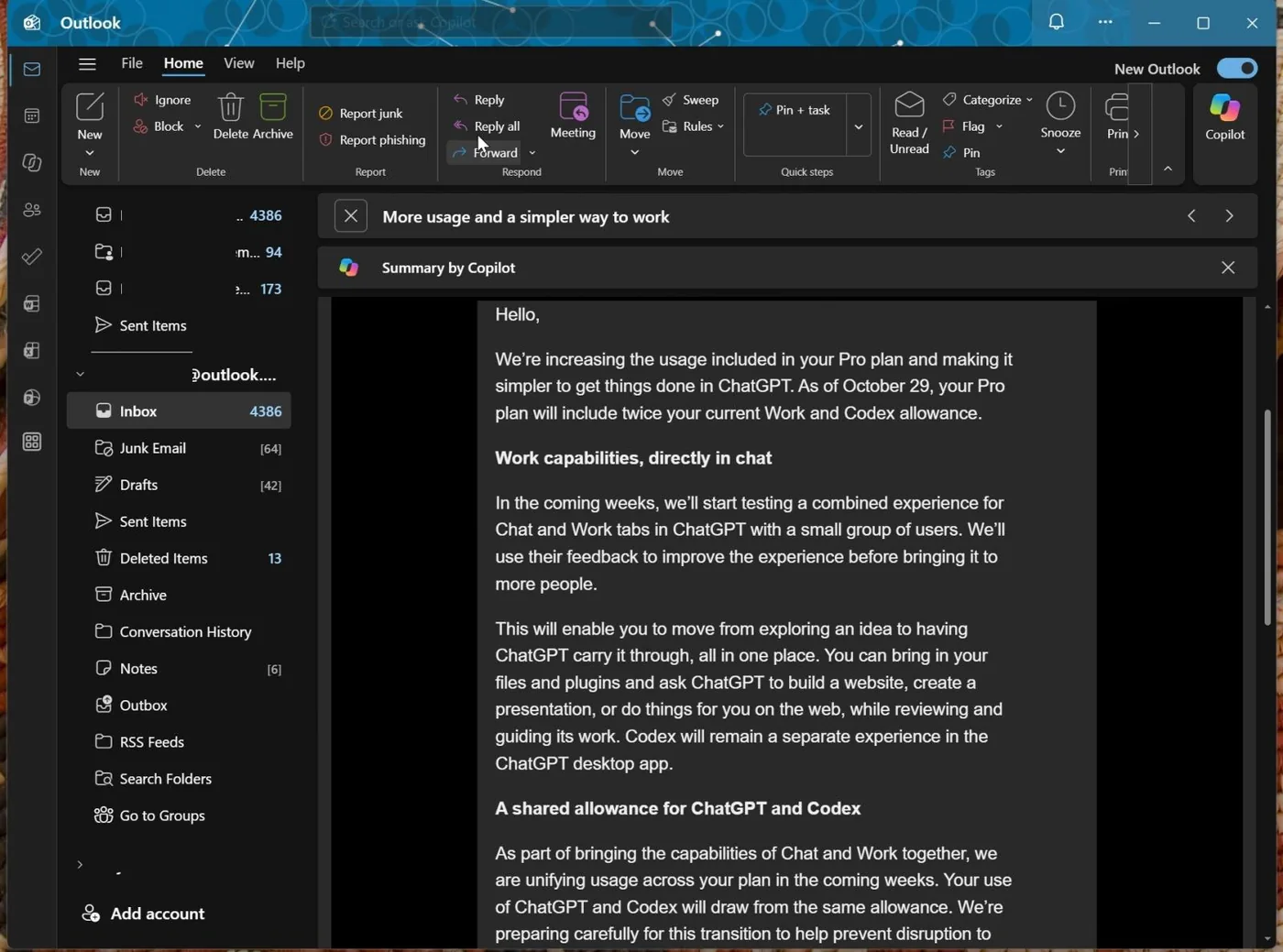
OpenAI sent an email to subscribers explaining that it will test a combined experience for Chat and Work tabs in coming weeks. The trial begins with a small test group before rolling out more broadly. It lets users move from regular conversation into complex tasks without switching between separate modes in the web app [1].
Under the combined design, users can upload files and connect plugins so the system can build websites, write presentations, or browse the web while the person reviews and guides its work. As OpenAI told users in the notice, “This will enable you to move from exploring an idea to having ChatGPT carry it through, all in one place”. The Work tools were previously tested in corporate environments, including when Uber deployed ChatGPT Work across its workforce of 30,000 employees. Bringing those capabilities into consumer chat aims to remove daily friction, though OpenAI said Codex will still stay a separate experience in the desktop app, keeping programming setups distinct from the browser interface [1].
The test comes as OpenAI and rival Anthropic compete for software teams. Anthropic is preparing for an initial public offering (IPO), and both labs want developers to stay. Quotas on Plus stay unchanged [2].
Higher ChatGPT Pro Limits for Work
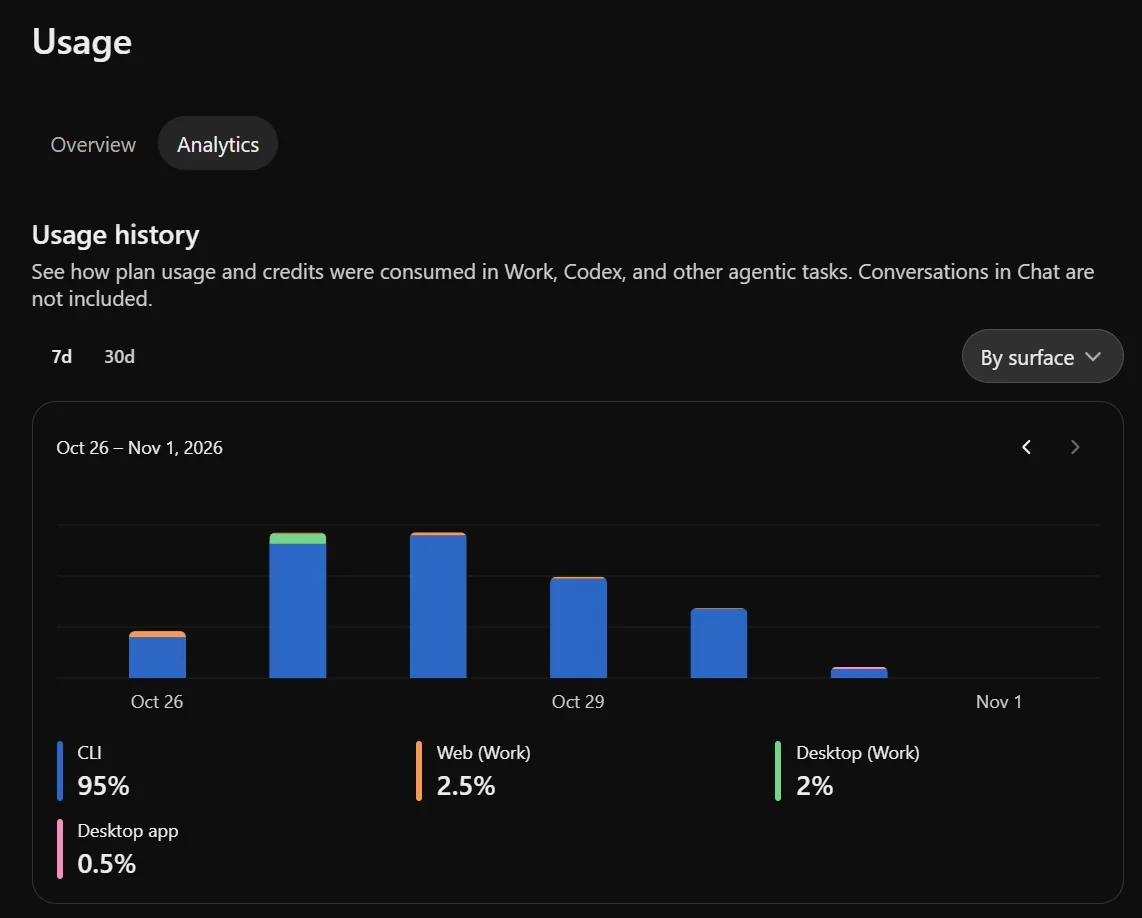
The quota adjustments took effect on October 29 for Work and Codex on Pro 100 and Pro 500 plans [2]. Both tiers received double their previous cap, giving subscribers room to run multi-step code tasks without hitting a limit mid-project [3]. The Plus plan stays unchanged [2].
OpenAI said higher ChatGPT Pro limits do not mean twice as many completed tasks, because usage draws tokens differently based on the chosen model, reasoning depth, and task settings. The company recently released its 6.1 models, Terra and Sol, which run with greater efficiency while matching or beating previous benchmark scores [2]. OpenAI product lead Thibault Sottiaux said on X that the team will keep shipping faster models and efficiency fixes that help users get more done within the same allowance over time [4].
The company also kept extended limits in place for Dots, its background personal AI agents. Sottiaux said usage from a dot will continue to run on its own allocation [4]. That decision helps power users, though Sottiaux said the special allocation remains temporary [3].


Dropping the Planned Pro 200 Cut
The decision to double allowances came after OpenAI faced pushback for attempting to cut capacity on its $200 plan [3]. At DevDay on September 29, the company announced that Pro 200 allowances would fall from 20 times the Plus baseline down to 10 times starting on October 30. OpenAI offered affected customers a one-time grant of $2,500 in usage credits to smooth the transition, but developers still objected to the reduction [6].
Subscribers complained that halving capacity harmed workflows [6]. In response, Sottiaux posted on X at 9:56 AM PT on October 29 to call off the cut: “We are doubling all usage limits for all Pro 100/200/500 tiers and Business Premium, effective today. We heard your kind feedback and won’t be reducing usage limits for Pro 200, so your Work and Codex usage will stay the same” [5].
The reversal ensured that existing Pro 200 subscribers kept their 20x allowance, while those on a lower quota saw their allowance doubled to match that level [5]. Pro 100 and Pro 500 tiers gained a true doubling over their earlier caps, but the $200 tier avoided a cut rather than gaining fresh capacity beyond its original ceiling. In discussing the updated ChatGPT Pro limits, OpenAI said Business Premium accounts also received an increase, though official documentation omits specific multipliers. Earlier software fixes had already made typical usage last about 18% longer after agentic behavior in GPT-5.6 Sol drained credits too fast, and Sottiaux acknowledged that OpenAI should have caught that consumption issue much earlier in testing [6].
Unified Quotas for Desktop and Web
OpenAI is preparing to unify allowances across ChatGPT and Codex so both tools draw from a single shared pool. In an email sent to subscribers, the company said users will no longer need to track separate quotas for desktop programming and web research. Unlimited Instant chats remain part of the paid subscription and will not count toward the shared usage ceiling [1].
More demanding tasks and reasoning models will draw more heavily from the shared allowance, depending on the computational workload involved. Subscribers can check their remaining capacity and track when their reset clock runs out under the Settings > Usage tab in the interface [1]. If a developer exhausts their allocation before the reset date, they can wait for the reset, upgrade to a higher tier, or buy extra credits for eligible features [7].
The desktop edition of Codex will remain a standalone app, preserving local workflows while still tapping the shared pool [1]. For heavy engineering teams, the $500 Pro tier remains the only tier with Ultrafast access, generating up to 300 tokens per second in Codex, which is up to eight times faster than standard output (up to eight times faster) [6]. Unifying quotas across interfaces aims to simplify subscription management, though users who balance heavy coding and web research will have to monitor their consumption more closely [1].

Subscriber Reactions to ChatGPT Pro Limits
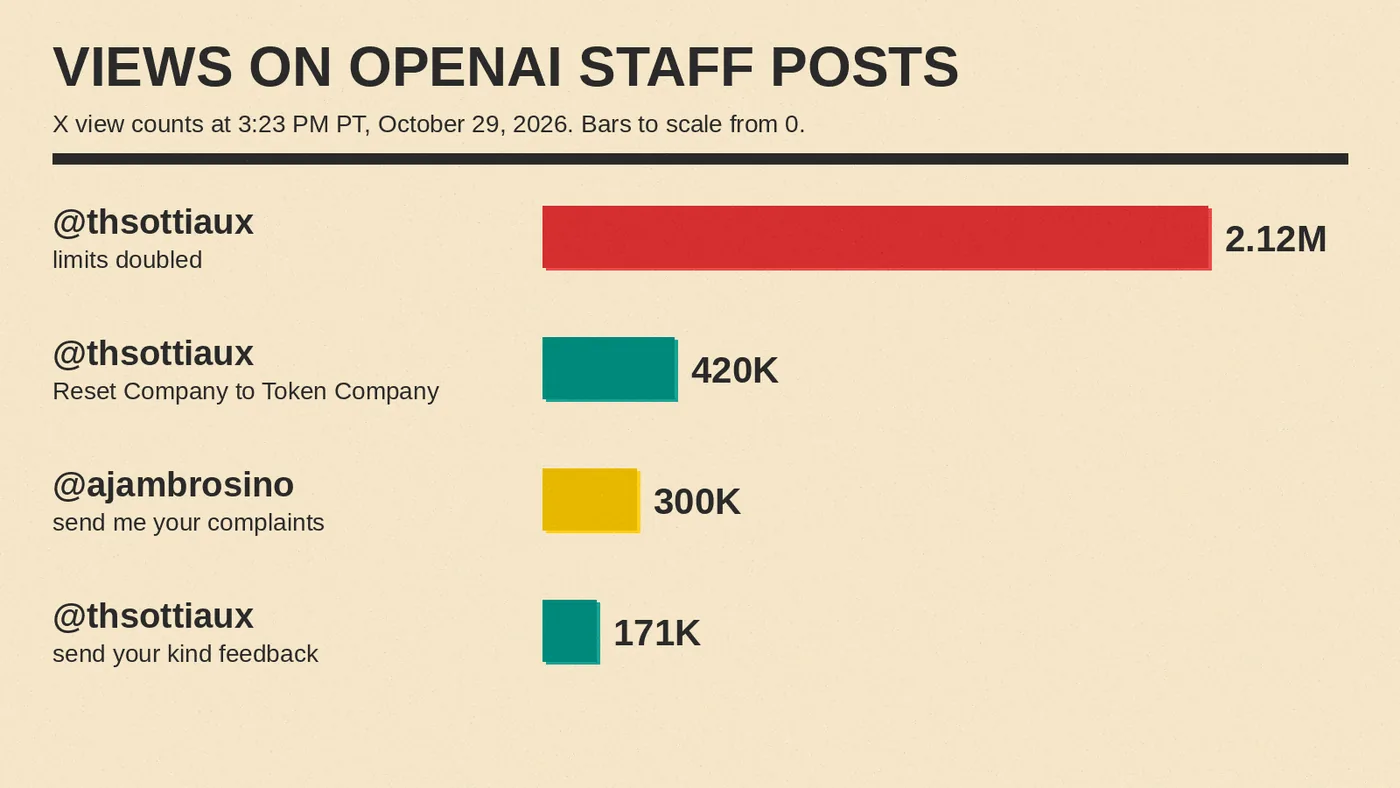
The announcement on X sparked immediate calculation among developers evaluating each tier. Sottiaux followed his initial post with a short comment saying OpenAI was graduating from The Reset Company to The Token Company, a post that drew over 420,000 views within hours. Community math shared by subscribers indicated that Pro 100 provides about 10 times the Plus baseline, Pro 200 sits at 20 times, and Pro 500 reaches 50 times [5].
Those numbers led some developers to argue that the $100 plan is now the sweet spot, costing $10 per unit of Plus usage compared to $20 on the standard Plus plan [5]. Other users calculated that the $500 plan yields roughly $10.5k per month of effective usage, while the $200 plan provides about $4.3k for Codex tasks [7]. Meanwhile, Plus subscribers expressed disappointment at being excluded from the update, noting their $20 plan received no changes [5].
Under a post by OpenAI staffer ajambrosino asking for feedback, developers submitted a list of software bugs and resource issues. Some Windows users reported that the desktop Codex app opened around 200 processes and used 27GB of RAM, while others noted that background subagents wrote up to 2 gigabytes per hour to disk. Other subscribers reported that their background dots consumed heavy allocations on high-tier models during overnight sessions without user oversight [5].
The reaction shows how closely developers track capacity as automated tools become central to daily work [5]. By expanding its ChatGPT Pro limits and testing a unified workspace, OpenAI answered immediate user anger. Sustaining these quotas will depend on efficiency gains as new models roll out [2].
- ONLINE NEWS Parmar, M. (2026, November 1). OpenAI says it’s doubling Pro usage limits and bringing Work features to Chat. BleepingComputer. [Article Link]
- ONLINE NEWS Bastian, M. (2026, October 29). OpenAI doubles usage limits on Pro plans as competition with Anthropic heats up. THE-DECODER.com. [Article Link]
- ONLINE NEWS Parmar, M. (2026, October 29). OpenAI doubles ChatGPT Pro usage limits after backlash over planned 50% cut. BleepingComputer. [Article Link]
- ONLINE NEWS McNeal, R. (2026, October 30). OpenAI caves to backlash and reverses course on reducing ChatGPT usage limits. Android Authority. [Article Link]
- ONLINE NEWS Axc. (2026, October 29). ChatGPT Pro Higher Limits: What People Are Saying. LLMs Blog. [Article Link]
- ONLINE NEWS Murphy, J. (2026, October 29). OpenAI Scraps the ChatGPT Pro 200 Usage Cut and Doubles Pro Limits. Startup Fortune. [Article Link]
- WEBSITE daily.dev. (2026, November 1). OpenAI says it’s doubling Pro usage limits and bringing Work features to Chat. daily.dev. [Article Link]


