




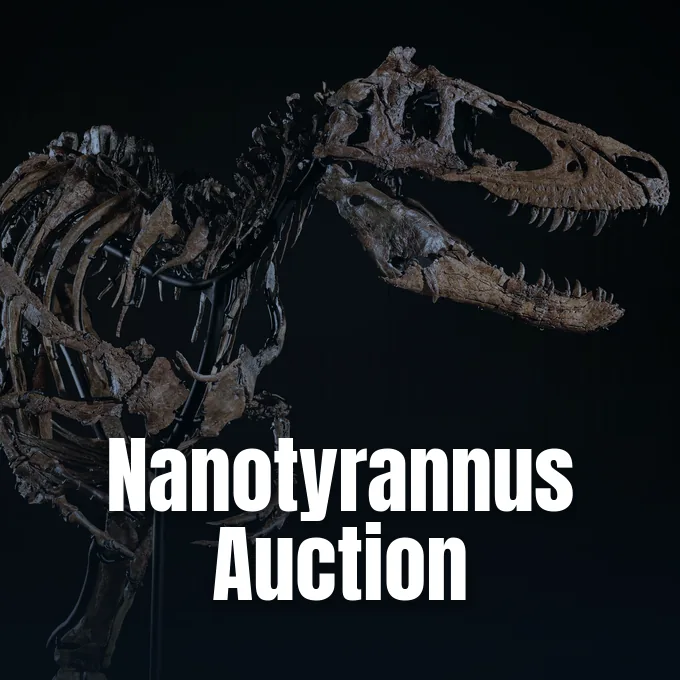
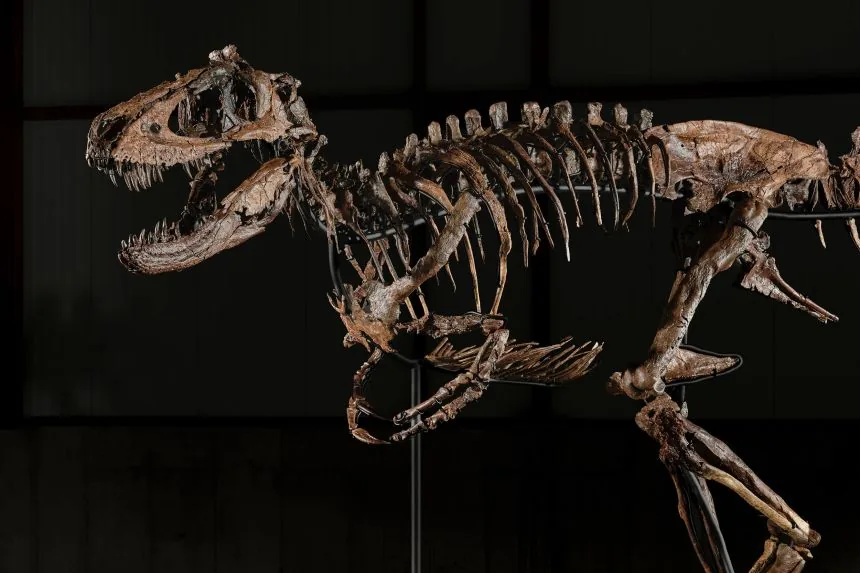
An exceptionally preserved Nanotyrannus skeleton nicknamed Jodi fetched $47.3 million (about £35.5 million) at Sotheby’s in New York on Tuesday, easily passing its early estimate of $9 million. The 67-million-year-old fossil became the second-most expensive dinosaur skeleton ever sold at auction, trailing only a Tyrannosaurus rex named Gus that fetched $50.1 million at Sotheby’s in July [1]. Six bidders competed by phone and online during a brisk 12-minute contest [2]. The high price pushed prehistoric fossils deeper into the high-end art market and prompted fresh objections from academic paleontologists who fear the loss of key specimens to private vaults [1].
Auction at Sotheby’s
Bidding opened well below the final sum as auctioneers sought an opening offer near the low estimate of $6 million. Telephone bidders drove the price higher in steady increments. The contest narrowed to six active buyers before a telephone client secured the lot [2]. Sotheby’s did not reveal the buyer’s identity [1].
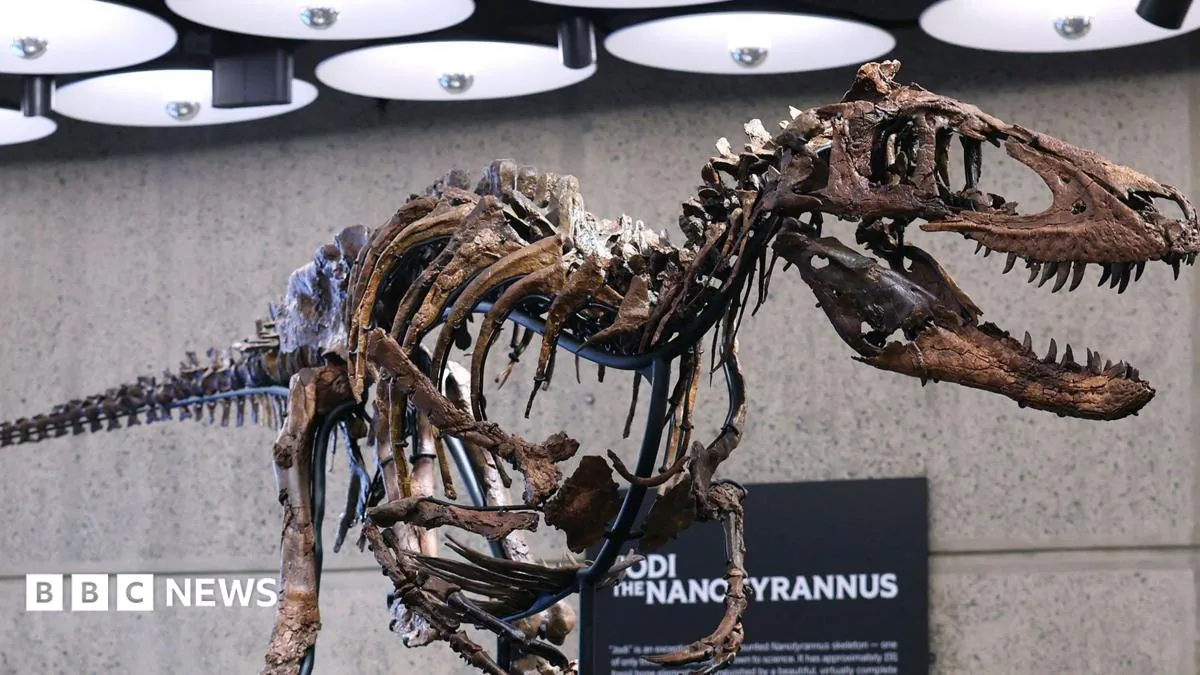
The final hammer price settled at $40.5 million, with auction house premiums and buyer fees lifting the full cost to $47,255,000 [4]. Sotheby’s described Jodi as an exhibition-ready Nanotyrannus skeleton that features a skull preserved in stone over 67 million years [1]. Cassandra Hatton, the head of science and natural history at Sotheby’s, said the outcome recognized the field team that recovered the specimen from the ground. She said their dedication helped bring the predator to public attention and showed how private field crews add to science [2]. The winning bidder also secured full commercial rights, allowing the owner to produce 3D printed replicas for museums or private collectors [3].
Discovery of the Nanotyrannus Skeleton
Montana rancher Jodi Pierson found the bones in 2019 while checking grazing land on her private ranch in Garfield County, near the small town of Jordan [2]. The fossil lay buried within the Hell Creek Formation, a rock layer where field crews found the first recognized T. rex bones back in 1902. Pierson called her cousin Clayton Phipps, a veteran field excavator known as the “Dinosaur Cowboy,” to inspect the exposed bone fragments [3]. Phipps organized a field recovery crew to quarry the site, an effort featured in 2020 on the Discovery Channel television series Dino Hunters [6]. Phipps had previously unearthed the renowned “Dueling Dinosaurs” fossil eight miles (about 13 kilometers) away on another Montana ranch in 2006 [1].
The mounted frame measures 19.6 feet in length from snout to tail and stands 9.6 feet tall on its steel support armature [2]. Preparators cleaned and fitted roughly 191 original fossil bone elements to build the complete mount. Missing skull sections and foot pieces were filled using custom sculpted and 3D printed elements to make the mount stable for display [3]. Bone grain analysis and joint fusing showed that the Nanotyrannus skeleton came from a mature adult rather than a rapidly growing juvenile predator [2].
The fossil counts as one of only three substantial Nanotyrannus finds known to science, joining Jane at the Burpee Museum in Rockford, Illinois, and the specimen preserved in the Dueling Dinosaurs pair in North Carolina [3]. Field teams took months to remove the surrounding sandstone without fracturing delicate rib sections. The fine preservation allowed researchers to see tooth serrations that rarely survive in large theropods [1].

Debate Over Dinosaur Classification
For nearly half a century, vertebrate paleontologists argued over whether bones from a Nanotyrannus skeleton represented a separate genus or merely young Tyrannosaurus rex. The dispute began in 1942, when a field crew from the Cleveland Museum of Natural History found a small carnivore skull in Montana and classified it as an adolescent predator. In 1988, a study led by paleontologists re-examined that skull and argued that it was a distinct genus named Nanotyrannus lancensis. Many researchers remained unconvinced, saying the differences might simply reflect changes as a young dinosaur grew into a giant adult [6].
The debate changed last year when researchers Lindsay Zanno and James Napoli published a study in Nature analyzing the Dueling Dinosaurs fossil [1]. Their work cataloged more than 150 anatomical differences separating Nanotyrannus from young T. rex specimens [2]. Megan Jacobs, a paleontologist at the University of Portsmouth, said Nanotyrannus possessed a sleeker frame and thinner limbs. “Nanotyrannus was for a very long time believed to be sort of a teenager of T. rex,” Jacobs told BBC Radio 4. She said the animal had blade-like teeth built for slicing meat rather than heavy bone-crushing jaws [1].
Linda Ivany, a professor of evolutionary paleoecology at Syracuse University, said that big carnivores leave few bones because top predators were never common in Late Cretaceous ecosystems. She said establishing true growth stages in rare meat-eaters is challenging without many fossils to compare. The Jodi skeleton provides researchers with valuable data to test whether Nanotyrannus lancensis is separate from another proposed species, Nanotyrannus lethaeus [6]. Both predators hunted in river valleys 67 million years ago, sharing territory with Triceratops and adult tyrannosaurs [2].
Prehistoric Fossil Market
Jodi first entered the international art market in October 2023 under the name Chomper, when London dealer David Aaron brought the mounted bones to the Frieze Masters fair with a $20 million price tag [4]. The skeleton did not find a buyer during the London event [5]. At the time, galleries and dealers still presented the specimen as a juvenile T. rex [1]. Sotheby’s provenance records state that the consignor bought the fossil in 2021. The price achieved on Tuesday reached more than double that earlier asking sum, reflecting how recent scientific classification boosted collector interest [5].
The soaring valuation in Manhattan follows a sequence of high-dollar dinosaur auctions that have reshaped commercial paleontology [4]. In 2020, Christie’s auctioned the T. rex skeleton Stan for $31.8 million to an anonymous buyer [6]. Sotheby’s followed in July 2024 by selling a Stegosaurus named Apex for $44.6 million to hedge fund executive Kenneth C. Griffin, who later loaned the specimen to the American Museum of Natural History in New York [1]. Last year, collectors paid $30.5 million for a young Ceratosaurus mount at Sotheby’s against an early estimate of just $6 million. In July, Sotheby’s established a record high when a South Dakota T. rex called Gus fetched $50.1 million [4].
Museum Concerns Over Lost Research
The sale alarmed university researchers who worry that premier fossils are moving into private hands where science cannot reach them [2]. Steve Brusatte, a paleontology professor at the University of Edinburgh, said public museums cannot match private fortunes [1]. “We’ve really just found out that Nanotyrannus is real, and now one of the best skeletons is about to be sold to the highest bidder,” Brusatte said in an email [3]. He called it “harrowing” that Jodi could disappear from public view [1].
Thomas R. Holtz Jr., a vertebrate paleontologist at the University of Maryland, pointed out that several natural history museums face deep budget cuts while fossils command tens of millions. He said the Academy of Natural Sciences at Drexel in Philadelphia faced financial pressure, while the Sternberg Museum of Natural History at Fort Hays State University struggled with deficits equal to a tenth of Jodi’s price. Holtz calculated that finding, preparing, and mounting a dinosaur skeleton costs roughly $1 million or less. “So a person really interested in paleontology could do vastly more good by supporting the ongoing operations of multiple museums than the sale of one specimen,” Holtz said. He said rare fossils kept in private homes are effectively lost to researchers and students [2].
David Hone, a reader in zoology at Queen Mary University of London, expressed skepticism about rising commercial valuations. “It does feel like this is a bubble of prices on dinosaurs which must burst at some point, they can’t keep rising forever,” Hone said in an email. He said specimens held in private collections remain outside scientific study [3]. Linda Ivany echoed that sentiment to reporters, saying fossils belong in the public sphere so children can be inspired and researchers can examine past worlds [2].

Public Access to the Nanotyrannus Skeleton
Commercial excavators argue that private field teams rescue delicate fossils that would otherwise weather away and erode into dust on private ranches. Excavating a large predator requires thousands of hours of skilled labor, heavy equipment, and plaster jackets. Megan Jacobs said that excavators invest substantial time and funding into complex field projects. “I don’t begrudge the people involved for wanting to sell it for such a large amount of money,” Jacobs told BBC Radio 4. She added that many high-value fossils eventually find their way into public museums through gifts or loans [1].
Past discoveries show that commercial finds can eventually reach the public [1]. The Dueling Dinosaurs fossil spent years in commercial hands before donors acquired it for the North Carolina Museum of Natural Sciences in Raleigh. Jane, another Nanotyrannus fossil, remains on permanent public display at the Burpee Museum of Natural History in Rockford, Illinois [3]. Scientists hope the buyer of the Nanotyrannus skeleton will allow academic teams to cast the bones and run CT scans of the skull [2]. Making the fossil available to visiting researchers would ensure that Jodi continues to teach the public about Cretaceous predators [1].
- ONLINE NEWS Thompson, A. (2026, October 27). Nanotyrannus: Dinosaur skeleton sells for $47.3m in New York auction. BBC News. [Article Link]
- ONLINE NEWS Betts, A., & Amatulli, J. (2026, October 27). Rare Nanotyrannus skeleton sells for $47.3m at New York auction. The Guardian. [Article Link]
- ONLINE NEWS Prisco, J. (2026, October 27). Rare Nanotyrannus sells at auction for $47.3 million, becoming second most valuable fossil ever. CNN. [Article Link]
- ONLINE NEWS Mitchell, S. (2026, October 27). Sotheby’s Sells “Jodi” Nanotyrannus Skeleton for $47.3 Million. USA Art News. [Article Link]
- ONLINE NEWS Cassady, D. (2026, October 27). Sotheby’s Dinosaur ‘Jodi’ Sells for $47.3 M., More Than Five Times Its High Estimate. ARTnews. [Article Link]
- ONLINE NEWS DNYUZ. (2026, October 27). Skeleton of ‘Jodi,’ T. Rex’s Littler Cousin, Is Auctioned for $47.3 Million. DNYUZ. [Article Link]
- ONLINE NEWS The New York Times. (2026, October 27). Nanotyrannus Skeleton ‘Jodi’ Is Auctioned for $47.3 Million. The New York Times. [Article Link]
APA 7: PerEXP Teamworks. (2026, October 28). Nanotyrannus Skeleton Jodi Sells for $47.3 Million at Sotheby’s. PerEXP Teamworks. https://perexpteamworks.com/en/nanotyrannus-skeleton-jodi-auction-sale/


