





NASA has updated its Small Business Supplier Development Program to help small shops build parts for deep space flights, creating faster ways for small firms to work with major industry primes. The plan cuts paperwork. It also speeds up official reviews for suppliers. Under this updated agency framework, the NASA supplier program pairs large aerospace contractors with smaller shops to share tools, improve shop standards, and build a stronger base for future missions. Dwight Deneal leads the effort from NASA Headquarters in Washington to support key flights. Both Boeing and GRACE Aerospace joined the effort to prove that large builders can train smaller vendors for complex flight tasks without relying on direct federal subsidies [1].
Cutting Application Red Tape
New rules take shape at NASA Headquarters in Washington. By changing how vendors apply, NASA offers faster review schedules and fewer office filings for small shops that lack legal staff, helping them join agency projects without spending months navigating complex government procurement rules. Dwight Deneal said NASA redesigned the plan for mission readiness. “We have intentionally redesigned the program as a mission-focused tool for strengthening industrial base readiness and mission success,” Deneal said [1].
NASA also added new incentives for prime contractors, encouraging established aerospace firms to sponsor small vendors throughout long flight programs so that critical hardware production stays on track without facing sudden factory delays. Earlier review cycles often dragged over several budget quarters. Those delays discouraged small shops from seeking NASA flight work. Shorter reviews now give suppliers a clear timetable when negotiating developmental agreements with Boeing and other primes, ensuring that production lines remain active for future exploration flights. Federal managers want supplier growth to align closely with agency flight schedules. By smoothing out these entry rules, NASA makes it much easier for small shops to bid on advanced spacecraft components [1].
NASA Supplier Program Mentorship Rules
Mentorship sits at the heart of the agency plan. The NASA supplier program pairs prime contractors with small shops that possess promising technical skills, guiding them to upgrade facility standards, workforce certifications, and quality control systems for demanding space missions. NASA relies on direct teamwork between mentor and protégé. Prime builders share design knowledge with small vendors, helping them learn how to fabricate flight-ready hardware that can pass strict qualification tests before entering integration facilities at NASA centers [1].
Deneal said NASA must target the exact skills needed most. “By simplifying participation and focusing developmental assistance on the capabilities NASA needs most, we are helping build a stronger, more resilient supplier base that can support the agency’s highest-priority missions,” Deneal said. While earlier interagency initiatives focused on joint scientific research, such as the NASA and USDA agreement to advance Earth science, this supplier effort concentrates on manufacturing capacity. Federal space programs require dependable parts that meet exact heat and pressure standards. When small shops master these difficult production steps under prime supervision, NASA avoids costly flight delays and keeps exploration programs moving forward on budget [1].
Boeing Sponsorship Terms
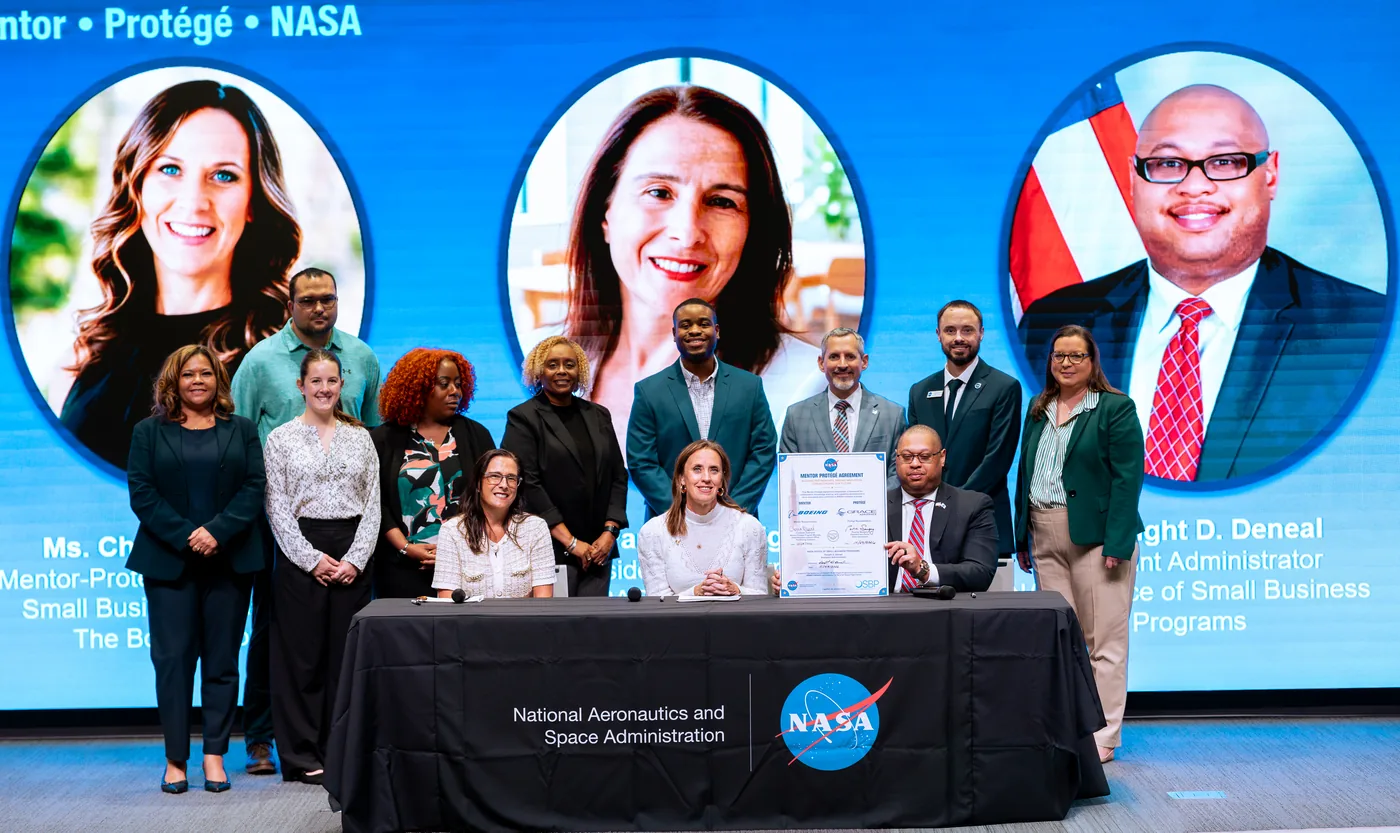
The Boeing Company signed the first agreement under the updated plan. Boeing selected GRACE Aerospace as its small business protégé partner. The agreement is valued at nearly $500,000, with Boeing funding the entire effort to help GRACE expand its hardware capabilities without drawing on public funds from NASA. Private funding lets NASA expand supply chains without new taxpayer grants. Boeing will fund the partnership [1].
Christian Diamond, who manages the mentor-protégé program and serves as small business liaison officer for Boeing, said the partnership creates valuable opportunities for both companies and the wider industrial base. Diamond pointed to the benefits of building dependable suppliers. “Boeing is proud to continue its longstanding relationship with NASA in support of its mission and the opportunities this agreement creates for Boeing, GRACE, and the broader aerospace industrial base,” Diamond said. “Through this partnership, Boeing looks forward to sharing our expertise to support the continued growth and long-term success of a small business while strengthening our supplier base,” Diamond said, describing the company’s commitment to small vendors. By sharing engineering tools and quality systems, Boeing helps GRACE modernize its manufacturing plant for upcoming civil spaceflight contracts, preparing the vendor for long-term program support [1].


NASA Supplier Program Supply Goals
Why do small suppliers matter to future NASA space missions? Spacecraft production relies on a web of machine shops, circuit fabricators, and hardware builders that feed parts into prime contractors assembling flight systems for NASA. Part shortages can quickly delay launch dates for major missions. By simplifying application rules and speeding up approval times, NASA helps small manufacturing shops stay open, active, and capable of building spaceflight components on schedule for upcoming exploration programs. Active supplier networks also help NASA keep flight hardware costs under control [1].
Unlike prime launch service contracts, where NASA directly contracted commercial flights through awards such as the SpaceX additional station flights, this framework pairs large firms with small subcontractors to expand component manufacturing. Boeing will transfer technical systems directly to its protégé. This collaborative approach helps small shops grow into durable suppliers, protecting key production skills that single contractors might struggle to maintain across long government exploration cycles. NASA officials view these supplier capabilities as necessary for future flight readiness. By fostering multiple qualified vendors across the country, the space agency prevents single points of failure in its subcontracting pipeline [1].
Hardware Work at GRACE
GRACE Aerospace brings two decades of experience to the partnership. Under the guidance of Boeing technical specialists, the company will expand its facilities to produce mission-critical aerospace hardware for complex orbital systems and deep space exploration programs. Pauline Sevigny leads GRACE Aerospace as president and owner. “GRACE Aerospace is thankful and honored to participate in the program,” Sevigny said. The firm has spent 20 years supporting defense and aerospace customers with precision components [1].
Sevigny welcomed the chance to work with industry leaders. “We look forward to growing and learning from industry experts and supporting the mission of resilience and space superiority,” Sevigny said, pointing to her team’s preparation for complex space contracts. As space programs demand tighter tolerances and specialized parts, smaller suppliers like GRACE must upgrade shop methods to stay competitive and support long-term space exploration missions. Boeing will help GRACE master those advanced production standards. The two firms will work together on factory floor improvements, precision machining techniques, and rigorous inspection protocols required for modern spacecraft assemblies [1].
Industrial Base Readiness
The supplier plan belongs to NASA’s Office of Small Business Programs. Led from Washington, the office oversees small business outreach across NASA spaceflight centers, working to protect supply chains against parts shortages that have slowed recent aerospace development schedules. Mentorship keeps specialized skills inside the domestic manufacturing base. When prime builders like Boeing train smaller domestic suppliers like GRACE, manufacturing knowledge stays within local factories, building technical readiness for upcoming lunar missions and deep space exploration programs [1].
Future space exploration requires dependable small suppliers across every subsystem. As lunar exploration missions demand intricate parts, the updated NASA supplier program offers a clear path for small firms like GRACE to achieve flight readiness while working directly with industry leaders like Boeing. Primes secure trusted suppliers, and small businesses gain valuable training. By lowering administrative delays and expanding mentorship incentives, NASA helps keep the aerospace manufacturing base ready to support the nation’s highest-priority space exploration goals for decades to come. Agency leaders plan to use this framework to expand supplier capacity as new deep space exploration missions move from the drawing board to the launch pad [1].
- PRESS RELEASE Dooren, J. M. (2026, November 25). NASA Enhances Supplier Program, Announces Mentor-Protégé Agreement. NASA. [Article Link]
APA 7: PerEXP Teamworks. (2026, November 26). NASA Overhauls Supplier Program with Boeing and GRACE Aerospace. PerEXP Teamworks. https://perexpteamworks.com/en/nasa-supplier-program-boeing-grace/


