





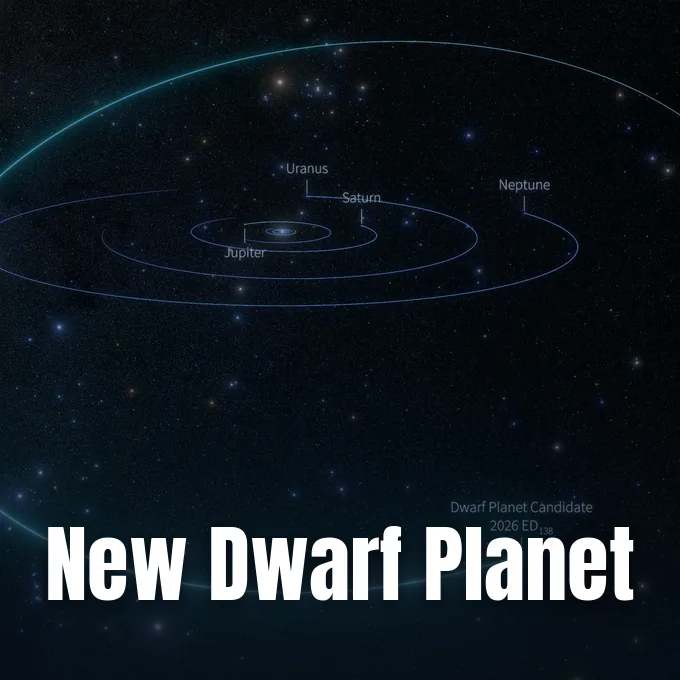
Astronomers analyzing survey images from Chile have identified candidate new dwarf planet 2026 ED138 circling the sun far beyond Neptune [1]. The frozen body travels along an elongated orbit roughly 46 astronomical units (roughly 4.3 billion miles) away from Earth and the sun [2]. Its discovery emerged from test observations collected by the Vera C. Rubin Observatory on Cerro Pachón [3]. If future measurements confirm its size, 2026 ED138 will join an exclusive group of recognized worlds [1].
First Detections in Rubin Data
Astrophysicist Matthew Holman first noticed the moving body on October 13 while evaluating automated tracking routines that he designed with Harvard & Smithsonian Center for Astrophysics colleague Kevin Napier to link isolated detections across different observation nights. When the computer code flagged an unusually bright trajectory beyond Neptune, Holman at first suspected a software defect because finding an unknown candidate of this magnitude seemed improbable. “My first reaction was one of excited disbelief,” Holman said, explaining that objects of this size are very rare in trans-Neptunian space. “Objects like this are very rare, so I immediately started checking whether I or the code had done something wrong.” [1]
The detections came from the Vera C. Rubin Observatory atop Cerro Pachón at an altitude of 8,799 feet (2,682 meters) in northern Chile, where an 8.4-meter primary mirror feeds light into a 3.2-gigapixel digital sensor built for optical astronomy [1]. The Rubin camera covers an area equivalent to 45 full moons in one exposure [2].
Mario Jurić, the Rubin solar system lead scientist at the University of Washington, confirmed the automated track by retrieving 30 detections over 20 nights between March 4 and July 11, 2026, while engineers were still tuning Rubin ahead of its ten-year Legacy Survey of Space and Time [1]. “Finding an object this big, roughly 1,000 kilometers across, is something that happens maybe once in a generation,” Jurić said, noting that 2026 ED138 is the largest trans-Neptunian body discovered in roughly two decades [2].

Archival Images from Cerro Tololo
To trace earlier sightings of 2026 ED138, Holman and Jurić examined archival exposures gathered by the Dark Energy Camera on the Víctor M. Blanco 4-meter Telescope at Cerro Tololo Inter-American Observatory in Chile [1]. Blanco telescope records revealed that the camera had already photographed this world in February 2016, with repeat detections following in 2017, 2018, 2019, and 2023 [4].
Why had a world of this size remained unnoticed in Chilean archives for a full decade? The candidate traveled through crowded stellar fields along the Milky Way band, where millions of background stars hid slowly moving solar system bodies from earlier automated searches. The world qualifies as a trans-Neptunian object, belonging to an icy population scattered around the outer perimeter of the planetary system. Because 2026 ED138 blended into the dense stellar background of the Milky Way, astronomers repeatedly recorded its light over multiple seasons without realizing a planetary candidate was hiding in plain sight [2].
A decade of archival observations allowed researchers to map the orbit with exceptional mathematical precision [4]. Earlier survey images become valuable scientific evidence once astronomers know where to look. University of Washington and Rubin researchers announced the discovery on October 27 at a press conference rather than in a journal paper [3].

Why Measuring a New Dwarf Planet Is Difficult
Astronomers estimate that 2026 ED138 measures between 600 and 1,500 kilometers (373 to 932 miles) in diameter, but its true size is still uncertain [4]. The main obstacle is that optical telescopes only register reflected sunlight [3]. A smaller icy body with high surface reflectivity can bounce back as much optical light as a significantly larger body wrapped in dark organic compounds [2]. Without knowing surface albedo, researchers must work within a broad range of plausible sizes [4]. At the upper end, 2026 ED138 would rival Makemake, while at the lower boundary it still ranks among the largest trans-Neptunian bodies found in twenty years [2].
How can astronomers determine the true diameter of an object that only reflects distant sunlight? The most reliable path needs infrared thermal emissions rather than reflected optical photons [1]. The body warms slightly under solar rays and reradiates that energy as heat in infrared wavelengths [4]. Comparing optical brightness with thermal emission breaks the mathematical degeneracy between surface reflectivity and area, giving astronomers an accurate measurement of true diameter [2].
That size range indicates 2026 ED138 carries enough mass for self-gravity to pull it into a roughly spherical shape [1]. Roundness is a key criterion set by the International Astronomical Union for dwarf planet status, separating true dwarf worlds from irregularly shaped asteroids. If 2026 ED138 maintains hydrostatic balance, its IAU classification will be secure [2].


An Orbit Shaped by Neptune
Calculations from the Minor Planet Center show that 2026 ED138 takes about 281 years to complete one orbit around the sun, traveling along an orbit tilted by roughly 24.5 degrees relative to the main planetary ecliptic. At perihelion, the world comes within 36.86 astronomical units of our sun. At aphelion, it swings out to 49.04 astronomical units, or nearly 4.6 billion miles [4]. The world currently sits 46 astronomical units (about 150 million kilometers per unit) from the sun, with an average orbital distance of 42.95 astronomical units [1].
Astronomers classify 2026 ED138 as a hot-classical trans-Neptunian object due to its steep orbital tilt. In planetary astronomy, the term does not describe environmental temperature, but instead refers to high orbital inclination and eccentric movement [2]. Ancient orbital shifts involving giant planets such as Neptune scattered smaller icy bodies into steep trajectories, preserving a pristine record of dynamical instability in the outer solar system [1].
Pluto’s orbital distance spans from 29.6 to 49.08 astronomical units. This means that 2026 ED138 spends its entire existence within the radial distance envelope where Pluto moves. Yet because its path is tilted much more steeply, 2026 ED138 escaped detection by previous sky surveys [4]. Its steep inclination kept it far above and below the ecliptic plane where planet-hunting surveys concentrated their observations [1].

What This New Dwarf Planet Tells Us
When the International Astronomical Union defined planetary categories in 2006, it created dwarf planets to describe round bodies that share their orbits. Unlike the eight major planets, these objects have not gravitationally cleared their surrounding neighborhoods of other icy fragments [2]. To qualify, a body must orbit the sun and possess sufficient mass to attain hydrostatic equilibrium [1]. If 2026 ED138 is round, confirming another new dwarf planet would expand the recognized outer solar system roster for the first time since 2008 [2]. That expansion would validate models predicting numerous spherical bodies in distant orbits [1].
The International Astronomical Union currently recognizes only five official dwarf planets: Ceres, Pluto, Eris, Haumea, and Makemake [1]. Haumea was the last member added when IAU officials approved its status eighteen years ago [2].
The discovery also sheds light on the broader population of objects populating the Kuiper Belt, an icy realm extending roughly 55 astronomical units outward from the sun [4]. Astronomers also noted that 2026 ED138 is entirely separate from the hypothetical world often discussed as Planet Nine, which theorists proposed to explain odd orbital clustering much farther out in trans-Neptunian space. Instead of being a distant giant planet, 2026 ED138 is a well-preserved survivor from the violent reshuffling of early planetary orbits [2].

Future Observations with Webb
Confirming the true status of 2026 ED138 will need specialized follow-up observations from premier space observatories. Researchers hope to secure observing time on NASA’s James Webb Space Telescope, which possesses the high infrared sensitivity needed to capture the object’s faint thermal glow. Webb could measure emitted heat over multiple infrared wavelengths, pinpointing diameter to within narrow margins [1]. Those thermal observations from Webb would also reveal whether surface ice consists of frozen methane, water, or nitrogen frost [4].
Another promising astronomical technique involves watching for stellar occultations, which happen whenever 2026 ED138 passes directly between observers on Earth and a distant background star. By recording how many seconds the star’s light disappears from multiple observation sites, astronomers can map the object’s exact silhouette. Occultation timings can reveal whether the body has a thin atmosphere or an irregular profile. If astronomers also detect an orbiting moon, tracking that companion’s orbit would yield an accurate calculation of bulk density [2].
Meanwhile, the Vera C. Rubin Observatory has only begun its decade-long sweep of the southern sky from Cerro Pachón in Chile [1]. In preliminary commissioning runs reported in April 2026, Rubin discovered more than 11,000 asteroids, including roughly 380 objects beyond Neptune. Over the next ten years, Rubin will repeatedly scan the sky roughly 800 times, hunting for another new dwarf planet in uncharted regions that earlier surveys skipped [2]. As Holman observed, astronomers are finally assembling a comprehensive inventory of our cosmic backyard, and many more worlds likely await discovery [1].
- ONLINE NEWS Wall, M. (2026, October 28). Astronomers found a mysterious object beyond Neptune, and it could be a new dwarf planet. Space.com. [Article Link]
- ONLINE NEWS Puiu, T. (2026, October 28). Astronomers Have Found a Possible New Dwarf Planet Beyond Pluto. ZME Science. [Article Link]
- ONLINE NEWS Knowridge Science Report. (2026, October 28). Astronomers discover a possible new dwarf planet hiding beyond Pluto. [Article Link]
- ONLINE NEWS Starr, M. (2026, October 28). Astronomers Discover a Giant New Dwarf Planet Candidate Hiding Beyond Pluto. ScienceAlert. [Article Link]
APA 7: PerEXP Teamworks. (2026, October 29). Rubin Observatory Spots Possible New Dwarf Planet Beyond Pluto. PerEXP Teamworks. https://perexpteamworks.com/en/new-dwarf-planet-spotted-beyond-pluto/


