






Modern web and mobile services rely on OAuth 2.0, an open standard for Open Authorization, to share private data across applications without exposing account passwords. Designed specifically to operate over the Hypertext Transfer Protocol (HTTP), the framework enables an end-user to instruct an identity provider like Google or Microsoft to issue temporary access tokens with narrow rights [7]. The standard handles access permissions rather than proving user identity [10]. Token boundaries keep primary accounts secure when connected client tools experience unexpected security incidents.
- Origin of Delegated Authorization
- Core Roles in OAuth 2.0 Systems
- Steps in the Authorization Code Exchange
- Bearer Tokens and Refresh Mechanisms
- Security Hardening with PKCE
- Why OAuth 2.0 Differs From Authentication
- Security Vulnerabilities Affecting OAuth 2.0 Deployments
- Extending Token Grants to AI Agents
Origin of Delegated Authorization
Before the industry developed delegated authorization protocols, connecting web services required sharing raw user passwords with external applications. During the rise of early blogging tools and photo networks, desktop utilities and printing sites asked people for their full account logins [1]. Programs stored these cleartext passwords on unverified private servers to download contact lists or post photos. This design exposed millions of users to catastrophic leaks because a security failure at one third-party utility revealed the master password across every linked service. Account holders could not revoke rights for a single tool without changing their main password and breaking every connected integration simultaneously [6].
In November 2006, developer Blaine Cook began building an OpenID implementation for Twitter. Around the same time, Larry Halff at Ma.gnolia sought ways for Mac OS X Dashboard widgets to access member bookmarks without saving passwords. Cook and Halff met with Chris Messina and David Recordon to define an open protocol for delegated API access. The work gained momentum when DeWitt Clinton from Google joined the initiative, coordinating with Eran Hammer to draft an initial specification that led to the release of OAuth Core 1.0 in October 2007 [6].
Early deployments suffered from session fixation flaws that required an updated 1.0a revision in 2009 [6]. The community gathered at the 73rd Internet Engineering Task Force meeting in Minneapolis in November 2008 to charter a formal working group. In October 2012, the IETF published RFC 6749 to establish the core OAuth 2.0 framework and released RFC 6750 to standardize bearer token usage [1]. An IBM Institute for Business Value study revealed that 52% of enterprise executives consider architectural complexity their greatest operational cybersecurity challenge, demonstrating why unified access standards remain vital for the web [10].
Core Roles in OAuth 2.0 Systems
The RFC 6749 standard divides system responsibilities into four distinct actors [1]. The resource owner is the human user who controls account data. The resource server hosts user files, photos, or contact records, answering incoming API queries after verifying token signatures [12].
The third participant is the client, meaning the app requesting permission to read or modify user assets on the resource server [1]. Author Aaron Parecki explains in OAuth 2.0 Simplified, published with Okta, that clients fall into confidential and public categories based on whether they can safeguard secrets. Confidential clients run on private backend servers where staff can store a client secret away from browser code [11]. Public clients, by comparison, include Single Page Apps (SPA) built with JavaScript or native packages running on Apple iOS and Google Android devices where users can inspect source code. The fourth actor is the authorization server, exemplified by Azure Active Directory (now Microsoft Entra ID) or Google accounts, which checks logins, prompts for user consent, and generates access tokens [12].
Tokens enforce boundaries through scope parameters. When an app requests data, it asks for specific permissions, such as read-only access to Google Calendar entries without requesting Google Drive file editing rights [12]. In an analysis published in IEEE Internet Computing, Leiba noted that standardized web authorization replaces dangerous password distribution with finely partitioned user consent boundaries [4]. Authorization platforms package these approved scopes into structured JSON Web Tokens (RFC 7519) so resource servers can verify claims instantly without querying central databases [11].
Steps in the Authorization Code Exchange
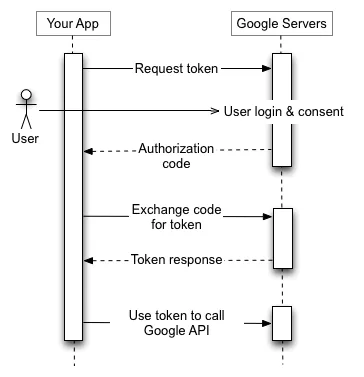
Described in Section 4.1 of RFC 6749, the authorization code flow is the foundation of web security because it separates browser consent from token acquisition [1] [11]. When a person clicks a login button, the app directs the browser toward the provider’s /authorize web path [9]. The request carries a client ID, registered redirect URI, scope list, and a cryptographically generated state parameter to block cross-site request forgery attacks [1]. The user reviews the requested permissions on a consent screen.
After the user logs in and confirms permissions, the authorization server redirects back to the app’s registered callback address [12]. Can an attacker steal tokens from this browser hop? No, because the server issues only a temporary authorization code that expires in 60 seconds [9]. Real access tokens never enter the browser URL bar.

The app takes this short-lived code and begins a back-channel exchange with the server [11]. The app’s backend sends a direct HTTP POST request to the /token endpoint, supplying the code, client ID, client secret, and callback address [1]. Because this transmission travels over encrypted TLS directly between machines, attackers on public Wi-Fi networks cannot snoop the conversation. The authorization server checks the client secret, confirms that the authorization code was not used before, and returns a response payload containing an access token and an optional refresh token [9]. The client stores these tokens in secure server sessions, ready to call protected API endpoints on platforms like GitHub or Google Workspace.
Bearer Tokens and Refresh Mechanisms
RFC 6750 specifies how apps present bearer tokens during HTTP requests, operating much like a hotel room keycard where whomever holds the string can unlock API resources without presenting private cryptographic keys [2] [10]. Bearer strings require no cryptographic key proof. Because any carrier can redeem an active string, Transport Layer Security is mandatory across every network request to prevent sniffing [2].
Clients send bearer tokens inside the standard HTTP Authorization header using the Bearer prefix [2]. While RFC 6750 permits sending tokens in request bodies or URL query parameters, security teams strongly advise against putting credentials into web addresses. Browsers, proxy servers, and caching appliances routinely record full query strings in plaintext logs, leaving tokens visible to system administrators [9]. Production APIs reject query strings. Access tokens also feature short operational lifespans lasting from 15 minutes to one hour, ensuring that an intercepted credential expires before an attacker can cause harm [11]. Developers test these headers using tools like Postman API Platform before shipping code.
When access tokens expire, software uses refresh tokens to get new credentials without bothering the user [12]. Refresh tokens stay restricted to server-side exchanges and never reach resource APIs [1]. Modern systems follow refresh token rotation: every time an app uses a refresh token, the server revokes it and issues a replacement string [11]. If an unauthorized party attempts to replay an old refresh token, the authorization server detects duplicate use and revokes the grant. The IETF OAuth Working Group defined token revocation under RFC 7009 and token introspection under RFC 7662, while RFC 9068 standardized JSON Web Token profiles for access tokens [1].

Security Hardening with PKCE
Public clients such as mobile apps and browser single-page applications cannot safely hide secrets. Attackers can decompile native app binaries or inspect client-side JavaScript to extract embedded credentials [11]. To fix this vulnerability, the IETF created Proof Key for Code Exchange (RFC 7636) [6]. PKCE stops authorization code interception.
Before starting the login flow, the client creates a random secret string called a code verifier [11]. It hashes this string with SHA-256 and encodes it to generate a code challenge, which it sends with the login request. The authorization server records this challenge with the generated authorization code. When exchanging the code for tokens, the client provides the original unhashed code verifier [12]. The server hashes that submitted verifier and checks whether it matches the stored challenge. If an attacker on a smartphone intercepts the authorization code through a custom URI scheme, they cannot exchange it for an access token because they lack the secret verifier, which never left app memory [11]. The OAuth 2.1 working group draft led by Aaron Parecki now makes PKCE mandatory for all client types.
Browser security guidelines published across several RFCs retired older flows that exposed tokens to web scripts. The original 2012 specification allowed an implicit grant where tokens returned directly in URL fragments, but modern IETF recommendations (RFC 8252 and RFC 10017) deprecate that practice due to history logging and token injection risks [12]. While passkeys in modern browsers handle user login verification without passwords, PKCE shields the separate handshake that delegates API permissions to client tools. Frontend developers now route single-page apps through authorization code flows with PKCE.

Why OAuth 2.0 Differs From Authentication
A frequent engineering mistake confuses access delegation with verifying personal identity. OAuth 2.0 does not tell an app who a user is; it only states what operations an app can perform on their behalf [7]. Treating access tokens as proof of identity creates dangerous pseudo-authentication flaws [6].
To provide standardized Single Sign-On (SSO) on top of token infrastructure, the OpenID Foundation created OpenID Connect (OIDC) [10]. When a client adds the openid scope to an authorization request, the authorization server delivers an identity token alongside the access token, formatting it as a digitally signed JSON Web Token that contains verifiable claims about the user’s subject identifier, issuing authority, and authentication timestamp [12] [7]. Apps verify signatures locally using published public keys. Applications establish authenticated local sessions without making extra network roundtrips [11]. Tech giants including Google, Apple, and Microsoft rely on OIDC to power buttons like Sign in with Google across millions of third-party apps.
Enterprise architectures often connect token protocols with legacy federated systems like Security Assertion Markup Language (SAML) [10]. SAML relies on heavy XML assertions to handle corporate single sign-on across intranet systems, whereas OAuth 2.0 and OIDC deliver lightweight JSON tokens suited for mobile devices and cloud microservices. External policy standards like XACML evaluate organizational attributes such as department or geographic location, allowing the authorization server to issue restricted tokens that mirror company security policies [6].
Security Vulnerabilities Affecting OAuth 2.0 Deployments
Even when core specifications are sound, implementation bugs on third-party sites can expose authorization systems to attack [5]. In May 2014, Singapore researcher Wang Jing, a PhD candidate at Nanyang Technological University in Singapore, disclosed the Covert Redirect vulnerability, showing how open redirect flaws on client apps allowed real login popups from Facebook and Google to steal user tokens. CNET writers Aloysius Low and Seth Rosenblatt covered the discovery in detail. Threatpost reporter Chris Brook reported that unvalidated redirect URIs jeopardized authorization codes across major platforms. Security experts Jeremiah Grossman at WhiteHat Security and Chris Wysopal at Veracode confirmed the danger. LinkedIn engineer Shikha Sehgal enforced redirect URL whitelisting, while PayPal CTO James Barrese reported merchant protections [8].
Academic researchers have also probed formal web properties for systemic gaps. In a 2016 research preprint that has not undergone peer review, authors Daniel Fett, Ralf Küsters, and Guido Schmitz proved the presence of four attacks in standard web models. Their research uncovered the AS Mix-Up flaw, where an attacker running a malicious authorization server confuses a client app into forwarding codes meant for an honest identity provider [3]. The authors proved that requiring servers to return explicit issuer identifiers fixes this vulnerability.
Phishing campaigns also target consent screens. In April 2017, an OAuth phishing scheme tricked one million Gmail users into authorizing a malicious third-party tool named Google Apps [6]. Google stopped the campaign within approximately one hour. Gateways need protection too, as seen in reports covering F5 BIG-IP APM OAuth server attacks in corporate setups. Restricting requested scopes minimizes damage if an integration gets compromised [5].
Extending Token Grants to AI Agents
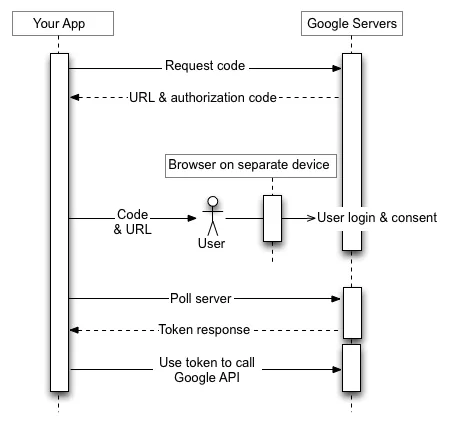
Smart televisions, gaming consoles, and command-line utilities lack full web browsers or physical keyboards. To support these input-limited devices, the IETF ratified the Device Authorization Grant under RFC 8628 [1]. Devices display an activation URL and user code, letting users complete authorization on a phone or laptop [11].
For automated server systems running without human supervision, applications authenticate through the client credentials grant [1]. Background microservices, scheduled cron jobs, and database sync scripts pass their registered client ID and client secret straight to the token endpoint [11]. The authorization server validates credentials and issues a scoped access token without interactive browser popups [10]. In Information and Computer Security, a 2015 study evaluated client-server environments and confirmed that OAuth 2.0 provides robust authorization for cloud API data when applications follow recommended threat mitigation models [5].
The newest use case for delegated tokens centers on autonomous artificial intelligence agents. Instead of giving an AI assistant standing root passwords or static API keys, developers implement the Model Context Protocol to treat tools and datasets as protected resource servers [11]. The AI agent acts as a standard OAuth client, obtaining scoped, short-lived tokens via authorization code flows with PKCE before reading emails or querying cloud storage. This pattern gives users granular oversight, ensuring they can revoke tool access instantly whenever autonomous operations finish.
- REPORT Hardt, D. (Ed.). (2012). The OAuth 2.0 Authorization Framework (RFC 6749). Internet Engineering Task Force. [Article Link]
- REPORT Jones, M., & Hardt, D. (2012). The OAuth 2.0 Authorization Framework: Bearer Token Usage (RFC 6750). Internet Engineering Task Force. [Article Link]
- PREPRINT Fett, D., Küsters, R., & Schmitz, G. (2016). A Comprehensive Formal Security Analysis of OAuth 2.0. arXiv. [Article Link]
- ACADEMIC JOURNAL Leiba, B. (2012). OAuth Web Authorization Protocol. IEEE Internet Computing, 16(1), 74-77. [Article Link]
- ACADEMIC JOURNAL Ferry, E., Raw, J. O., & Curran, K. (2015). Security evaluation of the OAuth 2.0 framework. Information and Computer Security, 23(1), 73-101. [Article Link]
- WEBSITE Wikipedia contributors. (2026). OAuth. Wikipedia, The Free Encyclopedia. [Article Link]
- WEBSITE Microsoft Security. (2026). What Is OAuth?. Microsoft. [Article Link]
- ONLINE NEWS Low, A. (2014). Serious security flaw in OAuth, OpenID discovered. CNET. [Article Link]
- WEBSITE Google for Developers. (2026). Using OAuth 2.0 to Access Google APIs. Google. [Article Link]
- WEBSITE Lindemulder, G., & Kosinski, M. (2024). What Is OAuth (Open Authorization) and How Does It Work?. IBM. [Article Link]
- WEBSITE Yang, D. (2026). Understanding OAuth 2.0 Flow: Complete Diagram and Implementation Guide. DEV Community. [Article Link]
- WEBSITE Auth0 by Okta. (2026). What is OAuth 2.0? Definition & Examples. Auth0. [Article Link]


1 comment