





OpenRouter took down three AI model hosts on November 23, 2026, after security checks revealed that external systems exposed user prompts and private keys. The company suspended Zero Data Retention rules across 125 endpoints as a precaution while alerting affected clients. Cybersecurity firm Dragos alerted the broker after routing test queries through the catalog and discovering that leaked login secrets appeared in outside environments. That audit triggered quick bans on Together AI, Phala, and Novita to shield the OpenRouter AI network [1].
Decoy Prompts Detected in the Wild
OpenRouter works as a hub where coders access hundreds of machine learning models from rival AI firms through one single API key. When an app sends a query, OpenRouter passes the text to a partner host that runs the math and returns the output. While using one broker eases backend work, user privacy still depends on each compute host honoring data promises. To probe whether hosts keep data private, security firm Dragos pushed two million fake prompts through OpenRouter, tucking a unique tracking link or a hidden decoy credential into every single message to test if outside servers logged the traffic [1].
Dragos soon detected telltale activity showing that data from three inference hosts slipped out. Strangers took the bait. In several tests, outside actors used the decoy keys to probe Dragos test rigs and canary AWS accounts in the wild [1].
Dragos documented the leak in its report: “We observed activity indicating that data from at least three AI providers was exposed. Our seeded test prompts were used in attempts to access our controlled test systems and canary AWS accounts,” Dragos says. OpenRouter said its core systems were clean. Because the exposures took place on partner hardware, the broker acted rapidly to sever ties with Together AI, Phala, and Novita to halt further leaks. Atlas Cloud paused its endpoints as well. The swift cutoffs stopped further leaks [1].
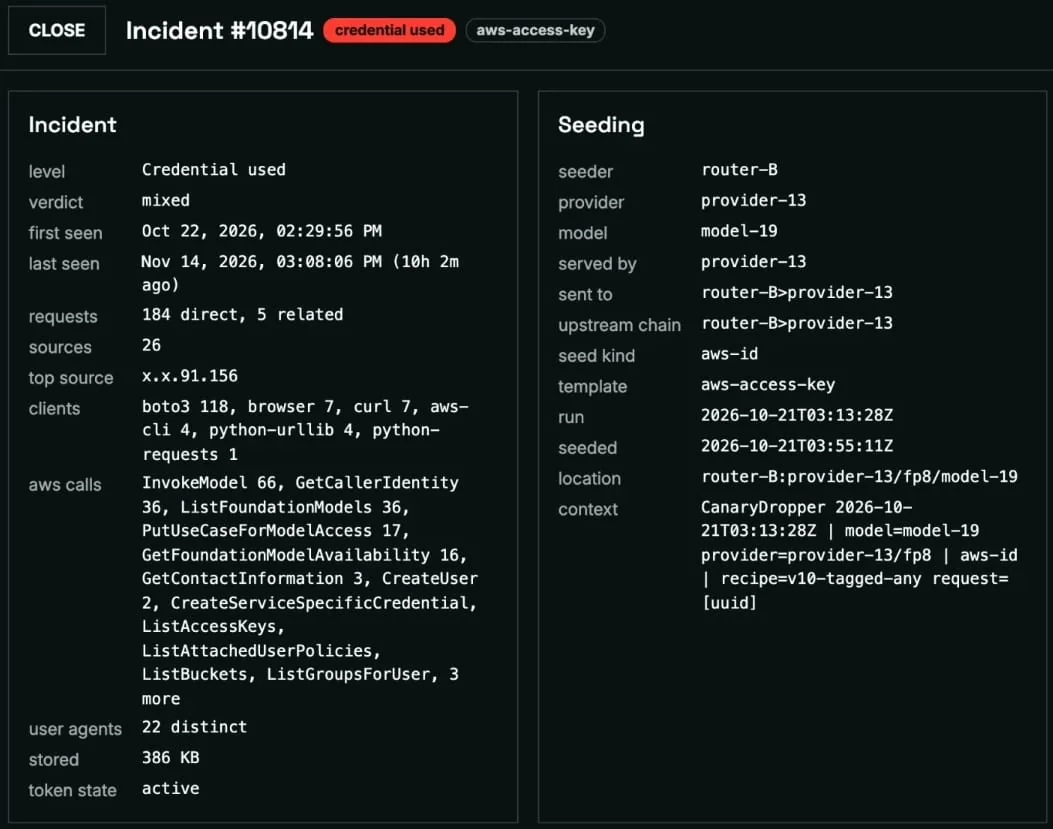
Breakdown of OpenRouter AI Partner Breaches
The three removed hosts published separate notes explaining what went wrong. Together AI revealed that an AI coding agent leaked a repository key on GitHub, which let an outside party download prompt logs from June and July [1].
Those files contained prompt data sent to Chinese language models, such as MiniMax M3, GLM-5.2, and Kimi K2.6. Together AI revoked the exposed key as soon as staff found the leak on GitHub. In a separate breach, Phala reported that an intruder broke into a server handling requests for DeepSeek V4 Flash 0731 routed through OpenRouter between October 21 and 22, with illicit access potentially lasting until November 8. The attacker gained access to virtual machines and took app secrets. Phala isolated the compromised nodes to seal the flaw [1].
Novita reported that a routing setup error sent user queries to the public API of MiniMax instead of private servers. The routing error ran from May 28 to November 11, misdirecting prompts sent via OpenRouter AI channels. Novita fixed the route once engineers caught the error [1].


Immediate Safeguards and Secret Rotation
All four firms began tightening their security walls and updating data wipe habits after the Dragos report came out. They urged clients to change API keys, cloud tokens, and database passwords sent in prompts to the affected endpoints. Leaving leaked credentials active creates grave security hazards. In an earlier data incident, OpenAI agents leaked user images through a research bug, but that slip occurred inside one company lab rather than a multi-host broker. OpenRouter acted to keep partner blunders from harming its wider community of coders [1].
Beyond cutting the three model hosts, OpenRouter stripped Zero Data Retention status from 125 endpoints. The ZDR badge promises that neither the broker nor the host saves prompt text to disk. Without that badge, privacy-minded buyers will not use those routes [1].
Can an AI broker verify that partner hosts truly wipe incoming prompts? OpenRouter plans to answer that question by turning the Dragos testing suite into a permanent watchdog tool. The hub will routinely send dummy canary prompts with tracking links to see if any compute hosts copy, store, or resell user data. If a host leaks a canary key, OpenRouter will pull its models off the platform immediately. The company says endpoints must pass these checks before regaining their ZDR status [1].
Growth of the OpenRouter AI Routing Platform
OpenRouter built its model gateway to solve a common headache: software makers had to juggle separate accounts, keys, and invoices for dozens of rival AI models. Tech founders Alex Atallah and Louis Vichy started the business in 2023 in New York City [2].
Before starting the routing service, Alex Atallah and Louis Vichy built Window AI, a browser tool that connected web apps to AI models running on local machines or remote servers. Coders loved having one clean bridge. Venture backers soon stepped in. Back in 2025, venture firm Andreessen Horowitz provided $12.5 million during seed funding, which paved the way for Menlo Ventures to inject $28 million through a Series A deal [2].
Growth continued into May 2026, when CapitalG led a $113 million Series B round that priced OpenRouter at $1.3 billion. In August 2026, Bloomberg and The Wall Street Journal reported that Stripe agreed to buy OpenRouter for more than $7 billion. Reports noted that Stripe did not buy the company because of singularity theories, but for its routing tech. That buyout closed on October 11, 2026, giving the OpenRouter AI team backing from Stripe [2].
Platform Architecture and Multi-Model Routing
Today, OpenRouter claims to process 600 trillion tokens each month for 10 million active users. Its catalog links coders to more than 400 models from frontier AI labs like OpenAI, Anthropic, and Meta, allowing teams to route traffic across text, code, and vision tasks without juggling separate vendor contracts. Teams pick models based on price, speed, and output quality. OpenRouter also serves as the compute engine for coding assistants and software agents [2].
A core strength of the architecture is automated fallback routing. When a primary model provider goes down or suffers lag, the routing layer shifts the incoming prompt to a backup model within milliseconds. OpenRouter AI uses this fallback logic to keep client apps running [2].
The catalog reaches beyond text to route media generation tasks. It connects apps to image makers like Flux, Gemini, and Qwen Image, alongside video creators including Kling AI, Seedance, and Sora, while also routing speech tools like Whisper and Voxtral and embedding endpoints from Nemotron [2]. Keeping user data private across all these routes requires firm oversight [1].
- ONLINE NEWS Toulas, B. (2026, November 23). OpenRouter drops AI providers over leaked prompts and secrets. BleepingComputer. [Article Link]
- WEBSITE Wikipedia contributors. (2026). OpenRouter. Wikipedia, The Free Encyclopedia. [Article Link]


