






The annual Orionid meteor shower reaches its peak during the early morning hours of October 21 and 22, 2026, offering observers one of autumn’s most reliable celestial displays. The shower follows the summer Perseids and precedes December’s Geminids, producing swift shooting stars that emerge from the constellation Orion [1]. A favorable lunar schedule leaves the morning sky dark after 2 a.m. local daylight time [2].
Peak Hours for October Observers
Skywatchers can expect peak activity during the pre-dawn hours of Wednesday, October 21, and Thursday, October 22. Hayden Planetarium lecturer Joe Rao said meteor counts during the peak typically reach 15 to 20 meteors per hour under dark rural skies, while sporadic background meteors add another six streaks per hour [2]. The radiant point from which the meteors appear to diverge sits in Orion, just above and to the left of the reddish supergiant star Betelgeuse. Orion stays below the eastern skyline through early evening, only climbing into view past 11 p.m. local daylight time [1]. The number of visible streaks climbs steadily as the constellation ascends into the southern sky after midnight [2].
Viewing conditions improve steadily after 2 a.m. when Orion stands well above the horizon and the brightest stars of the winter sky take center stage. Observers who wait until roughly 5 a.m. will see Orion at its highest point due south, just before the first light of dawn begins to brighten the sky [1]. Astronomy Magazine writer Alison Klesman said observers should look roughly 40° to 60° away from Betelgeuse instead of staring directly at the radiant, because meteors traveling farther from the origin point leave longer visible trains. Peak activity falls on Wednesday morning [2].
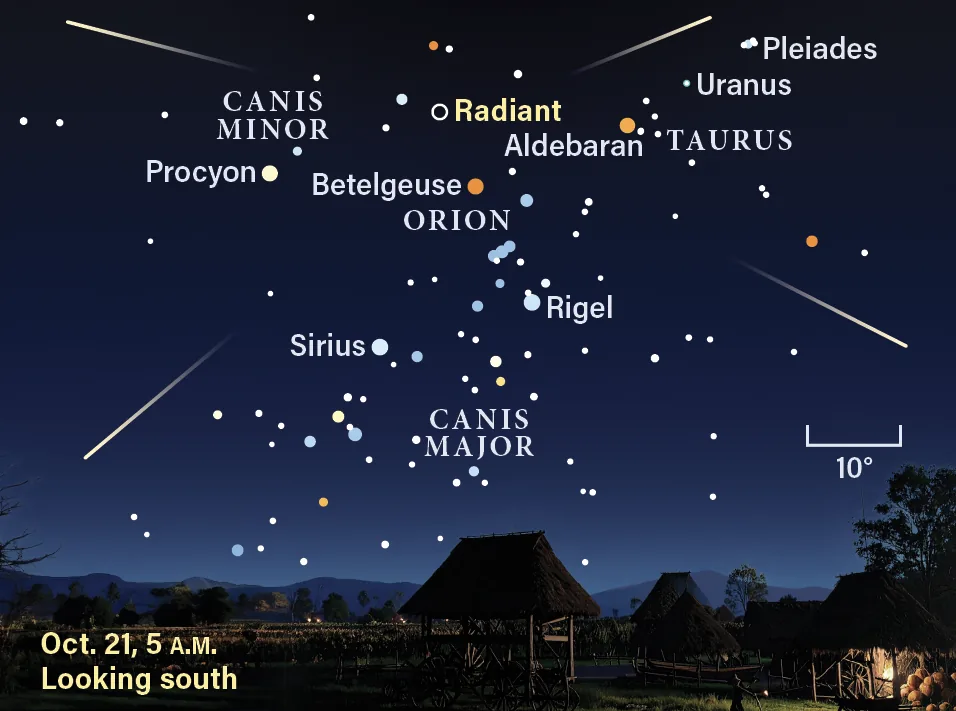
Locating the Orionid Meteor Shower Radiant
Locating the source of the shower in the autumn sky begins with finding the familiar outline of Orion the Hunter. The three distinct stars of Orion’s Belt point upward toward Betelgeuse, the bright red giant that marks the hunter’s right shoulder. A sky chart prepared by Roen Kelly for Astronomy Magazine illustrates how meteors appear to fan outward from the raised club of Orion, slightly northeast of Betelgeuse [2]. Because the particles travel in parallel paths through space, perspective causes them to appear to diverge from a single point, much like straight highway lanes seeming to fan out from a point in the distance [1]. Even though the radiant marks the center of activity, streaks appear across many parts of the sky [2].
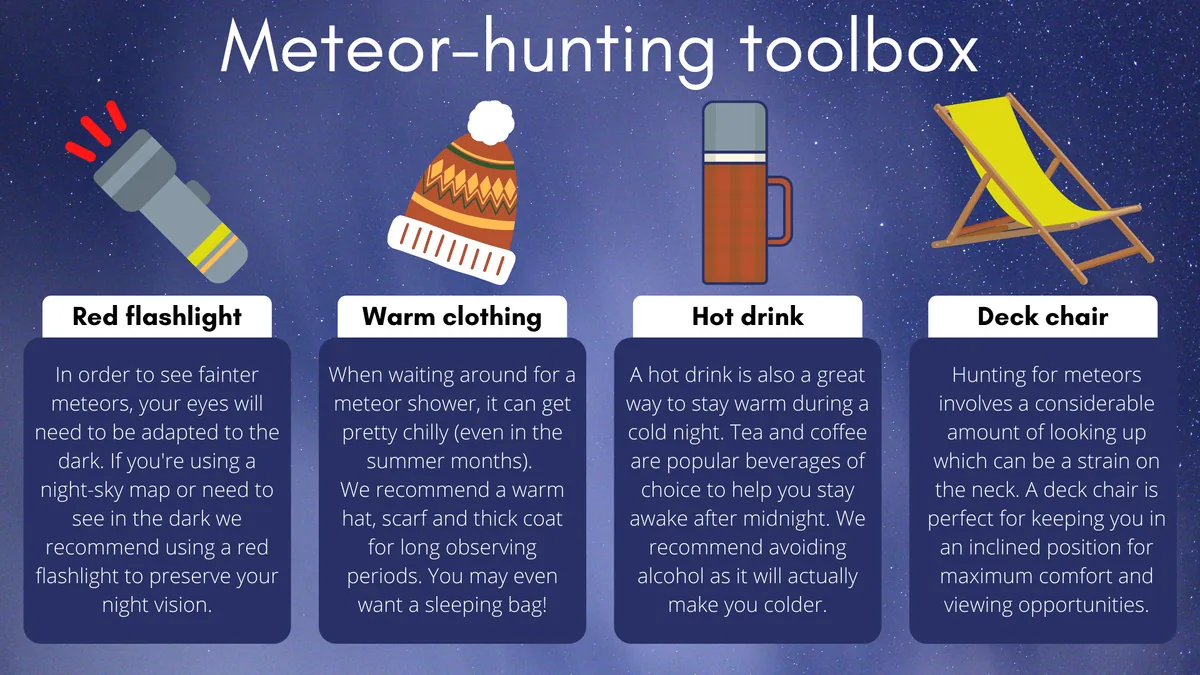
Spectators do not need telescopes or binoculars to spot the streaks, because optical instruments narrow the visual field too much for fast targets. Instead, lying back in a reclining chair with a wide view of the southern sky offers the best vantage. Giving human eyes twenty minutes to adapt to darkness makes faint streaks visible against the black background. Binoculars reveal faint stars but miss wide tracks [1].
Moonset Hours Before Morning Dawn
Moonlight often threatens to wash out faint meteors, but the lunar schedule for October 2026 provides a welcome dark window. On the peak morning of October 21, the waxing gibbous Moon sits in the dim constellation Capricornus, illuminated to roughly 81 percent of full brightness [2]. That bright lunar disk reaches its highest southern point around 8:45 p.m. local daylight time [1].
The setting time of the Moon makes the morning hours particularly favorable for meteor watchers. The lunar disk sets shortly after 2:15 a.m. on October 21, clearing the sky of glare for about three and a half hours before dawn. The dark window allows viewers to spot faint meteors that city lights or bright moonlight would otherwise drown out [1]. Lunar timing plays a major role throughout the autumn observing season, as outlined in the 2026 full moons schedule, where the next full moon arrives on October 25 and 26. Earlier in the month, the Moon reached apogee on October 16 at a distance of 251,434 miles (404,644 km) from Earth, following its first quarter phase on October 18 [2].
Stargazers can also look back at community sky events such as Observe the Moon Night celebrations to see how shifting lunar phases influence viewing conditions across different weeks [2]. While bright moonlight limits early evening skywatching, the post-midnight sky on October 21 leaves unobstructed views right when the radiant stands highest [1]. The Moon reaches 73 percent illumination on October 20 [2].


Debris Streams from Halley’s Comet
Every meteor seen during the display originates from microscopic debris shed by 1P/Halley, known colloquially as Halley’s Comet. Comets are primitive icy bodies that formed with the Sun and planets roughly 4.6 billion years ago, preserving ancient material in the cold outer solar system. Out past the major planets, these objects spend centuries in deep cold near -459.67°F (-273.15°C), where chemical reactions stop. Joe Rao called comets “time capsules from the solar system’s childhood”. Over the past 100,000 years, Halley has made well over a thousand trips around the Sun, leaving a broad trail of dust along its orbit [1].
As the comet sweeps close to the Sun, solar heat causes surface ices to sublimate into gas, releasing trapped dust grains into interplanetary space. Joe Rao said the particles resemble brittle bits of “cigar ash”, not solid rocks. Earth crosses this wide orbital stream twice each year, once in May to produce the Eta Aquarid shower and again in late October to create the Orionids. Halley itself last visited the inner solar system in early 1986, when the European Giotto spacecraft flew within 600 kilometers of its nucleus to photograph gas and dust jets. With an orbital period of 75.4 years, Halley will not return to the inner solar system until late July or early August 2061 [1].

Orionid Meteor Shower Particle Speeds
Particles that encounter Earth during the Orionid meteor shower travel at remarkable speeds relative to our atmosphere. Meeting Earth almost head-on along their orbital track, the tiny meteoroids strike the upper atmosphere at 41 miles (66 km) per second. Friction with atmospheric gas compresses and heats the air ahead of each grain, vaporizing the particle and leaving a glowing streak of light. Most of these particles burn up at an altitude of about 80 miles (130 km) above Earth, higher than meteors from many other annual showers. Fast grains vaporize high in thin air [1].
About half of the meteors produced by the Orionid meteor shower leave persistent trains, which are glowing vapor trails that linger in the upper atmosphere for several seconds after the meteor itself has vanished. Researchers think the composition of Halley’s outer surface explains this lingering glow, because lightweight particles vaporize easily at high altitudes. The speed of the particles makes them appear as swift, sharp streaks across the sky rather than slow fireballs. Observers watching from dark sites can see these glowing trails drift slightly in high-altitude wind currents before fading into the starry background [1].
Saturn and Neighboring Night Targets
Skywatchers stepping outside before the 2 a.m. moonset can explore several notable planetary targets while waiting for Orion to rise. The ringed planet Saturn shines brightly at magnitude 0.3 in the constellation Cetus the Whale, standing roughly 30° high in the southern sky by mid-evening. Titan orbits far to Saturn’s east [2].
Through a small telescope, Saturn displays its broad rings tilted to show their southern face, flanked by its largest moon Titan at eighth magnitude and smaller moons Tethys, Dione, Rhea, and Iapetus at tenth to eleventh magnitude. On October 18, tiny Tethys transited Saturn’s disk between 9:35 p.m. and shortly after midnight EDT, casting a small shadow that tracked across the pale cloud tops. High in the south around 10 p.m., the bright star Fomalhaut glows at magnitude 1.2 in Piscis Austrinus the Southern Fish, resting 20° above the horizon. Fomalhaut ranks as the eighteenth brightest star visible from Earth [2].
In the constellation Capricornus, binocular observers can find Alpha Capricorni and Beta Capricorni northwest of Sagittarius, where Beta Cap displays contrasting colors like Albireo in Cygnus across 330 light-years. Nearby in Scutum the Shield below Altair in Aquila the Eagle, observers can spot the Wild Duck Cluster, a 250-million-year-old grouping cataloged as M11 or NGC 6705 that glows at magnitude 5.8. In northern Pegasus, the Deer Lick Group galaxy NGC 7331 stands high near Matar, offering rewarding viewing before the pre-dawn meteor watch begins [2].
- ONLINE NEWS Rao, J. (2026, October 16). How to see the Orionid meteor shower 2026 peak this week — and when to look. Space.com. [Article Link]
- ONLINE NEWS Klesman, A. (2026, October 16). The Sky This Week from October 16 to 23: The Orionids peak. Astronomy Magazine. [Article Link]
APA 7: PerEXP Teamworks. (2026, October 17). Orionid Meteor Shower Reaches 2026 Peak in October Sky.


