





Post quantum cryptography refers to crypto tools built to protect digital networks against attacks by future quantum computers. Everyday systems rely on public-key tools like RSA and elliptic-curve cryptography to secure banking, web traffic, and code updates. When a large quantum computer arrives, running Shor’s algorithm will let it solve prime factors and discrete logs in polynomial time. Post-quantum tools rely on hard math puzzles that stymie both classical and quantum machines, keeping secret data safe across global networks [12].
- How Asymmetric Keys Fail Against Quantum Attacks
- Mathematical Limits of Classical Ciphers
- How Post Quantum Cryptography Uses Lattice Math
- Alternative Code and Hash Families
- The NIST Post Quantum Cryptography Standards
- How Single Laptops Broke Fragile Candidates
- The Threat of Harvest Now Decrypt Later
- Setting Post Quantum Cryptography Migration Deadlines
How Asymmetric Keys Fail Against Quantum Attacks
The main goal of post-quantum systems is replacing vulnerable public-key tools before quantum hardware matures. Standard symmetric ciphers like AES-256 stay safe against quantum attacks because Grover’s algorithm gives only a quadratic speedup, which engineers fix simply by doubling key lengths [12]. In contrast, public-key schemes that run digital signatures and key exchanges break down under Shor’s algorithm. Cryptographers build post-quantum tools to run on standard microchips, routers, and mobile phones without needing exotic quantum hardware or special optical links [1].
In October 2008, the University of Cincinnati hosted an international cryptography conference cochaired by mathematician Jintai Ding and Johannes Buchmann of Germany’s Technische Universität Darmstadt. Ding told IEEE Spectrum editor Monica Heger that public keys protect basic functions like operating system updates. Ding pointed out that if an attacker cracks RSA, an adversary could forge update signatures from vendors like Microsoft and wipe out user machines. Buchmann said preparing defenses is urgent because society uses RSA every day [1]. Joost Renes, principal security architect at NXP Semiconductors, said industry awareness grew as firms realized quantum machines threaten legacy hardware [6].
Richard Marty, chief technology officer at LGT Financial Services, said his firm spent 18 months and half a million dollars testing quantum-safe tools to block data harvesting [6]. Organizations cannot rely on quantum key distribution to solve this problem. Photons scatter quickly in glass fiber lines and cannot travel far without repeaters. Ding said quantum crypto cannot authenticate who is speaking, whereas post quantum cryptography verifies sender identity directly inside software protocols [1].
Mathematical Limits of Classical Ciphers
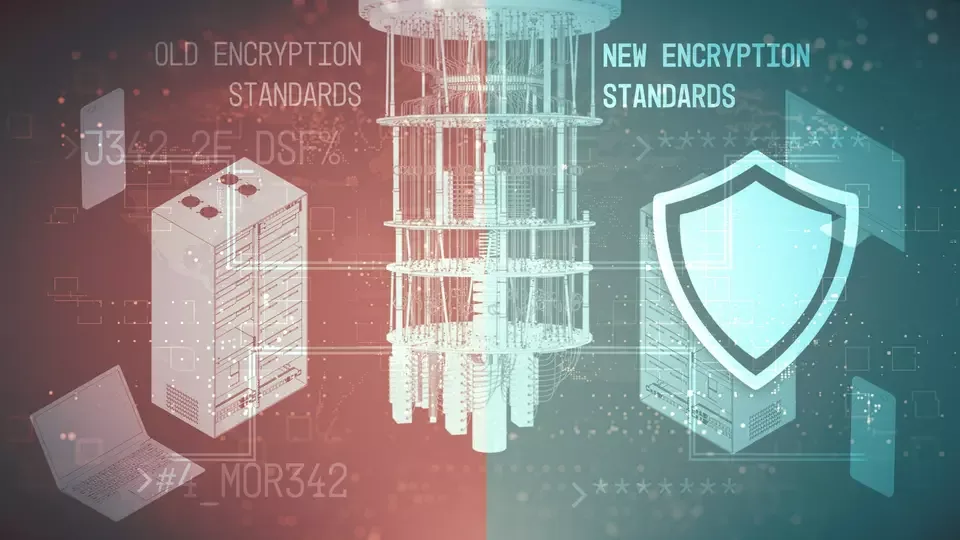
Public-key schemes depend on math puzzles that standard computers cannot solve in a human lifetime. RSA relies on the difficulty of finding the prime factors of huge numbers, while elliptic-curve cryptography depends on discrete logarithms. In 1994, mathematician Peter Shor published a quantum algorithm showing that a quantum computer using superposition and interference could solve both problems in polynomial time. That paper showed that classical public-key tools have a finite lifespan. When engineers build a fault-tolerant machine with enough qubits, every classical key exchange and digital signature protocol will become vulnerable to decryption [14].
At the National Institute of Standards and Technology (NIST), mathematician Dustin Moody said elliptic-curve systems like FIPS 186-4 and SP 800-56B give short keys that save device memory. Yet Shor’s algorithm cracks those elliptic curves as easily as RSA [5]. In March 2026, a research paper from Google Quantum AI, Stanford University, and the Ethereum Foundation showed that elliptic curves guarding major blockchains could fall to a quantum machine with fewer than 500,000 physical qubits [14]. Because corporate cryptographic transitions take over a decade, keeping old algorithms until quantum machines arrive creates huge risks [5].
Symmetric ciphers fare much better. Grover’s algorithm cuts symmetric strength in half, making AES-128 act like 64-bit encryption against a quantum adversary. Upgrading to AES-256 restores a 128-bit quantum security margin. The real exposure sits in public-key tools, where login systems like passkeys in modern operating systems rely on math that Shor’s algorithm untangles [14].
How Post Quantum Cryptography Uses Lattice Math
Lattice crypto has become the leading foundation for post-quantum defense. In multi-dimensional geometric grids, algorithms build puzzles around the shortest vector problem (SVP) and the closest vector problem (CVP), which are NP-hard. A core design called learning with errors, along with its variant ring learning with errors, hides secret vectors by adding small math errors or noise. Standard and quantum computers both struggle to find the hidden vector without the private key [12].
In April 2024, researcher Yilei Chen of Tsinghua University in Beijing posted a preprint claiming a quantum algorithm that could solve certain lattice problems. Global cryptographers studied Chen’s proof and found a bug within ten days, confirming that lattice systems stayed secure [6, 9]. Lily Chen, head of the NIST cryptography group, said that because skilled researchers tried hard to break the algorithm and failed, confidence in lattice math grew higher [6].
Hardware teams study how lattice schemes run on small microcontrollers and embedded chips. Tim Fritzmann and researchers at Technische Universität München built masked hardware accelerators for Kyber and Saber, using RISC-V instruction extensions to stop electromagnetic side-channel leaks. Rolling out post quantum cryptography on server chips keeps latency low while shielding high-volume network traffic [16].
Alternative Code and Hash Families
Cryptographers study other math families to avoid leaning only on lattices. Code-based cryptography, built by Robert McEliece using error-correcting Goppa codes, has withstood cryptanalysis for over 40 years. These schemes use large public keys, but their decrypt steps are fast. In a 2015 preprint titled Quantum Resistant Random Linear Code Based Public Key Encryption Scheme RLCE, mathematician Yongge Wang proposed using random linear codes to shrink key sizes, though that paper was an unreviewed preprint on arXiv [3, 12]. Wang added random columns to generator matrices, showing how coding theory provides backup options if lattices ever fail [3].
Hash-based cryptography offers another mature path, especially for digital signatures. Invented by Ralph Merkle in the late 1970s, Merkle tree signatures depend on hash functions rather than complex algebra. In 1989, Moni Naor and Moti Yung designed signatures based on universal one-way hash functions, paving the way for stateful systems like XMSS in RFC 8391 and modern stateless hash signatures. Hash signatures provide high trust, but they produce larger output files than lattice schemes [12].
Multivariate cryptography uses systems of nonlinear polynomial equations over finite fields, drawing on NP-hard algebra studied by Jintai Ding [1, 12]. The Unbalanced Oil and Vinegar scheme stays under active study, though building encryption tools from multivariate polynomials has proven difficult. The European Commission Post-Quantum Cryptography Study Group noted that maintaining diverse mathematical families ensures long-term security if unexpected algebraic shortcuts emerge [12].

The NIST Post Quantum Cryptography Standards
In 2016, NIST launched a global competition to standardize quantum-safe algorithms. Dustin Moody announced the project at PQCrypto in Fukuoka, Japan, drawing 82 initial submissions from teams in 25 countries [5, 6]. Over eight years and four rounds, NIST evaluated key sizes, speed, and math strength with help from industry and academia [2, 6]. Deputy Secretary of Commerce Don Graves said the effort protects economic competitiveness and secures electronic infrastructure [2].
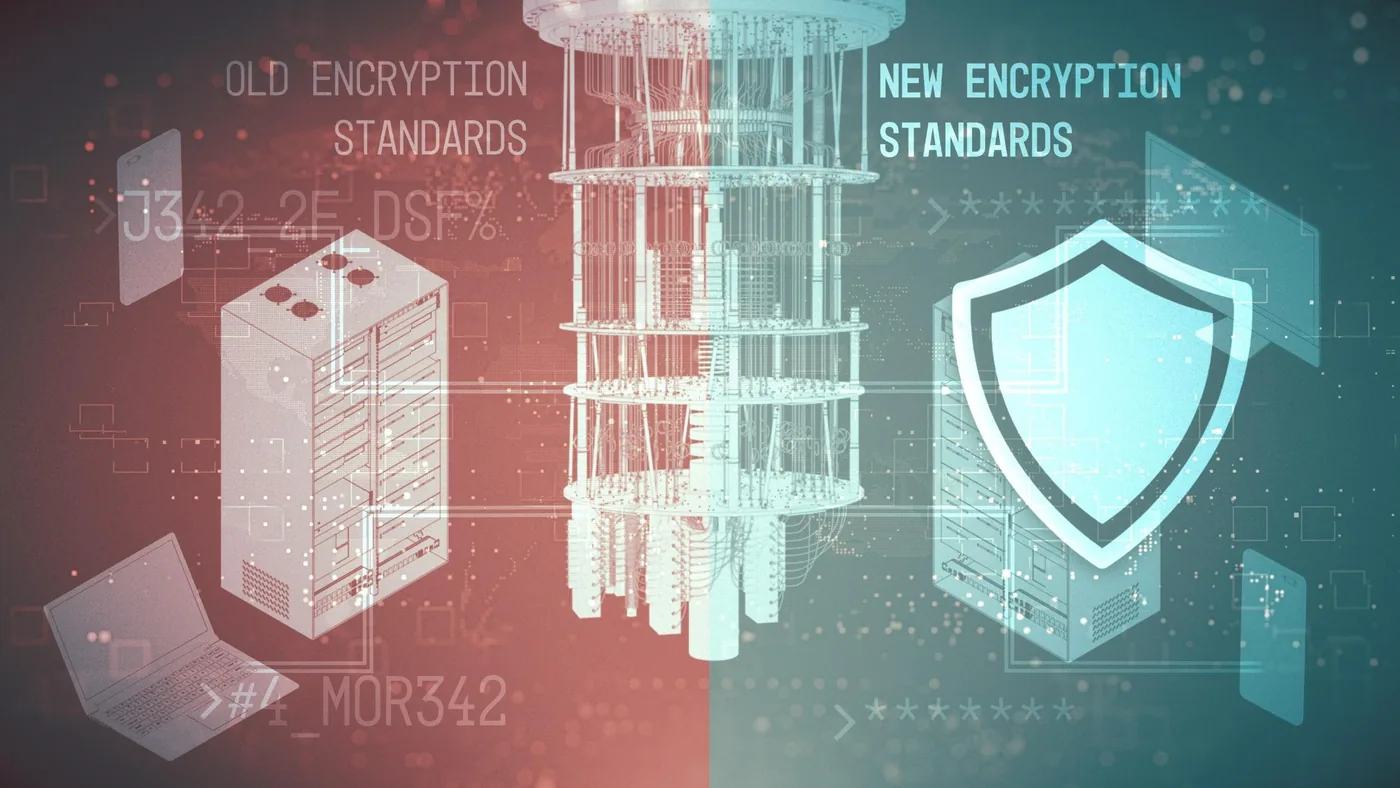
On August 13, 2024, NIST released its first three completed post-quantum Federal Information Processing Standards. The main general encryption standard is FIPS 203, based on CRYSTALS-Kyber and named ML-KEM, short for Module-Lattice-Based Key-Encapsulation Mechanism. For digital signatures, NIST issued FIPS 204, standardizing CRYSTALS-Dilithium as ML-DSA, and FIPS 205, standardizing Sphincs+ as SLH-DSA. NIST also prepared FIPS 206, based on the FALCON algorithm, dubbed FN-DSA [2].
Moody urged organizations to adopt the new standards right away rather than waiting for backup algorithms [2]. To keep math diverse, NIST continues testing backups, including the code-based Hamming Quasi-Cyclic (HQC) algorithm picked in March 2025 [4, 13]. Deploying post quantum cryptography allows teams to upgrade transport layer security and use Merkle tree certificates to scale web public key infrastructure [2, 4].
How Single Laptops Broke Fragile Candidates
The NIST contest showed that candidate algorithms can collapse under unexpected math insights. In round three, IBM cryptographer Ward Beullens broke the Rainbow multivariate signature scheme over a weekend using a personal computer [8, 13]. Rainbow had reached advanced stages because its short signature sizes suited fast networking, but Beullens found an algebraic flaw that let an attacker pull out secret keys without quantum hardware [8].
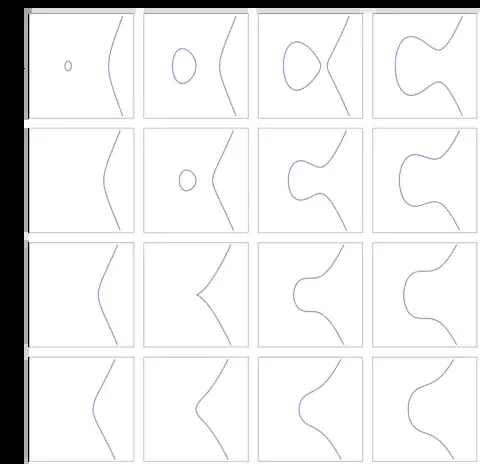
A larger shock hit the community in July 2022 with the supersingular isogeny Diffie-Hellman protocol (SIDH), an alternate candidate called SIKE. Proposed in 2011 by David Jao of the University of Waterloo and Luca De Feo of IBM, SIDH used walks on graphs of elliptic curves connected by isogenies to generate compact keys. But Wouter Castryck and Thomas Decru of the Catholic University of Leuven in Belgium applied a 1997 theorem by Ernst Kani regarding abelian surfaces to crack SIDH in 62 minutes on a basic laptop. Other researchers refined the attack to ten minutes, ending SIDH as a candidate [8].
Cryptographer Steven Galbraith called the break a shock, and Christopher Peikert said losing the scheme was a bummer. Thomas Prest of PQShield said the attack showed that a math structure with no obvious flaw from one view can fall apart from another angle. Jeffrey Hoffstein of Brown University said that in cryptography, true confidence comes only after many people try to break a system and fail [8].
The Threat of Harvest Now Decrypt Later
Waiting for a working quantum computer before upgrading creates severe dangers due to harvest now, decrypt later [6, 11]. Hostile groups and state spies record encrypted web traffic flowing through undersea fiber cables and data hubs [10, 14]. While attackers cannot read the scrambled text today, they store the data until a capable quantum machine comes online to decrypt it [6, 11].
Mathematician Michele Mosca created Mosca’s theorem to help leaders gauge their exposure timeline [12, 14]. Can companies afford to delay upgrades? If the years data must stay secret plus the years needed to upgrade exceeds the time until a quantum code-breaker appears, the system is already exposed [14]. Health records, trade secrets, and state intelligence often need secrecy for thirty years, meaning captured data faces future exposure [6, 10].
In October 2025, Cloudflare reported that the majority of human web traffic through its network uses post quantum cryptography. Cloudflare deployed hybrid key exchanges pairing standard X25519 with ML-KEM-768 [7, 9]. Cloudflare also launched its post-quantum GeoKey Manager, which uses hardware Trusted Platform Modules and temporary kernel memory to stop harvest-now attacks while keeping keys inside regional boundaries like Germany or the European Union [7].
Setting Post Quantum Cryptography Migration Deadlines
Upgrading world networks requires set roadmaps spanning several budget cycles. In March 2025, the UK National Cyber Security Centre (NCSC) issued guidance advising organizations to finish discovery work by 2028. The NCSC roadmap tells operators of critical national infrastructure and control systems to complete full migration by 2035 [7].
United States rules push similar schedules. A June 2026 White House Executive Order ordered high-impact federal agencies to adopt quantum-safe key exchange by 2030 and digital signatures by 2031, matching National Security Memorandum 10 which sets a complete migration deadline of 2035 [10, 14]. NSA rules set 2027 for new acquisitions in National Security Systems. Vendor Nathan Jokel of Cisco wrote that Cisco will enable quantum-safe communication across its core line by December 2026, equipping enterprise routers, switches, and firewalls with quantum-safe secure boot [10].
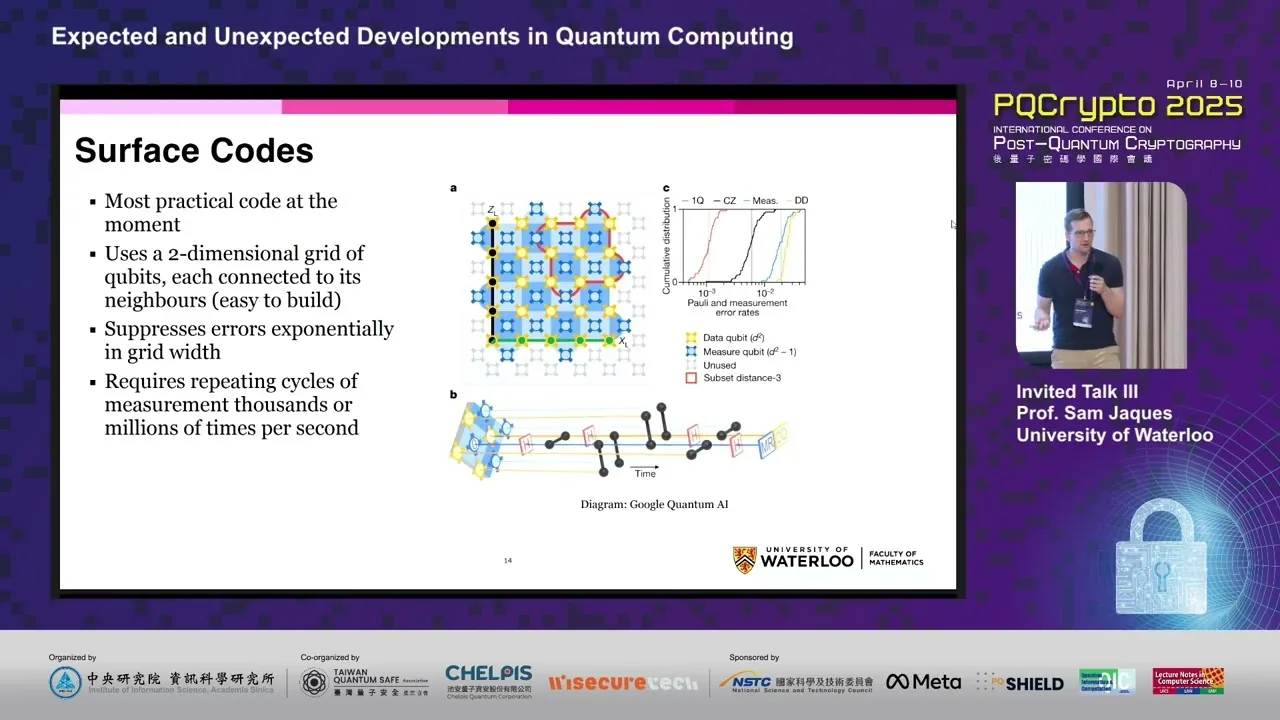
Projections for when quantum machines will crack public keys keep shifting. In June 2025, quantum researcher Craig Gidney published software optimizations showing that breaking RSA-2048 needs fewer than one million superconducting qubits, down from earlier estimates of 20 million. Samuel Jaques of the University of Waterloo calculated that cracking RSA-2048 needs over 242,000 superconducting qubits, projecting Q-day between 2039 and 2041. Because corporate upgrades take years to finish, rolling out post quantum cryptography today is the only way to shield sensitive records [9, 10].
- ONLINE NEWS Heger, M. (2008). Q&A With Post-Quantum Computing Cryptography Researcher Jintai Ding. IEEE Spectrum. [Article Link]
- PRESS RELEASE Boutin, C. (2024). NIST Releases First 3 Finalized Post-Quantum Encryption Standards. National Institute of Standards and Technology. [Article Link]
- PREPRINT Wang, Y. (2015). Quantum Resistant Random Linear Code Based Public Key Encryption Scheme RLCE. arXiv. [Article Link]
- REPORT National Institute of Standards and Technology. (2016). Report on Post-Quantum Cryptography (NISTIR 8105). Computer Security Resource Center. [Article Link]
- WEBSITE Moody, D. (2020). The Future Is Now: Spreading the Word About Post-Quantum Cryptography. Taking Measure, National Institute of Standards and Technology. [Article Link]
- ONLINE NEWS Genkina, D. (2024). Post-Quantum Cryptography Standard is Here. IEEE Spectrum. [Article Link]
- REPORT National Cyber Security Centre. (2025). Timelines for migration to post-quantum cryptography. UK NCSC Guidance. [Article Link]
- ONLINE NEWS Cepelewicz, J. (2022). ‘Post-Quantum’ Cryptography Scheme Is Cracked on a Laptop. Quanta Magazine. [Article Link]
- WEBSITE Cloudflare. (2025). State of the post-quantum Internet in 2025. Cloudflare Blog. [Article Link]
- WEBSITE Jokel, N. (2026). Are You Post-Quantum Ready? Build Quantum Readiness Into Today’s Infrastructure Strategy. Cisco Blogs. [Article Link]
- WEBSITE Cloudflare. (2026). Bringing post-quantum cryptography to geographically fenced key management. Cloudflare Blog. [Article Link]
- WEBSITE Wikipedia contributors. (2026). Post-quantum cryptography. Wikipedia, The Free Encyclopedia. [Article Link]
- WEBSITE Wikipedia contributors. (2026). NIST Post-Quantum Cryptography Standardization. Wikipedia, The Free Encyclopedia. [Article Link]
- WEBSITE Wikipedia contributors. (2026). Quantum threat. Wikipedia, The Free Encyclopedia. [Article Link]
- CONFERENCE PAPER Lequesne, M., & Tillich, J. (2018). Attack on the Edon-K Key Encapsulation Mechanism. IEEE International Symposium on Information Theory. [Article Link]
- ACADEMIC JOURNAL Fritzmann, T., Beirendonck, M. V., Roy, D. B., Karl, P., Schamberger, T., Verbauwhede, I. M., & Sigl, G. (2021). Masked Accelerators and Instruction Set Extensions for Post-Quantum Cryptography. IACR Transactions on Cryptographic Hardware and Embedded Systems, 414-460. [Article Link]


