






Microsoft shared new architecture details for Project Helix, outlining a hybrid console built to run both native Xbox releases and games from PC storefronts like Steam and GOG. The update arrived through a retrospective publication marking twenty-five years of Xbox hardware since the original system debuted in 2001. Speaking in the magazine, Vice President of Next Generation Jason Ronald said the team designed the hardware as a living room console that can run PC software, not as a desktop computer plugged into a television [1]. The design preserves the quick startup of an Xbox console while giving players access to deeper graphics settings if they choose to tinker [3]. It isn’t an attempt to turn consoles into desktop rigs [1].
Console Roots Behind Project Helix
Ronald detailed the hardware philosophy in Microsoft’s 25 Years of Play magazine, which distributed copies to attendees at Seattle FanFest before appearing online. Helix prioritizes a quick living room interface. “Helix is designed to be a console that is also capable of playing games from your PC. It is not a PC that can also play console games,” Ronald said. Players who connect the hardware to a television can launch titles without configuring Windows drivers or adjusting external launchers, while PC enthusiasts who want to modify resolution profiles or test hardware benchmarks can open full configuration menus [1].
Microsoft shaped this strategy around shifting habits among younger players, pointing specifically to Generation Alpha as a main influence during design discussions. Ronald said children in this demographic grew up with touchscreens, tablets, and streaming platforms where digital content moves freely between different screens. “So this idea that their content is locked to any one individual device is completely foreign to them; when you look at that generation, they apply those same expectations to games,” Ronald said. Older generations split television gamers from PC players. Today’s players expect their save files, friend lists, and game libraries to travel everywhere without hardware barriers [1].

Creator-driven gaming forms another key piece of this roadmap. Ronald said future Xbox titles will move beyond standard community mods into expansive virtual worlds where players craft interactive stories and share them directly with other gamers. Lowering technical barriers allows independent studios and solo creators to build new projects without managing platform-specific differences between Xbox and Windows. The goal centers on making creative tools intuitive for anyone holding a controller [1].
Neural Rendering and Silicon Architecture
Rising component expenses have created serious hurdles across the electronics sector because data center demand for artificial intelligence hardware has consumed vast amounts of memory and silicon fabrication capacity [2]. To counter these price pressures without sacrificing fidelity, Microsoft partnered with AMD to build a custom System-on-Chip manufactured on a TSMC 3nm process node. AMD Senior Vice President Jack Huynh confirmed the chip relies on the RDNA 5 graphics architecture co-designed for next-generation DirectX graphics pipelines [5]. A central pillar of this hardware is neural rendering, which uses machine learning algorithms running on an integrated Neural Processing Unit to generate frames without demanding raw compute power. Ronald said this technique lets developers boost visual quality without forcing players to buy more expensive memory chips [2].
“It’s an entirely new way to generate a frame without requiring more computational horsepower, additional memory, and things like that,” Ronald said. He stated that technological progress across the upcoming five years will surpass the total visual gains seen during the past ten years [2]. The silicon integrates AMD’s FSR Diamond technology, which replaces older FSR Redstone software and hooks straight into the Microsoft Game Development Kit to run multi-frame generation, neural texture compression, and ray regeneration. These machine learning tools handle upscaling and denoising at a fraction of standard GPU workloads [5].
Ray tracing gets dedicated silicon through Radiance Cores designed specifically for complex path tracing tasks, while the GPU executes work graphs directly to schedule its own geometry passes without waiting on CPU instructions. Ronald promised an order of magnitude increase in ray tracing performance over the current Xbox Series X. Storage streaming relies on DirectStorage paired with Zstandard compression on NVMe drives [4].


Four Generations of Backward Compatibility
Backward compatibility serves as a foundational feature for Project Helix [3]. Ronald said the console will support games from four full console generations, giving the device broader backward compatibility than any prior Xbox release [5]. Players can carry over their digital purchases, save files, and Xbox Live achievements as soon as they sign in. Preserving four generations of software lets players keep their catalogs when transitioning to new hardware [3].
Microsoft also wants to simplify production for studios by introducing a Unified Game Development Kit. In earlier console generations, developers had to build separate codebases for Windows PC and Xbox consoles, requiring separate testing passes and duplicate optimization work. Under this unified model, studios can compile a single PC build that runs efficiently on both Windows gaming computers and the living room console. That common software foundation lowers porting overhead and encourages studios to bring deep PC catalogs directly to living room displays [5].

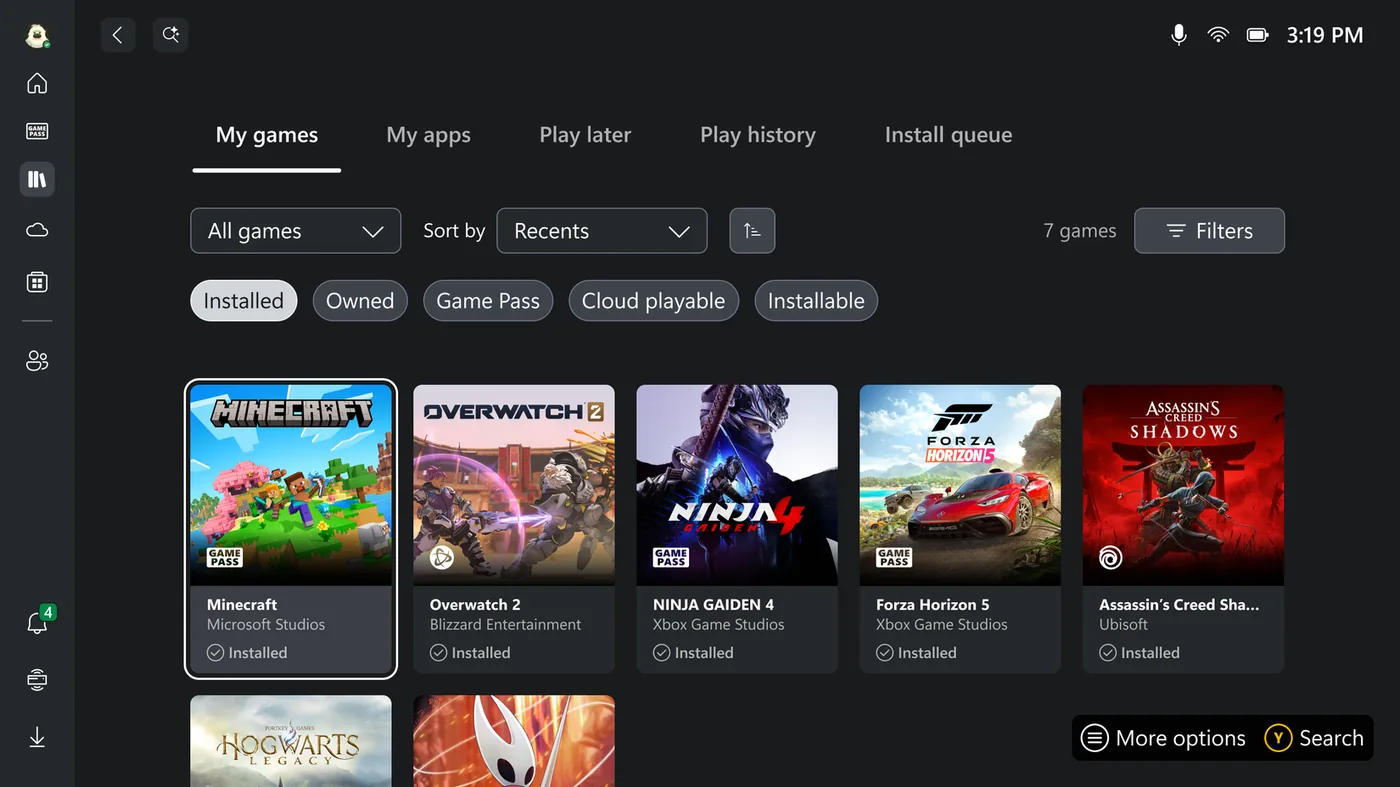
The user interface builds on the full-screen view seen on the ASUS ROG Xbox Ally and ROG Xbox Ally X handhelds. Microsoft rolled out an Xbox Mode for Windows 11 to test controller navigation on TV displays ahead of hardware launch [5]. The setup supports Xbox Game Pass, cloud saves, and PC storefronts like Steam and Battle.net [6].
Project Helix Alpha Kits in 2027
Microsoft announced at GDC 2026 that it will ship early alpha hardware to developers beginning in 2027. Providing devkits early gives partner studios the runway they need to adapt game engines to the RDNA 5 architecture and write custom shaders for the new graphics pipeline. IGN reporter Wesley Yin-Poole reported that this devkit schedule makes an early consumer launch unlikely, since major studios typically need at least eighteen months with final hardware to complete launch titles. Polishing launch games takes time [4].
A profile of Xbox Chief Executive Officer Asha Sharma in Fortune reported that Microsoft is targeting a consumer rollout late in 2028 ahead of the holiday shopping period [6]. That schedule shows an adjustment from earlier rumors from Call of Duty insider The Ghost of Hope, who suggested a late 2026 or 2027 arrival [5]. Component shortages in the memory market have influenced timelines across the video game industry, with Sony reportedly pushing the PlayStation 6 launch toward 2028 or 2029 for the same reasons [6]. Despite executive leadership changes that saw Phil Spencer retire and Sarah Bond depart, Microsoft Chief Executive Officer Satya Nadella insisted that the company remains long on gaming and will continue investing heavily in hardware development [4].

Sharma also described Helix as a “family of devices,” indicating that the brand plans to offer multiple hardware configurations [7]. Former Xbox leader Seamus Blackley questioned whether the leadership changes signaled a shift in gaming focus, but Sharma maintained that multiple form factors will expand player access [4]. Polygon reported that Microsoft is exploring an in-house handheld device planned for holiday 2027 [6]. Multiple devices would give players different price tiers while sharing the same unified software platform [7].
Estimated Retail Costs and Component Prices
Component pricing forms the steepest question mark hanging over next-generation hardware. The Fortune report revealed that Microsoft’s internal projections place the retail cost of the Project Helix console between $1,200 and $1,800 [6]. High manufacturing costs for GDDR7 memory modules and TSMC silicon dies explain why early hardware bills look so high [5]. Earlier reporting showed that Microsoft projects an $1,800 price for the top configuration. Microsoft could choose to subsidize the hardware to make it more affordable for mainstream living room players [6].
That projected range marks a sharp departure from earlier console pricing. The Xbox Series X arrived at $499 in 2020, but rising fabrication costs make repeating that price point difficult for cutting-edge silicon [5]. In an interview with BBC News, Sharma acknowledged that economic pressures affect hardware costs, but she reiterated that the team is working on a great family of devices that balances performance and accessibility [7]. Hardware analyst Moore’s Law Is Dead and AMD insider KeplerL2 estimated that the raw silicon could cost roughly $1,000 to produce before adding retail margins and packaging [5].
Physical disc media also faces an uncertain future on upcoming hardware. Industry reports indicate Sony will stop manufacturing optical discs in January 2028, leading analysts to anticipate an all-digital future for PlayStation 6 [5]. While Sony plans to halt disc manufacturing in 2028, a separate job listing hints Xbox Helix could keep discs for physical media collectors. When asked directly by BBC News about a disc drive, Sharma declined to share specific hardware configurations. That silence leaves room for Microsoft to offer both disc-based and digital versions in its Helix family [7].
- ONLINE NEWS DeFelice, R. (2026, November 15). Project Helix is a console first, not a PC, XBOX says. Insider Gaming. [Article Link]
- ONLINE NEWS DeFelice, R. (2026, November 15). Neural rendering could help XBOX Project Helix’s affordability. Insider Gaming. [Article Link]
- ONLINE NEWS Koepp, B. (2026, November 15). Xbox shares new Project Helix details on PC games and backward compatibility. VICE. [Article Link]
- ONLINE NEWS Yin-Poole, W. (2026, March 11). Microsoft reveals Project Helix features at next-gen Xbox GDC talk, alpha versions to be sent to devs in 2027. IGN. [Article Link]
- ONLINE NEWS Palumbo, A. (2026, July 2). Xbox Next “Project Helix” – Everything we know about Microsoft’s upcoming console. Wccftech. [Article Link]
- ONLINE NEWS Welsh, O. (2026, October 22). Everything we know about Project Helix, the next Xbox. Polygon. [Article Link]
- ONLINE NEWS Swanson, D. (2026, August 29). Xbox CEO confirms new detail about Project Helix. GameRant. [Article Link]


