





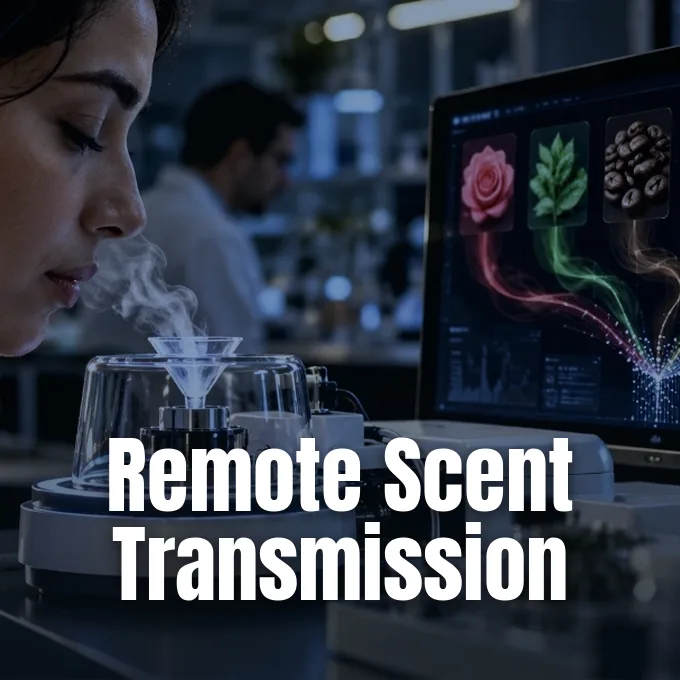
A research group led by The Ohio State University has demonstrated an experimental setup that detects food scents, transmits their digital descriptions across the internet, and triggers matching aromas on remote wearable dispensers. The study, published in Science Advances, introduces the Scentronic system as an automated bridge connecting chemical sensors to localized aroma generators [1]. Molecules never travel across fiber cables. Instead, software classifies volatile organic compounds with machine learning and transmits lightweight text labels over standard network protocols [4]. In controlled laboratory trials with 14 volunteers, participants identified five recreated everyday food odors with an average accuracy of 72.86 percent [2].
How the Scentronic System Reads Aromas
Transmitting an aroma over the internet presents a fundamentally different engineering hurdle than sending pictures or recorded sounds. Digital cameras break visual scenes into pixels of red, green, and blue light, while microphones measure oscillating air pressure waves that computers translate into standard digital formats. Olfaction relies on volatile organic chemicals that bind directly to sensory receptors inside the human nose [3]. Smells lack universal elementary building blocks. Lead author Chunyu Yang, a doctoral student in materials science and engineering at Ohio State, said that olfaction remains “still a very undeveloped sense” in digital communication [5]. The work, published in Science Advances, points toward a future in which digital communication could carry scent [1]. Because researchers can’t send actual molecules over network wires, any functional scent network must detect an aroma at the source, classify its identity, and command a distant physical generator to release matching liquid mist near the user’s face [5].
To capture volatile compounds, the researchers built an electronic nose containing an array of six metal-oxide gas sensors. As volatile vapors pass over the sensor surfaces, they bind to the metal oxide and alter electrical resistance, generating distinct voltage curves over time [5]. A machine-learning classifier reads these electrical traces and maps them directly to pre-programmed categories [4].
Sensor Design and Machine Learning
The electronic nose operates as a benchtop unit measuring about 15 centimeters (6 inches) across, designed to sample odors inside an enclosed chamber that shields the sensors from room air [2]. Training the setup required exposing the sensors to each target smell hundreds of times [5]. This step generated consistent voltage baselines for automated classification [2].
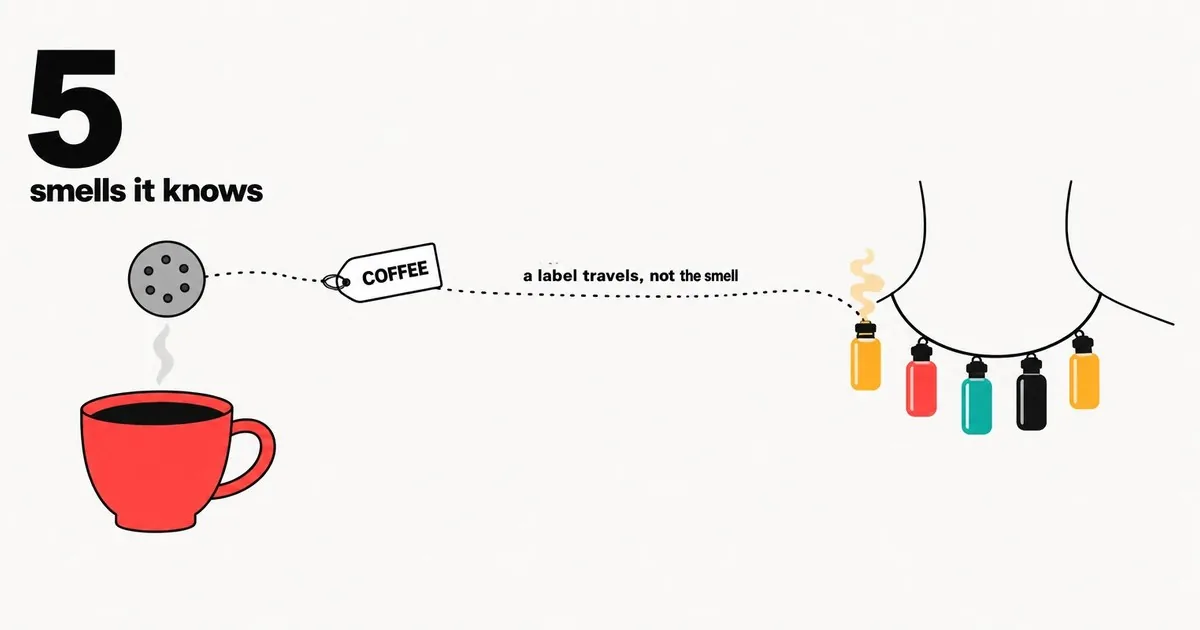
In structured laboratory runs, the team collected 250 sensor runs across five everyday foods: beer, cake, coffee, mandarin oranges, and red wine [1]. Each individual run lasted 200 seconds to record how resistance shifted across all six sensors as volatile compounds accumulated in the test chamber. The researchers selected specific commercial products to establish uniform chemical profiles, using King’s Hawaiian Sweet Rolls for the cake category and STōK cold brew for coffee [2]. Training the classifier was “the most challenging part” of the study, Yang said, because algorithm models had to untangle overlapping chemical cues such as alcohol vapor and citrus limonene [5]. A k-nearest neighbors classifier evaluating end-point voltages scored 100 percent on 50 held-out samples and averaged 98.5 percent across repeated splits, while a random forest model reached 96 percent. Once identified, the label travels over Wi-Fi to a Google Cloud server with an average delay of 65 milliseconds [2].
Laboratory Tests on Human Volunteers
Can human noses reliably distinguish scents delivered through automated network signals? To answer this question, researchers recruited 14 healthy volunteers for evaluation sessions with a handheld receiving device [5]. Participants sniffed bursts of released fragrance and selected matching names on an interface without knowing which odor had been triggered. In single-odor tests, participants identified the target scent correctly 72.86 percent of the time, easily exceeding the 20 percent baseline expected from random guessing. While single scents yielded dependable recognition, roughly one trial in four still resulted in a misidentification [2]. The Scentronic system also tested combined aromas to examine whether participants could untangle more complicated chemical cues, pairing beer with cake and coffee with orange [1]. In those combination trials, participants correctly named the paired scents 71.43 percent of the time [2].
Intensity ranking added another dimension to the human evaluations. In trials where volunteers ranked five distinct scent strengths, they placed the release strength in the correct order 58.57 percent of the time. In a separate threshold trial with 16 volunteers testing ten gradations of mandarin orange scent, level 5 emerged as the earliest strength noticed by six participants [2].


Wearable Formats for Remote Mist Delivery
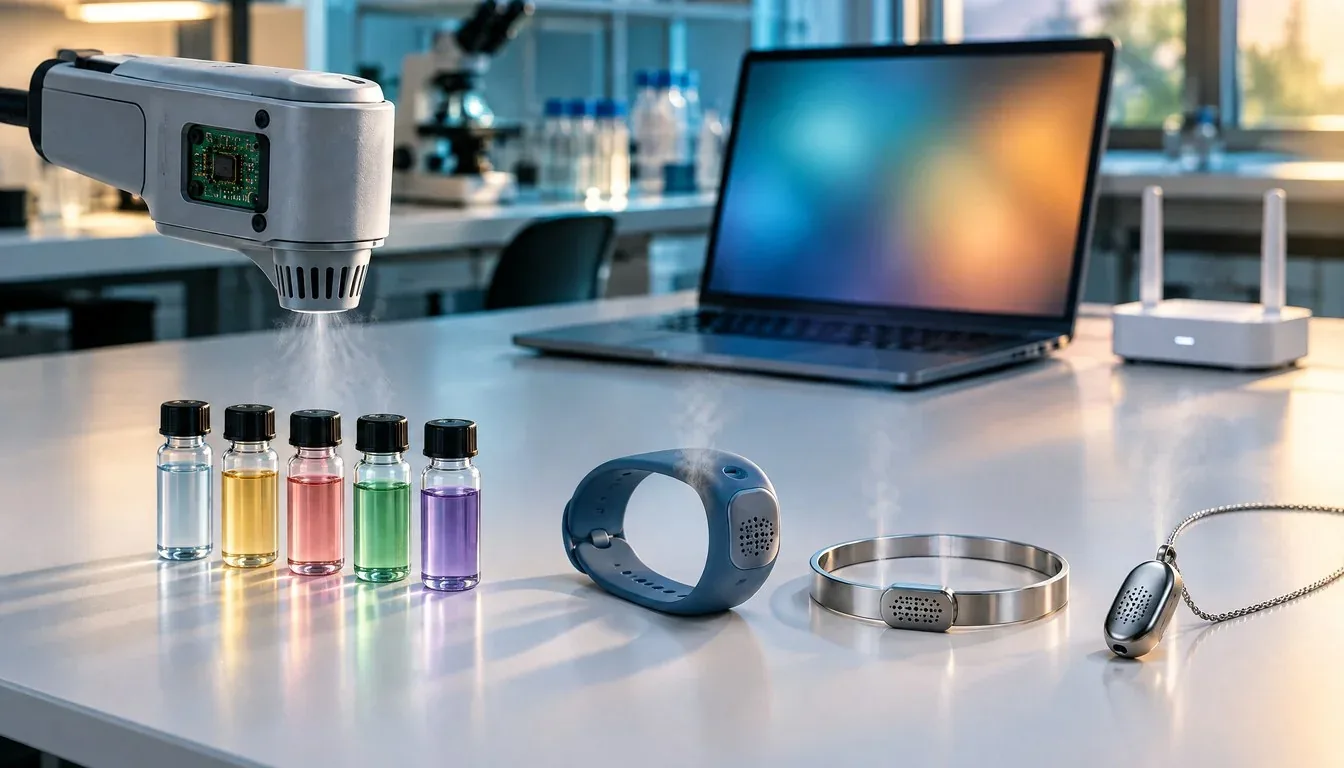
The receiving end of the Scentronic system relies on miniature piezoelectric atomizers rather than bulky thermal heaters. Each small atomizer vibrates at an ultrasonic frequency of 110 kilohertz, pushing scented liquid through a cotton filter to spray microscopic droplets into the ambient air in brief 10-millisecond pulses. In a live alcohol test, the full loop from sensor to mist responded in 0.6 seconds [2].
Yang and colleagues fabricated several wearable configurations to suit different daily activities, including a two-channel wristband, a five-channel handheld unit, and a five-channel necklace. The necklace arranges its five miniature scent reservoirs “like pearls on a string” along the front, connected to a thin flexible circuit board positioned along the back of the neck [2]. Positioning the emitters close to the collarbone lets small liquid puffs reach the nose quickly without saturating the surrounding room [4]. Beyond standalone olfactory gear, the team built a multisensory cup ringed with electromagnetic pumps that dispense flavored drops into water while atomizers release matching aromas. Users wearing mixed-reality headsets can select a virtual drink and experience both aroma and taste simultaneously [3].
Practical Limits of the Scentronic System
Despite viral attention online, where a Polymarket post on X passed 1.2 million views within four hours, the researchers point out that commercial hardware remains distant [2]. Lead author Chunyu Yang stated in a Reuters interview: “At present, this is a research prototype.” The setup can’t synthesize arbitrary odors from basic components the way computer displays blend primary colors into millions of hues [3]. Instead, the receiver only emits what it already holds in its physical reservoirs, meaning any aroma outside its preloaded catalog can’t be reproduced [6]. Lead author Chunyu Yang explained that recognizing an odor and accurately reproducing it remain separate challenges [2]. Moving from five foods in a closed box to thousands of ambient scents in a busy kitchen requires far larger training datasets and more intricate sensor arrays [4].
Hardware boundaries also restrict daily use. While the receiving atomizers fit into jewelry, the electronic nose remains a tabletop unit about 15 centimeters across and is not wearable. Battery life presents another hurdle: at a 10 percent operating duty cycle the reservoirs lasted over 35 minutes, but continuous firing drained the battery in under five minutes. Practical consumer devices will also need safe refill cartridges and durable nozzles [2].
Future Trials and Clinical Potential
How might remote scent transmission fit into everyday healthcare or entertainment? Study co-author Jinghua Li and colleagues plan to test the technology outside controlled laboratory settings, where drifting drafts and background smells complicate recognition [1]. The researchers also plan more complex evaluations to manage potential volunteer bias [7]. In a Reuters interview, Yang remarked: “Our current system has not demonstrated the transmission of a grilling-hot-dog scent or the exact mixture of smells at a tailgate party.” Similar hardware challenges appear in other sensory fields, such as the $30 million pre-seed round raised by Enact Intelligence to give robots artificial touch [4]. Marianna Obrist, a professor at University College London, called the Scentronic system “a great idea” but added: “There’s still a long way to go before we can truly record and replay smell experiences [5].”
Clinical research and specialized nutrition offer the most immediate paths forward for digital olfactory tools. Medical teams could use wearable scent generators to run remote sensory evaluations on patients recovering from viral illness or tracking early signs of neurodegenerative conditions. In spaceflight or military settings, synchronized scent pulses could make shelf-stable rations more appetizing by restoring aromas lost during food preservation [5]. The current prototype establishes an automated starting point for sending chemical cues across digital networks [8].
- ACADEMIC JOURNAL Yang, C., Wang, Q., Wang, C., Akoto-Yeboah, A., Cheng, S., Amoah, B., Jia, Y., Chen, S., Canumalla, A., Zhao, K., Simons, C., & Li, J. (2026). Scentronic: An artificial intelligence–assisted olfactory interface for remote odor sharing and transmission. Science Advances, 12(43). [Article Link]
- ONLINE NEWS Garg, N. (2026). Scentronic: The Device That Sends Smells Over the Internet. CellCog. [Article Link]
- ONLINE NEWS Mirchandani, V. (2026). Scientists have figured out how to send smells over the internet, and coffee is just the beginning. Digital Trends. [Article Link]
- ONLINE NEWS Vogel, H. (2026). Scentronic: Wearable Sends Smells Online (5 Facts) [2026]. Shattered. [Article Link]
- ONLINE NEWS Quincy, J. (2026). AI Device Sends Smells Over the Internet in First Tests. Science Official. [Article Link]
- ONLINE NEWS Gosavi, A. (2026). AI-powered wearables recreate five food smells sent over the internet. Interesting Engineering. [Article Link]
- ONLINE NEWS Superpower Daily Editorial Desk. (2026). Researchers send scent data to wearables, with 73% recognition in a small lab test. Superpower Daily. [Article Link]
- ONLINE NEWS Editor A. (2026). Scientists develop technology to transmit smells over the internet. Newswire. [Article Link]
APA 7: PerEXP Teamworks. (2026, October 25). Ohio State Team Sends Scent Data Using Scentronic System. PerEXP Teamworks. https://perexpteamworks.com/en/scentronic-system-transmits-odors-online/


