





Kubernetes automates the deployment, scaling, and daily care of containerized apps in computer clusters [6]. Created by Google staff Joe Beda, Brendan Burns, and Craig McLuckie and run by the Cloud Native Computing Foundation, it pools physical and virtual machines into one programmable compute system [12, 14, 20]. Users declare target setups in YAML files, and Kubernetes reconciles live cluster state until actual running pods match that declared intent [14, 15]. By automating pod restarts, health probes, and rolling updates, it stops unexpected downtime in cloud data centers [11].
The Origins of Kubernetes
Kubernetes grew out of Google’s Borg system, a cluster manager that ran billions of containers weekly for over ten years [1, 14]. In early 2014, Google coders Joe Beda, Brendan Burns, and Craig McLuckie launched the code, joined by Ville Aikas, Dawn Chen, Brian Grant, Tim Hockin, and Daniel Smith. Drawing on lessons from Borg and Omega, the team wrote Kubernetes in Go instead of C++ [1, 20]. They codenamed it Project 7 after the Star Trek character Seven of Nine, and Tim Hockin designed the seven-spoked ship’s wheel emblem inspired by the Ancient Greek word kubernḗtēs, which means helmsman [12, 20]. Staff from Red Hat and CoreOS soon joined development, including notable contributors Clayton Coleman and Kelsey Hightower [20].
Google announced Kubernetes at DockerCon in June 2014 and shipped version 1.0 on July 21, 2015, donating the code to the Cloud Native Computing Foundation under the Linux Foundation [7, 20]. “The intent is to take our technology and make it as ubiquitous as possible,” Craig McLuckie said about the shift to open governance. Linux Foundation director Jim Zemlin stated that “core developers matter” as founding partners like AT&T, Cisco, Docker, Intel, IBM, and Twitter joined the board. Enterprise vendors quickly added native support: VMware joined in August 2017, Mesosphere under Florian Leibert added DC/OS integration in September, Docker added native engines in October, and Microsoft launched Azure AKS [7, 8, 9]. By 2024, the CNCF counted 8,012 contributors and 123,000 GitHub commits, with IBM reporting that 71% of Fortune 100 firms rely on K8s [12, 14].
Core Components in a Kubernetes Cluster
Every cluster pairs a control plane with worker nodes [11, 16]. The kube-apiserver component is the front door, exposing a REST API over HTTPS for kubectl and node daemons [15, 16, 20]. Operating over mutual TLS, it checks user tokens, evaluates ABAC and RBAC rules, validates object schemas, and coordinates work without letting daemons talk to each other directly [16, 20]. Only the API server writes to etcd [15, 16].
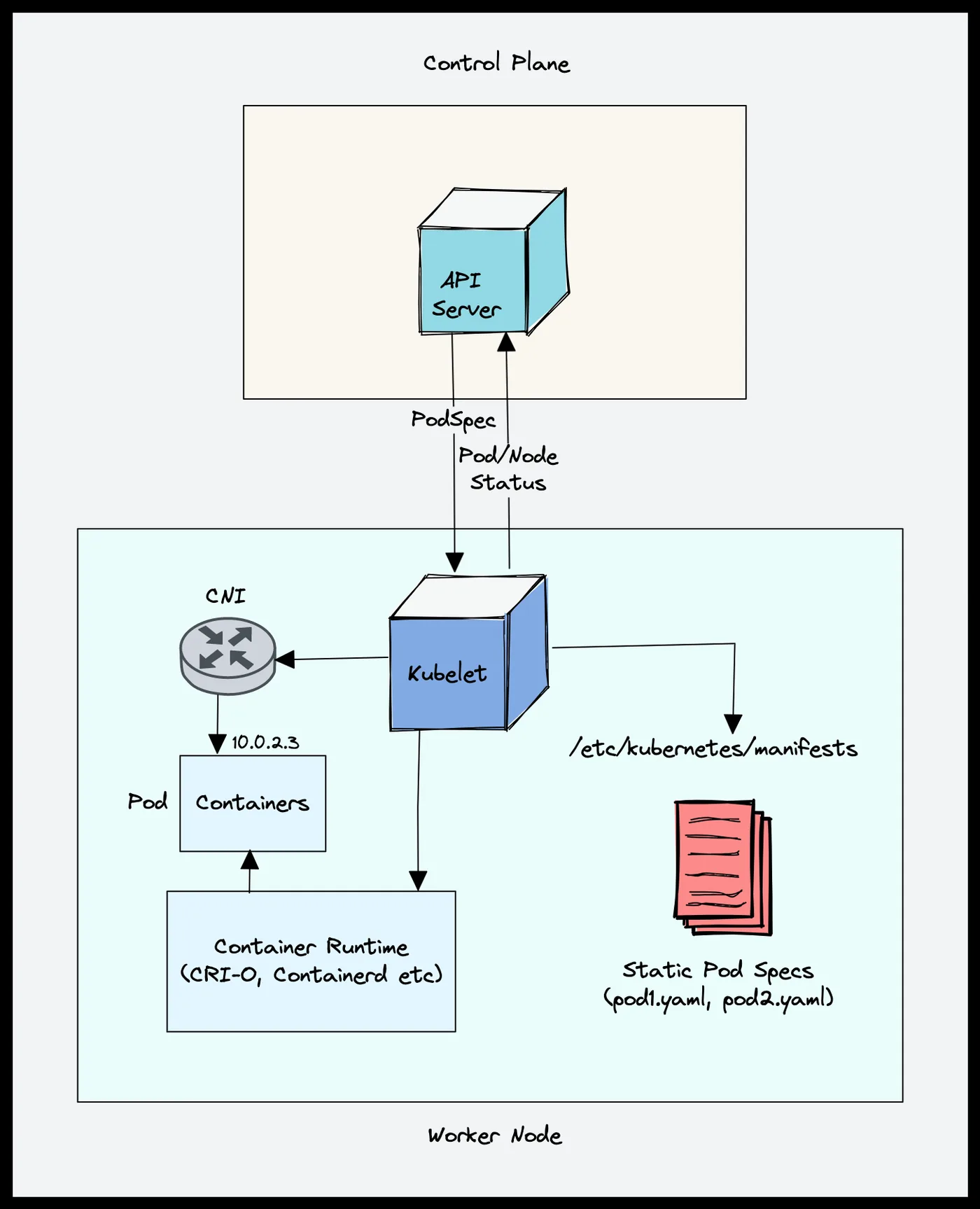
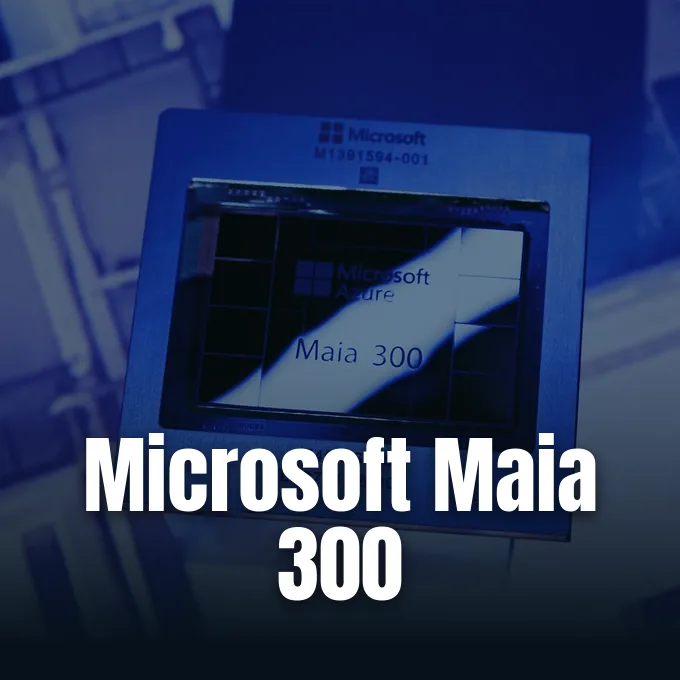
On worker nodes, kubelet runs as an agent managed by systemd, registering the host with kube-apiserver and executing pods assigned to that specific machine. When scheduling directives arrive, kubelet interacts with local runtime engines to launch containers, monitors workload health using cAdvisor metrics, and reports node status heartbeats to the API server. Each worker node also runs kube-proxy to configure iptables or IPVS packet forwarding rules for Kubernetes Services [16, 20]. Cloud providers deploy nodes on custom hardware racks, pairing container management with specialized chips like the Microsoft Maia 300 AI hardware in cloud data centers.
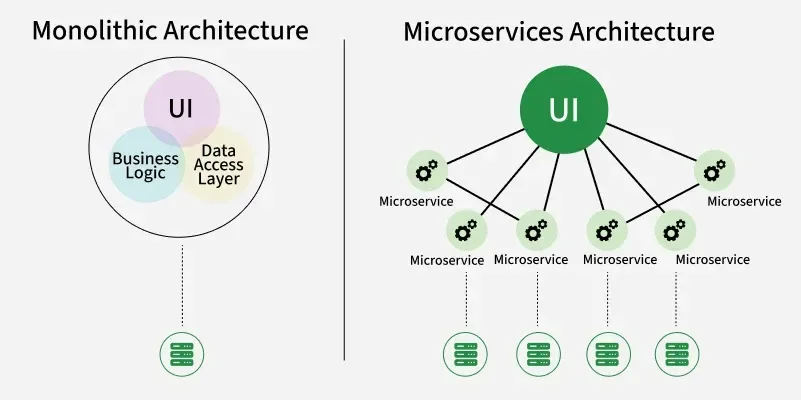
Early releases relied on Docker. To decouple node agents from proprietary runtimes, Google and Red Hat created the Container Runtime Interface (CRI) so any engine could plug into the cluster. Maintainers deprecated dockershim in November 2020 and removed it in version 1.24. Today, clusters run Open Container Initiative engines like containerd and CRI-O, executing Linux processes without overhead [14, 20].
How Pods Group Containers
A pod is the basic building block in Kubernetes [10, 13]. It wraps one or more cooperating containers that share compute storage and networking [15, 20]. All containers in a pod share an identical network namespace, using the same IP address and port mapping space so they can talk over localhost loopback without network delay [10, 20]. Shared disks mount via Persistent Volume (PV) claims and ConfigMap data [10, 11, 16].
To set up this network namespace, nodes run a small pause container from the kubernetes/pause:go image. Network engineer Jon Langemak tested this layout on Linux hosts, showing that the pause container starts first, takes the assigned IP, and binds the host ports. Other containers in the pod join the pause container’s network stack. If an app container crashes, the network endpoint stays up. Once the app restarts, it rejoins the existing network setup right away [19].
Teams rarely deploy bare pods because pods die if a host crashes [15, 20]. Instead, operators use Deployments and ReplicaSets to handle pod lifecycles [10, 15]. A Deployment manifest sets how many identical copies should run and conducts rolling updates without service pauses [6, 14]. For apps needing stable network hostnames or disks, teams choose StatefulSets, while DaemonSets place one copy on every worker machine [15, 20].
The Control Plane Reconciliation Loop
Kubernetes operates on a declarative reconciliation model where automated control loops continually work to drive actual cluster state toward declared configurations. Instead of running manual scripts that can break halfway through, teams write target goals in YAML manifests [14, 15]. A developer asks for three web pods, and kube-apiserver stores that record in etcd. If a node drops, the controller sees that only two pods exist, prompting it to launch a replacement on a surviving server [14, 15]. Because controllers are level-triggered, a restarted controller simply compares the current state recorded in etcd against desired manifests and resumes work without missing commands [15].
The kube-controller-manager binary bundles multiple independent control loops into a single process to simplify cluster administration [12, 16]. Within this process, the Deployment controller tracks pod templates and orchestrates ReplicaSets, while Job and CronJob controllers execute batch computing workloads until successful completion [15, 16]. If a newly deployed software version fails health checks, the Deployment controller automatically initiates a rollback to the previous stable ReplicaSet to prevent user-facing outages [6, 14]. Concurrently, the Node controller monitors worker heartbeats to evict workloads from dead servers, while cloud-controller-manager interacts with cloud vendor APIs like AWS, Microsoft Azure, and Google Cloud to provision external load balancers [16, 20]. In Mesosphere DC/OS, executives Florian Leibert and Peter Guagenti implemented similar controller patterns to integrate Kubernetes workloads with Apache Mesos [8].
Scheduling Workloads to Worker Nodes
When a controller creates a new pod, that pod enters a pending state until an appropriate compute host is assigned by the kube-scheduler. The scheduler watches for unassigned pods in the API server and assigns each workload to an optimal node through a two-phase evaluation pipeline of filtering and scoring. In the filtering stage, the scheduler eliminates nodes lacking sufficient CPU cores, memory, or storage volumes, while verifying node selectors, taints, and toleration directives [15, 16]. Nodes passing this initial filter proceed to scoring, where algorithms rank viable hosts based on workload spread, resource utilization balance, and pod affinity rules before binding the pod to the highest-scoring worker machine [15].
Academic research by Carrión and Senjab indicates that modern cluster scheduling algorithms must carefully balance conflicting Quality of Service parameters, including task execution latency, energy efficiency, and resource optimization [3, 4]. To support specialized hardware workloads, Kubernetes 1.34 promoted Dynamic Resource Allocation (DRA) to stable status, granting the scheduler native awareness of physical accelerator cards [16]. These scheduling extensions prove valuable when placing containerized AI jobs on hardware accelerators, such as the Microsoft Maia 300 AI accelerator deployed in enterprise cloud data centers. Once kube-scheduler writes a binding decision back to kube-apiserver, the assigned node’s kubelet detects the binding asynchronously, pulls container images, and starts execution [15].
Why Kubernetes Uses etcd
Kubernetes selects etcd because container orchestration requires a strongly consistent database to store cluster metadata [16, 17]. Developed by CoreOS and donated to the CNCF in 2018, etcd derives its name from the UNIX /etc folder and d for distributed [17]. Built upon BboltDB, etcd stores every cluster object, deployment spec, namespace, and secret under the /registry key hierarchy. Without this dependable database serving as the single source of truth, control loops could not verify whether workloads need replacement [16, 17].
To guarantee data safety across node outages, etcd implements the Raft consensus algorithm across an odd-numbered cluster of server nodes. A single elected leader accepts all incoming write proposals from clients, replicates log entries to follower members, and applies state commits only after a quorum of followers confirms storage [17]. In alignment with the CAP theorem, etcd prioritizes consistency over availability during network partitions, preventing split-brain scenarios where separated nodes accept conflicting configuration updates [16, 20]. Because disk write latency directly governs cluster performance, production deployments require solid-state drives (SSDs). While ZooKeeper and Consul offer related distributed consensus, etcd was built specifically for cloud-native infrastructure, persisting all transactions to disk to deliver greater durability than in-memory caches like Redis [17].
Within the Kubernetes architecture, kube-apiserver remains the only component authorized to interact with the etcd database. All other internal controllers and external management tools must query the API server through authenticated TLS connections [15, 16]. Rather than using resource-heavy polling routines to detect state changes, the API server leverages etcd’s streaming Watch API. When an operator applies a new configuration manifest or a node reports a pod failure, etcd streams real-time notifications to kube-apiserver, triggering relevant reconciliation controllers within milliseconds [15, 16, 17].
Service Discovery and Cluster Networking
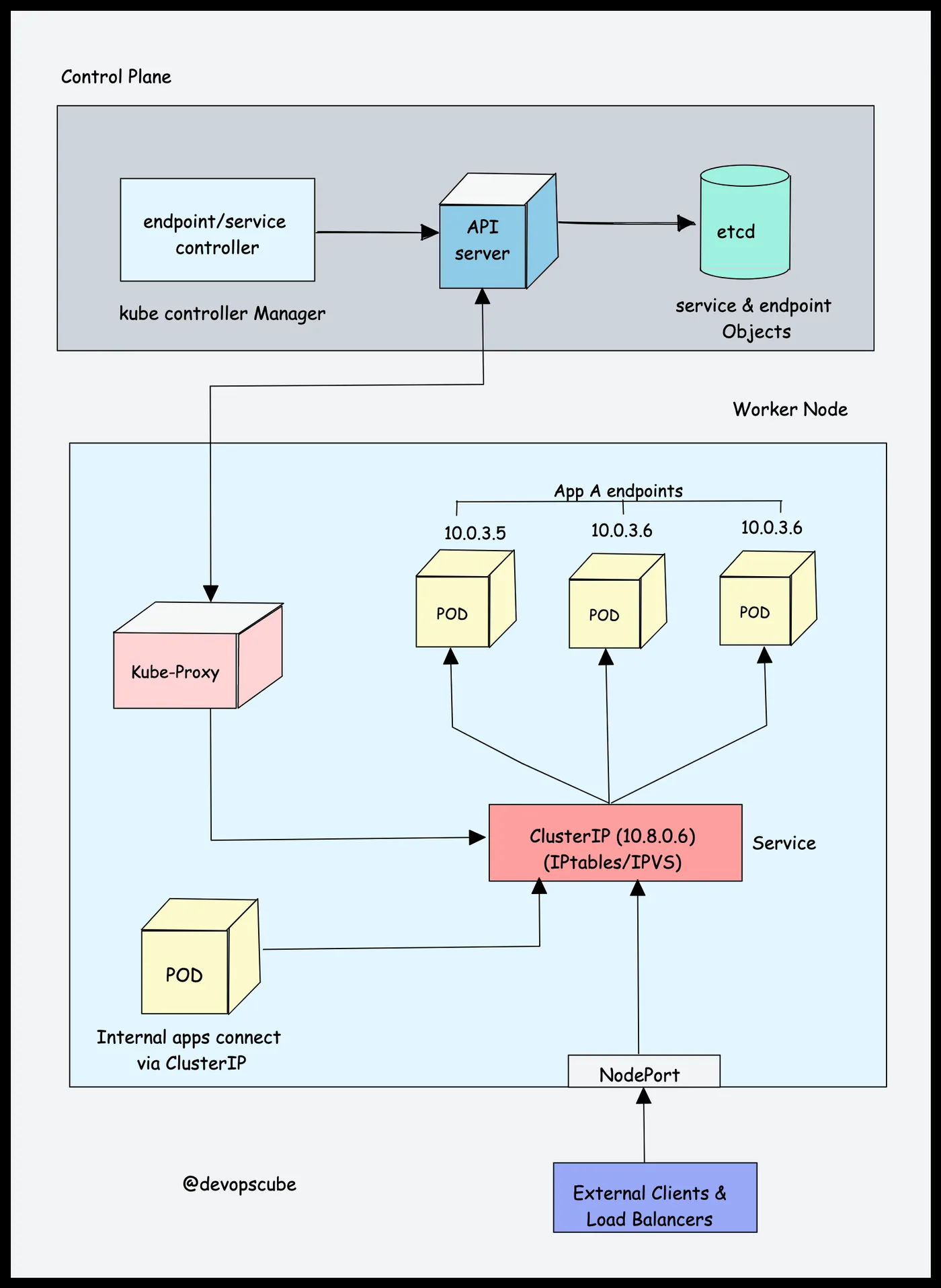
Kubernetes uses a flat IP-per-pod model [15, 19]. Every pod receives a unique, routable IP address from its host node subnet, letting pods communicate directly without complex network address translation (NAT) or host port mappings [19]. Because pods are ephemeral units that restart or migrate during rollouts, their private IP addresses change constantly [10, 20]. To provide stable endpoints, Kubernetes creates Services, assigning permanent virtual IP addresses and DNS hostnames to groups of matching pods so clients can find them reliably [10, 15].
Network forwarding for these virtual endpoints is handled by kube-proxy running on every worker node in the cluster [16, 20]. When an operator defines a service, Kubernetes allocates an IP from an internal portal network range, like 10.100.0.0/16, which exists purely as iptables or IPVS routing rules inside node kernels [16, 19]. Kube-proxy continuously synchronizes EndpointSlice resources, which maintain updated lists of healthy pod IP addresses matching the service selector [16, 20]. For external access, operators expose services using NodePort assignments, cloud load balancers, or Ingress controllers, where networking tests by Jon Langemak demonstrated that layer 7 health checks in proxies like HAProxy prevent traffic from reaching failing pods [10, 19, 20].
As user traffic fluctuates throughout daily operations, automated cluster scaling maintains consistent service performance [6, 11]. The Horizontal Pod Autoscaler (HPA) monitors workload resource metrics and dynamically adjusts pod replica counts to match target utilization thresholds [5, 6]. Academic investigations by Nguyen, Yeom, Kim, Park, and Kim demonstrated that HPA achieves optimal scaling responsiveness when evaluating native Kubernetes Resource Metrics (KRM) alongside Prometheus Custom Metrics (PCM). When client traffic subsides, HPA scales pod counts down gracefully, freeing compute capacity while maintaining application stability [5, 6].
Workload Security Best Practices
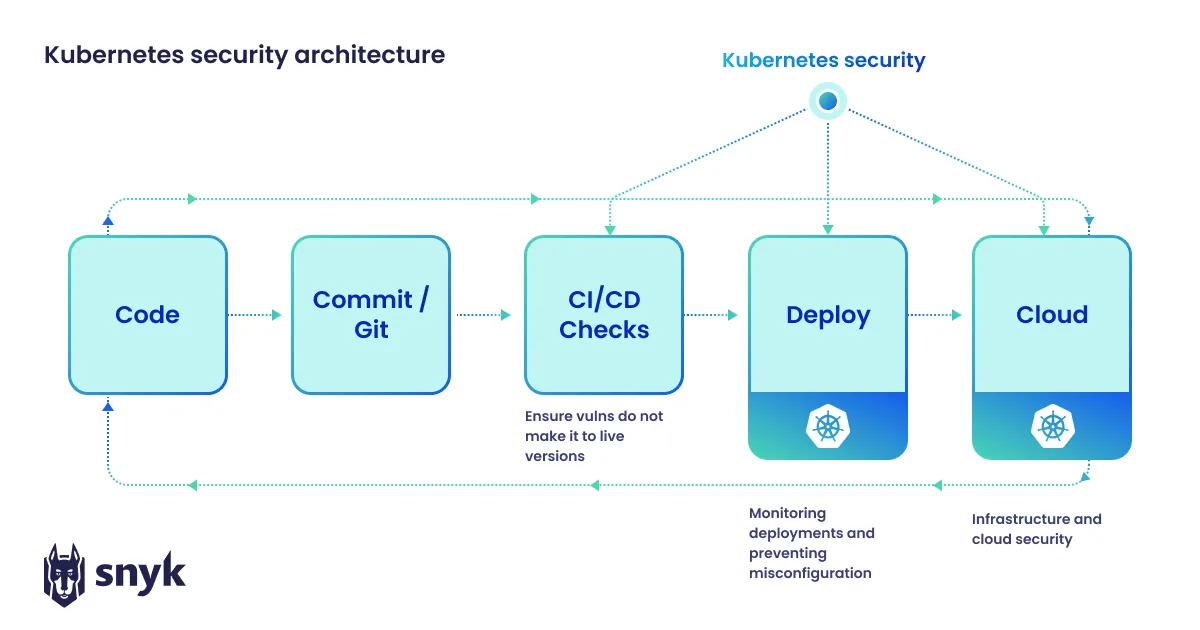
Kubernetes security begins inside the pod manifest, where developers configure granular execution boundaries. Snyk security researcher Liran Tal emphasized that open source Kubernetes deployments do not enable hardened security profiles by default, making deliberate workload configuration vital for cluster defense. Within pod specifications, engineers declare the securityContext block to restrict process privileges and prevent malicious container breakouts. Recommended controls include setting runAsNonRoot: true to prevent root escalation, mounting storage with readonlyRootFilesystem: true to block persistent malware modifications, and applying kernel isolation filters via seccomp and SELinux rules. These container boundaries ensure that a breached application cannot compromise the underlying Linux host [18].
At the administrative tier, security teams enforce Role-Based Access Control (RBAC) policies to restrict which developers and service accounts can create or modify cluster resources [11, 18]. Sensitive credentials like database passwords, OAuth tokens, and SSH keys must be stored in Kubernetes Secrets rather than plaintext container environment variables [6, 10, 18]. Because default configurations store secrets unencrypted in etcd, operators must enable encryption at rest within the storage engine. In addition, admission controllers in kube-apiserver validate incoming manifests against CIS Kubernetes benchmarks, while CI/CD pipelines use tools like Snyk Container and runtime monitors like Falco and Sysdig to detect anomalous system calls before threats impact production clusters [16, 18].
- ACADEMIC JOURNAL Burns, B., Grant, B., Oppenheimer, D., Brewer, E. A., & Wilkes, J. (2016). Borg, Omega, and Kubernetes. Communications of the ACM, 59(5), 50-57. [Article Link]
- ACADEMIC JOURNAL Bernstein, D. (2014). Containers and Cloud: From LXC to Docker to Kubernetes. IEEE Cloud Computing, 1(3), 81-84. [Article Link]
- ACADEMIC JOURNAL Carrión, M. C. (2022). Kubernetes Scheduling: Taxonomy, Ongoing Issues and Challenges. ACM Computing Surveys, 55(7), 1-37. [Article Link]
- ACADEMIC JOURNAL Senjab, K., Abbas, S., Ahmed, N., & Khan, A. u. R. (2023). A survey of Kubernetes scheduling algorithms. Journal of Cloud Computing Advances Systems and Applications, 12(1). [Article Link]
- ACADEMIC JOURNAL Nguyen, T., Yeom, Y., Kim, T., Park, D., & Kim, S. (2020). Horizontal Pod Autoscaling in Kubernetes for Elastic Container Orchestration. Sensors, 20(16), 4621. [Article Link]
- WEBSITE Kubernetes. (2026). Overview. Kubernetes Documentation. [Article Link]
- ONLINE NEWS Lardinois, F. (2015, July 21). As Kubernetes Hits 1.0, Google Donates Technology To Newly Formed Cloud Native Computing Foundation. TechCrunch. [Article Link]
- ONLINE NEWS Lardinois, F. (2017, September 6). Mesosphere adds Kubernetes support to its data center operating system. TechCrunch. [Article Link]
- PRESS RELEASE Microsoft Azure Team. (2017, October 24). Introducing AKS (managed Kubernetes) and Azure Container Registry improvements. Microsoft Azure Blog. [Article Link]
- WEBSITE GeeksforGeeks. (2019, September 19). Introduction to Kubernetes (K8s). [Article Link]
- WEBSITE Red Hat. (2024, November 20). What is Kubernetes? [Article Link]
- WEBSITE Susnjara, S., & Smalley, I. (2024, March 11). What Is Kubernetes? IBM Think. [Article Link]
- WEBSITE Google Cloud. (2026, October 29). What Is Kubernetes? [Article Link]
- WEBSITE k8s.info. (2026, January 1). What is Kubernetes? The Kubernetes Visual Handbook. [Article Link]
- WEBSITE Braundmeier, A. (2026, January 1). Kubernetes Overview for Beginners (Core Concepts Explained). k8s.guide. [Article Link]
- WEBSITE Wilson, B. (2026, July 2). Kubernetes Architecture Explained (With Illustrated Diagrams). DevOpsCube. [Article Link]
- WEBSITE IBM. (2021, October 1). What Is etcd? IBM Think. [Article Link]
- WEBSITE Tal, L. (2020, July 26). Kubernetes Security: Common Issues and Best Practices. Snyk. [Article Link]
- WEBSITE Langemak, J. (2015, February 12). Kubernetes 101 – Networking. Das Blinken Lichten. [Article Link]
- WEBSITE Wikipedia. (n.d.). Kubernetes. [Article Link]
Cover image: Google, Inc. / Wikimedia Commons, CC BY 4.0


1 comment