





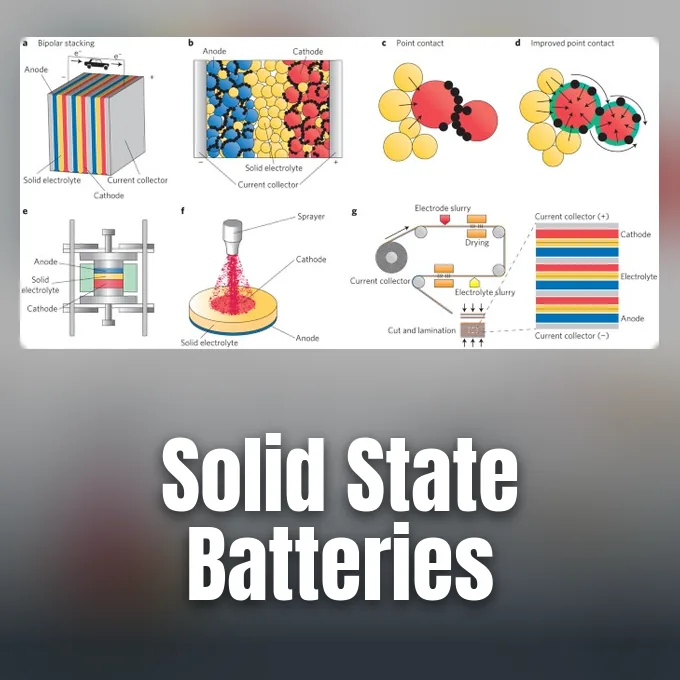
Solid state batteries replace volatile liquid electrolytes found in common electronics with solid ion-conducting separators, letting battery cells store far more energy and reduce fire risks. In standard lithium-ion hardware, liquid solutions carry ions between electrodes, but they pose thermal runaway dangers if damaged or overcharged. By swapping that liquid for a solid ceramic or polymer layer, engineers can replace common graphite anodes with pure metallic lithium. The switch packs more watt-hours into smaller battery enclosures [8].
- Solid State Batteries in Clean Energy
- Electrolyte Families and Separator Design
- Why Lithium Metal Anodes Boost Capacity
- What Is a Semi-Solid-State Battery?
- Interface Resistance from Dendrite Formation
- Scaling Solid State Batteries to Factory Volume
- Where Solid State Batteries Enter Vehicle Fleets
- Can Solid Electrolytes Transform Aviation?
Solid State Batteries in Clean Energy
Every electrochemical cell depends on three parts: a positive cathode, a negative anode, and a separator placed between them. During discharge, lithium atoms at the anode give up electrons to power an electric circuit, and the resulting ions travel through the electrolyte to settle into the cathode. When a charger supplies power, this process runs in reverse, pulling ions back to the negative terminal where they collect until needed. Sony commercialized this rocking-chair concept in Japan for its Handycam video cameras after M. Stanley Whittingham at Exxon and John Goodenough at the University of Texas at Austin built early rechargeable lithium prototypes [7].
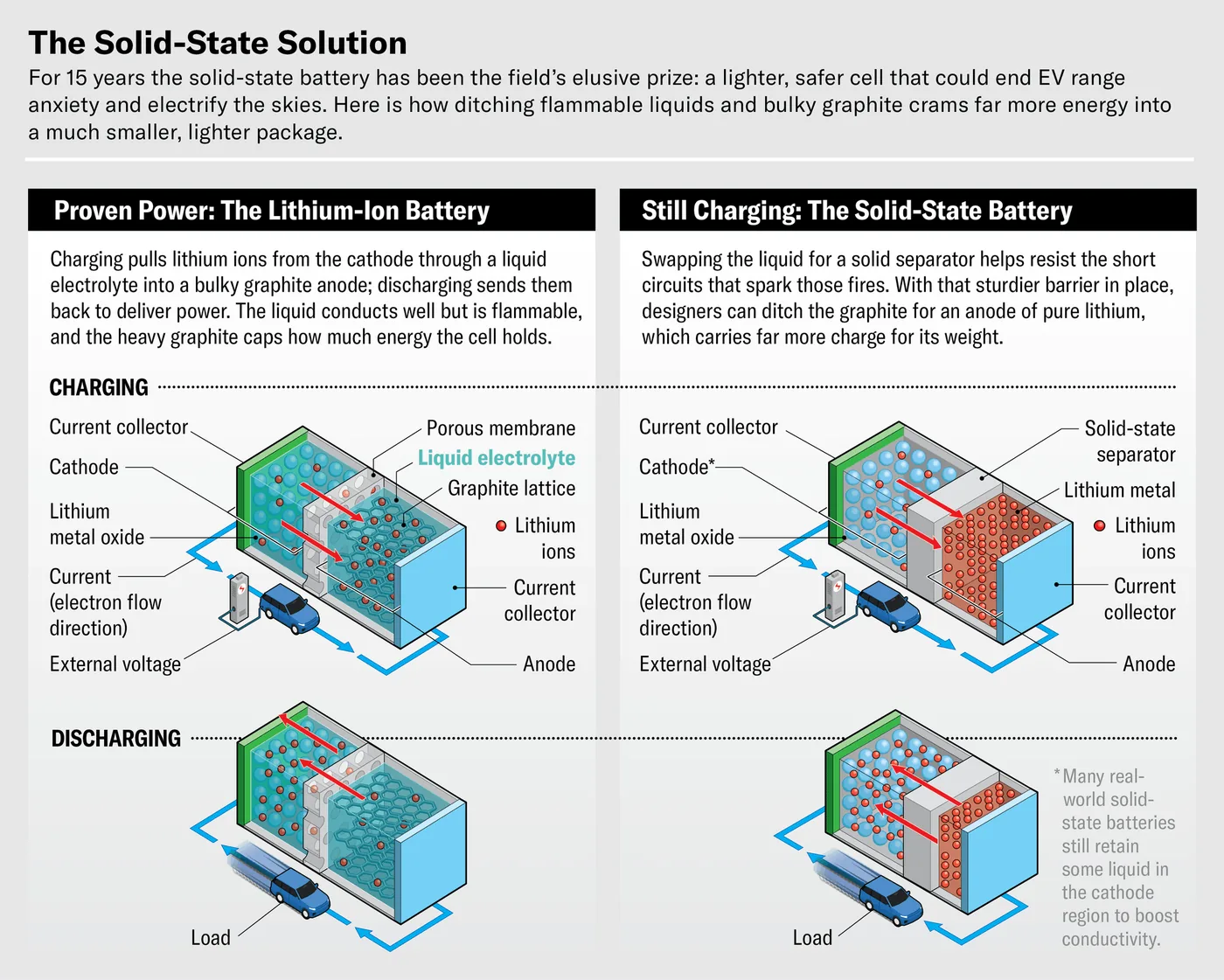
In older lithium-ion cells, liquid solvents like ethylene carbonate hold dissolved salts to keep ions moving, but these organic fluids burn easily if punctured. Solid designs remove that hazard by using thin ceramic sheets, glass mixes, or polymer layers that act as both electrolyte and separator. Because the solid barrier is nonflammable and keeps electrodes apart, it blocks electric shorts but lets ions hop through crystal gaps. In Germany and the US, Jürgen Janek and Wolfgang G. Zeier noted that stable solid transport paths form the foundation for safer high-voltage energy storage [2]. Earlier efforts in France saw Bolloré launch a fleet of BlueCar models in 2011 featuring lithium metal polymer packs, proving that solid polymer films could run on city streets [8].
Ion motion inside solids differs from flow in liquids. Liquid molecules move around ions, but a solid forces ions to hop between open sites under an electric field. Scientists measure this rate as ionic conductivity, seeking solid materials that match fluid speeds so that cells charge quickly without excess heat [10].
Electrolyte Families and Separator Design
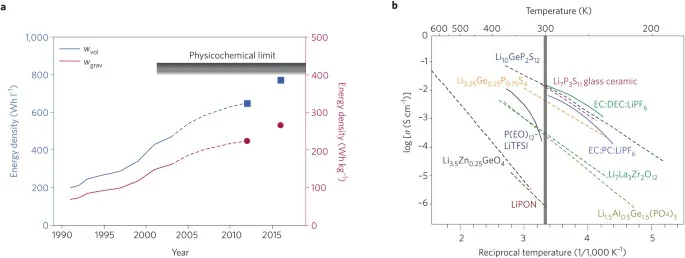
Selecting an electrolyte means balancing ion speed, chemical stability, and flexible handling. Researchers divide candidates into three families: ceramic oxides, sulfur compounds, and solid polymers. Ceramic oxides withstand high voltages, but their brittle texture makes them hard to roll into cylindrical cells. Sulfides conduct ions quickly at room temperature, but they turn into toxic hydrogen sulfide gas if exposed to moist air in factory rooms. In 2011, Ryoji Kanno and Nobuyuki Kamaya demonstrated LGPS, a sulfide solid electrolyte reaching room-temperature ion speeds that matched liquid electrolytes for the first time [8].
One early success arrived with lithium phosphorus oxynitride, known as LiPON, synthesized in 1993 at Oak Ridge National Laboratory. As J. D. LaCoste, Andriy Zakutayev, and Ling Fei detailed in The Journal of Physical Chemistry C, LiPON enabled thin-film microbatteries for medical pacemakers and RFID tags. The glassy structure of LiPON forms a stable boundary against lithium metal, blocking side reactions during cycling. But depositing LiPON needs vapor tools that yield tiny milliamp-hour capacities, keeping the chemistry in tiny sensors rather than car battery packs [1].
Polymer backbones like poly(ethylene oxide) offer simpler handling because plants cast them into bendable sheets. In Nature Energy, chemist Yong-Sheng Hu showed that an inorganic solid electrolyte can reach an ionic conductivity of 25 mS cm−1, allowing a test cell to deliver 70 percent of maximum capacity in one minute [3].
Why Lithium Metal Anodes Boost Capacity
The main reason to build solid batteries sits on the negative side of the cell. Standard lithium-ion hardware stores energy by tucking lithium ions between graphite carbon sheets, an intercalation method refined by Sony and A. Yoshino. Graphite holds up well across repeated charges, but it brings dead weight. Six carbon atoms are needed to hold just one lithium ion, capping the anode at a theoretical capacity of 372 mAh/g [8].
Pure metallic lithium delivers a theoretical capacity of 3,860 mAh/g, nearly ten times that of graphite. It also carries a low reduction potential of −3.04 V against a standard hydrogen electrode, raising total cell voltage. In liquid cells, raw lithium reacts violently with solvents, growing spiky dendrites that cause fires. A solid separator forms a firm wall that stops dendrite punctures. Jeff Sakamoto, who built rover batteries for NASA in 2003 and now leads the MUSIC center at UC Santa Barbara, stated that a solid layer stabilizes pure lithium so electrodes last [7].

Dropping graphite saves weight and volume. Common cells reach 250 to 300 Wh/kg, but solid designs reach 400 Wh/kg and 844 Wh/L. Clean energy projects also test novel carbon material for energy storage in supercapacitors, but lithium metal stays the focus for passenger vehicles. At the University of California, San Diego, Darren H. S. Tan and fellow researchers built a solid cell with a pure micro-silicon anode and an NCM811 cathode that retained 80 percent capacity after 500 cycles [8].
What Is a Semi-Solid-State Battery?
Why do so many companies market hybrid designs? A semi-solid-state battery, known as a quasi-solid-state cell, bridges the gap between liquid packs and all-solid systems by mixing a small gel plasticizer into a solid polymer matrix. This hybrid structure gives the physical strength of a solid and keeps the quick ion flow of a liquid. That tiny fluid volume wets electrode faces, cutting interface resistance that would otherwise throttle cell power output [9].
Gel polymer systems depend on the host polymer chosen for the matrix. Formulas using poly(ethylene oxide) dissolve salts well, but they suffer poor conductivity at room temperature and degrade above 4.0 V. Newer designs use polyvinylidene fluoride, called PVDF, which resists oxidation up to 5.0 V and matches high-voltage nickel cathodes. Plants make these films through solution casting or inject liquid precursors directly for in situ heat curing, wetting active particles inside the cell before hardening into a protective gel [9].
Tim Holme, chief technology officer at QuantumScape in Silicon Valley, noted that sales teams often call hybrid packs solid state. But semi-solid cells still hold flammable fluid, meaning severe heating can trigger thermal runaway if an inner short circuit develops. Automotive suppliers like WeLion and ProLogium in Taiwan ship semi-solid cells as an intermediate step, but startups like Donut Lab face pushback when claiming fully solid chemistry without shared data [7, 8].


Interface Resistance from Dendrite Formation
The toughest obstacle in all-solid cells sits at the boundary where the solid electrolyte meets the solid electrode. In a liquid cell, fluid seeps into every microscopic pore to make complete contact. When two hard solids press together, they only touch at high surface spots, creating high interface impedance. Ilias Belharouak, head of electrification at Oak Ridge National Laboratory, said that moving an ion through liquid is like swimming a river, but crossing a solid boundary is like climbing a mountain [7].
During rapid recharges, lithium stripping and plating leaves tiny voids at the interface. These empty pockets funnel electric current into narrow contact points, creating hot spots that spur dendrite growth. Although pure lithium is soft, growing metallic needles exert strong local pressure, cracking through brittle ceramic separators like tree roots splitting concrete sidewalks. In Nature Energy, Jürgen Janek and Wolfgang G. Zeier noted that managing these boundary stresses is vital for building durable cells that handle real driving cycles [2].
To keep layers touching as electrodes expand, packs use external spring tension. In March 2020, the Samsung Advanced Institute of Technology built an argyrodite cell reaching 900 Wh/L over 1,000 cycles by using warm isostatic pressing during assembly [10]. In Colorado, University of Colorado Boulder spinout Solid Power partnered with BMW and Ford to test sulfide separators that absorb stack pressures without cracking during road vibration [8].
Scaling Solid State Batteries to Factory Volume
Taking solid state batteries from university cleanrooms into full production is a tough step. A tiny crack or dust particle that causes little harm in a coin cell can short an entire vehicle pack. Mass manufacturing demands scaling output from an initial pilot quota of 1,000 daily units up to factory volumes exceeding 100,000 units. Since January 2025, at least 14 Western battery startups have collapsed trying to build volume lines [7].
To clear ceramic production bottlenecks, QuantumScape launched an automated pilot plant called the Eagle Line along with Cobra, a fast baking process. Cobra fires ceramic films in minutes instead of hours, saving plant space and boosting yields. Meanwhile in Massachusetts, Factorial Energy chief executive Siyu Huang chose a polymer system called FEST. Factorial built FEST to run on 80 percent of existing lithium-ion factory machines, avoiding the huge retooling bills that slow ceramic rivals. QuantumScape also partnered with glass maker Corning and electronics specialist Murata to refine ceramic separator production and drew up to $131 million in performance-gated funds from PowerCo [7].
Evaluating materials calls for automated testing. Labs now use setups where an autonomous system for accelerated development of quantum dots guides chemical synthesis without manual steps. Automated optical tools also check ceramic strips for voids before assembly begins.
Where Solid State Batteries Enter Vehicle Fleets
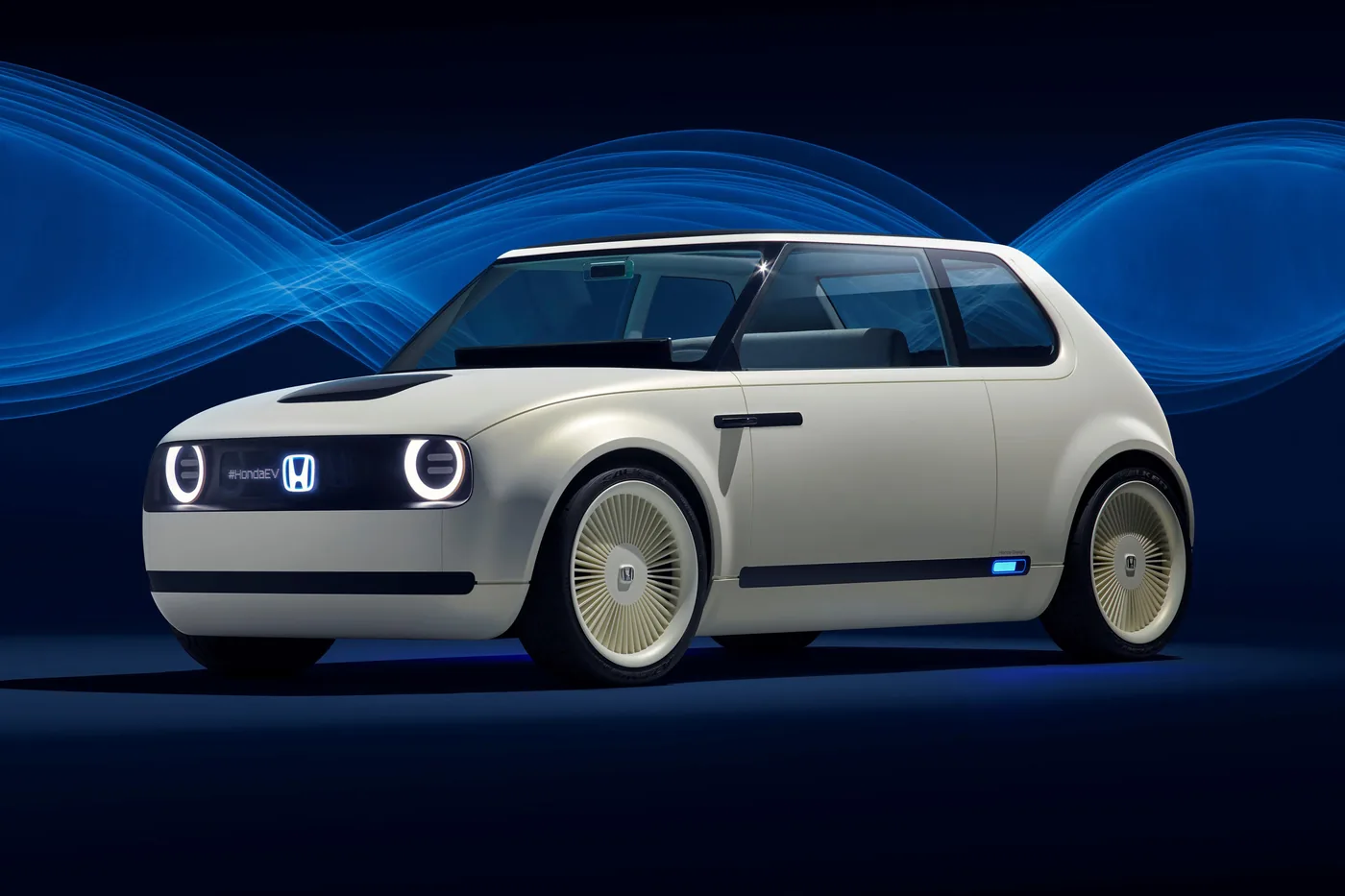
Automakers view solid state batteries as the clearest path to longer driving range without added curb weight. In Japan, Toyota leads the industry in solid-state patents and works with Panasonic toward late-decade electric models [8]. A spokesman for Honda confirmed that the firm conducts internal solid-state research, planning a demonstration line to test assembly tools [4]. In South Korea, Hyundai set up pilot manufacturing at its Namyang R&D Center without outside battery makers [5]. Nissan announced goals to launch an in-house all-solid electric car by 2028, and BMW plans demonstration vehicles before 2030 [8].
In East China, Tsinghua University spinout Qing Tao Energy Development Co spent 1 billion yuan, about 144 million dollars, on a 100 MWh line in Kunshan. Company leader Nan Cewen said the plant aims to scale to 700 MWh and build cells reaching 400 Wh/kg for gadgets and electric cars [6]. In Europe, Dyson invested $90 million to buy Sakti3 in Michigan, and Bosch evaluated solid cells before shifting strategy [5]. Fisker and Bosch also pursued solid cell programs, though Bosch ended its pilot funding after assessing factory costs [6].
Real car trials show practical cell stamina. A Mercedes EQS sedan powered by Factorial cells drove 1,205 kilometers from Stuttgart, Germany, to Malmö, Sweden, on one charge. Stellantis then installed Factorial cells into a Dodge Charger Daytona test car for American road runs [7].
Can Solid Electrolytes Transform Aviation?
Could lighter solid cells unlock regional electric flight? Aviation needs far higher energy densities than road transport because planes burn massive power lifting battery weight off runways. Electric planes need packs that do not catch fire under sudden pressure drops, making nonflammable solid separators attractive for aerospace engineers. Battery scientist Halle Cheeseman said that although Asia leads in car cells, “the race to electrify the skies is just beginning” [7]. Cells hitting 400 Wh/kg could soon make short passenger flights viable.
Flight projects require strict data proof to weed out unverified claims. Startup Donut Lab in Finland drew global headlines by claiming a solid cell with double energy density, but tester Ryan Hughes showed the unit used ordinary liquid electrolyte. To avoid burning cash, QuantumScape adopted a licensing model. Backed by Volkswagen battery unit PowerCo, the firm licenses designs to established factories capable of financing billion-dollar lines [7].
Nearly two centuries have passed since Michael Faraday found solid conductors between 1831 and 1834 by heating silver sulfide and lead fluoride. In 1963, Michael O’Keeffe showed these materials worked in batteries, and in 1967 Ford Motor Company and NGK developed molten sodium cells. From early silver conductors in England to global gigafactories, solid state batteries are proving that stable crystal lattices can store clean energy safely [8].
- ACADEMIC JOURNAL LaCoste, J. D., Zakutayev, A., & Fei, L. (2021). A Review on Lithium Phosphorus Oxynitride. The Journal of Physical Chemistry C, 125(7), 3651–3667. [Article Link]
- ACADEMIC JOURNAL Janek, J., & Zeier, W. G. (2016). A solid future for battery development. Nature Energy, 1(9), 16141. [Article Link]
- ACADEMIC JOURNAL Hu, Y.-S. (2016). Batteries: Getting solid. Nature Energy, 1(4), 16042. [Article Link]
- ONLINE NEWS Krok, A. (2017). Honda hops on solid-state battery bandwagon. CNET. [Article Link]
- ONLINE NEWS Lambert, F. (2017). Hyundai reportedly started pilot production of next-gen solid-state batteries for electric vehicles. Electrek. [Article Link]
- ONLINE NEWS Lambert, F. (2018). China starts solid-state battery production, pushing energy density higher. Electrek. [Article Link]
- ONLINE NEWS Pasternack, A. (2026). Solid-state batteries have been just around the corner for decades. Now they’re finally leaving the lab. Scientific American. [Article Link]
- WEBSITE Wikipedia contributors. (2026). Solid-state battery. Wikipedia, The Free Encyclopedia. [Article Link]
- WEBSITE Wikipedia contributors. (2026). Semi-solid-state battery. Wikipedia, The Free Encyclopedia. [Article Link]
- WEBSITE Wikipedia contributors. (2026). Solid-state electrolyte. Wikipedia, The Free Encyclopedia. [Article Link]


