






The virtual dom is a programming concept where a lightweight representation of a UI stays in memory before syncing with the real Document Object Model [1]. Modern web frameworks like React, Vue.js, and Elm build these virtual trees out of plain JavaScript objects to track view states without triggering immediate browser layout cycles [8]. When application data changes, the runtime compares consecutive tree snapshots to identify specific edits, passing only changed nodes to browser elements [2].
- Virtual DOM Architecture and Memory Trees
- Why Direct DOM Updates Cause Performance Bottlenecks
- How Diffing Algorithms Calculate Tree Differences
- React Fiber Architecture for Incremental Updates
- How Vue Compilers Optimize the Virtual DOM
- Memory Trade-Offs in Google’s Incremental DOM
- Why Svelte Avoids the Virtual DOM
- Ember Glimmer Stream Architecture for Templates
Virtual DOM Architecture and Memory Trees
React popularized the virtual tree pattern in 2013 [8]. Developers describe target views declaratively in JavaScript, leaving the ReactDOM library to synchronize real browser markup with internal component states. This synchronization step between in-memory structures and live browser elements is called reconciliation. Instead of writing manual DOM commands to mutate nodes, engineers manipulate lightweight object graphs that abstract away repetitive browser updates, event handling routines, and attribute configurations. React pairs these user interface element descriptions with internal fiber objects to coordinate ongoing state work across the tree [1].
A virtual node is a plain JavaScript object storing tag types, component properties, and child arrays without the browser power to paint pixels directly on the screen [4]. React generates these element representations via its createElement API. Developers usually write JSX syntax that transpiles directly into standard function invocations during application build steps [8]. Vue.js relies on an equivalent structure known as a vnode, created through an h function derived from hyperscript terminology [5].
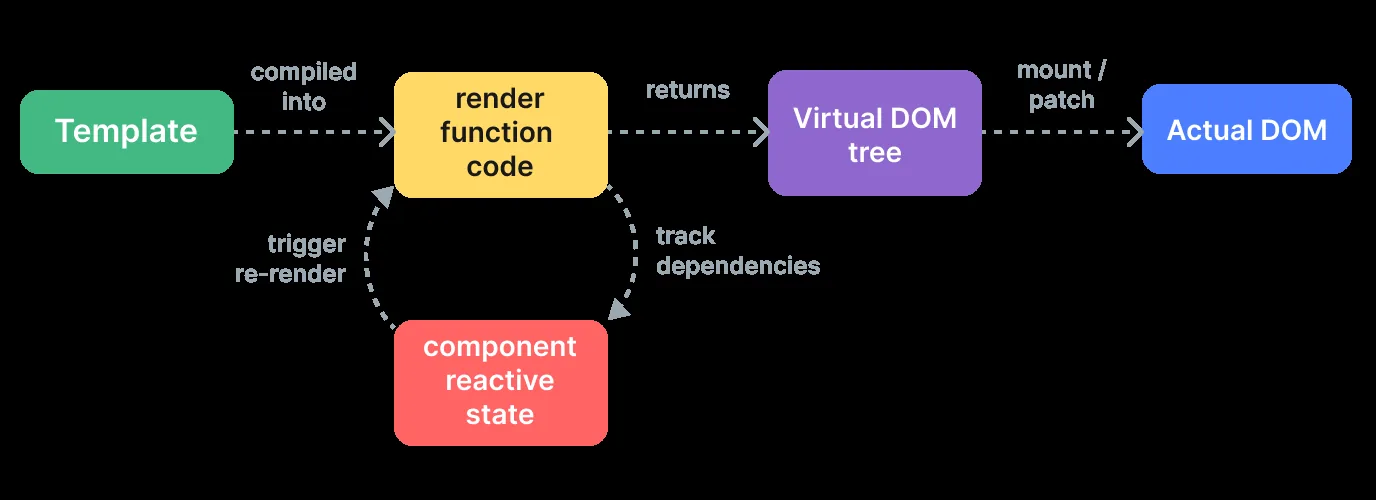
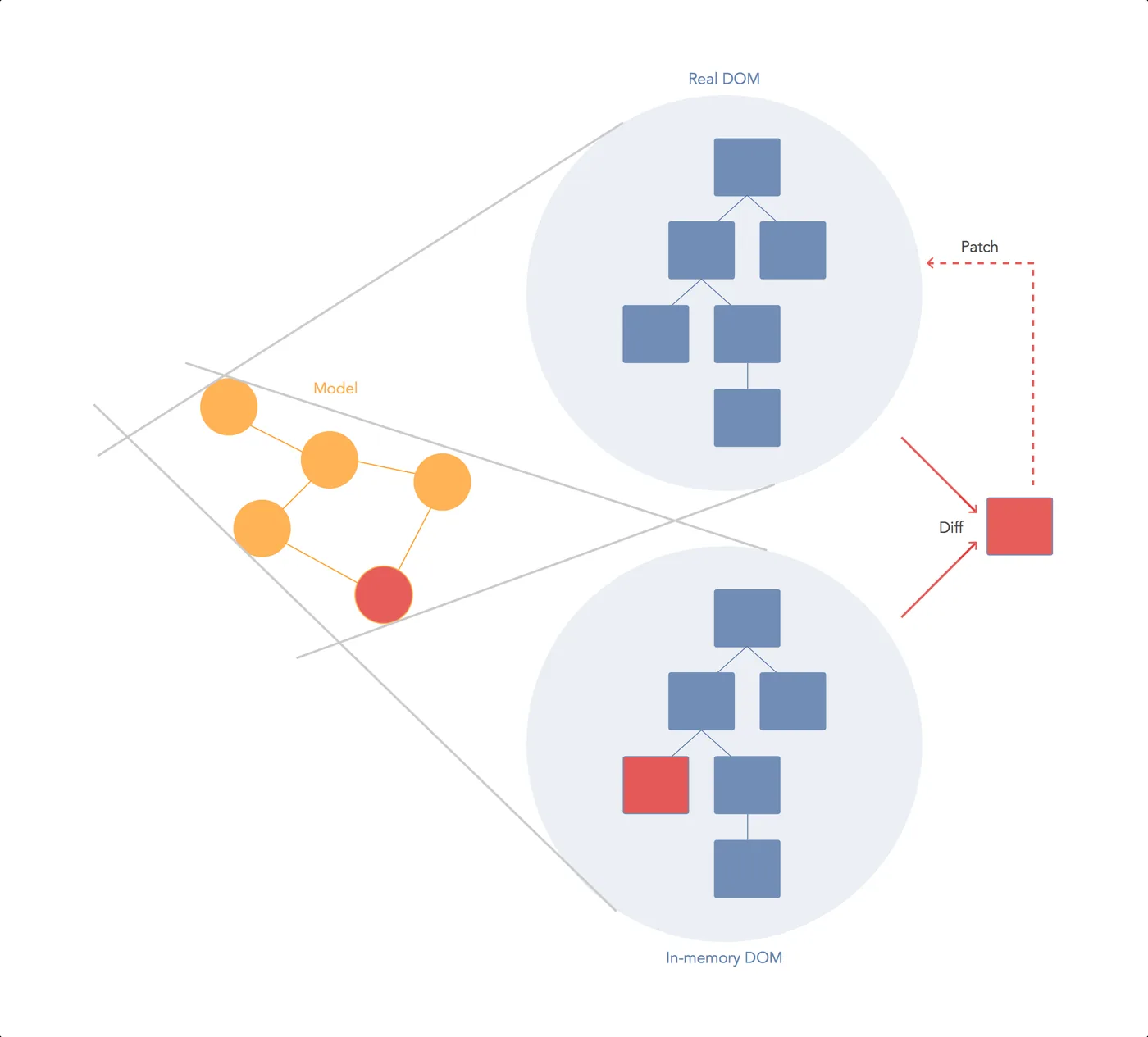
During the initial mount phase, a runtime renderer walks the object tree to construct matching HTML elements inside the browser document. State changes trigger fresh object trees. The framework then compares the updated virtual tree against the previous snapshot to identify exact property modifications, structural insertions, or deletions before applying changes [4, 7]. Because object operations run rapidly inside JavaScript engines, generating temporary trees costs significantly less time than triggering immediate browser layout recalculations on every single variable edit [2].
Why Direct DOM Updates Cause Performance Bottlenecks
Browsers implement the Document Object Model as a hierarchical tree of HTML elements standardized by the World Wide Web Consortium [6]. JavaScript executes basic object operations in fractions of a millisecond. However, writing directly to live browser nodes forces the layout engine to recalculate geometric coordinates, compute CSS rules, and repaint visible pixels across the display [2, 6]. These layout operations consume heavy rendering cycles [6].
Codecademy illustrates this bottleneck through a simple list containing ten items. When a user checks off the first item, older JavaScript frameworks rebuilt the entire list from scratch rather than updating that single changed element. Rebuilding nine unchanged items creates ten times more work than necessary, wasting browser processing cycles on identical markup. While repainting a tiny list remains unnoticeable on desktop hardware, repetitive document reconstructions create serious interface lag across dynamic applications managing nested tables, live feeds, and real-time form inputs. Modern single-page websites scaffolded with tools like Vite feature thousands of interactive elements, nested components, and real-time feeds, making uncoordinated browser writes a primary source of user interface stutter [2].
Unbatched DOM writes frequently drop animation frames. When scripts execute repetitive style mutations within brief sixteen-millisecond rendering windows, the browser fails to finish layout passes before the next screen refresh, creating visible interface stutter [6, 7]. During his 2013 presentation Rethinking Best Practices, former React core team member Pete Hunt pointed out that raw DOM operations routinely drop frames across browsers [7]. React tackles this problem by staging updates inside memory trees first, combining multiple property changes into unified write passes that shield browser layout engines from redundant reflow work [6].
How Diffing Algorithms Calculate Tree Differences
The tree comparison process is known as diffing. When application state shifts, the runtime engine builds a fresh virtual representation while retaining the snapshot captured immediately prior to the update [2]. The reconciliation algorithm then compares the two trees side by side to pinpoint modified nodes, updated props, and structural alterations. How does the engine identify minimal updates? It checks node tags first, tearing down entire subtrees whenever an element type changes between render passes. When tag types match, the renderer keeps the underlying DOM element intact and updates only changed properties or event listeners. If a single attribute shifts, the engine applies that targeted modification directly to the existing node rather than rebuilding the browser subtree [4].
In Vue.js, the runtime renderer provides an h() function that produces virtual nodes with predictable object shapes. A typical vnode object stores a tag type, component props, a children array, and a unique key used to preserve element identity across repeated render cycles [5]. Matching keys allow the renderer to reuse existing browser elements. The patch algorithm modifies only the specific fields that diverged from the earlier tree state [4].

Reconciliation diffing avoids pointless DOM updates, but tree comparisons introduce real runtime overhead [7]. Auth0 senior engineer Sebastian Peyrott observed that maintaining two complete in-memory trees during reconciliation increases heap allocations throughout complex single-page applications [6]. Traversing thousands of unvarying object properties burns CPU time before browser writes even begin [4, 7]. Because standard runtime diffing cannot predict which branches remain static, the comparison routine must inspect every attribute across every component to guarantee accuracy [4].
React Fiber Architecture for Incremental Updates
In React 16, developers introduced Fiber [1]. Prior React releases executed tree reconciliation through synchronous recursive calls that monopolized the main thread and caused noticeable input lag during large component updates [7]. Fiber resolved this bottleneck by restructuring reconciliation into an incremental work loop that divides large rendering operations into discrete execution chunks. The engine can yield control back to the browser between individual units [1].
Fibers act as internal work units. They store component state, effects, and relationships across the tree, unlike standard React elements that provide plain visual descriptions. By pausing, prioritizing, or discarding work units as browser events arrive from user input, Fiber prevents animations and keystrokes from lagging behind background renders [1, 7]. Svelte creator Rich Harris wrote that while Fiber keeps the browser main thread responsive by preventing long blocking pauses, it does not reduce the total computational work required to update the document. React still reconciles nodes across the tree to produce the final patch [7].
Developers sometimes confuse the virtual tree with the Shadow DOM, but the two technologies serve distinct architectural roles in web browsers. The Shadow DOM is a browser-native standard designed to encapsulate CSS styling and component markup inside self-contained web components. It restricts style leakage without implementing any diffing algorithms. In contrast, the virtual tree is a software pattern built entirely in userland JavaScript on top of standard browser APIs to coordinate state changes across declarative application views [1].


How Vue Compilers Optimize the Virtual DOM
Vue.js pairs its runtime renderer with compiler hints extracted during template builds. Because Vue.js controls both compiler and runtime, it analyzes templates ahead of time to find static elements. In a pure runtime model, the diffing algorithm cannot guess which elements stay fixed and must check props across every node, but the Vue compiler leaves flags inside render functions so the runtime skips static subtrees entirely. This tight bond enables performance shortcuts that pure runtime systems cannot match [4].
Through static node caching, the compiler generates virtual elements for unvarying tags once during the initial mount and reuses those exact references on subsequent renders, allowing the runtime renderer to skip diffing entirely whenever it detects identical node pointers. Consecutive static tags even collapse into plain HTML strings mounted directly via innerHTML. Dynamic elements receive numeric patch flags. A dynamic class binding receives a patch flag value of 2, whereas a stable multi-root fragment receives a flag value of 64 so the engine skips child-order reconciliation completely [4].
Tree flattening provides another compiler optimization. By partitioning templates into blocks with stable internal structures, the compiler tracks dynamic child nodes inside a flattened array rather than traversing deeply nested markup trees. During state transitions, the patch algorithm examines only the dynamic descendants registered within that block array, ignoring surrounding static markup. This optimization accelerates server-side rendering hydration, since browser hydration routines follow fast execution paths based on patch flags without walking through static subtrees [4].
Memory Trade-Offs in Google’s Incremental DOM
Google published Incremental DOM in 2015. Instead of allocating intermediate object representations across system memory like standard virtual frameworks, the open-source library mutates existing browser trees directly in place as application data shifts. Google designed the tool specifically as an in-place compilation target for templating engines like Closure templates, superviews.js, and starplate. Bypassing secondary memory trees curtails garbage collection pauses on mobile devices [3, 6].
Incremental DOM expresses HTML via elementOpen, elementClose, elementVoid, and text. Developers or template compilers patch existing nodes by passing target DOM elements with rendering callbacks directly into a central patch function that evaluates dynamic changes. The library supports legacy environments starting from IE9 and above, with version 0.5.1 distributing minified builds through Google developer endpoints for compilation pipelines. By separating tag openings and closings in its API, Incremental DOM accommodates templating tools that generate temporarily unbalanced HTML chunks, while limiting heap bloat to help garbage collectors reclaim transient memory fast [3].
Sebastian Peyrott benchmarked Incremental DOM against React and Ember using the dbmonster test application on Chromium 46 running on Linux. The test setup averaged five test runs on a Linux system with an Intel Core i5-5200U processor to evaluate garbage collection time losses and dropped animation frames under simulated load. Incremental DOM spent less time paused during minor garbage sweeps. But mutating nodes in place resulted in slower layout speeds than React’s batched memory diffing [6].
Why Svelte Avoids the Virtual DOM
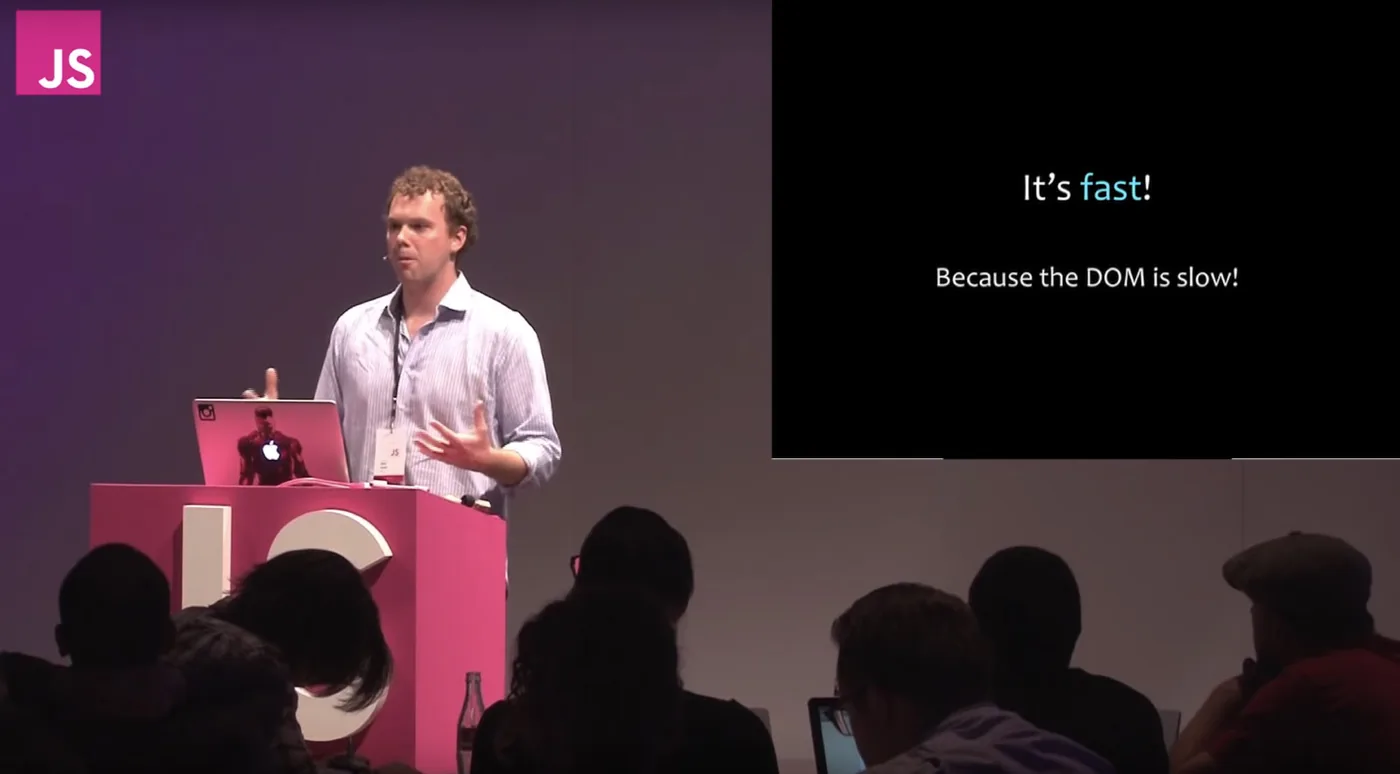
In late 2018, Svelte creator Rich Harris published an essay arguing that the virtual DOM is pure overhead. Harris challenged the belief that virtual trees run faster than real DOM nodes, pointing out that virtual operations occur in addition to actual document updates. The myth originated partly from Pete Hunt’s 2013 talk Rethinking Best Practices, which compared React against resetting body innerHTML on every update. Hunt said React was not magic. He noted that raw DOM API calls beat React, but emphasized that while React was fast enough for most tasks, virtual trees introduced unnecessary runtime work that modern compilers could eliminate [7].
Tree diffing is never free. Frameworks must compare every attribute and tag even when basic application structures remain unchanged across state transitions. Using a component example named HelloMessage, Harris demonstrated that changing a name property from world to everybody requires traversing element attributes just to update a single text node. Svelte eliminates this runtime traversal by shifting reactivity into an ahead-of-time compiler that produces focused JavaScript code to update target text nodes directly [7].
Component overhead extends beyond reconciliation diffing. Whenever components re-render during state changes, they allocate new arrays of virtual elements alongside fresh inline event handlers, generating continuous garbage collection pressure inside client memory. Harris warned that unpruned memory allocations cause applications to suffer death by a thousand cuts without leaving a single obvious bottleneck for developers to profile. While virtual trees deliver declarative convenience, modern compilers achieve reactive interfaces without paying runtime diffing penalties [7, 8].
Ember Glimmer Stream Architecture for Templates
Ember.js introduced Glimmer to bring the speed advantages of virtual reconciliation to existing applications while maintaining API compatibility. Rather than copying React, Ember developers centered their architecture on Handlebars templates. Glimmer separates static markup from dynamic expressions during template compilation, drastically reducing the volume of nodes evaluated when data bindings shift. Static structures are evaluated once [6].
Glimmer stores template nodes as lightweight, stream-like value queues rather than full-fledged object trees that mirror real DOM elements. When checking for state updates, the engine compares the final value of a Glimmer node directly against the last known browser value. Identical values require no further browser work. Sebastian Peyrott reported that Ember 2 achieved major reductions in garbage collection delays compared to Ember 1 because stream-based templates matched virtual tree performance without duplicating node graphs [6].
Web UI rendering reflects an evolving search for front-end balance. When AngularJS in 2010 introduced two-way data binding, its dirty-checking digest cycle struggled when tracking hundreds of variables across complex pages. React solved those scaling hurdles in 2013 by introducing in-memory tree reconciliation, while tools like Vue.js, Glimmer, and Incremental DOM refined how memory and CPU cycles are managed [6, 8]. Today, the virtual tree remains a cornerstone pattern of modern web architecture, offering software developers declarative power while continuing to evolve alongside compile-time framework innovations [1, 4, 8].
- WEBSITE React. (2021). Virtual DOM and internals. React Documentation. [Article Link]
- WEBSITE Codecademy. (2017). React: The virtual DOM. Codecademy. [Article Link]
- WEBSITE Google. (2015). Incremental DOM: An in-place DOM diffing library. GitHub. [Article Link]
- WEBSITE Vue.js. (2026). Rendering mechanism. Vue.js Documentation. [Article Link]
- WEBSITE Vue.js. (2026). Render functions & JSX. Vue.js Documentation. [Article Link]
- WEBSITE Peyrott, S. (2015). React virtual DOM vs incremental DOM vs Ember’s Glimmer: Fight. Auth0 Blog. [Article Link]
- WEBSITE Harris, R. (2018). Virtual DOM is pure overhead. Svelte Blog. [Article Link]
- WEBSITE Wikipedia. (n.d.). Virtual DOM. Wikipedia. [Article Link]


