





Security engineers and web developers asking what is cross-site scripting encounter a browser flaw that allows attackers to inject malicious client-side code into trusted websites. Because modern web browsers run embedded JavaScript to generate interactive pages, hostile scripts can bypass core security boundaries and harvest sensitive user records [9]. In the 2025 CWE Top 25 Most Dangerous Software Weaknesses ranking published by MITRE, cross-site scripting kept first place [6]. The vulnerability turns trusted platforms into delivery vectors for credential theft and account takeover.
- What Is Cross-Site Scripting?
- The Breakdown of the Same-Origin Policy
- Stored and Reflected XSS Vectors
- Historic Exploits from Apache to Social Networks
- Why Malicious Payloads Evade Browser Filters
- Contextual Output Encoding for Web Templates
- Content Security Policy as Defense in Depth
- Preventing Cross-Site Scripting in Modern Applications
What Is Cross-Site Scripting?
The expression emerged during the early days of dynamic web design when interactive scripts began modifying browser windows. Web pioneer Jeremiah Grossman noted that during the mid-1990s on Netscape and Yahoo, websites relied heavily on multi-frame layouts. Attackers soon realized that a hostile page loaded into one frame could cross domain boundaries and read private information from an adjacent frame [4].
Engineers at Microsoft met on January 16, 2000, to debate naming the newly recognized flaw. The team discussed candidate terms like Unauthorized Site Scripting, Synthesized Scripting, and URL Parameter Script Insertion before agreeing on Cross Site Scripting the following day. A coordinated advisory with CERT followed in February 2000 [1]. Security communities originally abbreviated the attack as CSS, but practitioners soon changed the acronym to XSS on the webappsec mailing list to avoid confusing the vulnerability with Cascading Style Sheets (CSS) [4]. Over time, the Open Web Application Security Project pointed out that the original name had become a misnomer. While the earliest attacks focused on stealing data across different domains, the category expanded to cover any unauthorized code running inside a client browser [2].
The core danger comes from attackers forcing their own JavaScript into pages that visitors trust [5]. Injected scripts turn legitimate platforms into delivery mechanisms for persistent exploitation [6]. That shift made client-side code injection a lasting problem for web infrastructure.
The Breakdown of the Same-Origin Policy
Web security relies on an underlying trust mechanism known as the same-origin policy. Under this browser rule, web content from a specific domain can only access stored resources like cookies and local storage if the URI scheme, host name, and port number match exactly. For example, a script loaded from an encrypted banking page cannot inspect the document object or session tokens of an unrelated domain. Browsers enforce these checks to keep independent websites strictly isolated from each other. However, cross-site scripting breaks this model by sneaking hostile instructions into legitimate traffic delivered by the trusted server. When the browser receives the combined payload, it has no way to tell whether a snippet of JavaScript was written by site administrators or inserted by an intruder [6].
The browser executes the script with all permissions granted to that origin, including full access to session cookies, sensitive form fields, and internal application endpoints. A 2007 security estimate found that up to 68% of active websites contained code injection weaknesses [6].
The nature of this attack differs fundamentally from request forgery. While cross-site scripting abuses the trust an end user places in a specific website, CSRF attacks exploit the trust that a web application places in a user’s authenticated browser. In request forgery, an unauthorized command rides on top of automatically submitted session cookies without running injected code on the target domain. Cross-site scripting proves far more dangerous because arbitrary script execution gives the intruder complete control over page behavior [7].
Stored and Reflected XSS Vectors
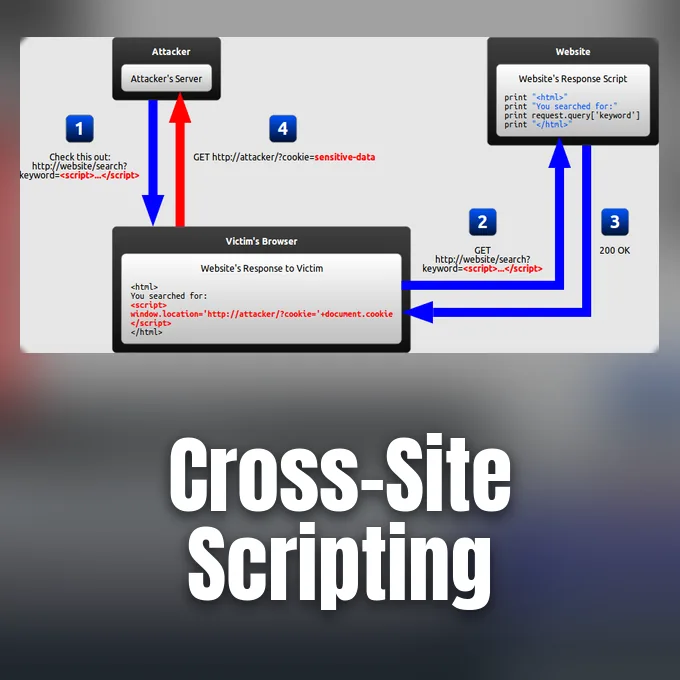
Security specialists generally divide script injection flaws into two primary groups: reflected and stored attacks. Reflected vulnerabilities, also known as non-persistent flaws, occur when user input from an HTTP query parameter gets echoed back to the screen immediately. A common vector involves search boxes: when a visitor searches for a keyword, the server repeats the query string on the results page. If the application returns the string without sanitization, an attacker can craft a link containing executable JavaScript and trick the victim into clicking it [6].
Stored vulnerabilities represent a more damaging hazard because the server permanently saves the malicious payload in a database or file system. On an online message board or dating platform, user submissions display to every member who views the page. Wikipedia illustrates this risk through a hypothetical dating profile where an attacker named Mallory submits JavaScript inside an Ideal First Date text field. When another member named Bob views her profile, his browser runs her hidden script, which extracts his private name and email address before transmitting the data to Mallory’s collection server. Persistent flaws allow malicious code to execute automatically without requiring custom bait for each victim [6].
Beyond server-rendered flaws, applications with heavy client-side logic face DOM-based vulnerabilities. In these scenarios, client scripts read user data directly from browser sources like the URL fragment and write it straight to the active Document Object Model without ever contacting the server. Security researchers identified widespread DOM flaws in 2011 inside popular jQuery plugins [6].
Historic Exploits from Apache to Social Networks
Real-world breaches show how quickly injected scripts can compromise high-profile infrastructure. Security educators Ryan Dewhurst and Thomas MacKenzie documented that the Apache Foundation had internal web servers compromised through an initial script injection attack. In another documented case, intruders targeted the official discussion forum of the Ubuntu Linux operating system [5].
That intrusion on the Ubuntu forums allowed attackers to download private credentials, email addresses, and passwords belonging to 1.82 million registered forum users [5]. Social networking platforms face unique risks from persistent injection because malicious code can self-propagate across friend networks. In past incidents on Twitter and Facebook, attackers embedded scripts that automatically posted links, updated profile statuses, and messaged contacts from the victim’s account without user consent. When contacts visited the infected profiles, their browsers executed the script and repeated the cycle. These fast-moving client-side worms infected thousands of connected profiles within minutes, turning social features into automated propagation channels [6].
Security testers frequently verify injection vulnerabilities by displaying a simple alert pop-up box with a test value. While this demonstration looks harmless, weaponized payloads go much further. Attackers use tools like the Browser Exploitation Framework (BeEF) to command compromised browsers, record keystrokes, and capture hardware feeds. Intruders also build deceptive login forms directly over the original page to harvest banking details [5].


Why Malicious Payloads Evade Browser Filters
Why do browsers struggle to separate harmless text from hostile scripts? The difficulty stems from the structure of web documents. An HTML page uses a flat serial format that blends structural tags, styling rules, and raw content together. When an application splices unvalidated user input into this stream, the browser parser cannot determine where safe data ends and executable instructions begin [6]. The 2021 OWASP Top 10 placed injection flaws in third position, recording 274,228 occurrences and 32,078 CVEs across 33 mapped weakness categories, including Cross-site Scripting (CWE-79). The report noted an average incidence rate of 3.37% across surveyed applications [3].
Browsers often try to repair malformed markup automatically, which inadvertently creates injection openings. Mutated XSS happens when a browser rebalances unclosed quotation marks or injects formatting quotes into font declarations. A string that looks clean to a server-side filter can transform into an active script once the browser finishes parsing it [6].
In a comprehensive research review published in the International Journal of Advanced Computer Science and Applications, P. Nagarjun and S. Shakeel analyzed 412 research papers published between 2002 and 2019. They observed that static filters and dynamic proxies struggle because attackers constantly invent novel character encodings to bypass inspection rules [11]. Writing in Computer, L. K. Shar and H. B. K. Tan noted that vulnerabilities persist largely because programmers do not fully understand browser execution contexts or the boundaries of existing filters. Simple blocklists that search for words like script regularly fail [8].
Contextual Output Encoding for Web Templates
The most reliable defense against script injection is contextual output encoding. Because web browsers interpret syntax differently inside HTML bodies, attribute values, JavaScript blocks, CSS definitions, and URLs, developers must apply the encoding scheme tailored to that specific location [2].
Inside standard HTML contexts like paragraph tags, applications encode five critical characters: ampersand, less-than, greater-than, double quotes, and single quotes. Turning these symbols into safe entity strings ensures that the browser interprets user input as plain text rather than markup. Placing untrusted variables inside HTML attributes demands enclosing values in quotes and using specialized attribute encoding. In inline script contexts, encoders must account for both the enclosing script tags and string boundaries. The OWASP Java Encoder provides distinct functions for HTML body text, attributes, and JavaScript string literals. When developers write client code, using properties like textContent creates safe text nodes, whereas assigning untrusted input to innerHTML exposes the page to immediate injection [2].
When web applications must accept rich text formatting from users, encoding is not enough because it strips out legitimate tags. In these cases, developers rely on HTML sanitization engines like DOMPurify to strip dangerous attributes and malicious script elements while keeping safe styling tags intact [2]. Keeping untrusted variables out of dangerous contexts is vital, much like how developers isolate untrusted code when handling WebAssembly execution inside browsers without granting elevated page access.
Content Security Policy as Defense in Depth
Even when developers follow careful coding practices, an overlooked input field can introduce a flaw. To guard against unescaped variables, administrators implement a Content Security Policy (CSP) via HTTP response headers [2]. A CSP specifies an allowlist of approved domains and cryptographic hashes from which browsers are permitted to load and run scripts [5]. In an experimental evaluation published in Computer, I. Yusof and A. K. Pathan demonstrated that an appropriately configured CSP successfully stopped all tested script injection variants across four popular web browsers [12]. Web browsers verify incoming scripts against these declared rules before execution.
Cookie protection provides another essential defense layer. By appending the HttpOnly flag to session cookies in Set-Cookie headers, web servers instruct the browser that client-side JavaScript must never read those tokens. Even if an attacker finds an injection hole and runs arbitrary JavaScript on the page, the script cannot extract HttpOnly session identifiers via document.cookie [5].
Organizations also deploy Web Application Firewalls (WAFs) like the open-source mod_security module to inspect incoming web requests for known injection signatures. Security teams use automated testing tools like OWASP ZAP to scan web forms and parameters during development cycles. On the client side, users can install browser extensions like NoScript on Firefox to block untrusted script execution. These tools provide layered protection, but security teams must treat perimeter firewalls as supplementary barriers rather than substitutes for proper code escaping [5].
Preventing Cross-Site Scripting in Modern Applications
Modern web frameworks have substantially reduced vulnerability rates by automating output encoding in their default template engines. Frameworks like React and Vue bind variables into HTML templates safely, treating untrusted data as plain text by default. However, injection risks reappear when engineers use built-in escape hatches to bypass framework protections. Vulnerabilities return when developers use React’s dangerouslySetInnerHTML, Angular’s bypassSecurityTrustAs functions, Lit’s unsafeHTML helper, or Polymer’s inner-h-t-m-l attribute without first sanitizing input strings [2].
To catch evasive injection patterns, computer scientists have developed machine learning models that analyze HTTP traffic. In a 2024 study published in Information, R. Alhamyani and M. Alshammari evaluated multiple algorithmic models on real-world datasets. They found that Random Forest models achieved 99.78% accuracy, while ensemble architectures exceeded 99.64% detection rates after applying ANOVA and Information Gain feature selection. Automated classifiers distinguish subtle injection patterns that conventional signature-based filters miss [10]. V. Nithya and colleagues also emphasized early algorithmic detection to protect web resources like cookies and credentials from unauthorized manipulation [9].
Complementing these classifiers, F. Younas and colleagues introduced an artificial intelligence pipeline in the Decision Analytics Journal that pairs Long Short-Term Memory networks with TFIDF feature extraction. Their combined LSTF method captures both temporal sequences and textual features from incoming web requests to identify injection payloads before execution occurs [13]. Integrating these models alongside static and dynamic security scanners in continuous integration pipelines helps development teams eliminate injection flaws before code ships to production environments [3].
- WEBSITE Microsoft Learn. (2009, December 15). Happy 10th birthday Cross-Site Scripting! [Article Link]
- WEBSITE OWASP. (2024, April 25). Cross Site Scripting Prevention Cheat Sheet. [Article Link]
- REPORT OWASP. (2025, January 1). A03:2021 – Injection. [Article Link]
- WEBSITE Grossman, J. (2006, July 30). The origins of Cross-Site Scripting (XSS). [Article Link]
- WEBSITE Dewhurst, R., & MacKenzie, T. (2010, January 1). scriptalert1. [Article Link]
- WEBSITE Wikipedia. (2026). Cross-site scripting. [Article Link]
- WEBSITE Wikipedia. (2026). Cross-site request forgery. [Article Link]
- ACADEMIC JOURNAL Shar, L. K., & Tan, H. B. K. (2011). Defending against Cross-Site Scripting Attacks. Computer, 45(3), 55-62. [Article Link]
- ACADEMIC JOURNAL Nithya, V., Pandian, S. L., & Malarvizhi, C. (2015). A Survey on Detection and Prevention of Cross-Site Scripting Attack. International Journal of Security and Its Applications, 9(3), 139-152. [Article Link]
- ACADEMIC JOURNAL Alhamyani, R., & Alshammari, M. (2024). Machine Learning-Driven Detection of Cross-Site Scripting Attacks. Information, 15(7), 420-420. [Article Link]
- ACADEMIC JOURNAL Nagarjun, P., & Shakeel, S. (2020). Cross-site Scripting Research: A Review. International Journal of Advanced Computer Science and Applications, 11(4). [Article Link]
- ACADEMIC JOURNAL Yusof, I., & Pathan, A. K. (2016). Mitigating Cross-Site Scripting Attacks with a Content Security Policy. Computer, 49(3), 56-63. [Article Link]
- ACADEMIC JOURNAL Younas, F., Raza, A., Thalji, N. J., Abualigah, L., Zitar, R. A., & Jia, H. (2024). An efficient artificial intelligence approach for early detection of cross-site scripting attacks. Decision Analytics Journal, 11, 100466-100466. [Article Link]
Cover image: Nurmukhamyed / Wikimedia Commons, CC BY-SA 4.0


