





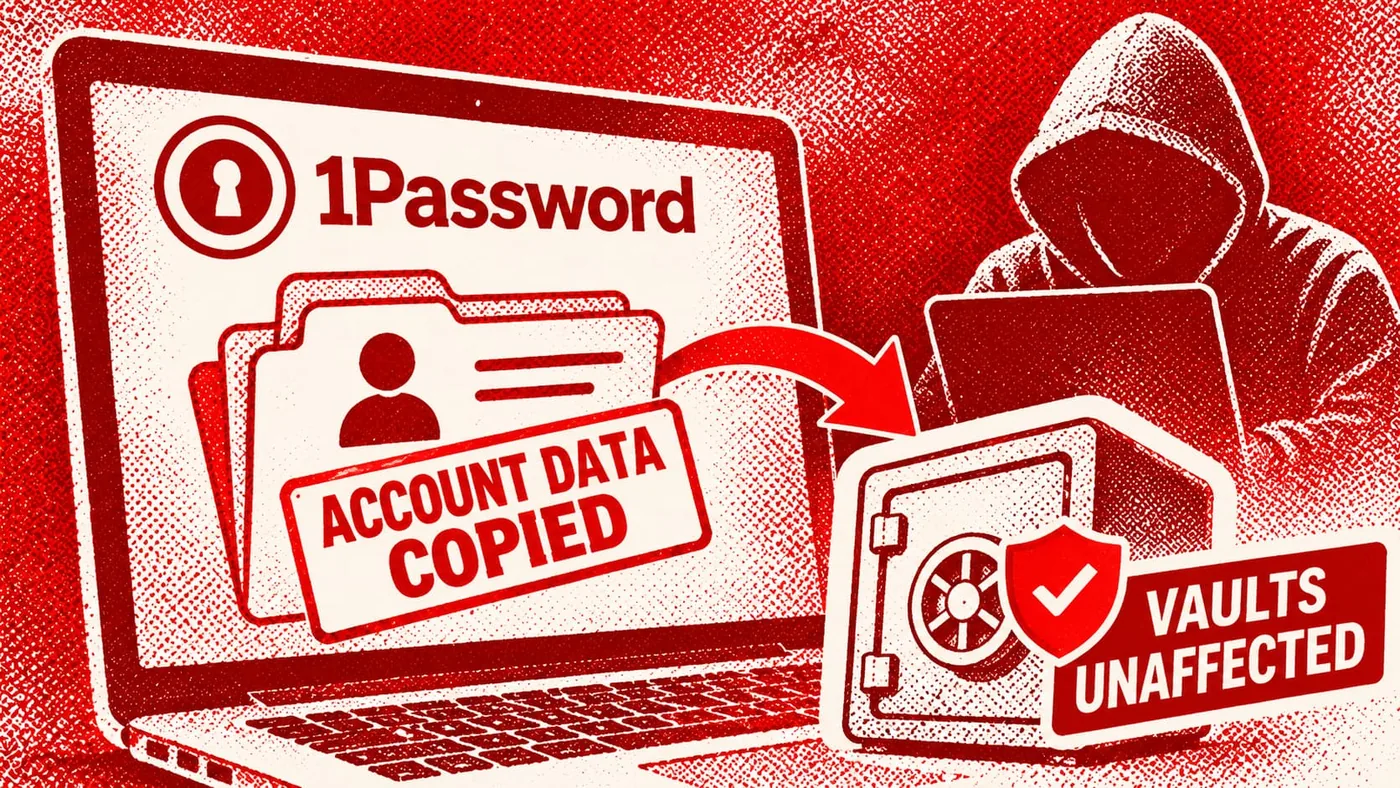
Toronto software maker 1Password announced on November 25 that an intruder accessed its backend systems and downloaded customer account records [2]. The company detected suspicious activity on November 19 after an attacker took over an employee GitHub account and used that foothold to push rogue code into backend services [3]. While the 1Password data breach exposed customer names and email addresses, user vaults stayed safe [1].
What the 1Password Data Breach Exposed
The security incident started when an unknown hacker took control of an employee account on GitHub, which 1Password relies on to store and manage its source code. Zack Whittaker reported for TechCrunch that the Toronto company serves more than 200,000 businesses and millions of retail customers who rely on its software to store passwords, payment card details, and logins [2]. In a blog post published on Wednesday, the company said the downloaded database files contained customer names, registered email addresses, account identifiers, and timestamps tracking account creation and last sign-in times [4]. Lawrence Abrams reported for BleepingComputer that the intruder ran database queries that copied user account metadata into storage controlled by the attacker [3]. Client software was not infected [2].
Beyond contact information and timestamps, the intruder copied security settings linked to customer accounts. These files contained public keys and data tied to the Secure Remote Password (SRP) protocol [3]. Because public keys work apart from the private keys that lock user vaults, 1Password said their disclosure does not let an attacker view stored passwords or decrypt user files [4].
The intruder also copied setup tokens found in links sent to users for team invites or account recovery. Emma Roth reported for The Verge that only a small number of users had active tokens exposed [1]. The company emailed those users [3].
How the GitHub Account Was Compromised
Engineers at 1Password first noticed warning signs inside their development systems on November 19 [1]. An attacker had seized an employee GitHub account, giving the intruder access to private source repos and the continuous delivery pipeline [3]. That access let the hacker inject rogue code into backend systems that handle customer account data [1]. 1Password said its source code repos hold no customer master keys or vault secrets, meaning the stolen code gave the intruder no way to decrypt customer records [4]. The company quickly cut off the hacked account [3].
Can an attacker use stolen setup tokens to take over an account without permission? 1Password said these tokens can’t grant access by themselves because completing account setup or recovery needs an extra check [1]. An intruder holding a leaked token still can’t log in without passing single sign-on (SSO) checks or typing a separate verification code delivered directly to the user’s primary inbox [3].
After checking server logs together with external security experts, 1Password found no evidence that any exposed token was used for account takeovers [3]. Desktop apps, mobile software, and browser extensions kept running normally without disruption [2]. Client installations were never modified [4].
Protection of Customer Vaults
The main finding of the internal review is that customer password vaults were “at no point” open to the attacker [2]. 1Password uses an end-to-end encryption model where passwords, logins, and card numbers stored in vaults are scrambled on user devices before syncing to cloud servers [3]. Because the Toronto firm does not hold customer account passwords or Secret Keys, its internal databases store only scrambled text that can’t be read without local keys [2]. Waqas reported for Hackread that even when an intruder pulls database records from backend systems, the vault contents stay locked and unreadable [4]. Local user keys protect the vaults [1].
To protect accounts whose setup links were copied in the 1Password data breach, the company updated its email login protocol [1]. It replaced six-digit numeric confirmation codes with ten-character alphanumeric codes, making them far harder to guess through automated attempts [3]. Lengthening these codes stops hackers from trying brute-force attacks if an attacker intercepts an invite link [1].
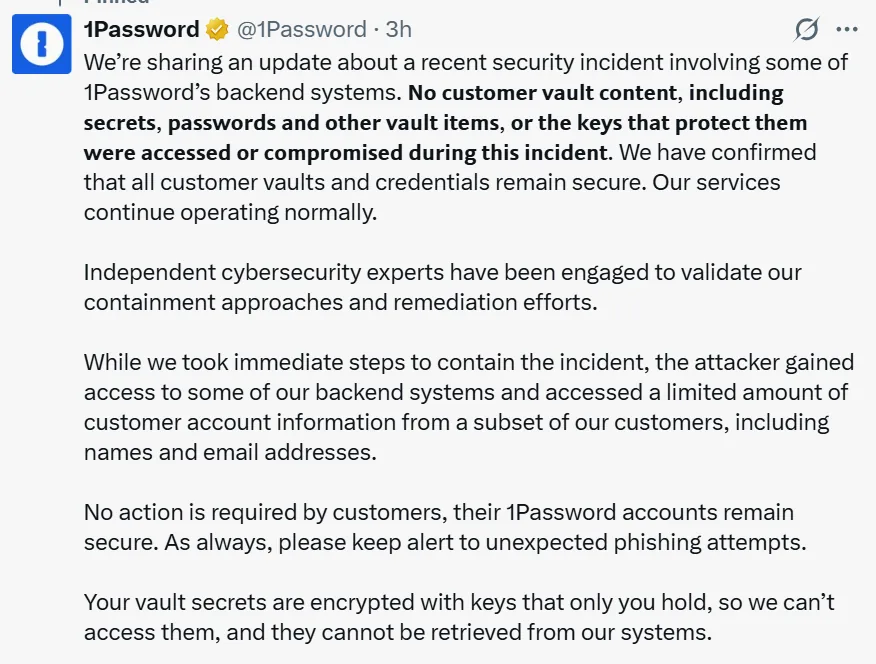
1Password said customers do not need to reset account passwords, change Secret Keys, or regenerate vaults because of the breach [4]. The crypto keys that guard stored items stayed safe on user devices throughout the intrusion, leaving user vaults secure [2].
1Password Breach Incident Response
Following the discovery on November 19, 1Password disabled the hacked employee GitHub account and revoked its access tokens [3]. Systems engineers cleaned the affected backend services, restored clean software builds from trusted source repos, and rotated internal infrastructure keys that might have been visible in the deployment pipeline [4]. Reporting from The Verge showed that 1Password also added new detection systems to spot similar intrusion attempts in the future [1]. The company isolated the affected services while running scans across its entire build setup [3]. Clean code builds reached production within days [1].
To review the cleanup and check network health, 1Password hired independent cybersecurity experts to audit its response steps [3]. Outside investigators found no evidence that the attacker stayed on company servers after the defense steps were taken, confirming full network recovery [4].
Phishing Risks for Customers
Although encrypted vaults stayed safe, security experts warned that the stolen names and email addresses give hackers prime material for phishing campaigns [3]. Threat actors can use the confirmed list of 1Password users to build fake messages that point to recent security alerts or account recovery requests [1]. Attackers often mimic trusted security firms to trick people into giving up passwords, Secret Keys, or one-time sign-in codes [3]. Because the stolen records confirm active accounts, criminals can tailor their lures to look real and trick unwary users who might panic after hearing about the breach [4]. Scams also spread by phone [1].
Reporters at TechCrunch pointed out that attackers might send fake messages claiming that users must secure their accounts following the 1Password data breach [2]. These deceptive notices often warn recipients that their vaults were locked or that a fast password reset is needed to keep access [3]. If users click links in such notes, they may land on fake login portals designed to steal Secret Keys [1].
1Password told customers to watch out for unexpected messages that ask for account checks or security updates [4]. The company said it will never contact users by email, text, or phone to ask for an account password or Secret Key [1]. Official software should always be opened directly [3].
- ONLINE NEWS Roth, E. (2026, November 25). 1Password breach leaked customer names and emails, but not passwords. The Verge. [Article Link]
- ONLINE NEWS Whittaker, Z. (2026, November 25). 1Password said hackers broke into its internal systems, but customer passwords are safe. TechCrunch. [Article Link]
- ONLINE NEWS Abrams, L. (2026, November 25). 1Password customer data stolen after employee GitHub account breach. BleepingComputer. [Article Link]
- ONLINE NEWS Waqas. (2026, November 25). 1Password says attacker copied customer account data, vaults unaffected. Hackread. [Article Link]


