






An international research team led by the University of Copenhagen and Leiden University analyzed more than 4,700 prehistoric genomes, using ancient DNA to trace the spread of Celtic and Germanic languages in Europe [5]. The dual studies, published in Nature, combine genomic data with archaeological evidence to test how ancestral populations moved into northern and western regions [1]. By tracking subtle shifts in population ancestry over several millennia, the researchers reconstructed demographic movements that brought early language varieties to their homelands [3]. The findings challenge long-held assumptions about when these linguistic traditions reached their geographic boundaries.
Steppe Migrations and Indo-European Roots
Centuries ago, scholars observed shared grammatical patterns and root words connecting European tongues, noting parallels among words like English father, Irish athair, and Greek patēr. Linguistics links these branches to Proto-Indo-European, an ancestral tongue spoken five millennia ago. Pastoral groups from the Yamnaya culture spread this speech while moving westward from the grassy steppes north of the Black and Caspian Seas [3]. In earlier research, insights from ancestral DNA reveal genetic roots that help clarify how prehistoric migrations shaped regional populations.
Around 4,400 years ago, groups tied to the Bell Beaker complex spread steppe-related ancestry into western Europe, establishing lineages that persisted into the Iron Age [1]. Geneticist Eske Willerslev said that DNA sequences alone do not reveal language. “DNA sequences do not tell us directly which language people spoke. But by combining ancient DNA with linguistic and archaeological evidence, we can begin to trace how languages spread and changed over thousands of years,” Willerslev said [4]. While eastern Europe received Corded Ware ancestry, western Europe remained shaped by Bell Beaker groups that carried Indo-European dialects toward the Atlantic [1].
Scandinavian Influx and Ancient DNA Findings
Linguists long assumed that early Germanic speech reached Scandinavia with the first steppe migrations about 4,800 years ago [3]. Genomic data revealed an arrival eight centuries later [2]. Around 4,000 years ago, an unrecorded population with steppe ancestry entered Sweden from the Baltic, settling between Finland and northeastern Sweden before moving south into Denmark. Lead author Hugh McColl, a population geneticist at the University of Copenhagen, said the team uncovered an unknown migration occurring where the earliest Germanic speech developed [4].
These newcomers spread through Scandinavia over five centuries, mixing with local hunter-gatherers and farmers [4]. By 3,500 years ago, their ancestry appeared in southern Sweden and Denmark, matching the territory where ancestral Germanic developed during the first millennium BC [2]. Guus Kroonen described this lineage as an effective tracer dye for following Germanic languages [5]. The timeline resets northern European linguistic history by showing that Germanic speech arrived in Scandinavia much later than early models assumed [3].
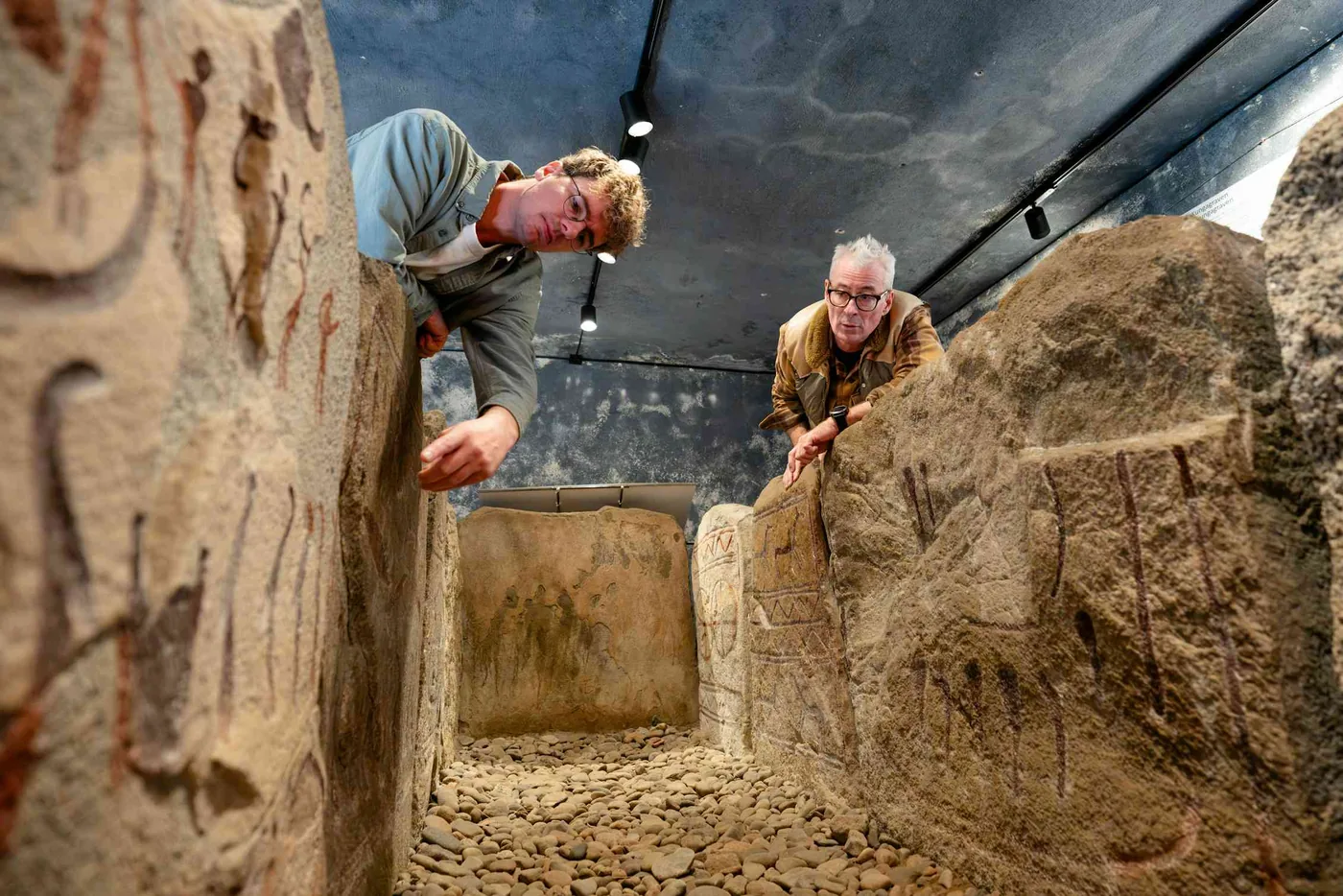
To map these changes, the researchers sequenced 712 ancient skeletons and analyzed them with 4,009 previously published human genomes. They compared biological markers with Bronze Age sites, including Kiviksgraven in southern Sweden, where rock art in the King’s Grave dates to the 15th century BCE [4]. The work also drew upon Mediterranean genomic surveys. A preprint led by Fatma Ece Yediay at bioRxiv, which has not undergone peer review, previously showed an east-west divide in steppe ancestry across southern Europe [6]. The Scandinavian findings confirm that northern population shifts followed Baltic routes rather than expanding from the south [2].

How Germanic Dispersals Shifted Southward
About 2,000 years ago, northern populations moved south into central Europe [3]. Genetic samples from around 1,650 years ago show people moving from southern Scandinavia into areas now belonging to Germany, Poland, and the Netherlands [4]. Archaeological records indicate that these central European territories were largely Celtic-speaking before northern groups arrived [2]. This movement coincided with the Migration Period around 400 AD, during which West Germanic-speaking Anglo-Saxons moved to Britain and Langobards founded a kingdom in Italy [3].
Genetic surveys also identified a reverse migration from northern Germany and southern Jutland back into Denmark and southern Sweden. These returning groups shared close genetic ties with continental ancestors of the Anglo-Saxons who settled in England. Old Norse emerged during this period [3]. This influx coincided with shifting political centers in Scandinavia and the spread of new artistic styles, while monuments such as the Rök Stone in Sweden, carrying more than 700 runic characters, record how these shared Germanic speech forms developed into early medieval dialects [5].
Norway followed a different path. Genetic data showed that pre-Viking Norwegians experienced little biological influx from the southern back-migration, yet they adopted the same linguistic innovations that shaped Old Norse [3]. “Archaeologists and linguists had not predicted it, but it helps explain several cultural and linguistic connections between Scandinavia and Britain that have puzzled researchers for a long time,” McColl said [4]. Genetic patterns in Norway confirm that languages spread through trade and cultural contact between Scandinavian communities without large population turnover [3].


Urnfield Roots of Celtic Speech
Before Germanic expansions and Roman conquests reshaped Europe, Celtic languages covered areas from the Iberian Peninsula to the British Isles and the Danube basin [3]. Today, these tongues survive in Atlantic areas as two branches: Goidelic, including Irish, Scottish Gaelic, and Manx; and Brittonic, encompassing Welsh, Breton, and Cornish [4]. Celtic speakers today number between two and three million people, while Germanic languages count more than one billion speakers worldwide [5]. Scholars have debated for over a century whether Celtic speech formed along the Atlantic coast or originated in central Europe [4].
To evaluate competing Celtic theories, the researchers examined genetic samples from 4,587 ancient individuals buried in Bronze and Iron Age Europe. They tested four models, including the Atlantic Bronze Age model and the inland French hypothesis. The strongest genetic signal matched the Urnfield model, showing that between 3,200 and 2,800 years ago, populations linked to the Knovíz and Urnfield cultures expanded westward from eastern central Europe into France, Britain, and northeastern Iberia. This genetic expansion aligns with later Hallstatt and La Tène archaeological horizons, providing a clear route for the emergence of Gaulish, Celtiberian, and Lepontic [1].
Monuments such as the Aghascrebagh and Coumeenoole Ogham stones in Ireland preserve early inscriptions from these surviving Celtic traditions [5]. Earlier Atlantic contacts between southwestern Europe and Britain around 3,800 years ago left measurable genetic traces, showing that western maritime routes also contributed to populations. However, the central European expansion during the Late Bronze Age accounts for the widespread distribution of Celtic dialects along continental river valleys [1]. The data indicates that successive demographic pulses influenced the Atlantic fringe rather than a single isolated wave [3].

Evaluating Ancient DNA in Language Models
Evaluating prehistoric languages through biology requires mathematical models to separate true population movement from long-term genetic continuity, leading researchers to run identity-by-descent mixture modeling through the limSolve package in R to resolve complex ancestral mixtures [1]. Earlier evolutionary research examined archaic hominin adaptations in Europe.
Work on ancient hominins shows that Neanderthal gene variants influenced circadian rhythms in early human groups.
The results showed that while genetic boundaries often shifted alongside cultural transformations, genes and grammar did not always travel together. Guus Kroonen said that individuals could adopt speech varieties from neighboring communities without leaving detectable biological signatures. “You can easily adopt a new language without changing your genes,” Kroonen said [5]. This principle explains why certain groups in Europe learned Celtic or Germanic tongues through trade networks and social integration while retaining their ancestral genetic background [3].

Limits of Genomic Linguistic Reconstruction
Ancient genomics provides a powerful lens for testing migration models, but it cannot definitively prove which dialect a specific person spoke in daily life [3]. Skeletal remains reveal ancestry and kinship, but spoken words leave no physical residue in fossilized bone [4]. Hugh McColl said that researchers wanted to observe how regional ranges swapped through time. “We wanted to kind of see how this change occurs. How does the range swap through time?” McColl said [5]. Combining genomic maps with runic carvings, Ogham inscriptions, and classical texts allows historians to narrow down plausible scenarios for European language origins [1].
Future sampling in central France and northern Germany will help clarify the timing of these language movements, while the two Nature publications demonstrate that European prehistory was shaped by repeated migrations, isolation, and reunion rather than simple continuity [3]. By tracking ancient DNA over five millennia, scientists can trace the biological threads that accompanied the rise of Europe’s major language families [1]. These discoveries show how genetics helps resolve long-standing debates about language origins [3].
- ACADEMIC JOURNAL McColl, H., Kroonen, G., Pinotti, T., Barrie, W., Koch, J., Ling, J., Demoule, J., Kristiansen, K., Sikora, M., & Willerslev, E. (2026). Tracing the spread of Celtic languages using ancient genomics. Nature. [Article Link]
- ACADEMIC JOURNAL McColl, H., Kroonen, G., Moreno-Mayar, J. V., Seersholm, F. V., Scorrano, G., Pinotti, T., Vimala, T., Sindbæk, S. M., Ethelberg, P., Fyfe, R., Gaillard, M., Larsen, H. M. E., Mortensen, M. F., Demeter, F., Jørkov, M. L. S., Bergerbrant, S., Damgaard, P. d. B., Allentoft, M. E., Vinner, L.,. Sjögren, K. (2026). Tracing the spread of Germanic languages using ancient genomics. Nature. [Article Link]
- ONLINE NEWS Willerslev, E., Kroonen, G., & McColl, H. (2026). We used ancient DNA to track the origins and spread of the Germanic and Celtic languages – new research. The Conversation. [Article Link]
- ONLINE NEWS Cockerill, J. (2026). Ancient DNA Rewrites The Story of How Germanic And Celtic Languages Spread Across Europe. ScienceAlert. [Article Link]
- ONLINE NEWS Callaway, E. (2026). Rise of Germanic and Celtic languages is written in ancient DNA. Nature. [Article Link]
- PREPRINT Yediay, F. E., Kroonen, G., Sabatini, S., Frei, K. M., Frank, A. B., Pinotti, T., Wigman, A., Thorsø, R., Vimala, T., McColl, H., Moutafi, I., Altinkaya, I., Ramsøe, A., Gaunitz, C., Renaud, G., Mederos Martin, A., Demeter, F., Scorrano, G., Canci, A.,. O’Shea, J. (2024). Ancient genomics support deep divergence between Eastern and Western Mediterranean Indo-European languages. bioRxiv. [Article Link]
APA 7: PerEXP Teamworks. (2026, November 5). Celtic and Germanic Language History Mapped by Ancient DNA. PerEXP Teamworks. https://perexpteamworks.com/en/ancient-dna-spread-celtic-germanic-languages/


