






A major Core Ultra 4000 leak revealed preliminary specifications for seven desktop processors from Intel, according to reports published by hardware outlets on November 25, 2026. Pre-release documentation obtained by VideoCardz describes qualification silicon built on Intel C1 stepping three months before expected official product announcements. Reporter Oliver Haslam at Tom’s Hardware said the lineup scales from 22 to 28 cores under the Nova Lake-S codename. Intel warned in the leaked material that clock targets and performance “may change before the final products are ready to be shipped,” but qualification samples rarely change significantly before retail production [1]. Hardware analyst Sarfraz Khan at Wccftech reported that the stack introduces higher memory speeds and massive cache pools to challenge rival desktop processors in PC gaming [2].
What the Core Ultra 4000 Leak Outlines
At the top of the stack sits the Core Ultra 9 4970K BFC, designed as the main flagship for desktop enthusiasts [1]. Intel pairs 28 total cores with 28 threads on this halo component, dividing work between eight P-cores, 16 E-cores, and four low-power background units [2]. P-core frequencies reach a base clock of 3.3 GHz and boost up to 5.5 GHz under light computing loads [1]. Intel adds 144 MB of last-level cache to keep data moving through execution pipelines smoothly. The chip runs on a 125-watt base power rating [2]. Efficiency cores run at 2.7 GHz base with a 4.6 GHz turbo ceiling, and low-power Crestmont cores peak at 3.4 GHz to service background operating system telemetry [1].
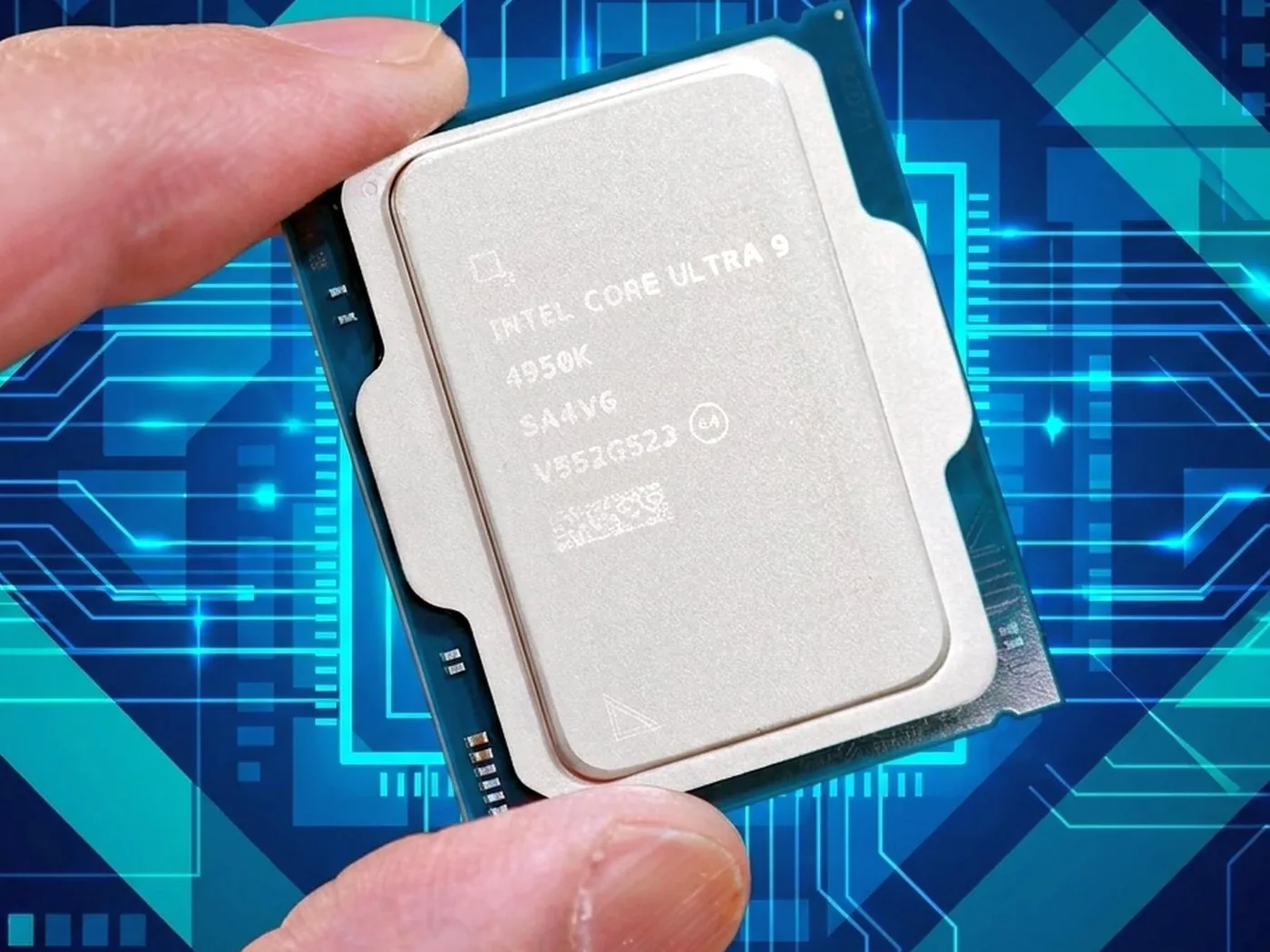
Intel pairs this flagship with the Core Ultra 9 4950K, which shares the identical 28-core layout but trims cache capacity to 36 MB [1]. Both processors use a 125-watt limit [2]. The 4950K reaches a 5.4 GHz turbo on its performance cores and omits Thermal Velocity Boost on the leaked chart, whereas the 4970K BFC hits 5.5 GHz through Intel Turbo Boost Max Technology 3.0 [1]. Both Core Ultra 9 models include integrated graphics running up to 3.1 GHz [2].
A third enthusiast tier appears as the Core Ultra 9 4900 BFC. Intel configured this variant with a 65-watt power rating for compact desktop builds [2]. The chip combines six P-cores with 12 E-cores and four low-power cores, yet it retains a 120 MB cache. P-cores achieve 5.3 GHz [1]. Thermal limits stay modest [2].
Cache Upgrades for Gaming
In reporting titled Desktop CPUs Preliminary Specs, Sarfraz Khan at Wccftech analyzed these desktop SKUs. Wccftech outlined that two Nova Lake-S Chips Get 144 MB LLC Cache While the Core Ultra 9 4900 BFC operates at 120 MB, providing substantial memory buffers across high-end SKUs. Intel added this LLC Last Level Cache specifically to challenge AMD X3D processors in modern game engines. Khan said previous testing showed these cache architectures can deliver up to 20% higher gaming performance compared to older Arrow Lake-S silicon to challenge future AMD Zen 6 architectures. Cache capacity benefits gaming benchmarks [2].
Identical cache allocation across tiers breaks with standard Intel product segmentation practices. In earlier desktop generations, Intel routinely reduced cache sizes whenever disabling compute clusters on mid-tier models, but the 24-core Core Ultra 7 4870K BFC keeps the same 144 MB cache volume as the 28-core flagship. Gamers gain optimal gaming memory capacity without paying extra money for surplus compute threads [1].
Oliver Haslam at Tom’s Hardware said earlier documentation indicated Nova Lake chips would “universally limit the maximum core frequency to 5.1 GHz when above 90°C” under full load. Tom’s Hardware commenter TerryLaze argued in forum threads that 125-watt processors remain straightforward to cool with mainstream solutions. Community member thestryker added that baseline clock rates reflect modern architectural tuning. Capable air coolers prevent thermal throttling during gaming [1].


Mid-Range and Entry Models
Below the flagship tier, Intel addresses the mainstream desktop market with two Core Ultra 7 processor models [1]. The Core Ultra 7 4870K BFC and Core Ultra 7 4850K each offer 24 cores and 24 threads, combining eight P-cores with 12 E-cores and four low-power cores. Both models carry a 125W TDP PL1 rating and reach a 5.2 GHz turbo frequency on their performance cores, while the 4900 BFC operates at 65W TDP PL1 [2]. Base clock speeds differ between the two chips, as the standard 4850K starts at 3.5 GHz and the cache-heavy 4870K begins at 3.2 GHz on its performance cores. Community leaks from Jaykihn tracked these cache allocations early [1].
Mainstream buyers receive two options in the Core Ultra 5 bracket, led by the Core Ultra 5 4650K and its KF sibling [1]. Both processors feature 22 cores across 22 threads, combining six P-cores with 12 E-cores and four low-power cores with a shared 30 MB cache pool [2]. Performance cores boost up to 5.1 GHz from a base clock of 3.6 GHz [1]. Both Core Ultra 5 chips share a 125W TDP rating [2].
The 4650KF omits display silicon entirely [2]. The standard 4650K incorporates 32 EUs clocked at 2.9 GHz, which mirrors how earlier desktop generations like the Core Ultra 7 260K in Newegg prebuilt desktop systems separated retail graphics capabilities. Budget builders can save money with the KF model [1].

Platform Memory and Video Features
Beyond raw core counts, the leaked documentation outlines improvements across the platform architecture supporting these new desktop chips. All seven processors support DDR5-8000 memory speeds as a native platform standard, marking a major jump over the DDR5-6400 ceiling found on older Arrow Lake-S desktop motherboards. The memory controller handles up to 256 GB of system RAM across four dual-channel slots, giving content creators plenty of memory headroom for demanding creative applications. The processor die supplies 24 PCIe lanes directly to the motherboard, accommodating high-speed graphics cards and solid-state storage drives without lane sharing [1].
Integrated video decoding receives notable enhancements through expanded codec hardware built into the graphics display engine on non-KF processors. The hardware decoder handles modern broadcast formats including DNx, XAVC, JPEG-XS, and VVC, with AV1 High and Professional profiles that ensure smooth playback of modern media. An on-die neural processing unit rated at 77 PTOPS handles local artificial intelligence tasks without taxing compute cores [1].
New desktop motherboards will be required across the lineup. Motherboard vendors must adopt new socket pins and trace routings to handle high DDR5-8000 signalling speeds and 144 MB cache power planes. PC builders upgrading from current platforms will need both a new processor and a compatible board [1].
Expected Nova Lake-S Launch Window
The emergence of complete qualification sample specs indicates that Intel desktop roadmap is advancing steadily toward commercial production and retail release. Earlier reports from HotHardware and VideoCardz suggested Intel might reveal the silicon during an event in Berlin, Germany between February 22 and 25, 2026, but retail availability is widely expected to land in early 2027. Motherboard partners are preparing to exhibit compatible desktop boards at CES 2027 in Las Vegas, Nevada this coming January ahead of the CPU rollout. Trade show previews will give buyers an early look at motherboard features and pricing tiers [1].
The desktop focus of these qualification samples also helps clarify how Intel organizes its client computing product lineup. Desktop users receive socketed processors with large cache pools, but mobile silicon roadmaps appear to follow separate architectural directions for power-conscious laptop form factors [1]. Recent reporting examined Why Reports Move Intel’s Nova Lake APU to Razor Lake, explaining how integrated mobile packaging shifts away from standard socketed desktop silicon designs. Socketed silicon prioritizes raw clock speeds [2].
Hardware enthusiasts will follow whether final retail hardware maintains the clock frequencies and cache configurations outlined in this Core Ultra 4000 leak [1]. If retail silicon mirrors these C1 qualification samples, the 144 MB cache pools and 5.5 GHz turbo speeds will give Intel a competitive gaming option [2]. Future announcements will confirm official retail pricing and global shipping dates [1].
- ONLINE NEWS Haslam, O. (2026, November 25). 7 new Intel Nova Lake-S Core Ultra 4000-series CPUs detailed in new leak. Tom’s Hardware. [Article Link]
- ONLINE NEWS Khan, S. (2026, November 25). Intel Core Ultra 9 4970K BFC reportedly gets 5.5 GHz turbo clock with 144 MB LLC cache; multiple Nova Lake-S SKUs leaked with specifications. Wccftech. [Article Link]


