





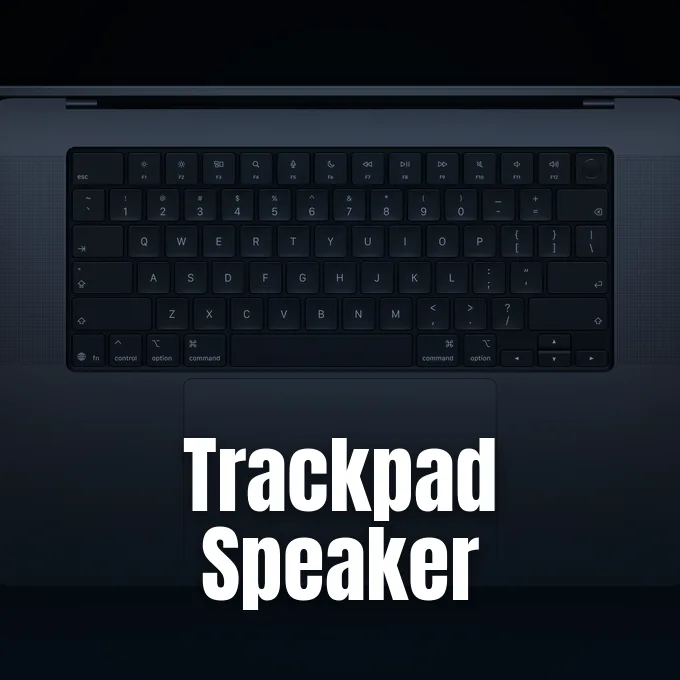
Software developer Cody Collier, AKA os6 on GitHub, released an open-source project called No Speaker on November 22, 2026, showing how a MacBook’s Force Touch trackpad can produce speech and musical notes. The project works while system speakers remain muted. Muted speakers stay silent. Fast vibrations from the trackpad’s internal motor rattle the glass surface to play melodies, drum patterns, and spoken phrases [1].
Vibrating the Force Touch Trackpad for Sound
Apple introduced the Force Touch trackpad in 2015 to replace older mechanical diving board clickers with a solid sheet of smooth glass providing uniform tactile response [2]. Underneath the surface, an electromagnet and moving mass tap the glass to simulate physical feedback. When Collier drives that motor thousands of times each second, tactile taps turn into audible acoustic sound [3].
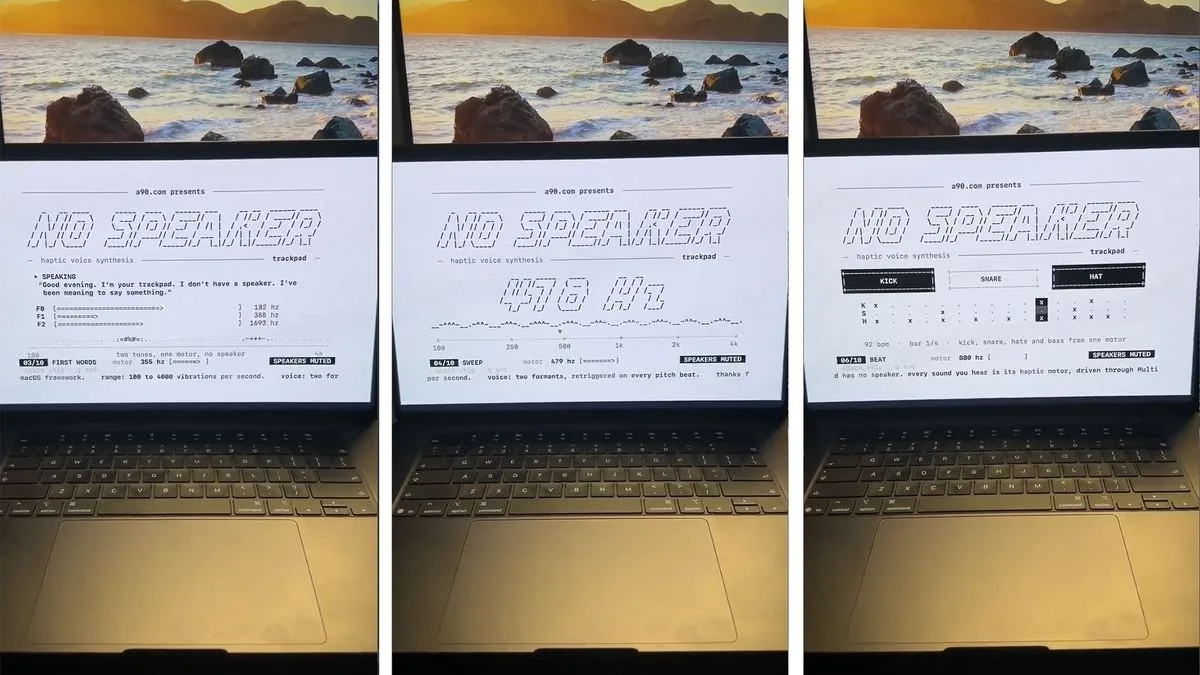
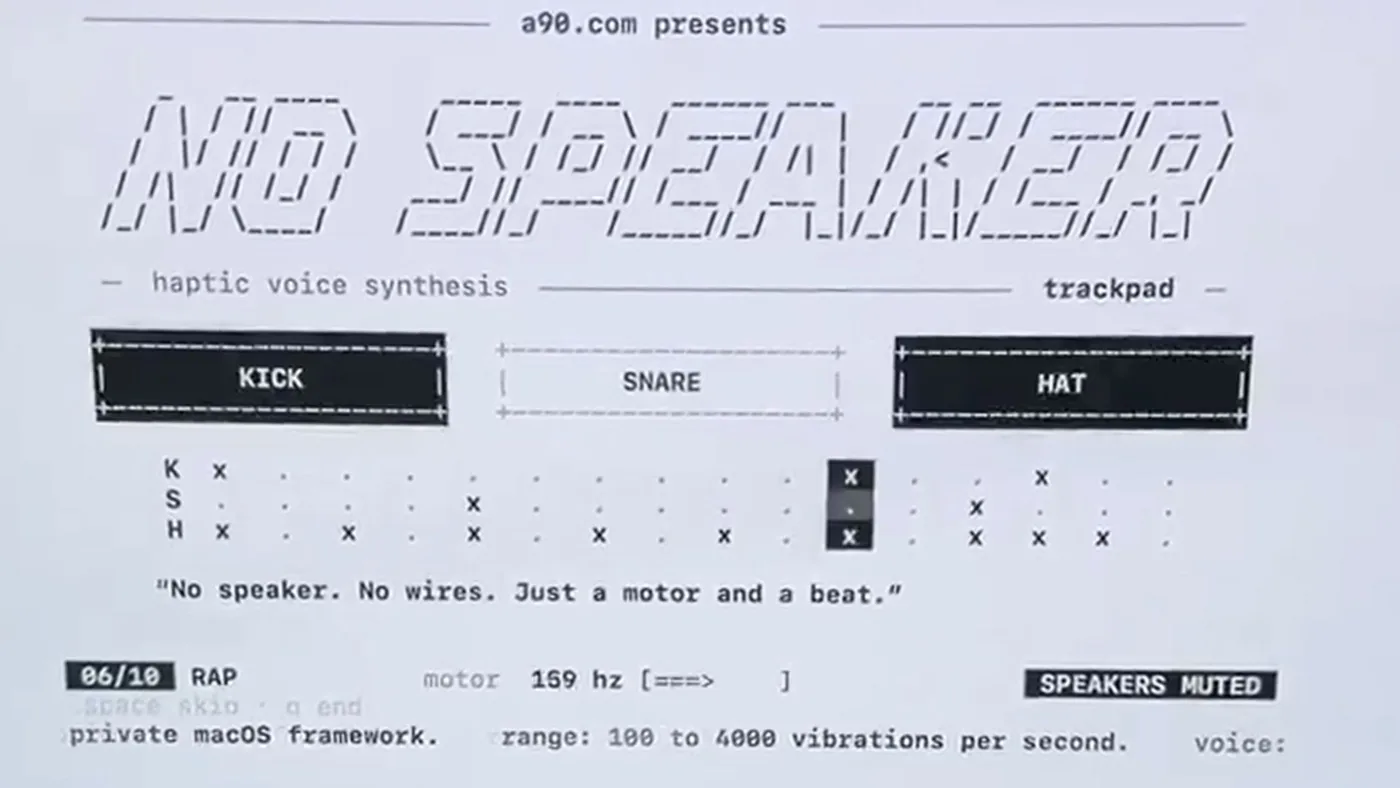
In a demo video shared on X, Hartley Charlton of MacRumors reported that Collier demonstrated an unusual set of audio tests lasting about 90 seconds [1]. The trackpad recited spoken phrases, played a melody, and generated a drum machine beat with kick drums, snares, and high hats programmed onto a 16-step grid [2]. “There’s no speaker in a MacBook trackpad, just a small haptic motor that taps the glass so you feel a click,” Collier said on his GitHub project page [3]. “No Speaker drives that motor up to 4,000 times a second, fast enough to make sound you can hear, and turns it into a voice.” He added that the glass surface “talks, sings, raps, and becomes an instrument under your finger.” Touching the glass during playback shifts tone pitch up or down dynamically [1].
Because trackpad glass was never engineered for audio, the resulting sound comes out rough and metallic. Collier said that the trackpad produces a quiet, robotic voice that is much easier to follow when users read the accompanying text printed on the screen [1]. Mark Tyson of Tom’s Hardware observed that the acoustic output resembles an ancient Speak & Spell toy operating through a broken speaker [2]. Still, the acoustic presence is unmistakable when resting on a firm wooden desk.
Reverse Engineering Apple’s Private Framework
Apple keeps tight control over how software communicates with MacBook input hardware, limiting standard developers to a public API that only fires three fixed feedback clicks [3]. To make the glass surface generate custom pitches, Collier had to use MultitouchSupport, a private macOS framework that handles low-level trackpad signals [1].
No Speaker relies on a private function called MTActuationCreateFromDictionary, which accepts custom vibration descriptions defined by frequency, duration, and strength [3]. A second internal call named MTActuationActuate then routes that instruction directly to the physical motor. This interface lets the program bypass preset tap limits, delivering continuous sine waves to the glass. Apple offers no comparable public tools.
Because Apple does not publish documentation for these internal libraries, Collier relied on function names originally uncovered by the open-source Tactile project [3]. Relying on undocumented macOS functions brings longevity trade-offs for experimental projects. Since Apple does not officially support this use-case, future macOS updates could easily alter private framework symbols and break the tool [1]. For now, Collier packaged the entire engine into a single Swift file called nospeaker.swift signed with an Apple Developer ID [3]. Users can compile the utility using Xcode command-line tools without outside dependencies.
Voice Synthesis and Frequency Range
To turn a clicking mechanism into an understandable voice, No Speaker uses macOS’s built-in text-to-speech engine to speak text into system memory [1]. Every 10 milliseconds, a linear prediction algorithm analyzes the voice buffer to calculate loudness, pitch, and the two strongest resonances, known as formants F1 and F2 [3]. The motor reproduces both acoustic formants on each pitch pulse, yielding a buzzing timbre instead of a clear whistle.
Fricatives and sharp consonants presented a different challenge for the moving glass. Unvoiced sounds like “s”, “f”, and “t” lack clear musical pitch, so Collier translated them into fast bursts of high tones [3]. In testing, synthesizing two formants produced clearer sound than attempting three. Collier said that splitting the motor’s power across three tones weakened overall volume and muddied words. The program types out each spoken line in the terminal window so listeners can read along [1]. Users can also select alternative voices like the built-in Daniel voice in macOS [3].
Acoustic measurements gathered through the laptop’s microphone show that the Force Touch trackpad vibrates audibly between 98 Hz and 3,951 Hz [3]. Output volume reaches between 16 and 34 decibels over a quiet room, with its cleanest notes clustering near 1,000 Hz. That range covers the main frequencies for speech recognition. Public notes stop at 600 Hz.
Force Touch Trackpad Limits and System Support
High-frequency buzzing naturally raises questions about component wear. Collier said that No Speaker stays within Apple’s normal maximum motor strength during operation [1]. The motor can exceed factory amplitude limits to create louder sound, but the underlying kernel driver stalls [3]. Collier said that while short tests seem safe, long-term effects on hardware lifespan remain unknown.
Hardware support spans over a decade of Apple portable machines, running on Apple silicon Macs with macOS Monterey (macOS 12) or later and Intel laptops with macOS Ventura (macOS 13) or later [1]. No Speaker flags unsupported machines on launch, alerting users if an older diving board trackpad is present [2]. Collier confirmed successful testing on a MacBook Pro (Mac17,10) equipped with an M5 Max chip running macOS 27.2.1 [3]. Older machines lacking the solid-state haptic motor can’t generate the required vibration frequencies, causing the program to display an error and quit [2]. Collier also designed the utility to work on external Magic Trackpad 2 units [3].
Physical placement also changes how well sound carries through the chassis into the room. A hard desk acts like a sounding board, amplifying the weak acoustic vibrations [1]. A soft lap muffles the glass and swallows sound [3]. Apple has updated other laptop hardware lines, such as when Apple unveiled MacBook Pro PROLED models with touchscreen capabilities, but the solid-state haptic motor in standard trackpads remains adaptable.
Earlier Hardware Hacks for Audio Playback
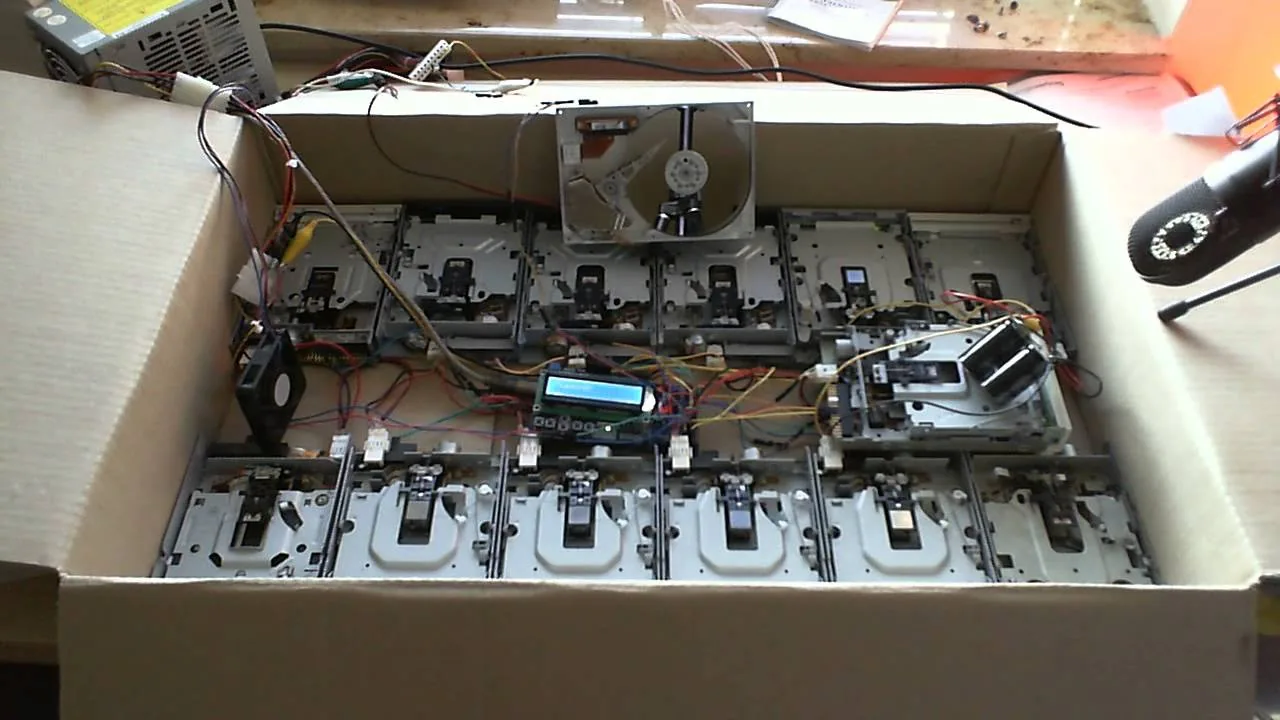
Hackers have repurposed computer peripherals for unauthorized sound generation throughout personal computing history. Long before trackpad hacks, hardware enthusiasts like Gigawipf programmed floppy disk drive stepper motors to hum recognized musical themes by stepping reader heads at specific frequencies [2]. Others routed sound signals into voice-coil actuators of mechanical hard drives. Collier continues that tradition.
Apple’s own internal sensors have often caught the attention of creative tinkerers looking to subvert intended operating system behaviors. Developers previously probed macOS’s hidden LidAngleSensor API to play realistic creaking door sound effects whenever someone opened or closed an Apple laptop screen during daily use [2]. These software experiments show the curious capabilities tucked inside consumer hardware that standard user interfaces never expose to the public. They turn everyday tools into playful experiments for programmers.
For users wanting to test the experiment themselves, Collier released No Speaker as open-source code under the MIT license on GitHub [3]. The tool provides command-line flags to trigger tone sweeps, choose alternative macOS voices, or change terminal display themes. Touch inputs let users slide a finger across the glass during playback to change tone frequencies in real time [1]. No Speaker does not replace standard speakers for daily music listening, but it shows that standard haptic parts can perform surprising tasks when driven by creative software.
- ONLINE NEWS Charlton, H. (2026, November 23). Developer Turns MacBook Trackpad Into a Speaker Using Haptic Motor. MacRumors. [Article Link]
- ONLINE NEWS Tyson, M. (2026, November 23). MacBook modder turns Apple’s Force Touch trackpad into a speaker using haptic engine. Tom’s Hardware. [Article Link]
- WEBSITE Collier, C. (2026, November 22). os6/nospeaker: make your macbook’s trackpad talk using its haptic motor. GitHub. [Article Link]


