






WebRTC gives web browsers and mobile applications direct voice, video, and data communication through open JavaScript APIs [2]. Rather than requiring separate desktop tools or plugins, the framework allows two web browsers to build a peer-to-peer connection inside a standard web page [5]. Understanding how WebRTC works requires tracing how software captures media from local hardware, how signaling servers negotiate session settings, and how discovery protocols bypass private network routers [3]. Both desktop and mobile platforms support the standard natively [1].
How WebRTC Works Without Plugins
Early web browsers lacked built-in real-time media tools. Before WebRTC arrived, browser audio and video streaming depended on proprietary third-party plugins like Adobe Flash or Microsoft Silverlight, but seeing how WebRTC works without plugins reveals how modern browsers handle interactive media natively. In May 2010, Google bought Global IP Solutions for its voice codecs and echo cancellation tools [2].
Google released those audio and video components as an open-source project in May 2011 to establish an open standard supported by teams across the web industry [2]. In January 2011, Ericsson Labs built the first functional browser prototype with a modified WebKit engine, while formal standardization progressed through joint coordination between the World Wide Web Consortium and the Internet Engineering Task Force [5]. Cullen Jennings of Cisco and Ian Hickson of Google directed RTCWEB specification work under RFC 7656 guidelines [3]. The WebRTC API followed W3C API-DESIGN-PRINCIPLES with WebIDL definitions and ECMAScript Bindings [1]. WebRTC 1.0 became a Recommendation in January 2021 [5]. Today, Google Chrome, Mozilla Firefox, Apple Safari, and Microsoft Edge ship native implementations [2].
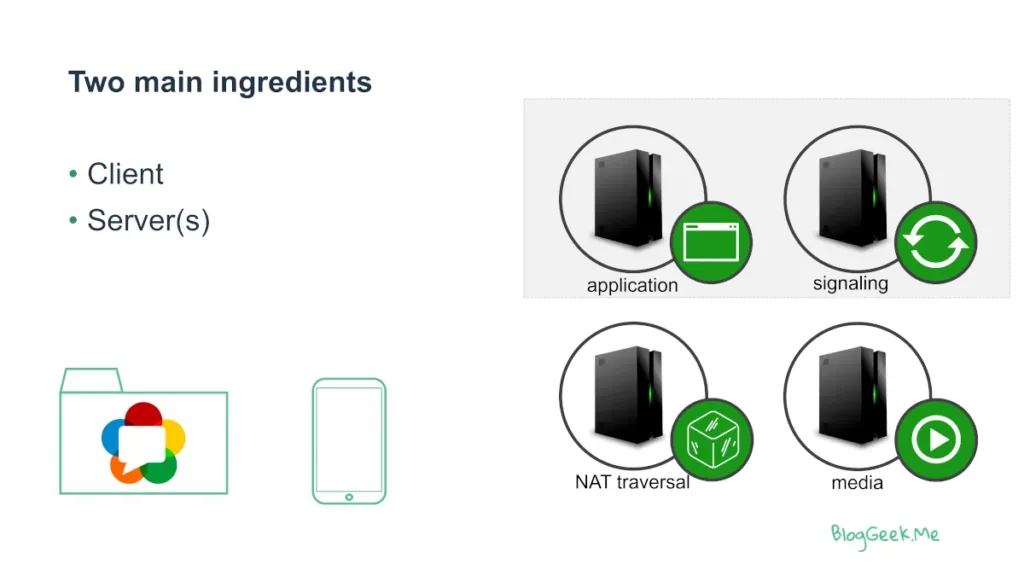
WebRTC operates by combining three software layers within the browser engine. The upper layer exposes ECMAScript APIs to web applications, the central media engine handles acoustic processing and video codecs, and the lower transport layer routes encrypted UDP packets to remote peers [3]. Browsers manage camera permissions and noise suppression internally [1].
Media Acquisition With getUserMedia
Every interactive audiovisual session begins with local hardware capture on the client device. The getUserMedia API prompts the user for camera and microphone permissions, returning a MediaStream object that bundles separate MediaStreamTrack audio and video tracks for real-time handling. Web applications cannot access connected capture hardware without explicit user approval [1].
Raw microphone audio feeds into an integrated voice engine originally derived from Global IP Solutions software. Under RFC 6716, compliant implementations must provide the Opus audio codec, with PCMA and PCMU formats defined in RFC 3551, as well as telephone event handling under RFC 4733. Opus adapts dynamically to shifting network bitrates and bandwidth limits during active calls [2]. The audio pipeline combines acoustic echo cancellation, automated gain control, and background noise filters to protect voice output without requiring developers to build custom digital signal processing algorithms [6].
For video tracks, compliant browsers support royalty-free VP8 and commonly implement VP9 or H.264 profiles under RFC 7742 to maintain compatibility with diverse receiving peers [2]. In their 2018 study on WebRTC-based video conferencing, researchers Jansen, Goodwin, Gupta, Kuipers, and Zussman showed that the Google Congestion Control algorithm gives WebRTC UDP traffic a slight priority over competing TCP flows. Observing how WebRTC works under network strain helps engineers evaluate video quality across varied links [9].
Session Negotiation and SDP
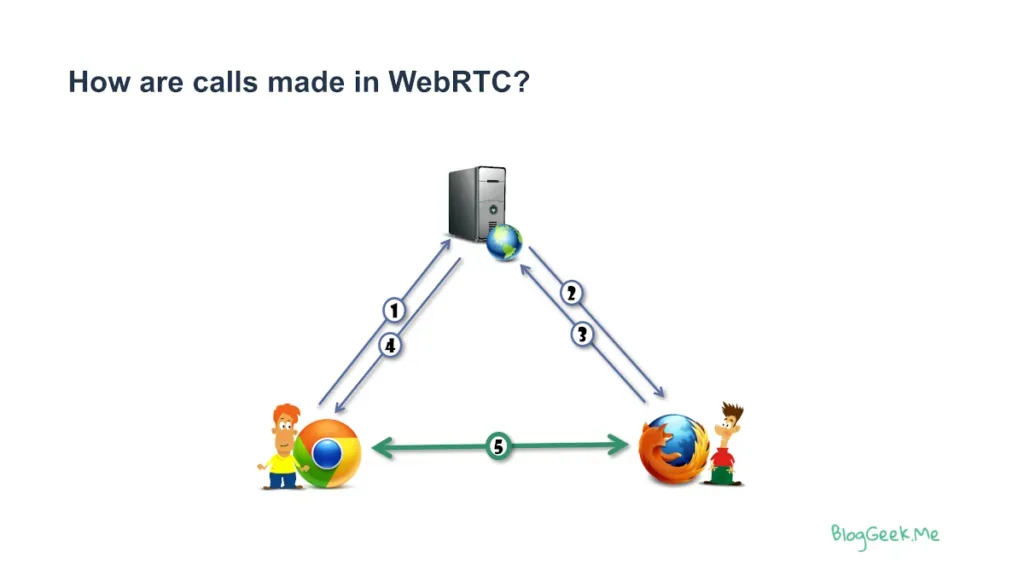
Before two remote browsers can stream audiovisual media, they must agree on encoding formats and transport coordinates. WebRTC relies on the Session Description Protocol, or SDP, defined in RFC 4566, to exchange details about supported codecs, crypto keys, and network addresses between communicating endpoints [3]. Endpoints exchange SDP text blobs rather than media packets during setup [4].
The JavaScript Session Establishment Protocol framework, formalized in RFC 8829 and updated in RFC 9429, dictates how client applications manage this structured offer and answer handshake. The negotiation process begins when the calling browser calls createOffer to inspect its local devices and compile an SDP message detailing its available codecs and transmission parameters. The receiving browser accepts this text as its remote description, constructs an SDP answer with its matching capabilities, and transmits it back through the signaling channel [4]. Both endpoints then lock in matching cryptographic keys and transmission ports [1]. Media streaming cannot begin without mutual agreement between both browsers [4].

WebRTC deliberately omits a signaling protocol from its official standards. Developers transport SDP text using WebSocket connections, SIP over WebSockets under RFC 7118, or messaging protocols like XMPP and MQTT. In an interview on federated architectures, Matrix.org technical co-founder Matthew Hodgson explained that exchanging decentralized JSON payloads over HTTPS enables resilient call signaling. Scheduled web services also interact with external automation endpoints, such as the Perplexity Monitor API used for programmed web searches. Signaling servers handle routing only [6].
NAT Traversal Using STUN
Connecting two browsers directly across the internet presents complex networking obstacles because consumer devices rarely possess public IP addresses. Home routers and office firewalls implement Network Address Translation, or NAT, to map multiple private devices to a single public IP address [6]. NAT routers hide internal device coordinates from the open internet [3].
Because private local addresses cannot route packets across the open internet, endpoints must discover what public IP address and port mapping the NAT device creates for their outgoing traffic [3]. To discover its external address, a browser contacts a Session Traversal Utilities for NAT server, known as STUN, which listens on the public internet under RFC 5389 and RFC 7064. When the STUN server receives a lightweight UDP packet from the browser, it inspects the incoming packet header to identify the public IP and port assigned by the NAT device. It writes those public coordinates into a binding response and returns it to the client [6]. RFC 7675 adds STUN consent checks to keep active sessions alive [3].
Because STUN servers only inspect packet headers without touching media streams, they require minimal bandwidth, allowing browsers to add each discovered public coordinate to their candidate lists and quickly establish direct links across standard routers. When WebRTC works with STUN across standard routers, peers establish direct connections without relays. Symmetric NAT firewalls block this path [6].


Firewalls and Web Real-Time Communication
Restrictive firewalls and symmetric NAT routers frequently block direct peer-to-peer transmission paths. When direct connectivity fails, WebRTC employs Traversal Using Relays around NAT, known as TURN, as defined in RFC 7065. A TURN server acts as an intermediary relay by receiving packets from one client and forwarding them to the destination peer over the public internet, requiring heavy bandwidth from service operators [6].
To manage these diverse connection candidates, WebRTC deploys Interactive Connectivity Establishment, formalized under RFC 8835. The ICE agent gathers host candidates from local network cards, server-reflexive candidates from STUN queries, and relay candidates from TURN servers. Peers exchange these candidate lists across the signaling channel and execute priority connectivity checks to find the lowest latency path [3]. If a direct STUN route succeeds, ICE selects that candidate pair and bypasses the TURN server to preserve server bandwidth, falling back to relaying only when direct paths fail [6].
Modern WebRTC clients employ an ICE candidate pool to minimize session establishment delay. Under RFC 9429 and section 4.1 of the JSEP framework, browsers can prefetch ICE candidates before the user initiates a call, eliminating setup latency during interactive sessions [4]. TURN servers operating over TLS can traverse corporate firewalls that inspect application traffic [6]. Understanding how WebRTC works across firewalls highlights the layered design of ICE traversal [3]. Prefetched candidates speed up connection initialization [4].
Encrypted Transport Protocols
Security in WebRTC is mandatory and integrated directly into the protocol architecture rather than offered as an optional setting. Under security requirements specified by the IETF in RFC 8826 and RFC 8827, browsers prohibit unencrypted WebRTC sessions under all circumstances. Endpoints perform an initial cryptographic handshake using Datagram Transport Layer Security, or DTLS, defined in RFC 6347 for UDP datagrams. DTLS negotiates symmetric session keys [3].
After completing the DTLS handshake, browsers transport audio and video media over the Secure Real-time Transport Protocol, or SRTP, to prevent eavesdropping and packet tampering across transit routes [13]. Endpoints also exchange Secure Real-time Transport Control Protocol packets to monitor packet loss and round-trip delay under RFC 3550 and RFC 3611 guidelines, allowing video encoders to adapt their bitrates in real time [9]. In their 2017 study, researchers García, Gortázar, Lopez-Fernandez, and Gallego analyzed video quality metrics in WebRTC, noting how packet loss impacts user experience across networks [15]. Mandatory encryption keeps third parties on public Wi-Fi networks from intercepting calls [3].
Despite robust media encryption, WebRTC exposed an unintended IP privacy leak in early 2015. Developer Daniel Roesler and TorrentFreak reported that websites could use STUN queries in JavaScript to reveal the true local and public IP addresses of VPN users on Windows. TorGuard CEO Ben Van Der Pelt advised tunneling VPN connections through physical routers, while Private Internet Access investigated software mitigations. Ad-blocking plugins like AdBlockPlus or Ghostery could not intercept these requests [8]. Browser vendors resolved this flaw by implementing mDNS hostname obfuscation to mask local network IP addresses [2].
Data Channels
In addition to real-time voice and video streams, WebRTC enables browsers to exchange arbitrary data. The RTCDataChannel interface, standardized in RFC 8831, provides bidirectional peer-to-peer data transfers using the Stream Control Transmission Protocol, or SCTP, encapsulated within DTLS. Data channels handle DOMString text messages and binary ArrayBuffer payloads without requiring an intermediary application server [7].
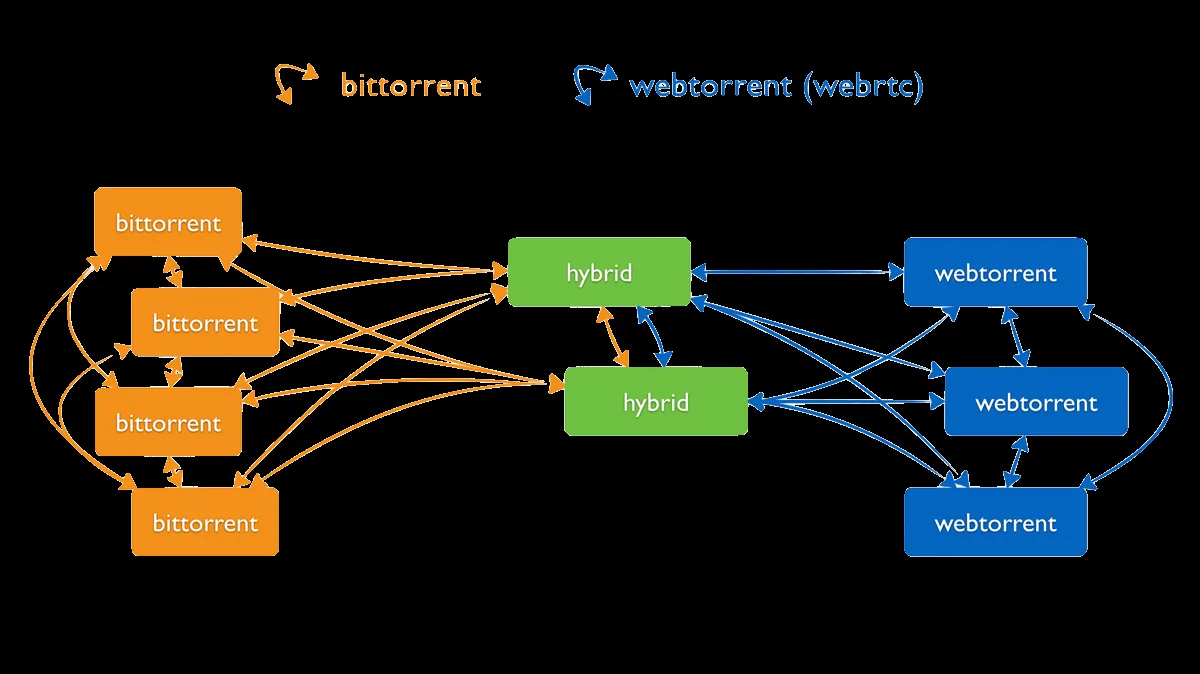
The core RTCPeerConnection object combines these data channels together with audio and video tracks onto a single underlying transport [1]. Data channels support both reliable and unreliable delivery modes depending on application requirements. Developers building multiplayer games or sensor streaming tools configure unreliable, unordered transmission under RFC 4960 and RFC 6525 to avoid head-of-line blocking delays. For file transfers, developers choose reliable, ordered delivery to ensure intact data arrival without server hosting [7]. In 2014, developer Feross Aboukhadijeh created WebTorrent, a browser torrent client that utilizes RTCDataChannel connections to let website visitors stream video files directly from one another. This distributed model illustrates how WebRTC works to cut hosting bandwidth costs for non-profit digital archives. Internet Archive founder Brewster Kahle described peer-assisted delivery as a method to reduce web hosting costs for community digital libraries [11].

Enterprise services also adopt peer data channels to distribute live corporate video. In August 2021, Microsoft acquired Peer5, an enterprise content delivery network founded in 2012 with engineering offices in Palo Alto and Tel Aviv. Microsoft integrated Peer5 mesh networking into Microsoft Teams, Stream, Yammer, and Office 365 so local client devices can share video segments during large corporate broadcasts without overloading external internet connections [10].
Deployments of Web Real-Time Communication
While two-party calls function over direct peer links, multi-party video conferences require dedicated media routing servers because a full mesh topology forces each participant to upload separate video feeds to every peer, rapidly overwhelming client uplink capacity. Modern conferencing platforms employ SFU, or Selective Forwarding Unit, architectures to route video streams intelligently. An SFU distributes video without transcoding [6].
Infrastructure events illustrate how virtual world communities implement independent WebRTC voice servers. In October 2026, a three-day outage of the Vivox voice platform prompted multiple OpenSim virtual grids to adopt self-hosted WebRTC voice architectures. Hosting4OpenSim CEO Josh Boam and Wolf Territories Grid owner Paul Clevett deployed WolfVoice to restore spatial audio, while BloodMoon sysadmin Vlad Helsing released directional audio fixes for the community. Kitely CEO Ilan Tochner built a custom WebRTC spatial voice implementation with volume falloffs up to 60 meters, and Virtual Life Brasil owner Milton Teixeira da Silva utilized os-webrtc-janus modules connected to Janus servers. Cloud teams evaluating hosting infrastructure also analyze updates like GPT-6.1 Terra pricing changes to plan server budgets [12].
Multi-party video quality also relies on advanced encoding techniques like simulcast. In an experimental study published in 2017, Grozev, Politis, Ivov, Noël, and Singh showed that simulcast with the VP8 codec allows clients to transmit multiple video streams at varying resolutions and bitrates. The SFU relays lower bitrate streams to mobile clients on cellular links while sending full high-definition video to desktop participants [14]. Today, WebRTC powers interactive tools ranging from Google Meet to virtual reality environments. Analyzing how WebRTC works in enterprise environments shows how modern collaboration tools scale to thousands of simultaneous users [5].
- REPORT Jennings, C. (2025). WebRTC 1.0: Real-Time Communication in Browsers. World Wide Web Consortium. [Article Link]
- WEBSITE Wikipedia contributors. (2026). WebRTC. Wikipedia, The Free Encyclopedia. [Article Link]
- REPORT Roach, A. (2021). Overview: Real-Time Protocols for Browser-Based Applications (RFC 8825). Internet Engineering Task Force. [Article Link]
- WEBSITE W3C WebRTC Working Group. (2012). Identifiers for WebRTC’s Statistics API. World Wide Web Consortium. [Article Link]
- PRESS RELEASE World Wide Web Consortium. (2021). Web Real-Time Communications (WebRTC) Transforms the Communications Landscape; Becomes a W3C Recommendation and Multiple IETF Standards. W3C. [Article Link]
- WEBSITE Levent-Levi, T. (2026). WebRTC Server Types: What Is It Exactly? BlogGeek.me. [Article Link]
- REPORT Jesup, R., Loreto, S., & Tuexen, M. (2012). WebRTC Data Channel Protocol. Internet Engineering Task Force. [Article Link]
- ONLINE NEWS Van der Sar, E. (2015). Huge Security Flaw Leaks VPN Users’ Real IP-Addresses. TorrentFreak. [Article Link]
- ACADEMIC JOURNAL Jansen, B., Goodwin, T., Gupta, V., Kuipers, F. A., & Zussman, G. (2018). Performance Evaluation of WebRTC-based Video Conferencing. ACM SIGMETRICS Performance Evaluation Review, 45(3), 56-68. [Article Link]
- ONLINE NEWS Foley, M. J. (2021). Microsoft Acquires Peer5 to Supplement Teams’ Live Video Streaming. ZDNET. [Article Link]
- WEBSITE Aboukhadijeh, F. (2015). WebTorrent FAQ. WebTorrent. [Article Link]
- ONLINE NEWS Korolov, M. (2026). OpenSim Grids Roll Out Their Own WebRTC Voice After Vivox Outage. Hypergrid Business. [Article Link]
- WEBSITE Wikipedia contributors. (2026). WebRTC Gateway. Wikipedia, The Free Encyclopedia. [Article Link]
- ACADEMIC JOURNAL Grozev, B., Politis, G., Ivov, E., Noël, T., & Singh, V. (2017). Experimental Evaluation of Simulcast for WebRTC. IEEE Communications Standards Magazine, 1(2), 52-59. [Article Link]
- ACADEMIC JOURNAL García, B., Gortázar, F., Lopez-Fernandez, L., Gallego, M., & París, M. (2017). WebRTC Testing: Challenges and Practical Solutions. IEEE Communications Standards Magazine, 1(2), 36-42. [Article Link]


