






Micro frontends describe a design style where teams split a web monolith into smaller, independently deliverable apps that compose into a cohesive UI [1]. While backend systems shifted toward microservices over the last decade, browser interfaces often stayed tangled in single codebases where teams stepped on each other’s toes [2]. This guide presents micro frontends explained through concrete composition patterns, team boundaries, and production case studies. Companies adopt this structure to decouple release pipelines, isolate codebases, and maintain continuous delivery at enterprise scale [3].
- How Decomposing the Frontend Monolith Began
- Core Benefits of Micro Frontends Explained by Engineering Teams
- The Four Decision Pillars of Luca Mezzalira
- Why Do Autonomous Teams Need Vertical Slices?
- Server Composition and Self-Contained Fragments at IKEA
- How Webpack Module Federation Connects Independent Builds
- Practical Pitfalls of Micro Frontends Explained Across Organizations
- Planning a Micro Frontend Architecture Migration
How Decomposing the Frontend Monolith Began
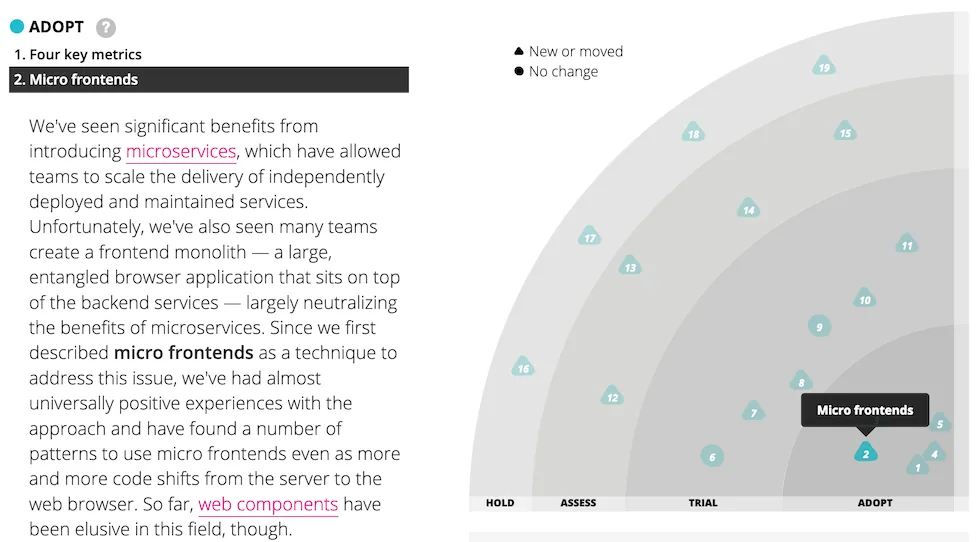
Frontend codebases grow hard to run when dozens of devs push commits into a shared repo. Cam Jackson analyzed this delivery bottleneck on martinfowler.com, observing how teams step on each other’s toes when build tools and release dates collide inside a single browser monolith. In November 2016, Thoughtworks placed micro frontends on its Thoughtworks Tech Radar under the Assess category [1]. Thoughtworks moved the technique to Adopt in later radar editions.
A full rebuild of a client app brings major financial risk and burns team momentum. Gustaf Nilsson Kotte said during an interview with Stefan Tilkov that firms regularly underestimate the cost of multi-year rewrite cycles at Jayway and IKEA [3]. Instead, teams apply the strangler pattern to carve off features incrementally [1].
A multivocal literature review by Peltonen, Luca Mezzalira, and Taibi in Information and Software Technology analyzed 173 sources to map how dev groups adopt modular frontends to solve scaling challenges. Their survey revealed that growing codebase complexity and cross-team bottlenecks drove early migration across prominent consumer platforms. The study identified DAZN, Ikea, and Starbucks among the early adopters breaking monolithic interfaces into smaller pieces. By isolating user journeys into discrete software units, companies gave separate teams the freedom to ship updates without waiting on a single corporate release train [5].

Core Benefits of Micro Frontends Explained by Engineering Teams
The main advantage of dividing a frontend monolith centers on separate deployment pipelines. In a standard setup, a broken build or failing test in one corner of the codebase holds back every other feature scheduled for production. Each micro app gets its own continuous delivery pipeline, which allows teams to build, test, and release code without coordinating with neighboring teams [1]. Mane, Kumar, Dandu, Goel, Jain, and Shrivastav evaluated this shift in the Journal of Quantum Science and Technology, reporting that case study teams achieved a 30% reduction in deployment times after switching to modular frontends through Webpack Module Federation. Parallel development cut code conflicts and shortened delivery cycles, allowing distributed software teams to ship customer features without blocking each other during daily releases [9].
Smaller repositories reduce accidental coupling between domain modules. With micro frontends explained through domain-driven design, drawing thick lines around bounded contexts stops teams from sharing internal domain models without explicit contracts. Cam Jackson called this the pit of success, where good design choices become easy and bad shortcuts become difficult. Apps upgrade dependencies on their own schedule. A single team can adopt React or Vue without forcing a sitewide library overhaul on other groups [1].
Team autonomy expands because dev groups take end-to-end ownership of complete business capabilities [2]. Taibi and Luca Mezzalira wrote in ACM SIGSOFT Software Engineering Notes that successful teams build full-stack slices from database tables to browser UI components. Companies including SAP, Springer, Zalando, and NewRelic adopted this structure to cut handoffs between departments. Teams make their own tech choices within agreed guardrails and deploy value at their own pace [6].
The Four Decision Pillars of Luca Mezzalira
At DAZN, architecture vice president Luca Mezzalira wrote Front-End Reactive Architectures to guide system design. Speaking at JS-Poland, Mezzalira said that every JavaScript framework brings fixed assumptions, but architects need a solid foundation before picking tools. He set out four core pillars: definition, composition, routing, and communication. These choices guide teams through future trade-offs [2].
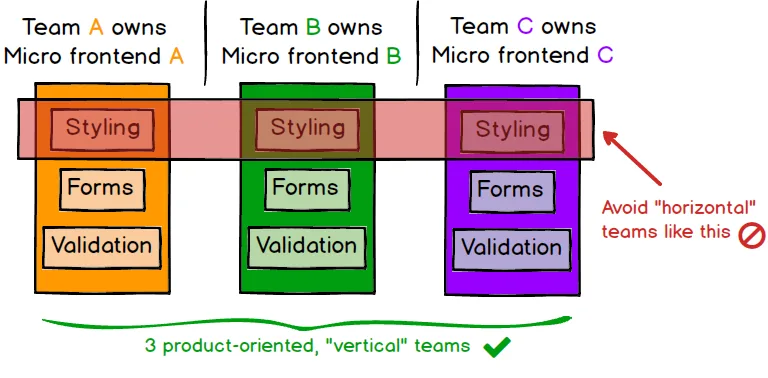
The definition pillar decides whether the UI splits horizontally or vertically. In a horizontal split, multiple teams build separate UI parts within a shared view, requiring constant sync to assemble screens. Vertical splits differ. A vertical split gives one team total control over an entire page view, from database calls to browser rendering, which Luca Mezzalira favored because it minimizes cross-team handoffs and matches standard frontend workflows [2].
Routing and composition depend on the split. When teams choose client-side composition, Luca Mezzalira recommended using Single-SPA inside an app shell. For server-side rendering, frameworks such as Tailor from Zalando, OpenComponents, or Piral assemble page fragments on the server before streaming the combined HTML document to the user. On the same page, micro frontends communicate strictly through custom events or an event emitter library. When users move between pages, the app passes state via web storage (such as session storage) or fetches fresh data from backend services [2].
Why Do Autonomous Teams Need Vertical Slices?
Why do large dev groups struggle when frontend code splits from backend services? Horizontal teams organized around styling, forms, or data validation create cross-team handoff queues that delay feature delivery. Feature delivery stops. Cam Jackson warned against dedicated styling teams on martinfowler.com, advising firms to align around business capabilities through vertical slices where one group owns a complete user journey from database queries to browser markup [1].
In enterprise systems with micro frontends explained around business capabilities, cross-functional teams avoid painful handoff bottlenecks. Gustaf Nilsson Kotte said during a chat with Stefan Tilkov that IKEA needed a better way to organize 24 software engineers. Kotte rejected setting up one frontend team and two backend teams. Two backend groups feeding one frontend team produce an endless queue of blocked frontend stories. Instead, Kotte formed two teams of 12 people, giving each group full control over its own backend and frontend services [3].
Team size plays a decisive role in preserving autonomy. Gustaf Nilsson Kotte observed at Jayway that software teams function smoothly with up to 10 or 12 members, but lose momentum once headcounts climb higher. Autonomous groups can own multiple small services if the system keeps them independent [3].



Server Composition and Self-Contained Fragments at IKEA
Server-side composition provides a dependable setup for content-heavy web pages. In this setup, a web server or reverse proxy stitches separate HTML slices together before sending the completed document to the user’s browser. Cam Jackson showed how a container server uses server-side includes to combine global navigation headers with page-specific HTML fragments generated by remote micro services across independent servers. Search engines receive fully rendered markup on the first request, which improves search visibility and cuts initial rendering lag [1].
At IKEA, web teams depend on Edge Side Includes (ESI) to power micro frontends across global retail websites. Gustaf Nilsson Kotte described how the company splits digital experiences into pages and fragments, with separate teams owning distinct assets. A product team, for instance, maintains thumbnail fragments that other domain teams embed directly into their views via ESI references. Because different teams work with distinct frontend tools, IKEA established self-contained fragments that package all necessary CSS styling and JavaScript code inside the fragment itself. A consuming page includes one ESI tag for styles and one ESI tag for scripts, insulating teams from managing shared asset bundles while letting engineers update visual elements independently [3].
To make cross-team integration sustainable, IKEA adopted a pragmatic engineering mindset. Instead of designing complex defensive checks against every potential runtime failure, engineering leadership prioritized mean-time-to-recovery over mean-time-between-failures. If a remote fragment fails, the responsible team deploys a repair rapidly. Kotte presented these lessons at Øredev 2018 [3].
How Webpack Module Federation Connects Independent Builds
While server-side composition serves content-driven pages well, highly interactive single-page apps often demand client-side module integration. Webpack answered this requirement with Module Federation, an architectural concept that allows multiple separate builds to form a single application. Each build acts as a container that can both expose internal code and consume remote modules exposed by other containers at runtime. This setup lets engineering teams build and deploy independent frontend applications continuously while presenting end users with a single unified single-page application experience [4].
At the code level, Webpack Module Federation distinguishes between local modules compiled into the current bundle and remote modules loaded over the network. Remote modules load asynchronously through browser chunk loading operations, typically initiated by dynamic import calls. The system relies on ModuleFederationPlugin, which combines low-level primitives named ContainerPlugin and ContainerReferencePlugin. When an app loads, the host initializes a shared scope using default sharing methods and passes that scope object to each remote container during startup. Provisions flow bidirectionally across the shared scope, allowing both host and remote containers to share libraries like React without duplicating code in bundle downloads [4].
Dependency coordination inside the share scope relies on automated version negotiation. When several builds register a library like React 18.3.1, the runtime assigns the highest version satisfying the requested range. Webpack breaks version ties with output.uniqueName. An already-loaded version is never replaced at runtime [4].
Practical Pitfalls of Micro Frontends Explained Across Organizations
Despite substantial organizational gains, micro frontends introduce specific trade-offs that teams must weigh carefully. The most noticeable drawback is payload size and duplicate dependencies. If individual teams bundle their own copies of common libraries, users download redundant JavaScript bytes that slow down page loads, particularly on mobile connections. Cam Jackson said that team autonomy can also cause fragmentation in engineering practices if organizations fail to align on core standards [1].
Enterprise reports with micro frontends explained show that payload bloat remains a leading concern. In a comparative evaluation of multi-framework design patterns, researchers Muppaneni and Palem analyzed the friction that occurs when combining React, Angular, Vue, and Svelte within a single application. They evaluated patterns including Web Components, Module Federation, iframe isolation, custom integration layers, and meta-framework orchestrators. Their research revealed that mixing disparate frontend frameworks increases maintenance complexity and complicates shared state management. While polyglot architectures remain technically possible, disciplined organizations standardize on a shared core framework to avoid overwhelming their engineering staff with competing build toolchains [10].

User interface inconsistency presents another common hazard when decentralized teams operate without close coordination. In the International Journal of Web Engineering and Technology, S. T. Wanjala examined how early micro frontend systems suffered from erratic layouts and unpredictable component behavior. Wanjala proposed an architectural framework designed to resolve layout conflicts and establish clear integration guidelines without degrading performance. Without shared design tokens and automated visual regression testing, independent groups quickly produce conflicting navigation bars, mismatched typography, and jarring visual transitions between neighboring page sections [7].
Planning a Micro Frontend Architecture Migration
A shift to micro frontend architecture in an established firm needs a phased rollout rather than a sudden rewrite. In Acta Polytechnica Hungarica, I. Pölöskei and U. Bub examined enterprise migration patterns across multi-vendor environments. They observed that while academic studies often focus on greenfield projects, enterprise developers almost always face existing monolithic systems. Their findings showed that successful programs decompose monoliths at function-level granularity, allowing developers to isolate and optimize individual user journeys step by step [8].
Cam Jackson demonstrated this incremental migration through an example food delivery service on martinfowler.com. A food ordering website includes distinct capabilities: a restaurant browsing screen, a restaurant menu page, and a customer account profile. An engineering group begins by building a container application to host the global navigation header and user authentication. Next, the team carves out a single high-value view (such as the menu view) as an independent micro application while leaving remaining pages in the legacy monolith. Once the new micro application deploys successfully through its own pipeline, developers migrate remaining pages one at a time [1].
Engineering leaders must ultimately ensure that architectural complexity aligns with organizational needs. At GOTO Berlin 2019, Monica Lent gave a presentation titled Building Resilient Frontend Architecture, stating that resilient systems match technical boundaries to organizational communication paths. Michael Geers reinforced this message in his book Micro Frontends in Action, arguing that breaking up a frontend makes sense when team coordination becomes a primary bottleneck [2]. For smaller teams operating on a single cohesive product, maintaining a modular monolith remains the simpler, more effective path [1].
- WEBSITE Jackson, C. (2019, June 19). Micro Frontends. martinfowler.com. [Article Link]
- ONLINE NEWS Stenberg, J. (2020, January 8). Decision Strategies for a Micro Frontends Architecture. InfoQ. [Article Link]
- ONLINE NEWS Stenberg, J. (2018, August 7). Experiences Using Micro Frontends at IKEA. InfoQ. [Article Link]
- WEBSITE Webpack. (2018, March 1). Module Federation. webpack.js.org. [Article Link]
- ACADEMIC JOURNAL Peltonen, S., Mezzalira, L., & Taibi, D. (2021). Motivations, benefits, and issues for adopting Micro-Frontends: A Multivocal Literature Review. Information and Software Technology, 136, 106571. [Article Link]
- ACADEMIC JOURNAL Taibi, D., & Mezzalira, L. (2022). Micro-Frontends: Principles, Implementations, and Pitfalls. ACM SIGSOFT Software Engineering Notes, 47(4), 25-29. [Article Link]
- ACADEMIC JOURNAL Wanjala, S. T. (2022). A framework for implementing micro frontend architecture. International Journal of Web Engineering and Technology, 17(4), 337. [Article Link]
- ACADEMIC JOURNAL Pölöskei, I., & Bub, U. (2021). Enterprise-Level Migration to Micro Frontends in a Multi-Vendor Environment. Acta Polytechnica Hungarica, 18(8), 7-25. [Article Link]
- ACADEMIC JOURNAL Mane, H. R., Kumar, A., Dandu, M. M. K., Goel, P., Jain, A., & Shrivastav, E. A. (2024). Micro Frontend Architecture With Webpack Module Federation: Enhancing Modularity Focusing On Results And Their Implications. Journal of Quantum Science and Technology, 1(4). [Article Link]
- ACADEMIC JOURNAL Muppaneni, K., & Palem, V. (2024). Micro-Frontend Design Patterns for Multi-Framework Applications. International Journal of Emerging Research in Engineering and Technology, 5, 181. [Article Link]


