






Every web connection begins when a device queries a domain name. For decades, the Domain Name System (DNS) handled these lookups in open text without transport encryption, allowing internet service providers, local network operators, and passive eavesdroppers to track visited destinations [16]. The protocol known as DNS over HTTPS changes this exchange by packing standard lookup messages inside encrypted web sessions on port 443 [1]. A client avoids plain UDP packets over port 53 [16]. Instead, it routes lookups through an encrypted session to a recursive resolver, stopping intermediate operators from intercepting queries or altering domain answers [3].
- Core Encryption Mechanism on Port 443
- Privacy Risks of Unencrypted Domain Lookups
- DNS over HTTPS in Modern Browsers
- Platform Integration in Major Operating Systems
- Resolver Support in BIND and Unbound
- DNS over HTTPS Enterprise Network Security
- British Filtering Rules and Policy Disputes
- Oblivious DNS over HTTPS Relay Architecture
Core Encryption Mechanism on Port 443
The Internet Engineering Task Force established the official protocol standard when it published RFC 8484 in October 2018, mapping ordinary query and response exchanges into secure HTTP transactions [1]. Classic domain lookups rely on open UDP packets over port 53 [16]. DoH routes lookups over port 443 instead. It hides domain requests inside standard web sessions [1].
Communication between the client and resolver relies on the application/dns-message media type, which carries binary wire-format DNS messages inside HTTP request bodies and responses. Clients construct lookups using standard HTTP GET or POST methods [1]. In a GET request, the client encodes the binary query using base64url encoding and attaches it to the endpoint URI within a specific query parameter, allowing shared caches to store and serve repeated queries with minimal delay. In contrast, a POST request delivers the raw binary payload within the HTTP request body without extra URL encoding. Google Public DNS supports both methods at its primary endpoint at dns.google/dns-query, giving developers broad flexibility when implementing secure lookups in web applications [2].
Resolvers return an HTTP 200 OK status code upon successful message parsing, delivering the DNS answer payload in the response body. When an issue arises, the server provides descriptive HTTP status codes such as 413 for oversized payloads, 415 for unsupported media types, or 429 when a client issues excessive queries [2]. Understanding traditional Domain Name System architecture clarifies why running lookups over HTTP/2 connections provides concurrent stream multiplexing, which prevents head-of-line blocking on busy client connections. Resolvers can also use HTTP/2 server push to deliver anticipated records ahead of time [1].

Privacy Risks of Unencrypted Domain Lookups
Legacy DNS sends messages in open text [16]. Whenever a computer connects to a site, it transmits the desired hostname in unencrypted packets over local network wires, switches, and intermediate routers where observers can inspect the data. Internet service providers often log these requests to build browsing histories [4]. The plain lookup exposes the visited domain [16].
Unencrypted lookups also invite tampering from attackers attempting to redirect traffic. To counter spoofing, engineers developed DNSSEC cryptographic signatures, which use public key validation to prove that a record originated from the authoritative source without modification. However, DNSSEC was designed for message integrity rather than message secrecy. It does not conceal domain names from eavesdroppers [3]. DoH resolves this specific shortcoming by providing cryptographic confidentiality between the client device and the upstream recursive resolver [1].
These privacy protections become critical when users connect through untrusted Wi-Fi access points in cafes, airports, and hotels. In those shared public settings, neighboring devices running network packet sniffers can easily monitor all cleartext DNS traffic. How does encrypting domain requests change local security? By enclosing lookups in encrypted TLS sessions over port 443, DoH stops adjacent snooping devices from identifying online services contacted by a user [7]. During a presentation at WWDC 2020, Apple software engineer Tommy Pauly said that cleartext queries permit outside parties to track network habits, whereas encrypted transports prevent local profiling and protect user privacy on shared networks [5].
DNS over HTTPS in Modern Browsers
Web browsers served as the initial deployment ground for encrypted name resolution [16]. Mozilla led early experimentation by testing DNS over HTTPS in Firefox Nightly builds starting in March 2018. Early tests relied on shield studies. Patrick McManus, an engineer at Mozilla, organized the pref-flip shield study to evaluate performance under real browsing conditions. “Soon we’ll be launching a Nightly-based pref-flip shield study to confirm the feasibility of doing DNS over HTTPs (DoH),” McManus announced during the testing rollout [3]. Following extensive trials, Mozilla turned the protocol on by default for all United States Firefox users in February 2020, selecting Cloudflare as its default trusted partner to resolve lookups securely [16].
Google introduced a different rollout model when it launched Chrome 83 in May 2020. Instead of routing all client queries to a single external resolver by default, Chrome implemented an automatic upgrade approach. When Chrome detects that the operating system already relies on a provider supporting DoH, such as Google Public DNS, Cloudflare, Quad9, CleanBrowsing, or NextDNS, the browser automatically switches to encrypted queries. Users can also manually select a preferred provider or enter a custom DoH URI template in browser settings [16].

Chromium developers added management controls for enterprise admins. In managed office networks that rely on split-horizon DNS to map internal resources to private local IP addresses, admins can disable automatic upgrades to prevent internal resolution failures. Microsoft Edge adopted identical configuration menus. Brave enabled encrypted resolution by default in desktop version 1.4 in April 2020. Opera also supports DoH settings connecting to Cloudflare [16].
Platform Integration in Major Operating Systems
Encrypted DNS expanded from independent browser applications into core operating system platforms [16]. Apple introduced system-level support for both DoH and DNS over TLS (DoT) in iOS 14 and macOS 11 in late 2020 [5]. Speaking at WWDC 2020, Apple software engineer Tommy Pauly said: “There are two ways in which encrypted DNS can be enabled… The first way is to use a single [encrypted] DNS server as the default resolver for all apps on the system… The second way is to enable encrypted DNS is to opt-in directly from an app”. Administrators can deploy profiles through Mobile Device Management or create context rules that activate encryption when devices leave office networks [6].
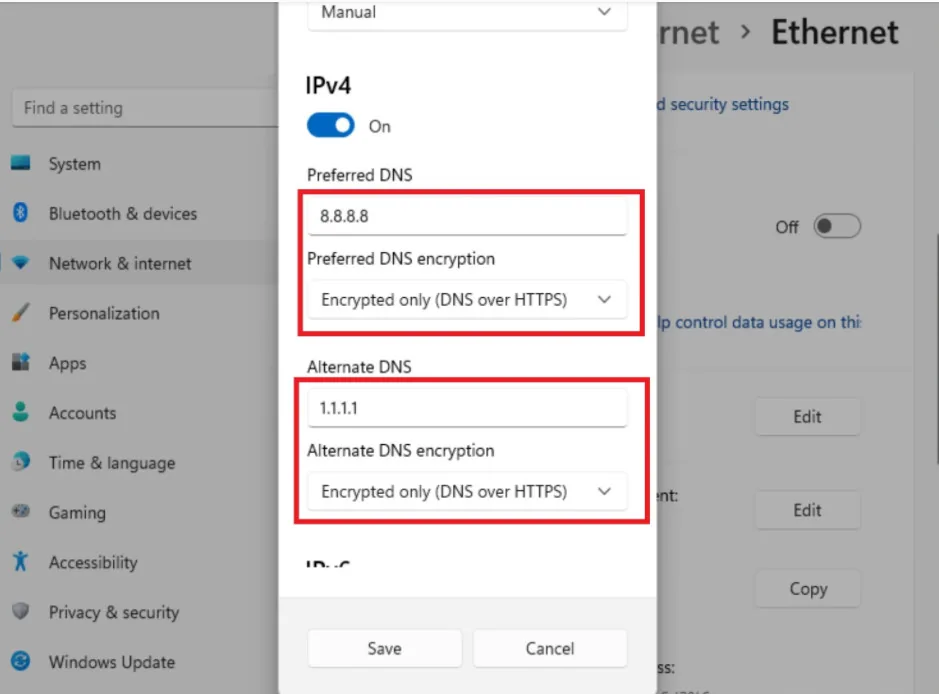
Microsoft started testing native resolution within Windows 10 Insider Preview Build 19628 in May 2020, crediting feature work to Alexandru Jercaianu and Vladimir Cernov. Insiders could activate the client by creating the EnableAutoDoh DWORD registry key and setting its value to 2. Windows automatically promoted lookups to DoH when network adapters were configured with public resolver IP addresses from Cloudflare, Google, or Quad9 [7]. In Windows 11, Microsoft introduced graphical controls in Network & Internet settings, allowing users to choose encrypted resolution for IPv4 and IPv6 adapters, or enforce policies via the Group Policy Editor [8].
Android adopted DNS-over-HTTP/3 in July 2022. Google engineers Matthew Maurer and Mike Yu announced that Android 11 and newer releases received DoH3 support via a Google Play system update. The client uses Rust and Cloudflare’s quiche library for memory safety. The team reported that replacing DoT with DoH3 reduced median lookup time by 24% and cut 95th percentile query latency by 44% [9].


Resolver Support in BIND and Unbound
Open-source DNS resolvers added DoH server capabilities so network operators could host their own encrypted endpoints [16]. In October 2020, NLnet Labs released Unbound 1.12.0 with native support for incoming HTTPS queries. The software incorporates the nghttp2 library to handle HTTP/2 framing, integrating cleanly into the existing Unbound event loop. Ralph Dolmans of NLnet Labs explained the design in release documentation [10].
Unbound’s DoH implementation was funded through the Mozilla Open Source Support awards program to expand privacy options for local networks. Beyond encryption features, Unbound 1.12.0 adopted DNS Flag Day 2020 guidelines by adjusting its default EDNS buffer size to 1,232 bytes to prevent packet fragmentation. The software allows administrators to apply custom TCP timeout settings, enforce query buffer limits, and assign private TLS certificates directly within configuration files [10].
Internet Systems Consortium introduced native DoH functionality to BIND in its February 2021 development release, version 9.17.10. BIND uses nghttp2 to operate a specialized HTTP/2 server that receives lookups on port 443. It also supports TLS offloading, enabling operators to terminate TLS on a reverse proxy such as NGINX before passing cleartext HTTP/2 streams to BIND on a local port [11]. PowerDNS introduced similar proxy capabilities in DNSdist version 1.4.0 in April 2019, giving administrators flexible open-source choices for network infrastructure [16]. By managing their own resolvers, organizations maintain complete authority over local DNS logs while keeping communication secure [11].

DNS over HTTPS Enterprise Network Security
Encryption protects privacy but complicates enterprise security monitoring [16]. Network defense teams rely on open DNS traffic to spot malware activity, data exfiltration, and malicious command-and-control servers. When client devices turn on DNS over HTTPS, queries blend with standard web traffic, which neutralizes response policy zones and domain blocking rules [11]. In 2019, the Godlua DDoS worm used DoH queries to mask connections to its control servers [16].
To regain oversight, the National Security Agency (NSA) issued guidance in January 2021 recommending that enterprise organizations operate in-house DoH resolvers. The NSA advised administrators to block unauthorized public DoH resolvers at network firewalls while directing internal systems toward enterprise-managed endpoints. This setup preserves encryption on local networks while retaining security logging and query filtering [16]. In parallel, computer scientists have investigated machine learning classifiers capable of detecting DoH abuse without inspecting decrypted payloads [17].
In an academic study published in IEEE Transactions on Information Forensics and Security, researchers evaluated machine learning models using the CIRA-CIC-DoHBrw-2020 dataset. Their stacked Random Forest classifier achieved a 99.91% precision rate in identifying malicious DoH traffic [17]. A survey by Kamil Hynek and colleagues in IEEE Access documented how malicious actors abuse DoH tunnels in web environments, while research by K. Jeřábek in Computer Networks showed that standard flow telemetry can classify DoH connections without requiring heavy deep packet inspection [18]. These analytical tools give network defenders new methods to monitor encrypted sessions without breaking transport confidentiality [17].
British Filtering Rules and Policy Disputes
The shift toward default browser encryption sparked immediate political controversy in several nations [16]. Tensions escalated quickly in London. In July 2019, the UK Internet Services Providers’ Association (ISPA) nominated Mozilla for an “Internet Villain” award alongside Donald Trump and the EU copyright directive. The trade group argued that activating encrypted queries by default would let web users bypass British network filters and parental restrictions, weakening digital safety rules. British intelligence agency GCHQ and the Internet Watch Foundation also voiced concerns that encrypted lookups could impede automated filtering of child exploitation imagery and piracy domains [12].
The nomination triggered heavy criticism from internet security professionals and civil liberties organizations. British broadband provider Andrews & Arnold publicly supported Mozilla by donating £2,940, roughly $3,670, stating the sum equaled what its ISPA membership fee would have cost [12]. Facing widespread pushback, the ISPA withdrew the nomination a month later and canceled the award category, conceding that the move had sent the wrong message [13].

Mozilla sought common ground with British authorities while maintaining its broader encryption objectives. Alan Davidson, who directed global policy at Mozilla, wrote to UK Culture Secretary Nicky Morgan that Mozilla had no plans to enable DoH by default in the United Kingdom without consulting public stakeholders. Davidson wrote: “Because current DNS requests are unencrypted, the road that connects your citizens to their online destination is still open and used by bad actors looking to violate user privacy, attack communications, and spy on browsing activity”. This dialogue allowed the nonprofit to deploy security improvements while addressing regulatory concerns [13].
Oblivious DNS over HTTPS Relay Architecture
Standard DoH still leaves a privacy gap: the recursive resolver sees both the client’s IP address and the requested hostname [4]. Centralized resolvers operated by entities such as Cloudflare, Google, or Comcast could potentially assemble complete user browsing profiles. To resolve this concentration of data, engineers designed Oblivious DNS over HTTPS (ODoH), standardized by the IETF as RFC 9230 in June 2022. The protocol builds upon earlier Oblivious DNS concepts created at Princeton University and the University of Chicago [14].
ODoH solves this vulnerability by splitting information between an Oblivious Proxy and an Oblivious Target server. The client encrypts its query message with the Target’s public key, then delivers the payload to the Proxy using the application/oblivious-dns-message media type. The Proxy observes the client’s IP address but cannot read the encrypted query, whereas the Target decrypts the query but only sees the Proxy’s IP address [14]. “What ODoH is meant to do is separate the information about who is making the query and what the query is,” said Nick Sullivan, Cloudflare’s head of research [4].
For this separation to hold, the proxy and target must operate independently without colluding [4]. In a preliminary study by Sudheesh Singanamalla and colleagues, published as an unreviewed preprint on arXiv in November 2020 before later peer-reviewed appearance, experimental benchmarks demonstrated that ODoH delivers resolution latency comparable to standard DoH [15]. This privacy-partitioning framework matches the relay architecture used by the Cloudflare OHTTP Gateway, demonstrating how cryptographic proxies expand privacy protections across modern network protocols. By decoupling identity from request contents, oblivious protocols ensure that no single infrastructure provider can observe complete user browsing activity [14].
- REPORT Hoffman, P., & McManus, P. (2018). DNS Queries over HTTPS (DoH) (RFC 8484). Internet Engineering Task Force. [Article Link]
- WEBSITE Google for Developers. (2024, September 3). DNS-over-HTTPS (DoH). Google Public DNS. [Article Link]
- ONLINE NEWS Cimpanu, C. (2018, March 20). Mozilla Is Testing “DNS over HTTPS” Support in Firefox. BleepingComputer. [Article Link]
- ONLINE NEWS Whittaker, Z. (2020, December 8). Cloudflare and Apple design a new privacy-friendly internet protocol. TechCrunch. [Article Link]
- ONLINE NEWS Spadafora, A. (2020, June 29). Apple devices will get encrypted DNS in iOS 14 and macOS 11. TechRadar. [Article Link]
- ONLINE NEWS Cimpanu, C. (2020, June 25). Apple adds support for encrypted DNS (DoH and DoT). ZDNET. [Article Link]
- WEBSITE Microsoft Networking Team. (2020, May 13). Windows Insiders can now test DNS over HTTPS. Microsoft Community Hub. [Article Link]
- WEBSITE Anwar, K. (2021, July 28). How to Configure and Use DNS-Over-HTTPS (DoH) in Windows 11. Appuals.com. [Article Link]
- WEBSITE Maurer, M., & Yu, M. (2022, July 19). DNS-over-HTTP/3 in Android. Google Online Security Blog. [Article Link]
- WEBSITE Dolmans, R. (2020, October 9). DNS-over-HTTPS in Unbound. The NLnet Labs Blog. [Article Link]
- WEBSITE Internet Systems Consortium. (2021, February 17). BIND Implements DoH. ISC Blog. [Article Link]
- ONLINE NEWS Whittaker, Z. (2019, July 5). Internet group brands Mozilla ‘internet villain’ for supporting DNS privacy feature. TechCrunch. [Article Link]
- ONLINE NEWS Hern, A. (2019, September 24). Firefox: ‘no UK plans’ to make encrypted browser tool its default. The Guardian. [Article Link]
- REPORT Kinnear, E., McManus, P., Pauly, T., Verma, T., & Wood, C. A. (2022). Oblivious DNS over HTTPS (RFC 9230). RFC Editor. [Article Link]
- PREPRINT Singanamalla, S., Chunhapanya, S., Vavruša, M., Verma, T., Wu, P., Fayed, M., Heimerl, K., Sullivan, N., & Wood, C. (2020). Oblivious DNS over HTTPS (ODoH): A Practical Privacy Enhancement to DNS. arXiv:2011.10121. [Article Link]
- WEBSITE Wikipedia contributors. (2026). DNS over HTTPS. Wikipedia, The Free Encyclopedia. [Article Link]
- ACADEMIC JOURNAL Zebin, T., Rezvy, S., & Luo, Y. (2022). An Explainable AI-Based Intrusion Detection System for DNS Over HTTPS (DoH) Attacks. IEEE Transactions on Information Forensics and Security, 17, 2339-2349. [Article Link]
- ACADEMIC JOURNAL Hynek, K., Vekshin, D., Luxemburk, J., Čejka, T., & Wasicek, A. (2022). Summary of DNS Over HTTPS Abuse. IEEE Access, 10, 54668-54680. [Article Link]


