






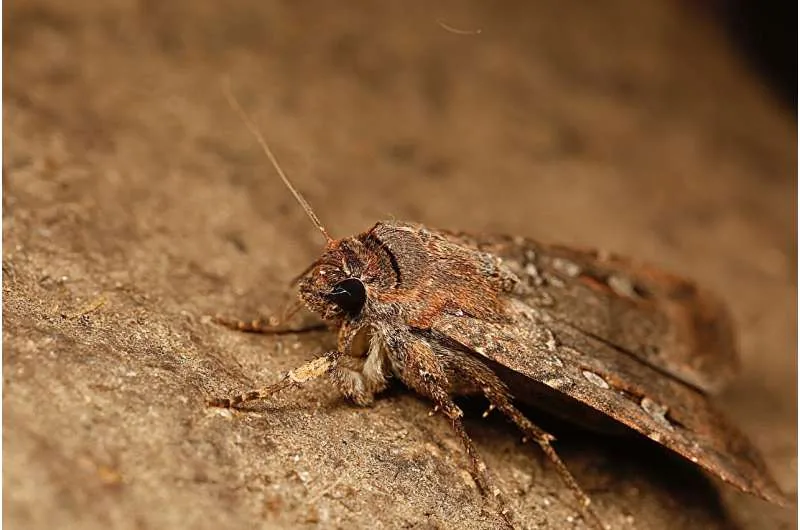
The Australian bogong moth (Agrotis infusa) completes an arduous journey every spring, flying more than 1,000 kilometers from inland breeding grounds to cool granite caves in the Australian Alps. In earlier work, neuroethologist Eric Warrant and his team at Lund University in Sweden showed that these insects navigate by observing starlight from the Milky Way. Questions lingered about how moths maintain their headings when cloud banks obscure night skies. In a study published in Nature, Lund University researchers showed that migrating moths also possess a magnetic compass. The geomagnetic sense lets winged travelers stay on course even when nocturnal celestial guides are completely hidden by overcast weather [1].
Why Are Moths Migrating?
Bogong moths migrate to escape the scorching heat of inland breeding plains and find cool, humid shelter within high-altitude caves in the Australian Alps. In early spring, millions of newly emerged adults leave subterranean cocoons in pastures in Queensland, New South Wales, and Victoria to travel south [3].
Upon reaching the Australian Alps, the insects pack onto shaded granite cave walls, reaching densities of roughly 17,000 moths per square meter. Cool cave interiors protect their bodies during summer aestivation until autumn temperatures fall in the Snowy Mountains. Each spring journey is demanding because every adult moth flies along this migration corridor for the first and only time in its life [3]. No guides lead them. Young travelers rely on inherited biological instructions to reach specific granite crevices in Mount Selwyn that their ancestors visited. Their brain measures one-tenth the size of a rice grain [2].
In 2025, Eric Warrant and colleagues showed that moths could orient by the Milky Way on clear nights [2]. Visual cues often vanish behind mountain clouds. Even under heavy cloud cover, migrating moths continued flying southward toward peaks in the Australian Alps [1].
Night Flight Simulator in Adaminaby
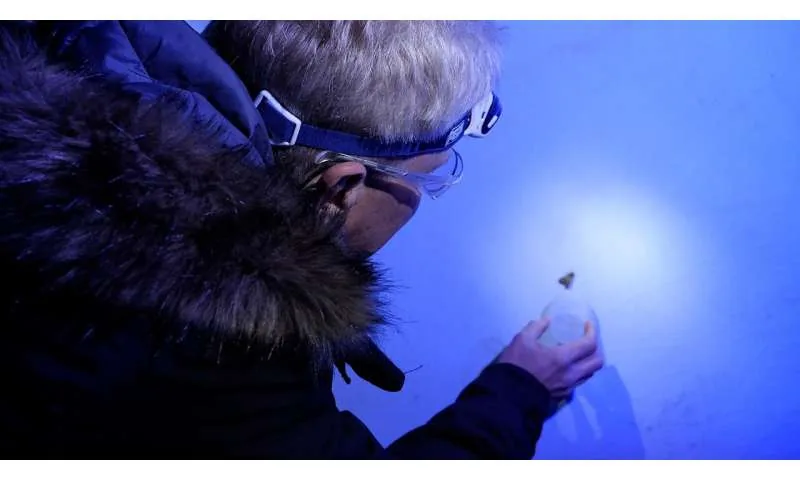
To examine this navigation puzzle under controlled laboratory conditions, biologist Hui Chen and Eric Warrant set up a field station in southeastern Australia [2]. The research team captured traveling insects by placing light traps on Mount Selwyn, situated roughly 70 kilometers north of the alpine caves. Attracted to artificial illumination, hundreds of specimens were caught during spring and autumn flights [3]. The team then transported the captured insects to a dark testing laboratory near the town of Adaminaby in the Snowy Mountains of New South Wales [2].
The team built the testing facility using nonmagnetic materials. Eliminating iron nails, steel brackets, and common wiring ensured that local construction would not distort Earth’s faint geomagnetic field [2]. Inside this metal-free room, researchers placed individual insects into a custom flight simulator arena [3].
Each moth was tethered to a delicate sensor arm, allowing it to fly continuously while recording devices tracked its heading in real time [2]. The simulator recreated an immersive nocturnal landscape of New South Wales. A black cardboard silhouette surrounding the arena mimicked the shapes of distant trees, shrubs, and mountain ridges. Beneath the tethered insect, a projector cast a dim visual pattern on the floor to simulate terrain gliding past below. Overhead, an optical system projected a panorama of the Australian night sky, which could be displayed naturally or scrambled to test flight choices under confusing visual cues [3].

Magnetic Inclination Angle
The flight simulator was encased inside a three-dimensional Helmholtz coil, an electromagnetic device capable of generating controlled magnetic fields within its interior volume [3]. Under a scrambled starry sky, tethered moths continued flying in their inherited southerly direction as long as the magnetic field remained on [1].
When researchers shut off the magnetic field, the tethered insects lost their heading and fluttered aimlessly, confirming that migrating moths rely on geomagnetic cues whenever celestial guides disappear [1]. The team then manipulated magnetic angles. Inclination measures the vertical dip between Earth’s magnetic force lines and the horizontal ground surface, steepening near the South Pole and flattening toward the equator. As bogong moths travel south through New South Wales, this dip angle steepens steadily, offering a consistent benchmark along their 1,000-kilometer route [2].
To confirm whether moths detect inclination rather than polarity, researchers altered field orientations. When the team inverted inclination or turned the field by 180 degrees, moths turned around and flew north. Inverting polarity without altering inclination caused no directional change [1].


Light Sensitivity and Radical Pairs
Biologists led by Hui Chen tested whether the insect compass requires light to function. In trials under altered illumination spectra, the magnetic compass operated only when specific wavelengths illuminated the arena. When researchers removed violet-blue light between 380 and 500 nanometers from the simulator, orientation collapsed. Photoreceptors must absorb short wavelengths [1].
The team also exposed flying moths to weak broadband radiofrequency fields spanning 150 kilohertz to 60 megahertz. Under this electromagnetic noise, the insects lost their sense of direction [1]. Comparable sensitivity to radiofrequency fields occurs in migratory European robins, where anthropogenic noise disrupts magnetic orientation [5]. The disruption supports a radical-pair mechanism, in which light absorption creates transient, magnetically sensitive electron pairs within cryptochrome proteins [1].

A light-dependent inclination compass also guides migrant monarch butterflies (Danaus plexippus) traveling from North America to wintering sites in central Mexico. These butterflies rely on ultraviolet-A and blue light [4]. Biologist Pauline Fleischmann from Carl von Ossietzky University Oldenburg in Germany noted that bogong moths differ fundamentally from desert ants, which rely on polarity cues rather than inclination angles. “This suggests that there are probably several types of magnetoreception, with migratory and nonmigratory animals using the magnetic field in different ways,” Fleischmann said [2].
Migrating Moths Rely on Dual Compasses
By combining visual cues from stars with geomagnetic signals, migrating moths maintain two independent compass systems for variable nocturnal conditions [1]. On clear nights, the insects steer by stellar patterns, which provide direct guidance across open terrain in Australia [2].
When storm clouds roll over the Snowy Mountains and hide the stars, the light-dependent magnetic compass takes over smoothly. Having access to complementary sensory streams allows travelers to maintain their heading without stopping during mountain storms [1]. Multi-sensory navigation strategies are common among long-distance voyagers [2]. For example, studies examining how Adélie penguins use sea ice to optimize migration journeys show that polar birds combine ocean currents, celestial cues, and ice geography to cross thousands of kilometers. Nocturnal insects similarly synthesize multiple sensory streams to avoid navigation errors. When one environmental cue fades, another calibrated sensor keeps the animal traveling in its inherited direction [1].
Convergent evolution explains this shared sensory ability. Vertebrates and arthropods diverged roughly 700 million years ago in evolutionary history. Yet despite separate anatomical paths, both groups developed similar biophysical solutions for long-distance travel. “Although insects and birds have evolved along separate paths for around 700 million years, they appear to be able to use similar biological solutions,” researcher Hui Chen said [2].
When Do Adults Travel to the Caves?
Bogong moths migrate twice each year, flying south in spring between September and November to reach alpine caves, and returning north in autumn during March and April to breed in lowland pastures. The spring passage carries young insects across hundreds of kilometers of dry terrain, while the autumn return journey brings surviving adults back to inland pastures to lay eggs and complete their life cycle. Space weather events such as episodes where fast solar wind buffets Earth’s field can introduce localized magnetic fluctuations during flight. Because moths rely on both starlight and magnetic dip angles, brief geomagnetic disturbances rarely disrupt their overarching travel heading [3]. “Geomagnetic and stellar compass cues could enable Bogong moths to continue navigating in their inherited migratory direction even when one of these cues diminishes,” the research team concluded in Nature [1].
The research project brought together scientists from Lund University in Sweden, Carl von Ossietzky University Oldenburg in Germany, the Australian National University in Canberra, and the University of South Australia in Adelaide. “The next step is to understand in greater detail how this mechanism works and how it interacts with other senses when animals navigate,” Eric Warrant said [2].
- ACADEMIC JOURNAL Chen, H., Rosberg, L., Dreyer, D., Leberecht, B., Mouritsen, H., Fleischmann, P. N., & Warrant, E. J. (2026). Bogong moths navigate with a light-dependent geomagnetic inclination compass. Nature. [Article Link]
- ONLINE NEWS Joelsson, J. (2026). Migrating moth uses Earth’s magnetic field as a compass. Phys.org. [Article Link]
- ONLINE NEWS Cockerill, J. (2026). Moths Are Guided by Earth’s Magnetic Field in Massive Australian Migration. ScienceAlert. [Article Link]
- ACADEMIC JOURNAL Guerra, P. A., Gegear, R. J., & Reppert, S. M. (2014). A magnetic compass aids monarch butterfly migration. Nature Communications, 5(1). [Article Link]
- ACADEMIC JOURNAL Engels, S., Schneider, N., Lefeldt, N., Hein, C. M., Zapka, M., Michalik, A., Elbers, D., Kittel, A., Hore, P. J., & Mouritsen, H. (2014). Anthropogenic electromagnetic noise disrupts magnetic compass orientation in a migratory bird. Nature, 509(7500), 353-356. [Article Link]
APA 7: PerEXP Teamworks. (2026, November 19). Migrating Moths Navigate Night Skies Using Earth’s Magnetic Field. PerEXP Teamworks. https://perexpteamworks.com/en/migrating-moths-earth-magnetic-field/


