





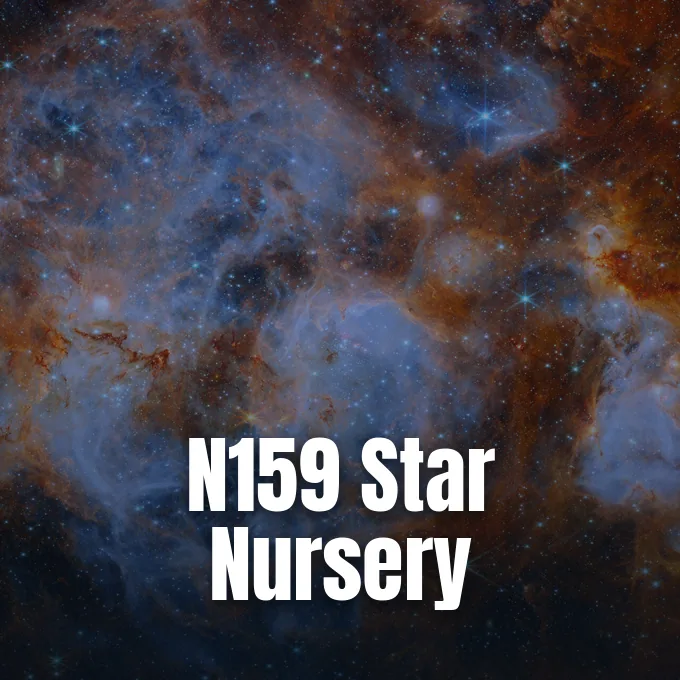
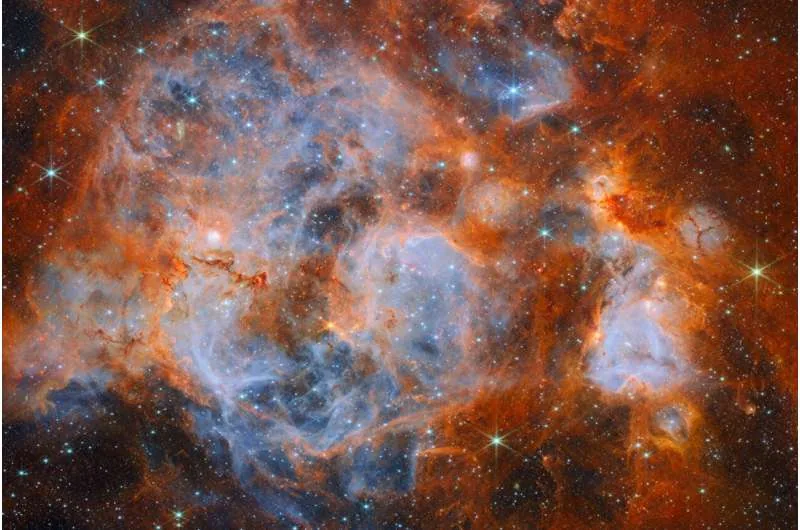
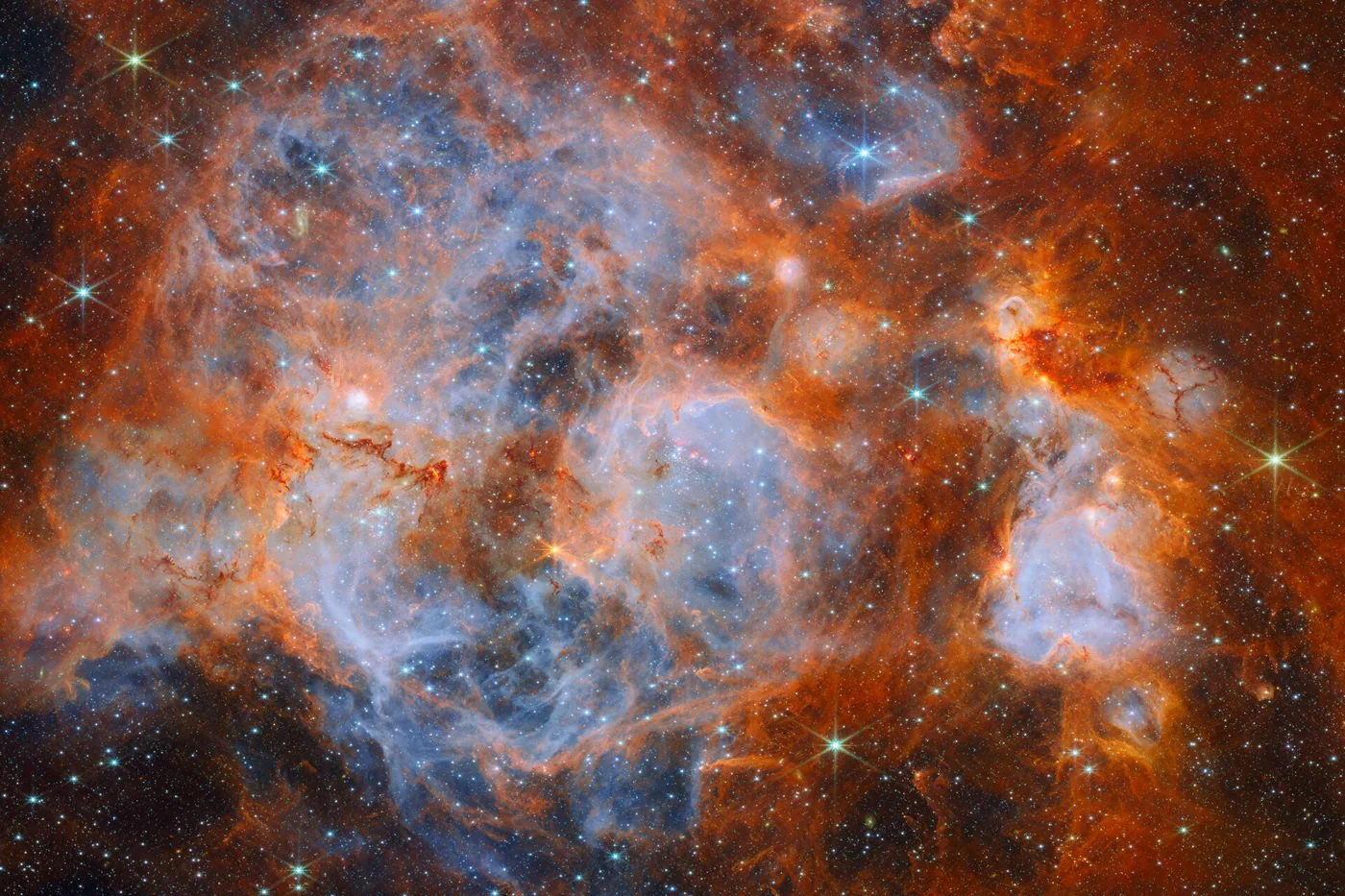
The NASA/ESA James Webb Space Telescope turned its Near-Infrared Camera toward the N159 nebula, an active stellar nursery located roughly 161,000 light-years away in the Large Magellanic Cloud. The glowing cloud of ionized hydrogen gas spans about 230 light-years across satellite space. Webb NIRCam captured how gravity condenses cold interstellar gas into infant stars. Older space observatories photographed parts of the expanse, but new infrared imaging penetrates deep into hidden stellar nurseries shielded behind dense molecular filaments inside the satellite galaxy. Astronomers now possess a clear view of continuous star birth inside a satellite system orbiting the Milky Way [1].
Mapping N159 Nebula Gas Clouds
Astronomers categorize LHA 120-N 159 as an H II region, which refers to an area of interstellar space filled with ionized hydrogen gas where cold molecular clouds collapse under gravity to form new stars. Inside stellar nurseries like this one, giant molecular clouds of cold hydrogen collapse under gravity to form new stars. Many of these stars are massive and hot, releasing intense ultraviolet radiation that ionizes surrounding gas clouds and turns them into a glowing emission nebula visible across the Large Magellanic Cloud. Fierce stellar winds from these newborn stars sculpt dense ridges and carve open large cavities within the gas, which Webb NIRCam captured in detail during the observing run. Expanding gas cavities alter the density of neighboring clouds to trigger later star birth across the satellite galaxy [1].
Thick smoky orange clouds billow through the middle of the field, enclosing the turbulent interior of the N159 nebula. The glowing orange color marks light emitted by polycyclic aromatic hydrocarbons, which are common carbon-based molecules that glow when illuminated by energetic radiation from nearby massive stars. Pools of pale blue gas trace clouds of ionized hydrogen that shine under energetic ultraviolet light. Contrasting gas clouds delineate separate pockets where newborn stellar clusters gather inside the Large Magellanic Cloud [2].
Dark red filaments cross the center of the image, floating right above the blue gas on the right side. Cool molecular hydrogen makes up these thick filaments, which represent the densest parts of the entire N159 complex. Dense molecular gas barriers shield fragile young stars from harsh stellar winds until radiation melts the filaments away [1].
Chemical Clues in the Dust
Infant stars appear as points of light embedded within dark filaments and small orange pillars reaching into blue cavities carved out by intense stellar radiation from nearby massive stars. High-energy winds blow away thinner gas while leaving dense columns standing. The resulting columns resemble classic stellar pillars seen in other galactic nurseries. Stars remain cocooned in these pillars until radiation disperses surrounding dust. Outward pressure from newborn stars clears the surrounding cavities [2].
Earlier studies of a protostar in Perseus tracked an isolated infant star inside the Milky Way, but N159 contains an entire starburst network where thousands of young bodies develop together. Webb allows astronomers to separate mature stars from young stellar objects wrapped in thick birth clouds. While dense dust filaments block visible light, infrared wavelengths penetrate the clouds to reveal embedded protostars to NIRCam detectors [1].

Near-infrared observations also identified a distinct subpopulation of young sources exhibiting water ice absorption features, confirming that protected niches survive amidst energetic radiation fields. Ice mantles on dust grains supply basic chemical ingredients for potential planetary systems forming around newborn stars. Sheltered environments endure even in regions dominated by harsh ultraviolet light. Water molecules stay frozen onto dust grains within the coldest pockets of the N159 cloud [3].
The Papillon Nebula
A brightly glowing patch on the left side of the scene marks the Papillon Nebula, named for its compact butterfly shape. Astronomers regard this high-density pocket of ionized hydrogen as an important site linked to the formation of massive stars. The NASA/ESA Hubble Space Telescope resolved this exceptionally compact blob of ionized hydrogen for the first time in 1999, showing that massive stars can form inside dense gas environments. Hubble proved that compact gas clumps survive intense radiation. ESA astronomers continue to study the Papillon Nebula to understand how massive stellar systems assemble [1].
Hubble photographed N159 again in 2025, releasing a pair of images covering the east and west sections of the cloud. Optical detectors could not penetrate the thickest dust lanes in the complex. Webb NIRCam peered through those obscuring layers to resolve individual stars that remained invisible in earlier surveys. Combining data from Hubble and Webb helps astronomers trace how dust affects stellar brightness measurements across the eastern and western sections of the star-forming complex [2].
While Webb surveyed older circumstellar debris such as the dusty cat’s tail in Beta Pictoris, the N159 nebula captures an earlier developmental phase before planetary debris disks take shape. With an estimated age under 3 million years, N159 represents an early evolutionary stage where thousands of stars assemble inside the satellite galaxy [1].


Why the Magellanic Cloud Matters
Why do astronomers study the Large Magellanic Cloud when the Milky Way contains nearby star nurseries? The reason centers on metallicity, which is the proportion of elements heavier than hydrogen and helium that astronomers call “metals” when evaluating chemical evolution in distant galaxies [1]. Because the Large Magellanic Cloud has a significantly lower metallicity than our home galaxy, it offers conditions that closely resemble star-forming environments in the early universe when the cosmos was young. European Space Agency records document that the nebula sits 161 000 light-years away in the satellite galaxy [2].
The Large Magellanic Cloud hosts many rich H II regions, including the larger N79 complex and the famous Tarantula Nebula. Because this satellite galaxy lies at a nearly uniform distance from Earth, astronomers compare stellar brightness without confusing distance uncertainties that often complicate surveys inside the Milky Way. Clear viewing geometry helps researchers measure stellar properties across large complexes. Every cluster in the Large Magellanic Cloud shares the same viewing distance [2].
A lower proportion of heavy elements changes how interstellar gas cools and collapses, altering the rate at which cold molecular clouds fragment into new stellar embryos under gravity. Interstellar molecular clouds require higher densities before gravity can overcome thermal gas pressure. Webb NIRCam observes how these physical differences affect star formation in real low-metallicity environments across N159 [1].
Examining N159 Nebula Stellar Populations
The new image comes from Webb observing program 5114, an initiative focused on studying stars across different stages of evolution in this giant nebula. A research team led by Nolan Habel collected photometric measurements from ten near-infrared NIRCam filters spanning wavelengths from 1 to 4.7 microns. Key co-authors on the research project include E. Sabbi, P. Zeidler, T. Ziliotto, G. D. Marchi, O. C. Jones, A. S. Hirschauer, K. D. Gordon, and A. Nota. Their analysis covered more than 300,000 point sources across an area stretching over roughly 130 parsecs, creating a detailed catalog of the entire stellar population within the N159 nebula [3].
Webb detected extremely dim stellar sources down to about magnitude 27 in the F115W filter, corresponding to stellar masses reaching below 0.1 solar masses in the satellite galaxy. Astronomers can now identify stars less than a tenth the mass of the Sun in another galaxy. Small stars form efficiently even in low-metallicity gas. Faint stellar bodies populate the lower end of the initial mass function throughout N159 [3].
Nolan Habel posted the research findings in a preprint titled Sequential Star-Formation and the Near-Infrared Stellar Populations within N159 on the arXiv preprint server. Because the study is an arXiv preprint, it has not yet undergone formal peer review by an academic journal. Even so, the ten-filter photometric dataset allows researchers to construct color-magnitude diagrams that separate young stars from older field stars and reveal populations younger than 0.5 million years [3].
Sequential Collapse in the West
By measuring Paschen-alpha excess emissions, Nolan Habel and colleagues identified accreting pre-main sequence stars that actively draw cold matter from surrounding circumstellar gas disks. The team also identified candidate young stellar objects that show strong infrared excess indicative of thick circumstellar dust envelopes. Infant candidates match the physical locations of dark dust filaments and cold molecular gas, confirming their deeply embedded state. Active accretion and star birth remain concentrated in the densest gas pockets where cold molecular clouds shield young stellar objects [3].
Spatial analysis revealed that star formation does not occur evenly across the N159 complex. The western region of N159 contains more young stellar objects grouped in a concentrated area than the eastern section. The spatial distribution demonstrates that the western portion is at an earlier stage of gravitational collapse than other parts of the nebula, showing sequential star formation across the cloud [3].
Because star formation occurs sequentially across the cloud, the N159 nebula offers astronomers an opportunity to study every stage of stellar birth at once within a single pointing. Observers follow the path from pristine molecular gas to emerging stellar clusters within a single pointing. The nebula will gradually melt away to reveal an open star cluster to enrich the Large Magellanic Cloud [1].
- ONLINE NEWS ESA. (2026, October 22). Webb image reveals young stars brewing in a nebulous cauldron. Phys.org. [Article Link]
- PRESS RELEASE European Space Agency. (2026, October 22). Stars brewing in a nebulous cauldron. ESA. [Article Link]
- PREPRINT Habel, N., Sabbi, E., Zeidler, P., Ziliotto, T., Meixner, L. C. M., Marchi, G. D., Jones, O. C., Hirschauer, A. S., Meena, B., Jaspers, J., Lenkic, L., Indebetouw, R., Gordon, K. D., Gunay, B., Madden, S., Page, J. M., Nayak, O., Nota, A., Oneill, T., & Mercia-Jones, P. Y. (2026). Sequential Star-Formation and the Near-Infrared Stellar Populations within N159. arXiv. [Article Link]
APA 7: PerEXP Teamworks. (2026, October 23). Webb Telescope Reveals Newborn Stars Inside the N159 Nebula. PerEXP Teamworks. https://perexpteamworks.com/en/n159-nebula-webb-star-birth/


