






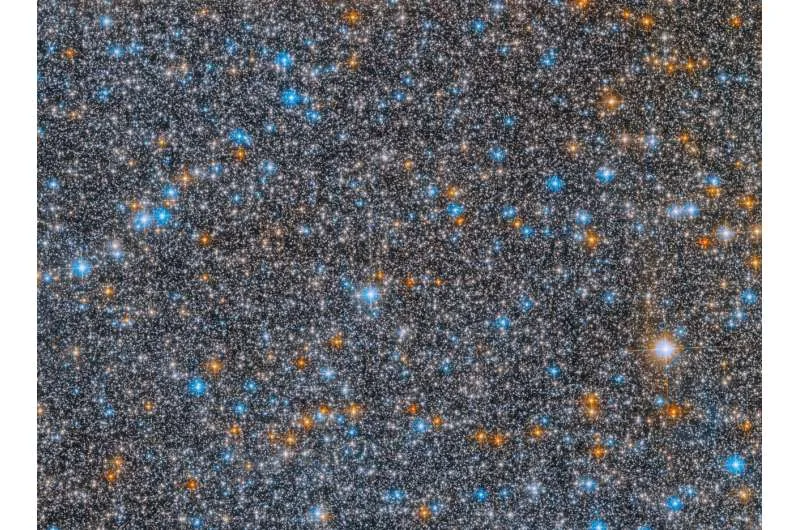
The NASA Hubble telescope surveyed an ocean of stars in the Milky Way Galaxy to build groundwork for the Nancy Grace Roman Space Telescope. Astronomers targeted a spherical expanse near the galactic center, where millions of old stars cluster in dense swarms. Phys.org covered the release, reporting that Hubble’s high-resolution cameras separate individual stars in a luminous field shining with vibrant multi-colored hues toward the galactic bulge [1]. Andrea Gianopoulos and the NASA Hubble Mission Team reported that these observations will help astronomers characterize stars and detect candidate exoplanetary systems near the galactic core [2].
How the NASA Hubble Telescope Views the Bulge
The Milky Way Galaxy harbors a spherical swarm of stars called the galactic bulge. Positioned at the center of the galactic disk, the bulge holds nearly one-quarter of the stellar mass of the galaxy [1]. Ground observatories face atmospheric distortion. From orbit above the atmosphere, the NASA Hubble telescope uses sharp optical cameras to separate crowded stars [2].
Astronomers concentrate their investigations on the Milky Way’s central core because its close physical distance enables researchers to study crowded stellar populations with unrivaled clarity. Ground-based and spaceborne observatories can readily photograph the diffuse luminescence radiating from spherical bulges inside other spiral galaxies across the cosmos, yet those distant cosmic structures remain far too congested and remote for astronomers to identify individual stars [1]. Examining our own galactic heart gives astronomers a practical pathway to discover uncharted exoplanetary systems while tracing the prolonged evolutionary pathways that govern how giant stellar disk systems assemble and interact across cosmic history [2]. Through its sharp cameras, Hubble tracks changes in stellar luminosity, age distributions, chemical makeup, and orbital motions across decades of flight operations [1].
Why Astronomers Study the Core
Galactic bulges preserve durable physical records detailing environmental conditions that governed the early universe billions of years ago. These densely populated cosmic regions reveal how gravitational forces gathered clouds of interstellar gas and dust into organized, rotating galactic disks. Within the Milky Way Galaxy, Hubble delivers extraordinarily crisp vantage points that remain obscured inside distant star systems [1]. These comprehensive star catalogs allow astrophysicists to test and refine mathematical simulations describing galaxy formation and long-term cosmic evolution [2].
Beyond reconstructing cosmic history, scientists observe the central bulge to search for new planets and map unseen mass distributions across the inner Milky Way Galaxy [1]. The crowded core contains millions of ancient stars. As these older stars travel through the inner galactic disk, their orbital paths provide valuable clues about the presence of dark matter and unmapped black holes. High-resolution brightness data collected by the NASA Hubble telescope allows researchers to isolate subtle gravitational disturbances caused by compact objects and pinpoint the locations of massive bodies [2].
Visible and Infrared Filter Overlap
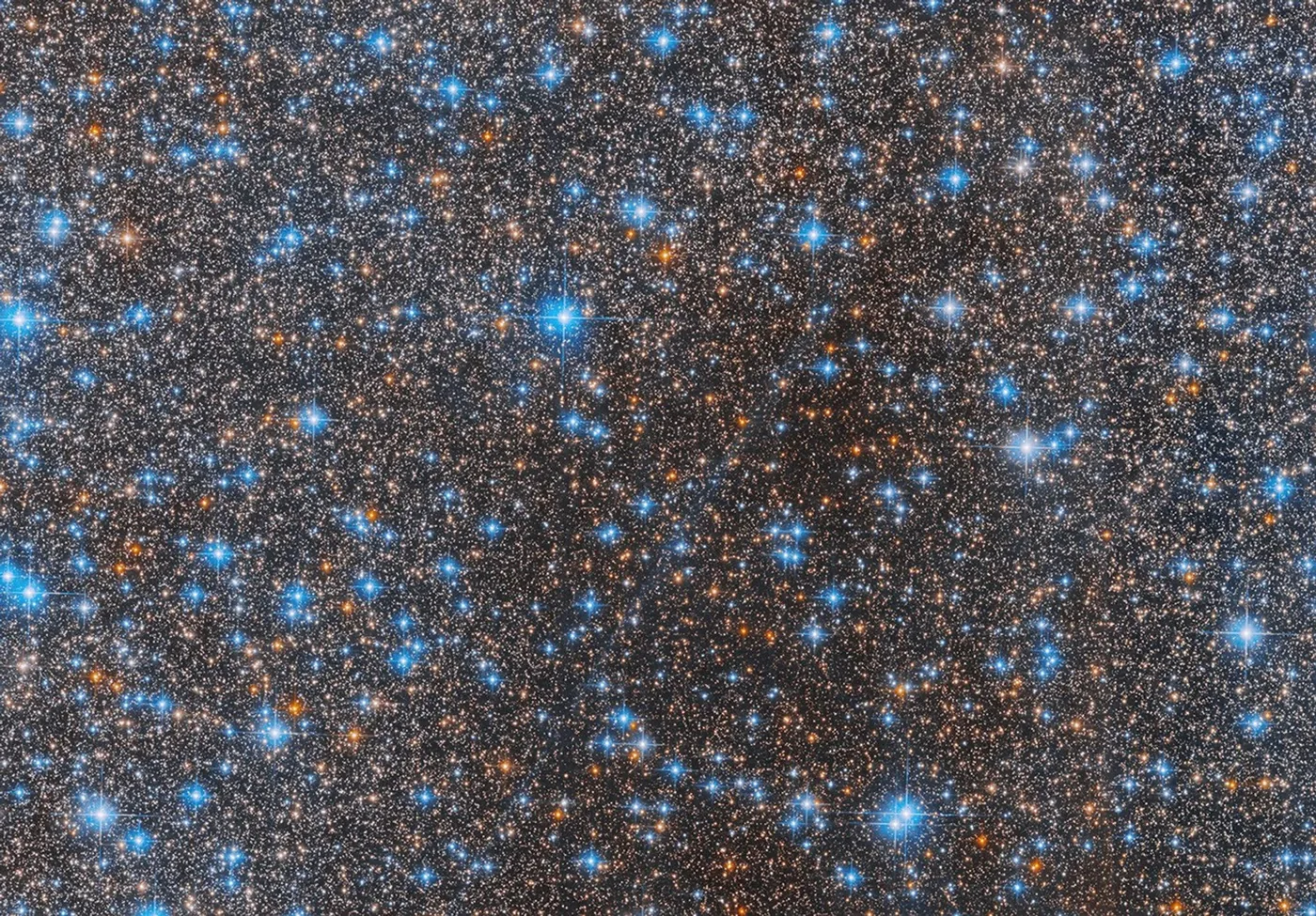
Astronomical surveys rely on matching filter sets and shared wavelength coverage between space observatories. Hubble views the cosmos in ultraviolet, visible, and near-infrared light, whereas the Nancy Grace Roman Space Telescope collects near-infrared and visible data [1]. To make cross-mission comparisons possible, astronomers configured Hubble to observe in filters matching Roman’s detectors, targeting the red end of visible light and near-infrared bands [2].
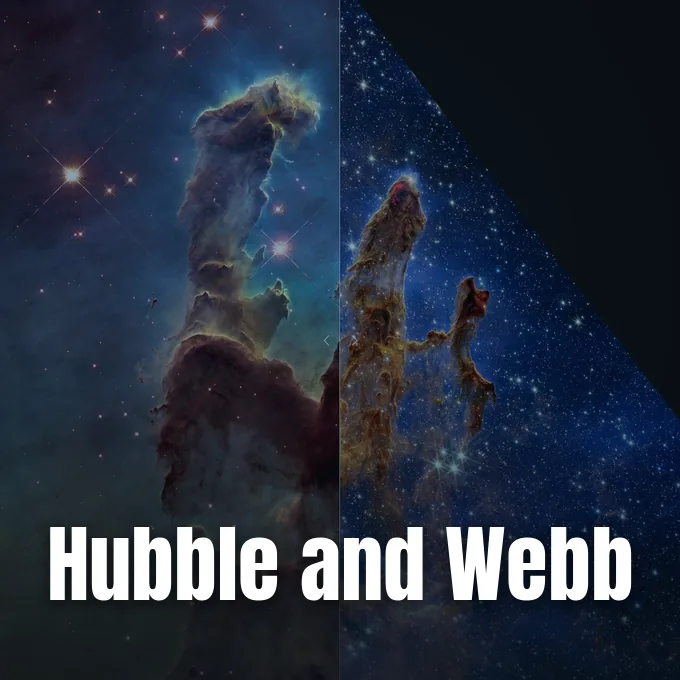
Shared spectral bands allow scientists to compare brightness measurements taken across different years without needing complex instrument adjustments. When Roman scans the galactic bulge, researchers can cross-reference Roman infrared images directly against Hubble optical and infrared catalogs to verify stellar brightness, ages, and chemical composition [1]. Coordinated filter choices reflect methods seen where Hubble and James Webb observatories show how pairing different space platforms expands multi-wavelength science. These multi-epoch catalogs enable researchers to track changes in stellar brightness and spatial velocity across prolonged observation intervals [2].

Preparing Hubble Space Telescope Data for Roman
The Nancy Grace Roman Space Telescope will search for unseen exoplanets by capturing gravitational microlensing events across dense starfields in the Milky Way Galaxy [1]. Microlensing takes place when the gravitational field of an intervening cosmic body curves and amplifies starlight traveling from a distant background star toward Earth. These planetary microlensing encounters operate on far smaller physical scales, involving individual stars and planets, than the vast gravitational lenses observed around massive galaxies and galaxy clusters [2].
Upcoming Roman observations aim to find exoplanets by detecting gravitational microlensing events across the Milky Way Galaxy. This phenomenon happens when the gravitational pull of an intervening star bends and magnifies illumination coming from a background stellar source. Subtle brightness variations in that distorted background signal reveal the presence of the foreground star and any smaller planets orbiting it. Survey data gathered by Hubble helps researchers establish baseline profiles for crowded stars well before any brightening begins [1]. Andrea Gianopoulos and the NASA Hubble Mission Team said that these preparatory observations will “help researchers better interpret upcoming Nancy Grace Roman Space Telescope observations” when analyzing microlensing events [2].
Archival catalogs establish a stable reference framework for confirming planetary discoveries in crowded sectors. When Roman detects a transient brightening event months or years into its survey, scientists will consult archival Hubble images to establish the baseline luminosity and precise coordinates of the background star [1]. Cross-referencing baseline data against future Roman observations ensures that astronomers can distinguish genuine planetary lensing signatures from intrinsic stellar variability or unexpected stellar flares [2].
Surveys from WFC3 to SWEEPS
Hubble has repeatedly observed our galaxy’s central bulge throughout its long operational lifespan. A foundational effort was the WFC3 Galactic Bulge Treasury Program, which deployed the Wide Field Camera 3 (WFC3) to determine the brightness, precise positions, and dynamic orbital motions of stars in this congested environment [1]. By cataloging dense stellar clusters without atmospheric distortion, the project showed how orbital observatories resolve stars that ground-based facilities cannot separate [2].
In addition to the Treasury program, Hubble conducted the Sagittarius Window Eclipsing Extrasolar Planet Search, commonly designated as SWEEPS. That project employed the Advanced Camera for Surveys (ACS) to monitor more than 180,000 stars situated inside the crowded galactic bulge [1]. By tracking periodic dips in starlight across that massive stellar census, SWEEPS proved that space-based instruments can detect transiting exoplanets located deep inside our galaxy’s crowded inner core [2].
Goals for Program 17776
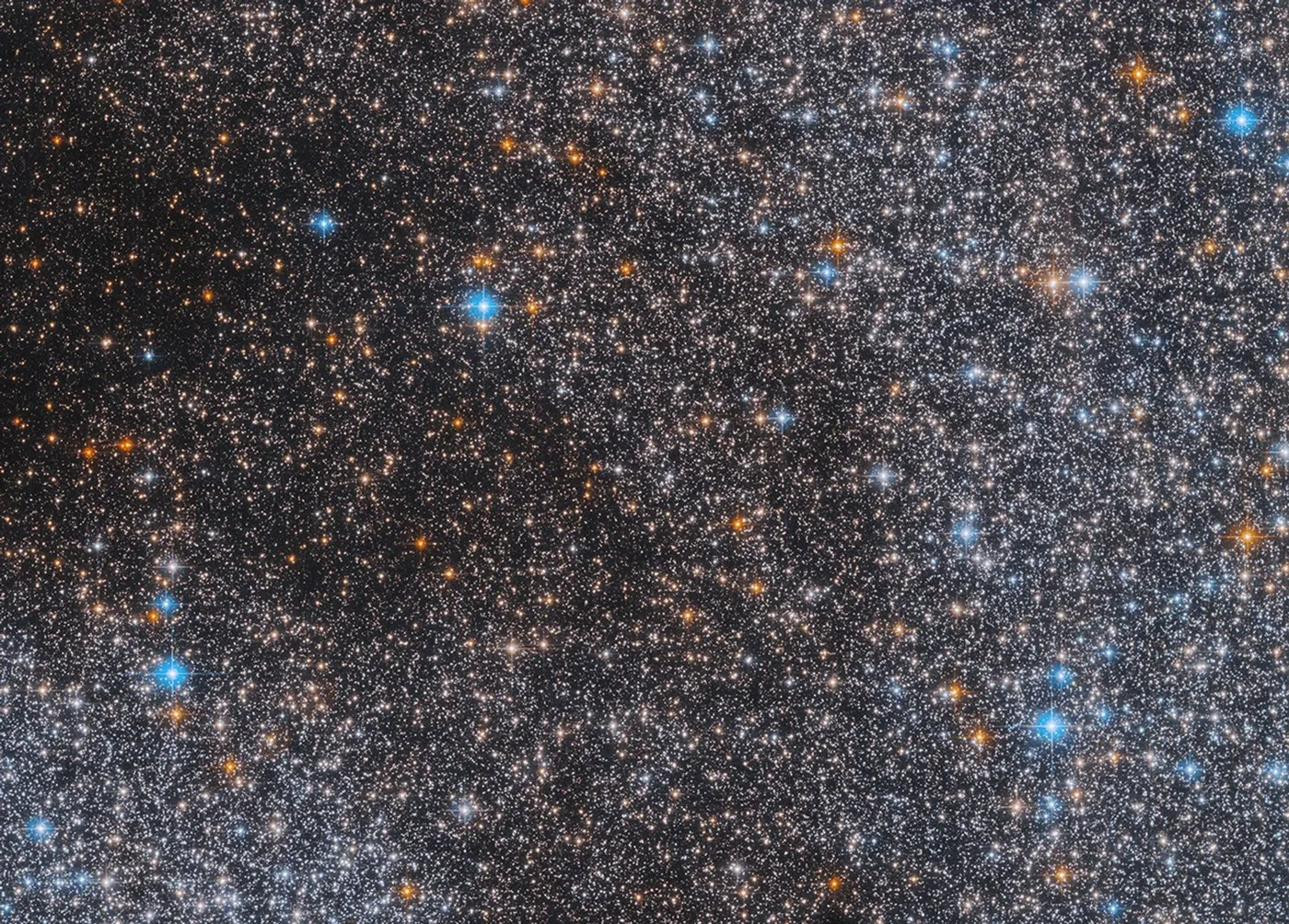
The newest bulge observations were gathered under Program 17776, led by principal investigator S. Terry. Designed to prepare the global astronomical community for Roman operations, the survey records high-precision stellar coordinates and multi-color photometry across congested starfields [1]. Program data will aid scientists in their active hunt for exoplanets, wandering stellar-mass black holes, and isolated neutron stars that drift through the inner Milky Way Galaxy [2].
NASA coordinates Hubble’s early imaging with upcoming Roman surveys to establish an unbroken observational record across decades of space exploration. NASA media contact Claire Andreoli at NASA’s Goddard Space Flight Center in Greenbelt, MD, published the survey release to support ongoing preparations for the NASA Roman mission. When Roman initiates its wide-field infrared surveys, researchers will have the baseline stellar catalogs required to interpret complex gravitational microlensing events within the central bulge [1]. Linking these two flagship missions ensures that astronomers can fully characterize our galaxy’s dense stellar heart [2].
- ONLINE NEWS Phys.org. (2026, November 25). NASA’s Hubble views ocean of stars in groundwork for Roman. [Article Link]
- PRESS RELEASE Gianopoulos, A., & NASA Hubble Mission Team. (2026, November 25). NASA’s Hubble Views Ocean of Stars in Groundwork for Roman. NASA Science. [Article Link]
APA 7: PerEXP Teamworks. (2026, November 26). NASA Hubble Telescope Surveys Ocean of Stars for Roman Mission. PerEXP Teamworks. https://perexpteamworks.com/en/nasa-hubble-telescope-ocean-stars/


