



Astronomers often describe brown dwarfs as celestial bodies caught between giant gas planets and small stars. First recognized in the 1990s, these dim objects collapse from gas clouds like normal stars do, but they never gather enough mass to ignite stable hydrogen fusion in their cores. New observations from the NASA SPHEREx telescope show that their cloudy atmospheres contain water vapor, methane, carbon monoxide, and carbon dioxide, spanning temperatures from 2,200 down to minus 20 degrees Celsius [1].
What Is the SPHEREx Mission Related to?
NASA designed the SPHEREx mission to address three big questions in astrophysics: cosmic inflation after the big bang, the formation of cosmic structures in hundreds of millions of galaxies, and the origin of water and biogenic molecules in interstellar ice. Built by BAE Systems and managed by the Jet Propulsion Laboratory in Southern California for the Astrophysics Division within the Science Mission Directorate in Washington, the space telescope operates under principal investigator Jamie Bock at Caltech and project scientist Olivier Dore at JPL. A science team from 13 partner institutions in the United States, South Korea, and Taiwan oversees data processing and archiving at IPAC in Pasadena California [1].
While other astronomers watch a protostar forming in Perseus to study the birth of stars, free-floating brown dwarfs drift alone in deep space without a host star to heat them. “They’re kind of goth,” said lead author Zafar Rustamkulov, a researcher at IPAC at Caltech. “Unlike exoplanets, free-floating brown dwarfs are completely independent celestial objects that will fade into eternity alone. We’re still learning how complex they are.” [1]
Unlike temperate exoplanets like Gliese 12 b that receive steady warmth from nearby stars, brown dwarfs cool down as their internal heat slowly radiates into space. Only a few dozen of these objects had been studied in detail with space telescopes like the James Webb Space Telescope and the retired Spitzer Space Telescope before this survey [1].

How Does the SPHEREx Telescope Work?
The NASA SPHEREx telescope collects infrared spectra without pointing at single targets, creating spectroscopic data for each patch of sky as objects drift past its detectors. Science.Report science writer Gemma Lavender explains that the observatory steps each target through 17 separate detector positions, recording 51 flux points per channel to assemble 102 color values within its infrared range. This approach captures faint or crowded objects that ground-based instruments cannot cleanly resolve [4].
Space observations avoid atmospheric interference. Water in Earth’s atmosphere absorbs infrared wavelengths, which blocks ground telescopes from seeing critical molecular absorption bands. “From orbit, SPHEREx sees wavelengths of light that are basically impossible to see with telescopes on the ground because water in Earth’s atmosphere absorbs them,” Zafar Rustamkulov said. “We are picking up light from the deep, red clouds of brown dwarfs all over the sky.” [1]
The instrument measures light between 0.75 and 5 micrometers with resolving power between 40 and 100, covering major molecular bands and more than four-fifths of the total radiant output (bolometric luminosity) for most brown dwarfs. That full spectral coverage is detailed in an unreviewed arXiv preprint submitted on 1 July 2026, which served as the preliminary report by Rachel Akeson, Michael Werner, and their team before peer review in The Astrophysical Journal. Measuring most of an object’s radiant energy helps scientists benchmark atmospheric models against real physical outputs [2].
Chemical Signatures in Cold Atmospheres
The initial paper focused on 37 nearby field brown dwarfs spanning spectral types L0 to Y4, with temperatures ranging from 2,200 degrees Celsius down to minus 20 degrees Celsius (about 4,000 to minus 10 degrees Fahrenheit). Science writer Sally Younger and media officer Calla Cofield at Jet Propulsion Laboratory highlighted that these objects span nearly the entire known temperature regime of brown dwarfs. The warmer L-type dwarfs carry strong signatures of carbon monoxide and water, while cooler targets show rising levels of methane [1].
Caltech IPAC scientist and study coauthor Davy Kirkpatrick pointed out how much chemical variety appears through the temperature sequence [1]. Working with coauthors Brendan Crill, Carey Lisse, and Daniel Masters, the team mapped spectral trends through multiple evolutionary stages [2]. “We’re seeing the signatures of these molecules and how they change from object to object across the entire temperature regime,” Davy Kirkpatrick said. “Our paper concentrated on just three dozen, but we have thousands more that we are in the process of analyzing. I really want to see what bounds the universe places on the variety of brown dwarfs.” [1]
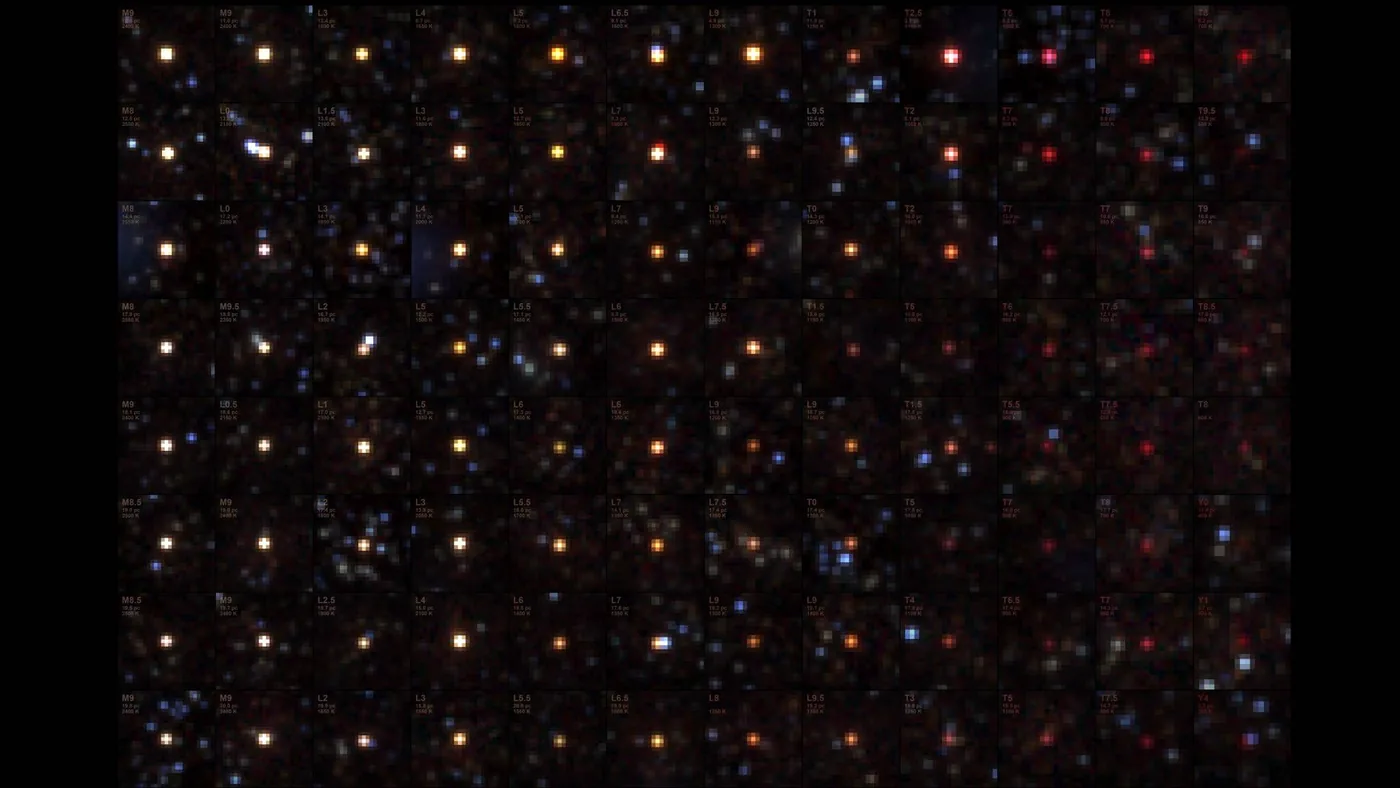
The researchers also compiled spectra for low-gravity and low-metallicity dwarfs to see how surface gravity and chemical abundance shape atmospheric light. Coauthors Gary Melnick and Michael Zemcov assisted in comparing these distinct sub-classes [2]. Even when two objects share nearly identical temperatures, their spectra reveal noticeable differences in molecular band strengths and cloud opacities [1].


Cloudy Transitions Challenge Current Models
The sharpest test for theoretical models occurs during the transition between L and T spectral types, when thick silicate clouds break apart and clear out to reveal methane-dominated layers below. Zafar Rustamkulov and his colleagues tested five well-known model grids against the data: Sonora Diamondback, Elf Owl, BT-Settl, ATMO2020, and ATMO2020++. While these grids reproduce broad chemical trends, they struggle to fit near-infrared flux peaks and the 4-micrometer opacity window simultaneously [2].
Zafar Rustamkulov explained that models struggle most when clouds start to break apart. “The state-of-the-art models are capturing the general chemical trend, but when it comes to these cloudy transitions, the models are struggling to match the data,” Zafar Rustamkulov said. “No two brown dwarfs are alike. Even at the same temperature, their spectra look quite distinct.” [1] The largest offsets appear around carbon dioxide and carbon monoxide features, where observations strongly favor weak vertical mixing over strong convective mixing [2].

This discrepancy does not mean that unknown chemical elements are hiding in the skies of brown dwarfs. Rather, it shows that current computer simulations simplify the way cloud particles condense, settle, and move through atmospheric layers. By comparing 37 standardized spectra from the NASA SPHEREx telescope with model grids, astronomers now have concrete data to guide better cloud physics [4].
Accidental Meteorologists Tracking Alien Weather
Explaining the complex behaviors observed in these cold worlds has forced astronomers to rethink how they study stellar atmospheres. Davy Kirkpatrick noted that studying brown dwarfs feels like trying to forecast weather on an alien planet. “The findings are a call to action to explore even more of these dark worlds,” Davy Kirkpatrick said. “This journey has turned many of us into accidental meteorologists. We know how hard it is to predict weather on our own planet, and we realize it’s going to be just as challenging to explain the phenomena we see in these bizarre, cold objects.” [1]
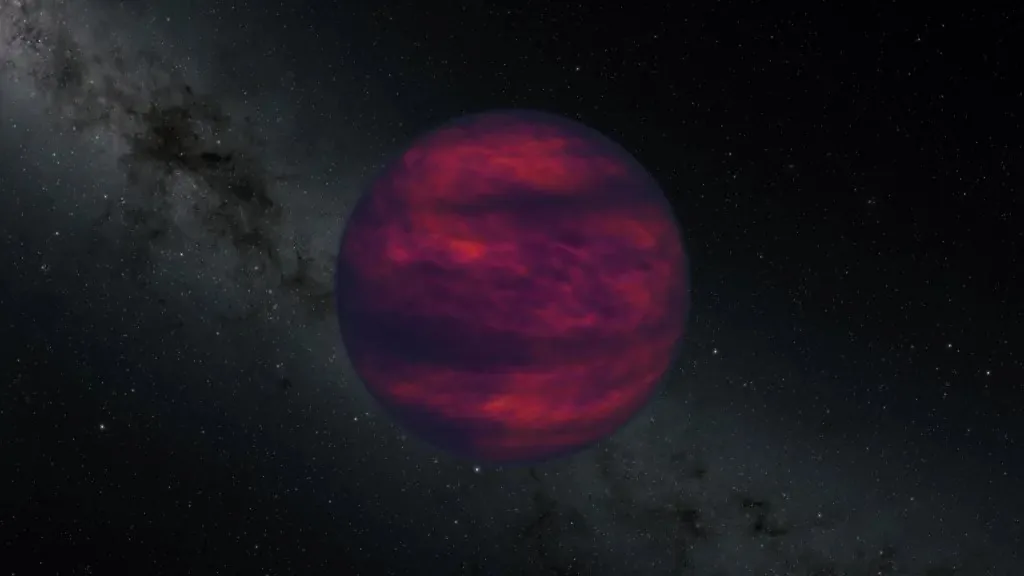
Unlike planets in our solar system where sunlight drives atmospheric dynamics, brown dwarfs are heated entirely from within by gravitational contraction [1]. Coverage updated on 8 October 2026 by PressBee highlighted visualizations from UC Berkeley researcher M.H. Wong, NOIRLab, NSF, and AURA depicting these objects as banded, Jupiter-like worlds [5]. Spectroscopy provides the only direct window into their cloud decks, because ordinary visible-light cameras cannot pierce their dim, infrared-dominated glow [4].
The dataset is openly accessible to the scientific community and the public through Caltech IPAC in Pasadena California. Independent researchers can download the spectra to test their own cloud simulations, examine individual targets, or hunt for unusual spectral outliers. With thousands of additional candidates waiting in the pipeline, citizen scientists and professional teams can work together to discover more dark wanderers in the galaxy [1].
NASA SPHEREx Telescope Surveys the Entire Sky
Observing brown dwarfs is an added scientific bonus for SPHEREx rather than its primary mission goal [1]. Writing from Chicago Illinois on 8 October 2026 in When the Curves Line Up, astronomy writer Jeffrey Hunt noted that the observatory continues its mission to study objects heated from within that do not revolve around host stars [6]. The spacecraft records about 3,600 unique images per day, scanning the entire sky in regular sweeps [1].
The primary mission of SPHEREx focuses on mapping hundreds of millions of distant galaxies to trace the first moments after the big bang, while searching for interstellar ice that could seed water on newborn planets. That broad cosmological scope shares techniques with simulations linking early black holes to little red dots in the distant universe, where spectra untangle light from crowded cosmic regions. SPHEREx bridges the gap between the largest cosmological scales and nearby planetary atmospheres in the Milky Way [1].
With thousands of additional brown dwarf spectra currently being processed at IPAC, astronomers will soon have the largest homogeneous infrared catalog of these objects ever assembled. This expanding survey will reveal whether the striking chemical variations seen in the first 37 targets are typical or exceptional throughout the Milky Way. As data from the NASA SPHEREx telescope continues to accumulate, researchers like Zafar Rustamkulov and Davy Kirkpatrick will finally have the observations needed to solve the mysteries of these cold, isolated worlds [1].
- ACADEMIC JOURNAL Rustamkulov, Z., Kirkpatrick, J. D., Akeson, R., Werner, M. W., Ashby, M. L. N., Chang, T., Chen, S., Cooray, A., Crill, B. P., Doré, O., Dowell, C. D., Faisst, A. L., Hui, H., Jeong, W., Kang, M., Korngut, P. M., Lisse, C. M., Masters, D. C., Melnick, G. J.,. Zemcov, M. (2026). SPHEREx 0.75–5 μm spectra for a sequence of nearby brown dwarfs. The Astrophysical Journal, 1009(2), 185. [Article Link]
- PREPRINT Rustamkulov, Z., Kirkpatrick, J. D., Akeson, R., Werner, M. W., Ashby, M. L. N., Chang, T., Chen, S., Cooray, A. R., Crill, B. P., Doré, O., Dowell, C., Faisst, A. L., Hui, H., Jeong, W., Kang, M., Korngut, P., Lisse, C. M., Masters, D. C., Melnick, G.,. Zemcov, M. B. (2026). SPHEREx 0.75 to 5 μm spectra for a sequence of nearby brown dwarfs [Preprint – not peer reviewed]. arXiv. [Article Link]
- PRESS RELEASE Younger, S., & Cofield, C. (2026, October 8). NASA’s SPHEREx telescope sees menagerie of brown dwarfs. NASA Jet Propulsion Laboratory. [Article Link]
- ONLINE NEWS Lavender, G. (2026, October 8). SPHEREx maps the chemical weather of brown dwarfs. Science.Report. [Article Link]
- ONLINE NEWS PressBee. (2026, October 8). NASA’s SPHEREx telescope sees menagerie of brown dwarfs. PressBee. [Article Link]
- WEBSITE Hunt, J. L. (2026, October 8). 2026, October 17: NASA’s SPHEREx telescope sees menagerie of brown dwarfs. When the Curves Line Up. [Article Link]
APA 7: TWs Editor. (2026, October 9). How NASA’s SPHEREx Telescope Uncovers Odd Brown Dwarfs. PerEXP Teamworks. https://perexpteamworks.com/en/nasa-spherex-telescope-brown-dwarfs/


