






What is Perseverance? NASA built the Perseverance rover to hunt for signs of ancient microbial life and collect sealed rock cores on the surface of Mars. The car-sized machine landed in an ancient lake basin to document geology, test oxygen extraction technologies, and cache pristine samples for a future retrieval flight back to Earth [2].
What Is the Perseverance Rover?
NASA launched the Mars 2020 mission from Cape Canaveral Space Force Station in Florida on July 30, 2020. An Atlas V rocket carried the spacecraft into space. The flight took 203 days. Touchdown inside Jezero Crater occurred at 3:55 p.m. EST on Feb. 18, 2021 [2].
Alex Mather from Northern Virginia named the rover after winning a nationwide contest, while JPL engineers often call the machine Percy. Acting NASA Administrator Steve Jurczyk declared the arrival a major step for planetary science. The robotic geologist measures 10 feet long, 9 feet wide, and 7 feet tall. It weighs 1,025 kilograms. A boxy chassis carries nineteen cameras, seven science instruments, two audio microphones, and a robotic arm designed to conduct fieldwork without human hands on the surface [2, 4].
Scientists sent the rover to Mars to resolve fundamental questions about whether microscopic life ever emerged in wet environments early in planetary history. Unlike earlier surface explorers that examined rocks only with onboard sensors, this vehicle extracts rock cores and stores them inside clean titanium tubes. Those sealed tubes await a joint campaign between NASA and the European Space Agency to ferry them home for laboratory inspection. Lori Glaze, director of NASA’s Planetary Science Division, said verifying past microbial life requires the sensitive laboratories and instruments available on Earth. The rover continues operating through the decade [2].
Why NASA Chose Jezero Crater
Mission planners picked Jezero Crater after a five-year study evaluating sixty candidate locations on Mars. The crater measures 28 miles (45 kilometers) wide along the western edge of Isidis Planitia. Jezero once held deep water. Orbital mapping revealed an ancient river delta that deposited clay minerals over the basin floor [3].
Scientists determined that 3.5 billion years ago, rivers emptied into Jezero Crater to fill a lake more than 800 feet deep. Scientists recognize that rock samples from an ancient lakebed could preserve evidence of microbial life because muddy sediments protect delicate organic chemistry from cosmic radiation. Inflowing rivers carried smectite clays from nearby highlands, laying down fine strata that trap biological markers [11].
Jezero sits roughly 2,300 miles from Gale Crater, where Curiosity continues its own exploration of ancient water environments. Surface sweeps inside Jezero revealed surprising diversity, uncovering two types of igneous volcanic rocks on the crater floor that interacted with water long after their crystallization. At a prominent rock named Wildcat Ridge, the rover found fine-grained mudstones formed in a stable lake environment. Deputy project scientist Ken Williford from JPL pointed out that deltas provide exceptional conditions for preserving ancient organic signatures. That setting ranks among the most favorable rock types for preserving microfossils and complex chemical traces [10, 11].
Perseverance Chassis and Upgraded Wheels
The core structure relies on an insulated warm electronics box that shields computers and batteries from nighttime temperatures plunging past minus 100 degrees Celsius. Electricity and heat flow from a Multi-Mission Radioisotope Thermoelectric Generator (MMRTG) loaded with 4.8 kilograms of plutonium-238 oxide. Decaying plutonium generates about 110 watts of electrical output, charging two lithium-ion batteries that supply power during peak scientific tasks. The Department of Energy supplied the power generator [2, 10].
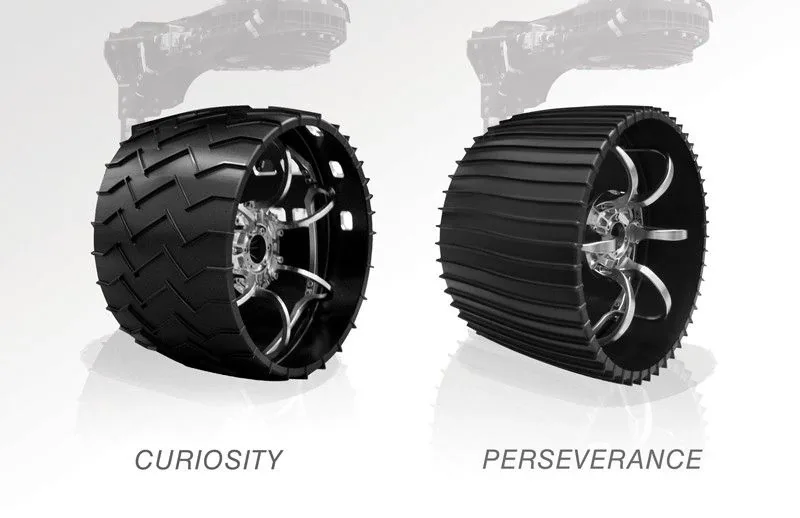
Engineers reworked the mobility system after sharp volcanic rocks in Gale Crater punched holes through Curiosity’s aluminum wheels. The new vehicle features six aluminum wheels spanning 52.5 centimeters across each rim with a diameter of roughly 20.7 inches, built with thicker metal skins and 48 curved grousers machined into the surface. Curved titanium spokes provide springy support while traveling over rugged rock fields. A rocker-bogie suspension system connects the wheels, allowing the rover to climb over 15.75-inch rocks and withstand tilts of 45 degrees in any direction without tipping over [4].

To survive the atmospheric plunge before touchdown, the spacecraft used a heat shield built by Fiber Materials Inc in Biddeford, Maine. Program manager Mark Lippold said the protective shell relied on PICA, a specialized carbon ablator designed to endure friction temperatures up to 2,400 degrees. Dual redundant computers run the rover, each powered by a BAE Systems RAD750 processor operating on the VxWorks operating system. The computer memory tolerates extreme space radiation while managing motor drivers and telemetry. Back in California, engineers work with an Earth test twin named Optimism in the Mars Yard at JPL. Driving Optimism over simulated Martian terrain allows engineers to evaluate computer commands, arm motions, and software routines before sending data millions of miles to Mars [4, 10, 12, 14].
The Multi-Robot Sample Caching System
The collection mechanism aboard the rover represents one of the most intricate assemblies ever sent into deep space. Chief engineer Adam Steltzner from JPL said that while a Swiss chronometer has under 400 components, this sampling network contains more than 3,000 components working in unison. Steltzner said: “In terms of technology, it is the most complicated, most sophisticated mechanism that we have ever built, tested and readied for spaceflight.” The mission carries 43 sample tubes to hold core specimens [5].
Three robotic mechanisms manage the sampling workflow from the drill strike to final storage. A 7-foot robotic arm on the front chassis holds a heavy turret equipped with a rotary percussive coring drill that cuts solid cylinders from Martian stone. Mounted directly below the arm, a rotating bit carousel functions as an automated exchange station that feeds fresh drill bits and empty tubes to the drill head. Inside the rover belly, a smaller 0.5-meter arm called the T. rex arm grabs filled tubes [5].
Once the small belly arm retrieves a sample tube, it transfers the cylinder to stations inside the chassis for inspection and volume measurement. Test lead Kelly Palm oversaw Earth testing of the system to verify that the components withstand mechanical stress. A motorized ramrod drops into the tube to measure the exact depth of the rock core, while an onboard camera photographs the sample surface to verify its structural integrity. The robotic arm then moves the tube into a sealing station where a press drives a metallic plug into the opening, creating a hermetic seal [5, 10]. Sealed containers remain protected from Earth contamination until retrieved.

Key Science Instruments on the Rover
The remote sensing mast serves as the rover’s sensory perch, holding high-resolution imaging tools and diagnostic sensors to inspect geologic features from a distance. Mastcam-Z features two zoomable color cameras that take stereoscopic 3D panoramas, helping scientists study surface topography and choose promising rock targets from dozens of yards away. Beside it, the SuperCam instrument fires a pulsed laser at rock targets up to 20 feet away, vaporizing small specks of stone into luminous plasma clouds for remote chemical analysis. Spectrometers analyze the emitted light to identify elemental composition, while an integrated microphone listens to the sound of each laser pulse to assess rock hardness and physical density under Martian conditions [2, 10].
Two advanced analytical tools sit on the robotic arm turret to inspect targets at point-blank range. PIXL fires a 120-micrometer X-ray beam onto rock surfaces to measure chemical elements across sand-sized grains, mapping elemental variations within seconds. Beside PIXL, the SHERLOC tool shines an ultraviolet laser to excite fluorescence from organic chemicals, working with a high-resolution color camera named WATSON to resolve fine mineral grains [2, 9]. Abigail Allwood and her science colleagues designed PIXL to bridge microscopic chemical maps with larger outcrop features.
The chassis holds three sensor suites that track environmental conditions and probe underground layers. RIMFAX operates as a ground-penetrating radar, sending pulses up to 10 meters into the subsurface to reveal buried rock strata, faults, and ancient sediment beds. The MEDA weather station monitors atmospheric dust, wind speed, relative humidity, and air temperatures each sol. Two microphones recorded the sound of Martian wind blowing over Jezero Crater, providing the first authentic audio ever captured on the surface of Mars [2, 10].

How MOXIE Extracts Martian Oxygen
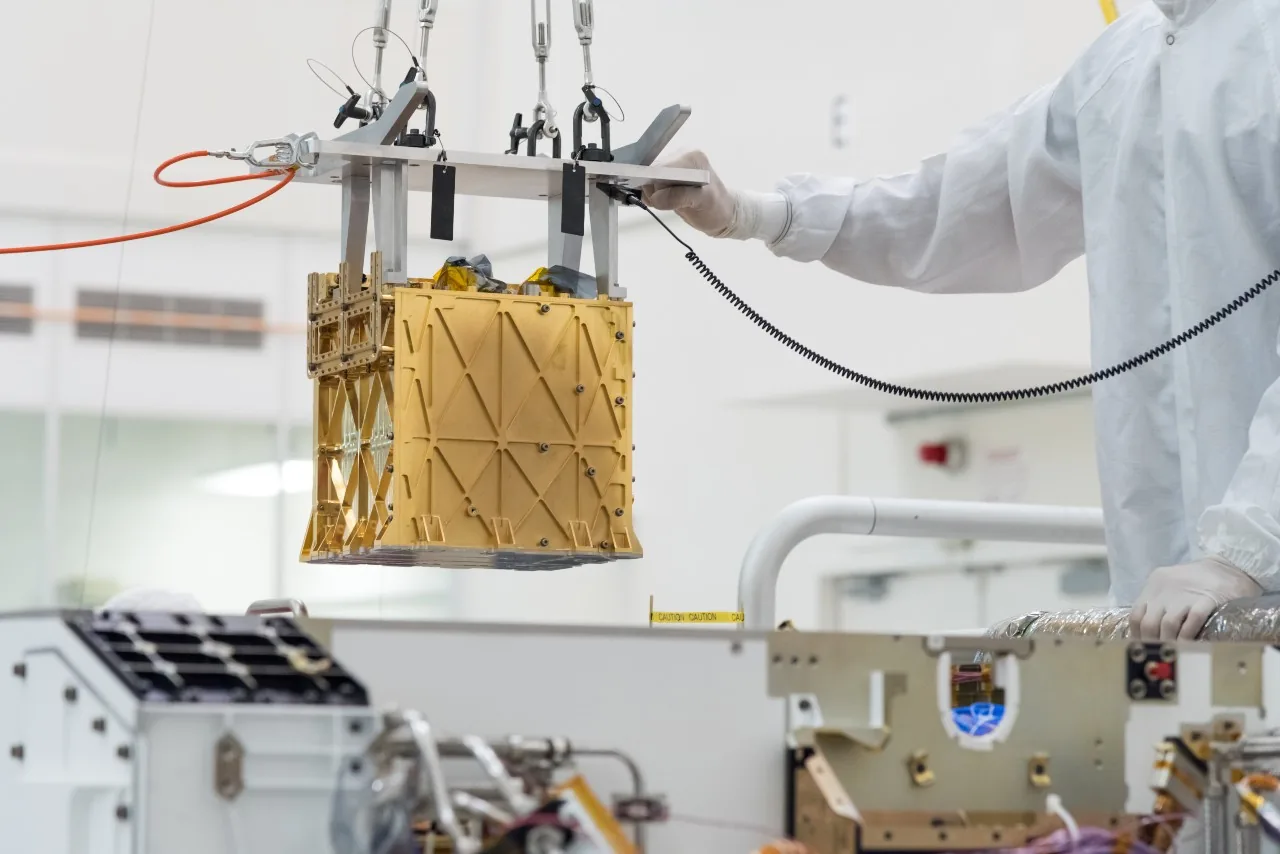
The Mars Oxygen In-Situ Resource Utilization Experiment, known as MOXIE, tested an important capability for future human voyages by harvesting oxygen from the Martian atmosphere. The Red Planet’s thin air consists of 96 percent carbon dioxide, offering virtually no breathable gas for astronauts or oxidizer for rocket engines. Instead of hauling tons of oxygen from Earth, future expeditions could rely on local manufacturing units based on MOXIE’s operating principles. NASA Space Technology Mission Directorate associate administrator Jim Reuter called the test a critical step toward human exploration [7].
The device operates through a process called solid oxide electrolysis, pulling in carbon dioxide and compressing it through an automated intake filter before passing the gas into a heating chamber. An internal module warms the gas to 800 degrees Celsius (1,470 degrees Fahrenheit) inside a ceramic electrolysis stack where electricity separates carbon dioxide into oxygen ions and carbon monoxide exhaust [7, 10]. The oxygen ions combine to form breathable diatomic oxygen gas with greater than 98 percent purity. During its first operational run on April 20, 2021, MOXIE produced about 5 grams of oxygen, proving that carbon dioxide dissociation functions in the cold Martian environment. Over its complete campaign, the device generated 122 grams of oxygen while operating under diverse Martian seasonal conditions.
Principal investigator Michael Hecht from the MIT Haystack Observatory calculated that four astronauts living on Mars for a year would require about one metric ton of breathable oxygen between them. However, launching an ascent rocket off Mars to carry those four astronauts back home demands roughly 15,000 pounds of propellant alongside 25 metric tons of liquid oxidizer [7]. Transporting that much oxygen across space would be impractical and prohibitively expensive. Scaled-up descendants of MOXIE could run continuously for months prior to crew arrival, filling propellant tanks before astronauts leave Earth.
How Far Did Perseverance Drive on Mars?
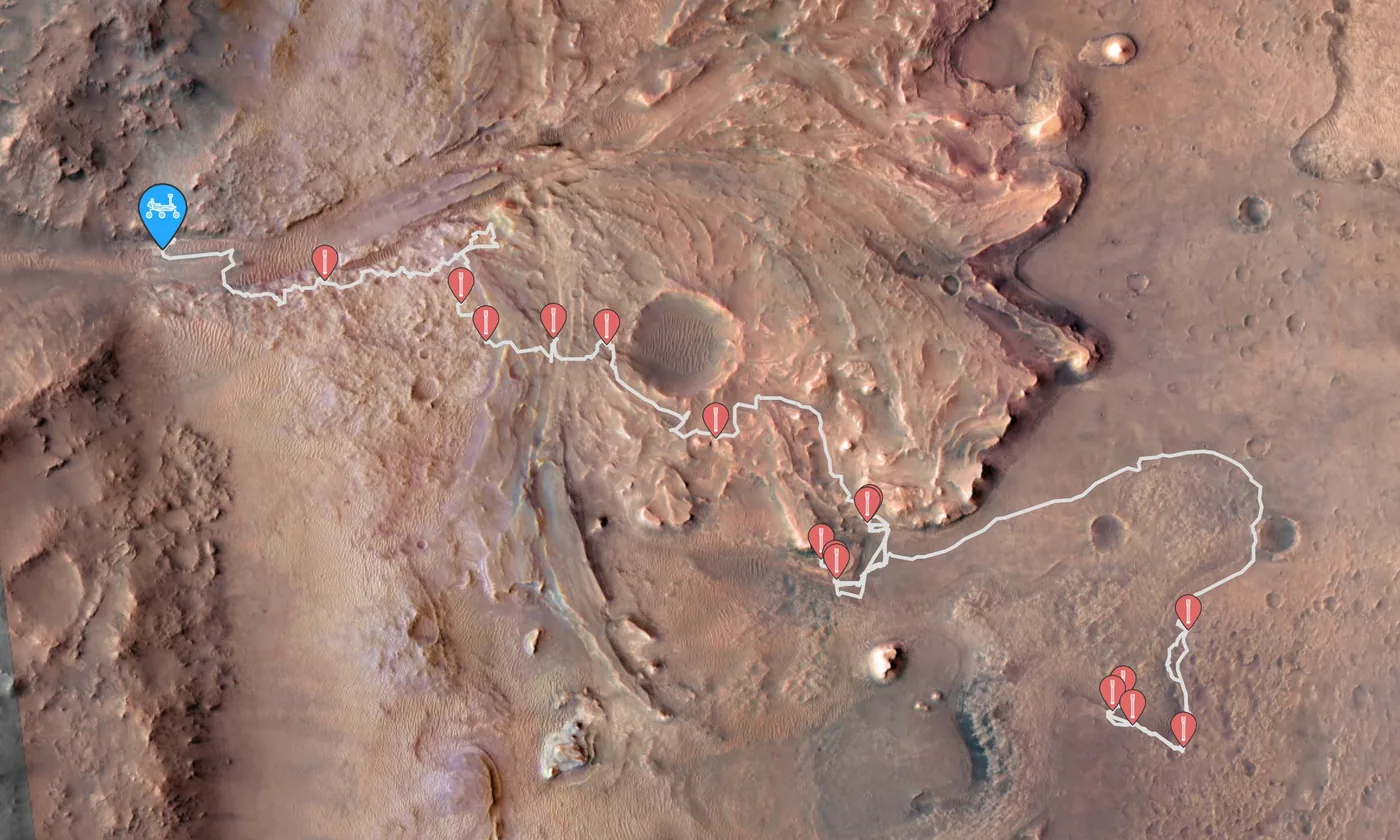
How far can a robotic explorer travel on another world? On October 11, 2026, the rover’s odometer passed 28.10 miles (45.22 kilometers), logging sol 2,006 of surface operations. The rover set an off-world distance record on Mars after passing 28 miles of driving. It eclipsed the previous record of 28.06 miles (45.16 kilometers) held by NASA’s Opportunity rover, which explored Mars from 2004 to 2018. Perseverance covered that mileage in about five and a half years, demonstrating the speed of autonomous navigation algorithms [1, 3, 6].
The traverse pushed through several geologic terrains in Jezero, beginning on the crater floor before winding along the ancient delta front at Three Forks and entering Neretva Vallis. Drivers later steered the vehicle through boulder fields and up toward the northern rim of the crater to explore impact rocks thrown upward 3.9 billion years ago. Cameras recorded wide panoramas of Turquoise Bay along the inner margin of the crater. During early operations, the diminutive Ingenuity helicopter, led by project manager MiMi Aung, flew ahead as an aerial scout, completing 72 flights before retiring in 2024. In feats compared to the Wright Brothers, Ingenuity proved powered flight on another planet [3, 6, 10].
During its traverse in July 2024, the rover drilled a rock nicknamed Cheyava Falls within the ancient river valley, extracting a core sample labeled Sapphire Canyon. Laboratory analysis showed organic molecules and chemical textures that formed under ancient liquid water conditions. In September 2025, after a yearlong peer review, the scientific journal Nature published the team’s findings confirming the sample contains potential biosignatures. Katie Stack Morgan, deputy project scientist at JPL, emphasized that returned samples allow Earth laboratories to test for life with technologies that do not exist today [3, 10, 11].
Psychological Roots and Cultural Namesakes
Outside planetary exploration, perseverance defines an enduring human quality involving steadfast effort for long-term goals despite obstacles, setbacks, and recurring frustration. Angela Duckworth from the University of Pennsylvania popularized the concept of grit, defining it as passion paired with sustained perseverance. Her research showed that disciplined perseverance predicts career success more reliably than talent alone [13].
Philosophers and developmental psychologists have analyzed how individuals maintain perseverance when facing demanding cognitive tasks. Philosopher Heather Battaly described intellectual perseverance as a virtue positioned between the deficiency of premature surrender and the excess of stubborn recalcitrance. In a developmental study published in Child Development, researchers documented the Batman effect, showing that young children who impersonate an exemplar hero work significantly longer on repetitive tasks without giving up [13]. Self-distancing strategies help individuals regulate frustration and maintain effort during complex problems. Sustained focus enables long-term mastery.
The name also carries historical resonance in music and naval history. In heavy metal music, The Sound of Perseverance was the 1998 final studio album released by American band Death on Nuclear Blast. Singer and guitarist Chuck Schuldiner led the group alongside guitarist Shannon Hamm, drummer Richard Christy, and bassist Scott Clendenin. AllMusic reviewer Jason Hundey praised the album as a high point in heavy metal. In naval history, the British Royal Navy commissioned three warships named HMS Perseverance, beginning in 1781 with a fifth-rate vessel outfitted with 35 guns. Later vessels included a wooden screw discovery sloop abandoned in the Arctic in 1854 and an iron screw troopship purchased in 1854 [14, 15, 17].
- WEBSITE NASA Science. (2024). Perseverance Rover Location Map. NASA. [Article Link]
- PRESS RELEASE NASA. (2021). Touchdown! NASA’s Mars Perseverance Rover Safely Lands on Red Planet. NASA. [Article Link]
- WEBSITE NASA Science. (2026). Mars 2020: Perseverance Rover. NASA Science. [Article Link]
- WEBSITE NASA Science. (2024). Perseverance Rover Components. NASA Science. [Article Link]
- PRESS RELEASE NASA. (2020). The Extraordinary Sample-Gathering System of NASA’s Perseverance Mars Rover. Jet Propulsion Laboratory. [Article Link]
- WEBSITE NASA Science. (2023). Mars 2020: Perseverance Rover News & Features. NASA Science. [Article Link]
- PRESS RELEASE NASA. (2021). NASA’s Perseverance Mars Rover Extracts First Oxygen from Red Planet. NASA. [Article Link]
- ACADEMIC JOURNAL Hecht, M., Hoffman, J., Rapp, D., McClean, J., SooHoo, J., Schaefer, R., & the MOXIE Team. (2021). Mars Oxygen ISRU Experiment (MOXIE). Space Science Reviews. [Article Link]
- ACADEMIC JOURNAL Allwood, A. C., Wade, L. A., Foote, M. C., Elam, W. T., Hurowitz, J. A., & the PIXL Team. (2020). PIXL: Planetary Instrument for X-Ray Lithochemistry. Space Science Reviews. [Article Link]
- WEBSITE Wikipedia contributors. (2026). Perseverance (rover). Wikipedia. [Article Link]
- ONLINE NEWS Drake, N. (2020). NASA’s Perseverance rover launches on mission to find life on Mars. National Geographic. [Article Link]
- ONLINE NEWS Kooser, A. (2020). Meet the NASA Perseverance Mars rover’s Earth doppelgänger, Optimism. CNET. [Article Link]
- ACADEMIC JOURNAL Shukla, S. (2017). Grit: The Power of Passion and Perseverance. Harvard Educational Review. [Article Link]
- ONLINE NEWS Meyer, M. (2021). Biddeford company creates critical part for Mars rover ‘Perseverance’ to land safely. WGME. [Article Link]
- WEBSITE Wikipedia contributors. (2026). The Sound of Perseverance. Wikipedia. [Article Link]
- WEBSITE Wikipedia contributors. (2026). HMS Perseverance. Wikipedia. [Article Link]


