





Proof of stake (PoS) is a blockchain consensus mechanism that selects block proposers in proportion to their committed cryptocurrency holdings, not their ability to solve math puzzles. The design emerged to solve the heavy energy use of earlier proof of work (PoW) setups, where miners run hardware all day to compete for coin rewards. Bitcoin started the PoW approach in 2009 [9]. Later, developers launched Peercoin in 2012 as the first working model of a stake alternative to resist Sybil attacks without running mining farms [11]. Today, networks like Cardano, Solana, Tezos, Avalanche, and Ethereum use economic bonds to secure billions in transfers without industrial mining operations [9].
How Proof of Stake Works
Proof of stake works by assigning block verification duties to bonded validators who lock native cryptocurrency tokens into a network deposit contract, allowing a deterministic algorithm to pick proposers who bundle valid transfers into blocks [11]. Garrick Hileman said that stakers vote to approve legitimate transfers and earn newly minted cryptocurrency over time as compensation for securing the ledger [9]. Honest nodes earn protocol yield. Dropping offline causes small inactivity penalties. This setup links financial self-interest with network health, so nodes lose more from attacking the chain than they could gain through fraud [2].
Standard PoW networks demand graphics cards or ASIC hardware to solve repetitive hash puzzles [9]. Bitcoin, Dogecoin, Bitcoin Cash, and Litecoin rely on this competitive thermodynamic approach. In contrast, PoS replaces hardware races with capital at risk, letting regular computers validate blocks without purchasing racks of specialized mining hardware or burning industrial amounts of electricity [1]. Because participants commit monetary value instead of physical machines, energy consumption remains low across all network nodes. The Ethereum Foundation transitioned away from proof of work to eliminate this computational overhead [7].
Researchers Riposo and Gupta built a formal math model showing that staker returns equal the ratio of average validation gains to total staked coins [11]. Staking yields reflect penalties like slashing and priority tips from Maximal Extractable Value (MEV). When user activity climbs, block proposers collect extra fee tips, which lifts overall annual yield without burning more grid power [7]. Token holders in Blackcoin, Nxt, and Algorand also adopted variations of this deposit-driven security model to maintain trust without computational waste [11].
Proof of Stake Validator Economics
Validators need enough capital to clear the protocol deposit floor before proposing blocks on the network. Running an independent node on Ethereum needs 32 ETH of staked Ether, worth about $41,416 during the 2022 network transition [10]. This deposit remains locked within the protocol while the validator stays active. Stakers who own less than 32 ETH pool funds in liquid staking protocols, letting small holders earn yield alongside institutional capital [11].
Protocol rewards must stay balanced to keep the network stable over long operational horizons. In the Review of Financial Studies, economist Saleh created the first formal economic model showing that modest reward schedules build quick consensus and stop ongoing chain forks. Saleh showed that because validators own the native coin, they lose wealth if their actions harm ledger trust. Unlike PoW miners who point GPU rigs at Bitcoin Cash or Dogecoin when one chain stumbles, PoS stakers cannot move locked coins away from host chain risks [2]. When crypto markets drop, validators keep protecting the ledger because their own assets are locked inside the system.
Ethereum stakers route fee tips to a chosen fee recipient address to capture unburnt gas priority payments. Skipping this configuration forfeits MEV revenue. The node still produces blocks. Staking APR shifts dynamically with the total pool of locked tokens, dropping annual yields when staking participation expands and raising returns when capital leaves the network [7].
The Beacon Chain Transition
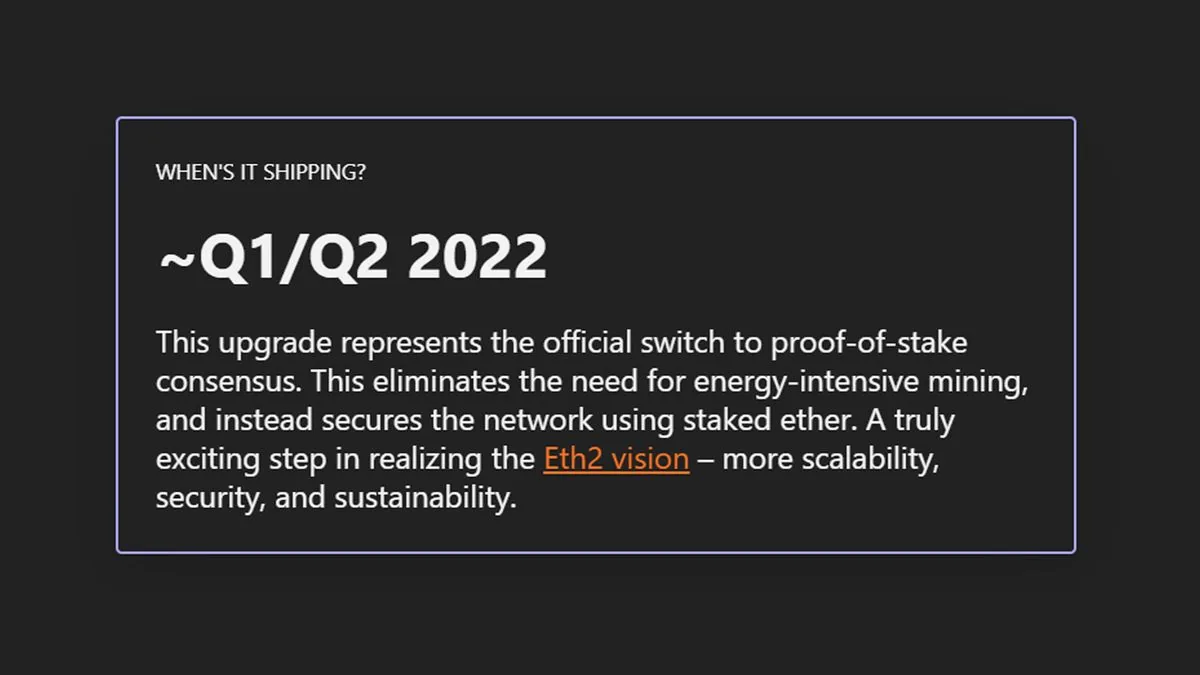
Ethereum Mainnet ran on PoW from its launch in July 2015 until developers finished the consensus upgrade called The Merge. Because an active chain holding billions in decentralized finance carried big operational disruption risks, engineers launched the Beacon Chain on Dec. 1, 2020. The Beacon Chain ran in parallel for nearly two years, organizing active validators and checking account balances while Ethereum Mainnet processed transfers with graphics cards. During this trial run, the Beacon Chain reached agreement on its own state without touching user wallet balances on Mainnet [7].
The main upgrade happened on September 15, 2022. Ethereum Mainnet joined the Beacon Chain, permanently ending computational mining across the network [10]. Katie Wickens wrote for PC Gamer that scheduling delays pushed The Merge into 2022 while miners competed for desktop gaming GPUs like the Nvidia RTX 3070 and AMD RX 6700 XT [5]. Vitalik Buterin and Ethereum developers compared the event to swapping a spaceship engine mid-flight, keeping all past ledger history intact without requiring users to exchange old tokens for new assets [7].

Node operators must run an execution client like Geth, Erigon, Besu, or Nethermind and a consensus client to process blocks. Both client programs talk over the Engine API using a shared JWT secret to protect communication between the layers. Tim Beiko said the transition reshaped Ethereum application logic, while normal consumer laptops with 4 TB of storage can still verify every block without staking money [7].
Why Proof of Stake Cuts Energy Use
Proof of stake cuts energy use by replacing non-stop hash math with lightweight digital signatures, unlike proof of work where mining rigs test trillions of solutions every second to turn electricity into ledger defense [1]. Slots arrive every 12 seconds. Nodes simply wait for their scheduled turn to propose or verify incoming blocks [7]. Vitalik Buterin said at the StartmeupHK event in Hong Kong that shifting to PoS could cut crypto energy use by a factor of 100 or even 10,000. Concerns over fossil fuel use by miners also grew when Tesla CEO Elon Musk paused Bitcoin vehicle purchases, while Buterin donated 50 trillion Shiba Inu tokens to an India relief fund [8].
A study by Moritz Platt, Johannes Sedlmeir, Jiahua Xu, Nikhil Vadgama, Juan Ignacio Ibañez, and Paolo Tasca at the University of London found that Bitcoin uses at least 1,000 times more power than analyzed PoS networks [1]. After Ethereum completed The Merge, Cointelegraph reported that network power demand dropped by more than 99.9%, falling from 46.31 to 93.98 terawatt-hours per year down to small levels. Digiconomist data showed a single Ethereum transfer uses about 0.03 kilowatt-hours, creating a carbon footprint of 0.01 kilograms of carbon dioxide [10]. That matches the power used watching two hours of YouTube videos.
Annual Ethereum carbon emissions fell to 0.1 million tonnes of carbon dioxide after abandoning graphics card mining [10]. The Ethereum Foundation said the network uses about 2.62 megawatts, matching the power needs of 2,100 American homes. In contrast, China State Council regulators acted against crypto mining farms after finding coal plants were burning heavy fuel to power regional mining hardware [8].


Slashing and the Nothing at Stake Problem
Early stake protocols fought the nothing at stake problem, where stakers had economic motives to vote on rival blockchain branches at the same time. In PoW, splitting mining power between two chains halves hash output on each branch, creating a natural thermodynamic cost against dishonest behavior. In early PoS setups, signing an alternate block cost no electricity, so validators voted on every fork to harvest transaction fees without capital risk or fear of financial penalty [11]. If an attacker launched a double-spend attempt, validators could sign both chains without buying extra hardware. Protocol designers had to create penalties that make signing rival blocks expensive [2].
Modern chains stop this attack with automatic slashing rules that burn deposited coins when misbehavior is detected. Catherine Mulligan from Imperial College London said validators face slashing if they approve bad blocks or sign conflicting transactions in one slot, directly endangering their bonded assets [9]. Protocols like Casper FFG and Tendermint build economic finality by punishing conflicting votes, making dishonest acts destroy the validator’s own capital. Chains like Tezos, EOS, Lisk, and Tron deploy variants of this penalty model to deter malicious forks [11].
Ethereum groups 32 slots into epochs lasting 6.4 minutes. Two-thirds of stakers must justify consecutive epochs to achieve finality. Reversing a finalized block needs burning more than one-third of all staked Ether on the network, making attacks economically impossible for rational actors who value their deposited assets [7].

Delegated Elections Under Sequential Phragmén
Networks need fair voting methods to spread staked tokens among active block producers without centralizing control. Polkadot and Kusama run Nominated Proof of Stake (NPoS) using the sequential Phragmén method, an approval voting algorithm formulated by Swedish mathematician Edvard Phragmén during the 1890s to elect representatives fairly. Brill studied this method in Phragmén’s Voting Methods and Justified Representation, showing how multi-winner voting balances seat weights [6]. Polkadot uses it to balance nominator votes among elected validators.
The Phragmén election algorithm balances three distinct targets: maximizing total stake, maximizing the stake behind the lowest-backed validator, and minimizing stake variance among winners. Because solving this graph problem takes heavy computation, Polkadot offloads the election calculation to off-chain workers. This division keeps a firm six-second block time and prevents transaction slowdowns at the end of staking eras. Staking Miners submit election graphs, and the protocol picks solutions where voter ballots carry the lowest average load in sequential election rounds [6]. Other chains use Ouroboros Praos or BABE to elect block producers through verifiable random functions [11].
Enterprise server clusters rely on the Raft consensus algorithm to synchronize state across trusted machines. Parity Technologies co-founder Gavin Wood helped formalize decentralized network architectures to solve governance scaling [12]. In open blockchains, weighted Phragmén voting stops Sybil attackers from creating fake accounts to hijack council seats or validator slots, keeping minority voter preferences alive [6].
Long-Range Network Attack Vectors
A key risk in stake consensus is the long-range attack, where attackers buy old private keys from past stakers to rewrite history from the genesis block without spending thermodynamic energy [3]. Because making blocks costs almost no power, an attacker can build an alternate ledger in seconds that looks valid to new nodes [11]. This cheap simulation contrasts with PoW chains, where rewriting past blocks takes months of heavy computation. Without defense, an attacker could build a secret fork and fool newly synced clients [3].
In IEEE Access, researchers Deirmentzoglou, Papakyriakopoulos, and Patsakis studied alternate history risks and outlined core defenses. They said that nodes must use weak subjectivity checkpoints, fetching trusted state hashes from external sources instead of syncing unchecked from genesis when joining the network after long offline periods [3]. Nguyen, Dutkiewicz, and their co-authors added that forward-secure signatures and key erasure prevent old keys from signing past blocks if compromised [4].
Ethereum limits daily validator exits to about 0.33% of total staked Ether. Churn limits stop attackers from committing a slashable fraud and pulling out coins before the protocol can detect the crime and burn their bonded assets during subsequent withdrawal epochs. The Shanghai and Capella upgrades introduced orderly withdrawals [7].
Centralization Concerns and Regulatory Scrutiny
Even with clear power savings, critics warn that PoS helps rich token holders grow richer over time [9, 11]. Wealthy stakers collect steady rewards. That gives them growing say over protocol upgrades. Cointelegraph reported that right after The Merge, 46.15% of block-producing Ethereum nodes belonged to just two addresses, sparking debate about censorship resistance [10].
Regulators in the United States and Europe closely watch staking yields across crypto platforms. The Securities and Exchange Commission argued that staking yields act like interest on securities, though the SEC allowed spot Ethereum funds in 2024 if they avoided staking. That decision cost funds about 3% in yearly staking yields. At the time, Ethereum had 27% of its coin supply staked, while Cardano reached 66% and Solana reached 63%. Erik Thedéen from the European Securities and Markets Authority called for Europe to favor PoS over PoW to cut energy use [11].
The end of Ethereum GPU mining released retail graphics cards, leaving fast models like RTX 50 GPUs for software creators and PC gamers [5]. In Proof of Personhood research, Borge and other scholars evaluated the PGP Web of Trust and Apple Secure Enclave biometric architectures to verify real human users. Alternative systems explore Gavin Wood’s proof of authority in VeChain, Bitgert, and Palm Network, or proof of personhood to counter wealth concentration [12, 13].
- ACADEMIC JOURNAL Platt, M., Sedlmeir, J., Platt, D., Xu, J., Tasca, P., Vadgama, N., & Ibañez, J. I. (2021). The Energy Footprint of Blockchain Consensus Mechanisms Beyond Proof-of-Work. IEEE International Conference on Software Quality, Reliability and Security Companion (QRS-C). [Article Link]
- ACADEMIC JOURNAL Saleh, F. (2020). Blockchain without Waste: Proof-of-Stake. Review of Financial Studies, 34(3), 1156-1190. [Article Link]
- ACADEMIC JOURNAL Deirmentzoglou, E. A., Papakyriakopoulos, G., & Patsakis, C. (2019). A Survey on Long-Range Attacks for Proof of Stake Protocols. IEEE Access, 7, 28712-28725. [Article Link]
- ACADEMIC JOURNAL Nguyen, C. T., Hoang, D. T., Nguyen, D. N., Niyato, D. T., Nguyen, H. T., & Dutkiewicz, E. (2019). Proof-of-Stake Consensus Mechanisms for Future Blockchain Networks: Fundamentals, Applications and Opportunities. IEEE Access, 7, 85727-85745. [Article Link]
- ONLINE NEWS Wickens, K. (2021). ‘The Merge’ to end cryptocurrency mining on gaming GPUs won’t come until 2022. PC Gamer. [Article Link]
- WEBSITE Polkadot Wiki. (2025). NPoS Election Algorithms. wiki.polkadot.com. [Article Link]
- WEBSITE Ethereum Foundation. (2026). The Merge. ethereum.org. [Article Link]
- ONLINE NEWS Lau, Y. (2021). Ethereum founder Vitalik Buterin says long-awaited shift to ‘proof-of-stake’ could solve environmental woes. Fortune. [Article Link]
- ONLINE NEWS Campbell, T., & Chandler, S. (2024). Proof of Work vs. Proof of Stake: Comparing blockchain consensus. Business Insider. [Article Link]
- ONLINE NEWS Sarkar, A. (2022). The Merge brings down Ethereum’s network power consumption by over 99.9%. Cointelegraph. [Article Link]
- WEBSITE Wikipedia. (2026). Proof of stake. Wikipedia. [Article Link]
- WEBSITE Wikipedia. (2026). Proof of authority. Wikipedia. [Article Link]
- WEBSITE Wikipedia. (2026). Proof of personhood. Wikipedia. [Article Link]


