



Can directional shifts in starlight reveal cosmic distance and galaxy expansion? In observational astrophysics, radial velocity measures the precise velocity component of a celestial target moving directly along an observer’s line of sight. When distant stellar sources move toward or away from Earth, emitted spectral lines shift systematically toward blue frequencies or red wavelengths. Mount Wilson Observatory astronomer Milton Humason demonstrated this observational power in 1929 by recording an unprecedented velocity of +3779 km/s from nebula NGC 7619 [1].
What Is Radial Velocity?
Radial velocity defines the speed at which an astronomical body recedes from or approaches an observer along the direct line of sight. Because spatial trajectories across the universe rarely align flat against an observer’s focal plane, researchers divide total motion into tangential velocity across the sky and line-of-sight velocity toward terrestrial detectors. Mount Wilson Observatory researchers demonstrated how the Doppler effect shifts characteristic spectral absorption lines toward redder, longer wavelengths. Approaching sources produce negative velocities [1].
Spectroscopic line shifts supply vital kinematic coordinates that imaging surveys alone cannot recover. Measuring these subtle wavelength displacements permits researchers to map structural dynamics across binary star orbits, expanding nebulae, and galactic clusters. Line-of-sight velocity differs from proper motion, which tracks angular displacement across the celestial sphere over decades. In high-energy astrophysics, comparing line-of-sight speeds with transverse outflows clarifies how compact objects release matter, echoing inquiries into relativistic jets in microquasars. Mount Wilson Observatory astronomers established that line-of-sight kinematics provides a bedrock diagnostic across observational cosmology [1].
Astronomers rely on systematic wavelength calibration to separate intrinsic stellar Doppler shifts from laboratory instrument drift. Spectrograph VI provided stable dispersion [1].
How Is Radial Velocity Calculated?
Astronomers calculate radial velocity by dividing the measured wavelength displacement of a spectral line by its rest wavelength and multiplying that value by the speed of light. In non-relativistic regimes where velocities remain small compared to the speed of light, this Doppler formula yields accurate kinematic measurements for stellar targets. Observers compare observed nebular absorption lines against stationary reference spectra generated by Mount Wilson Observatory arc lamps inside the telescope dome. Dual prisms dispersed incoming starlight [1].
Instrument design directly dictates the measurement precision achievable on faint astronomical targets. When Milton Humason mounted Cassegrain spectrograph VI on the 100-inch telescope at Mount Wilson Observatory, the optical assembly featured a 24-inch collimator, two prisms, and an attached 3-inch camera. Mount Wilson Observatory recorded a dispersion of 183 Angstroms per millimeter at 4500 Angstroms, spreading spectral features across photographic plates so that subtle line displacements could be measured under a microscope. Higher dispersion demands longer exposure times to record faint nebular absorption features [1].
Line profile broadening complicates exact displacement calculations when evaluating composite stellar systems. In unresolved nebulae, absorption lines often appear wide, shallow, and diffuse rather than sharply etched. In Proceedings of the National Academy of Sciences, Milton Humason noted that spectra of distant nebulae resemble composite Milky Way clouds in Sagittarius and Cygnus, as well as contact binary stars of the W Ursae Majoris type where rapid stellar rotation broadens spectral lines. Carnegie Institution astronomers noted that velocity dispersion among thousands of constituent stars in a nebular core blends differing spectral types into a single diffuse absorption band [1].
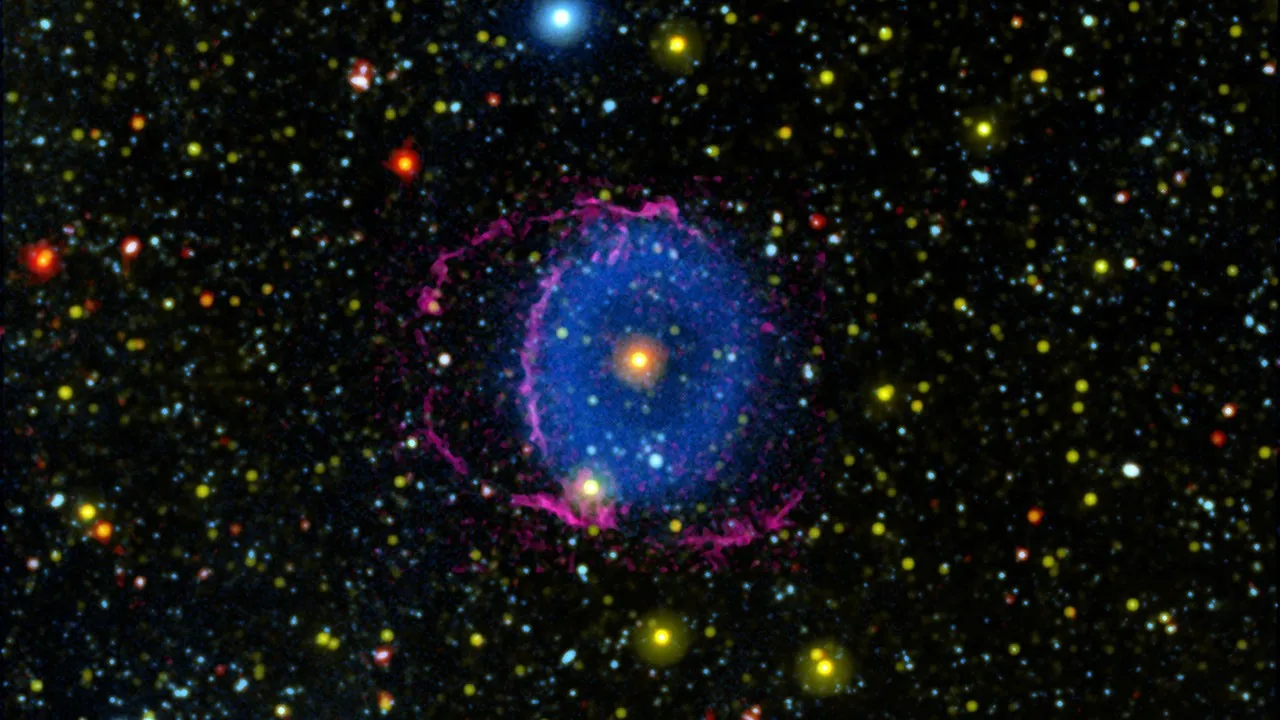
Milton Humason Observed NGC 7619 at Mount Wilson
Edwin Hubble suggested that Mount Wilson Observatory astronomers compile a targeted list of fainter, more distant extragalactic nebulae to evaluate cosmological theory. Hubble aimed to test whether absorption lines in remote nebulae displayed large displacements toward longer wavelengths, a phenomenon anticipated under de Sitter’s theory of curved space-time. Milton Humason selected NGC 7619, a globular nebula situated in a cluster of small spiral, globular, and elongated nebulae centered near coordinates R. A. 23h 16m and Dec. +7 degrees 50 minutes (1920 epoch). Visually examined at the Cassegrain focus of the 100-inch telescope, NGC 7619 appeared slightly brighter than neighboring nebula NGC 7626 [1].
Securing readable spectrograms of NGC 7619 required immense observational stamina under California skies. At Mount Wilson Observatory, Milton Humason collected two spectrograms of the nebula using Cassegrain spectrograph VI. Humason recorded 33 exposure hours. Miss MacCormack of the computing division joined Humason to measure the resulting photographic plates. The 33-hour exposure plate yielded an apparent velocity of +3828 km/s, whereas the 45-hour plate produced +3754 km/s. The 45-hour plate received double weight [1].
Combining these two photographic plates yielded a weighted mean velocity of +3779 km/s. Milton Humason classified the spectral type of NGC 7619 as F8 and estimated the probable measurement error to be no greater than 100 km/s. Although the poor definition of absorption lines contributed to observational uncertainty, the probable error remained small compared to the displacement observed. Carnegie Institution astronomers recognized the reliability of these measurements [1].


Spectroscopic Redshifts Confirmed the Expanding Universe
The measured velocity of +3779 km/s for NGC 7619 astounded the international astronomical community. This velocity was twice as large as any radial velocity previously recorded in astronomical history, dramatically exceeding the prior record of +1800 km/s obtained by Vesto Slipher for NGC 584. Slipher recorded 1800 km/s. In a companion paper published in the Proceedings of the National Academy of Sciences, Edwin Hubble presented approximate distances for 24 extragalactic nebulae and demonstrated a marked increase in radial velocity with distance. Hubble analyzed 24 extragalactic nebulae. The velocity derived for NGC 7619 fell precisely on Hubble’s line relating spectral displacement directly to distance [1].
This empirical alignment provided pivotal observational validation for Willem de Sitter’s relativistic cosmological models. Theorists linked this displacement to cosmological redshift, considering whether light vibrations slow across expansive distances or whether physical matter tends to disperse across space. The NGC 7619 observation transformed radial velocity from a localized kinematic tool into an indispensable cosmological ruler. Rather than drifting randomly within a static void, extragalactic nebulae were systematically receding from one another at rates proportional to their spatial separation [1].
Humason’s Mount Wilson Observatory spectrograms transformed nebular astrophysics into quantitative cosmology. Observers recognized that mapping additional distant clusters would solidify the velocity-distance relationship, laying the empirical groundwork for modern cosmological expansion models. The Carnegie Institution of Washington supported subsequent spectrographic campaigns, enabling Mount Wilson astronomers to probe deeper cosmic horizons. Systematic spectroscopy opened remote cosmic horizons [1].

Radial Velocity Method Detects Distant Exoplanets
Decades after unlocking cosmic expansion, the radial velocity method found transformative new applications in stellar astronomy by enabling the detection of alien planetary systems. In a 2026 preprint published on the arXiv repository (astro-ph.EP), which has not yet undergone formal peer review, astrophysicists Rafael Luque and Matthew Standing provide a comprehensive review of exoplanet detection techniques using radial velocity measurements. The radial velocity method enabled astronomers to discover the first exoplanets orbiting Sun-like stars by tracking periodic Doppler wobbles induced in a star by an orbiting companion. Precision spectrographs track stellar wobbles [2].
Through continuous refinements in instrument precision and spectrographic sensitivity, observers have expanded the planetary census beyond 2,000 confirmed exoplanets detected via the radial velocity technique. While transit surveys detect planets only when orbital planes cross an observer’s line of sight, the radial velocity method measures Keplerian reflex motion directly, providing critical constraints on minimum planetary mass, especially at long orbital distances. Rafael Luque and Matthew Standing demonstrate that detecting small signals from Earth analogs requires overcoming stellar activity jitter and instrumental systematic noise. Circumbinary planet surveys also benefit from high-resolution spectrographs [2].
To illustrate practical applications, Rafael Luque and Matthew Standing analyze three publicly available radial velocity datasets: a single star, a circumbinary planet system, and a single star hosting transiting exoplanets. Luque and Standing evaluated spectrographs. Their Supplementary Material provides a sample telescope observation proposal and practical guidance to assist early-career researchers entering exoplanetary astrophysics. Rafael Luque and Matthew Standing documented open-source tools [2].
Gas Kinematics and Metallicity Gradients in NGC 3344
Beyond stellar wobbles and cosmic expansion, radial velocities also reveal how gas circulation drives the internal chemical evolution and physical growth of spiral galaxies. In a 2026 preprint submitted to arXiv (astro-ph.GA), which has not undergone peer review, Alejandro Olvera from Cornell University, Sanchayeeta Borthakur, Enrico Teodoro, Kanak Saha, Mansi Padave, Hansung Gim, and Emmanuel Momjian investigate the extended ultraviolet disk of galaxy NGC 3344 as part of the DIISC-VII initiative. The research team observed neutral hydrogen gas kinematics with the Very Large Array using high-resolution 21cm radio maps, while MMT multi-slit optical spectra measured gas-phase metallicity across 76 regions. MMT spectroscopy evaluated 76 regions [3].
Their spectroscopic analysis revealed a negative radial metallicity gradient of -0.378 dex R_25^-1 across NGC 3344. Regions in the outer extended ultraviolet disk exhibited twice the metallicity scatter of inner disk zones, with several outer pockets displaying anomalously low metal abundances. By modeling neutral hydrogen as tilted concentric rings using the 3DBarolo kinematic software, Alejandro Olvera and colleagues determined that neutral gas moves radially inward across the extended ultraviolet disk at an average radial velocity of 6 km/s. Inward flows average 6 km/s [3].
This inward radial gas flow fuels outer disk star formation while diluting interstellar gas with pristine, metal-poor material. These kinematic flows resemble infall processes seen in localized stellar nurseries, such as early protostellar accretion in Perseus, illustrating how gas transport shapes structure across multiple cosmic scales. Chemical evolution models confirmed that gas fraction, effective yield, and mass-loading factor profiles become disrupted at the extended ultraviolet disk boundary. The DIISC-VII findings deliver the first direct kinematic detection linking radial gas flows to stellar disk expansion and inside-out galaxy growth [3].
- WEBSITE Stoltz, J. (2026, September 25). The Large Radial Velocity of NGC 7619. NASA Science. [Article Link]
- PREPRINT Luque, R., & Standing, M. R. (2026). Exoplanet Detection Techniques: Radial Velocity. arXiv. [Article Link]
- PREPRINT Olvera, A. J., Borthakur, S., Di Teodoro, E. M., Saha, K., Padave, M., Gim, H. B., & Momjian, E. (2026). DIISC-VII: Linking Radial Gas Motions to Anomalously Low Metallicity Star-forming Regions in the XUV Disk of NGC 3344. arXiv. [Article Link]
APA 7: PerEXP Teamworks. (2026, September 25). How Radial Velocity Measurements Map Galaxy Expansion. PerEXP Teamworks. https://perexpteamworks.com/en/radial-velocity-measurements-galaxy-expansion/


