





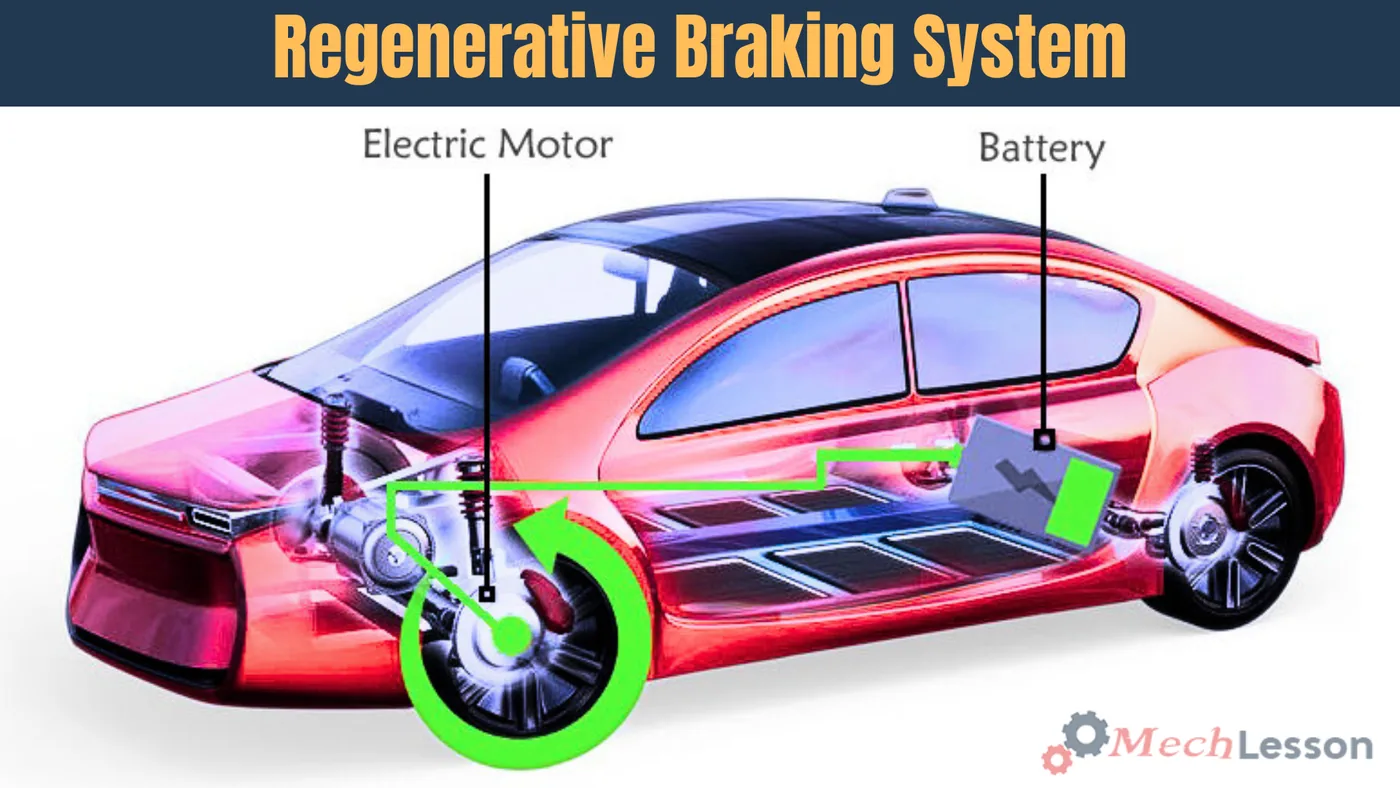
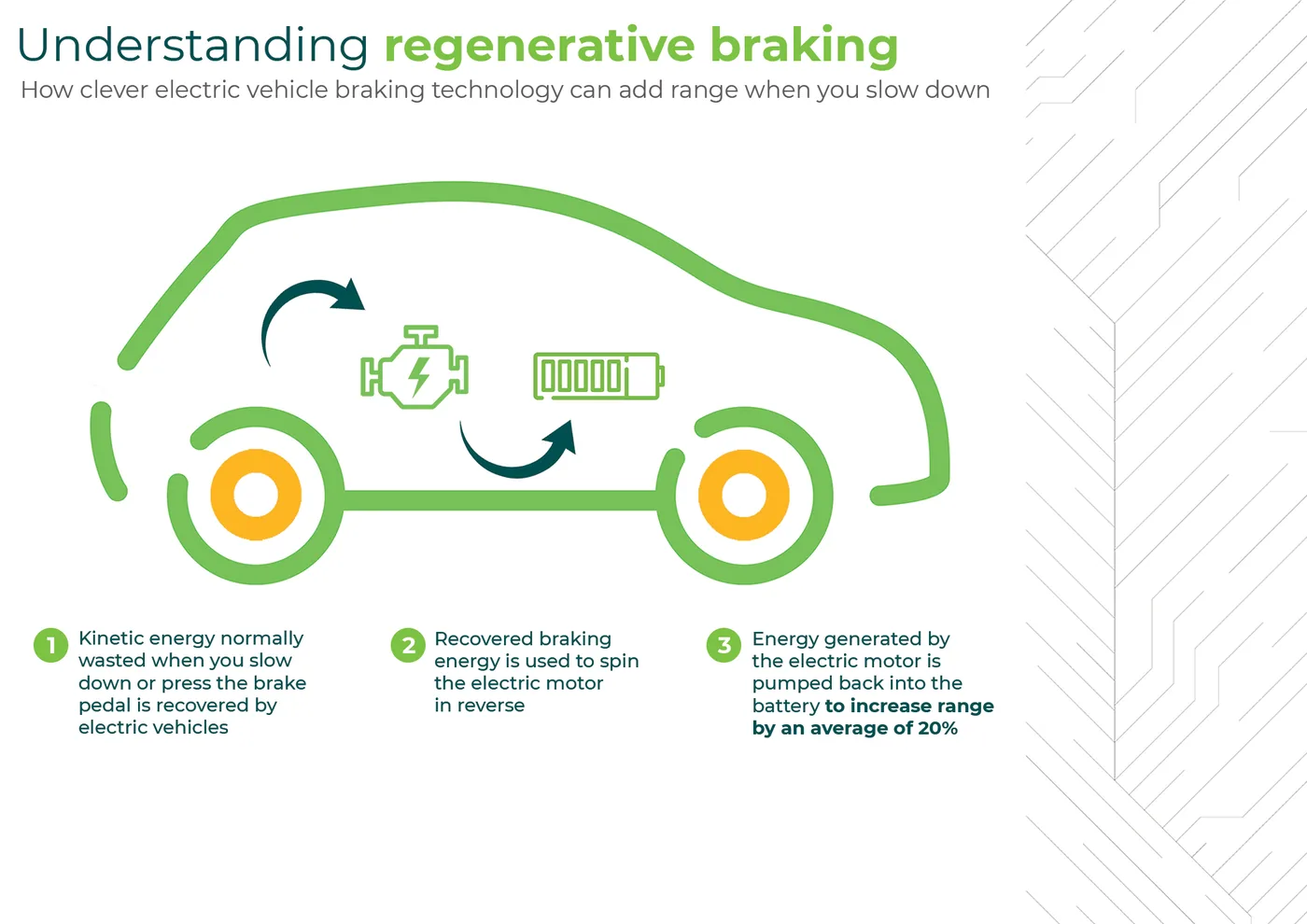
Electric cars slow down differently than gasoline cars because their drivetrains rely on regenerative braking to recover energy that would otherwise turn into waste heat. Instead of depending only on friction pads clamping against spinning discs, an electrified powertrain uses its electric drive motor to capture motion as the car decelerates. The motor flips into an electric generator, routing electric current back into the battery pack while creating resistance that slows the wheels. Drivers in models like the Nissan Leaf and Tesla Model Y notice this deceleration upon easing off the throttle pedal, and the recovered power extends overall driving range while cutting wear on standard brake hardware [2].
The Core Physics of Deceleration
Every moving vehicle carries kinetic energy. That energy grows with the square of vehicle speed. When a driver presses the brake pedal in a gasoline car, hydraulic pressure clamps composite pads against spinning steel rotors. Friction between these contact surfaces turns rolling motion into heat that dissipates into surrounding air as wasted energy, providing zero returned power to the fuel tank [1].
Energy recovery systems rely on the physical principle of the conservation of energy, which states that energy can’t be created or destroyed, but changes from one form to another. Electrified powertrains redirect spinning wheel momentum into usable electric power. Commuter models like the Toyota Prius and Ford F-150 Lightning encounter hundreds of stop cycles across suburban commutes, where capturing deceleration momentum significantly raises overall travel efficiency across repeated stops [3].
Kinetic energy equals half of vehicle mass multiplied by velocity squared. Because speed is squared in this physical equation, doubling travel pace quadruples the amount of kinetic energy stored in the rolling chassis. Deceleration from highway speeds of 70 miles per hour gives an electric car an opportunity to harvest greater power per second than neighborhood crawling. In heavy city traffic, frequent stops give vehicles like the Tesla Model Y and Rivian R1T dozens of chances to reclaim smaller packets of electricity that accumulate over a full commute. Independent road tests confirm that urban driving environments provide the highest net percentage of recaptured power because stopping events occur repeatedly at intersections along the daily commute [1].
How Electric Motors Switch to Generators
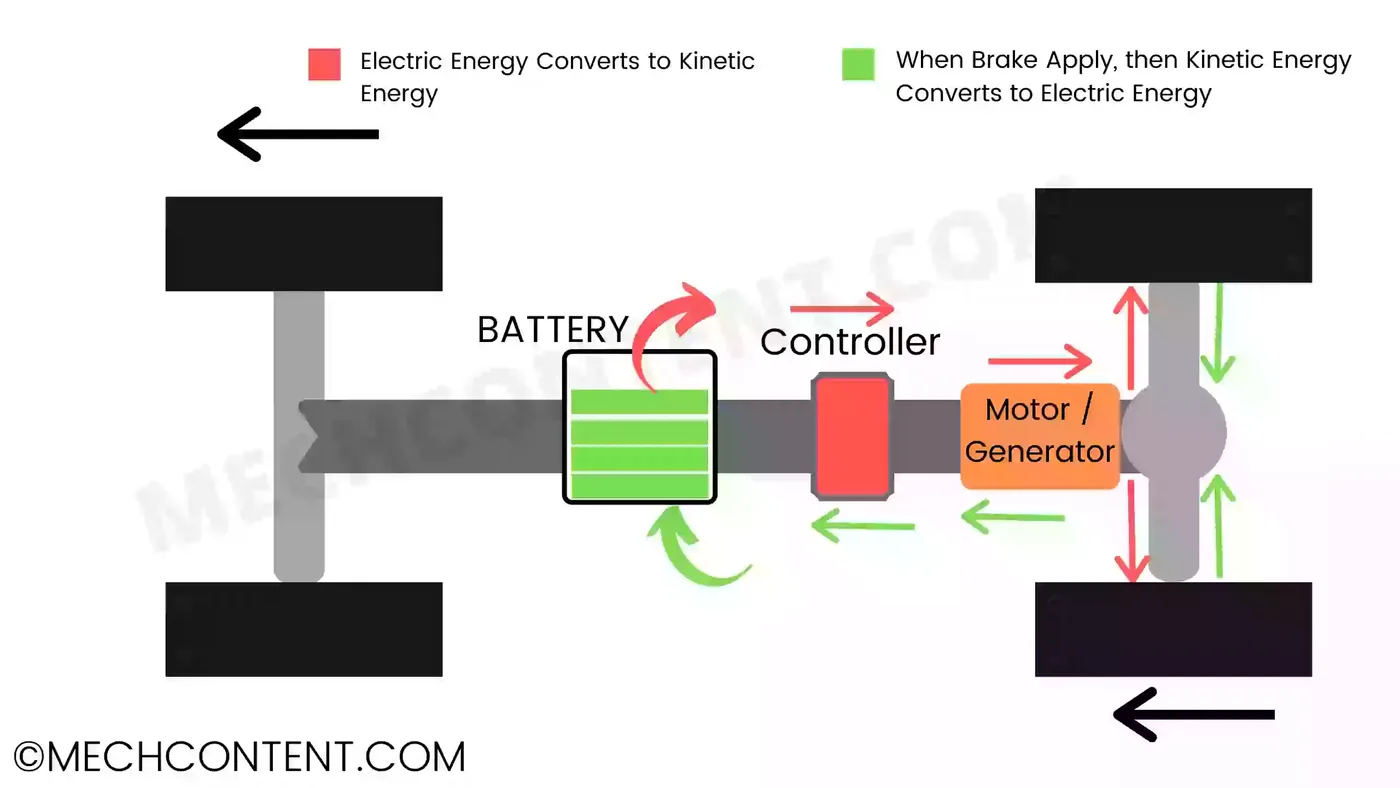
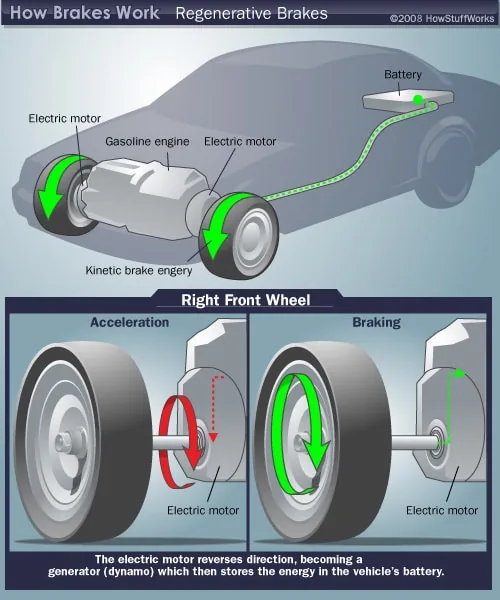
An electric motor and an electric generator share the same architecture of copper coils and magnets. When a battery feeds current through an inverter into stator windings, it creates a magnetic field that forces the rotor to turn the drive axles. Cutting off that power supply allows the rolling wheels to spin the rotor within the magnetic field, transforming the traction motor into an electrical generator that feeds high-voltage current back to the vehicle electronics [3].
This functional switch relies on an electromagnetic reaction known as back electromotive force, or back EMF. As the rotor spins inside the stator coils without incoming drive power, it cuts across magnetic flux lines and produces an opposing voltage that pushes current backward to the inverter. The inverter converts this alternating current into direct current suitable for recharging the high-voltage battery pack. Opposing magnetic forces create drivetrain drag. The drive wheels encounter firm resistance through the reduction gearbox, slowing the car down smoothly without friction brake pads touching the spinning metal discs at the wheel hubs [3].
A helpful comparison described by automotive technician Pratik is a hand-crank emergency flashlight that illuminates a small bulb when turned by hand. The human hand provides mechanical effort to spin an internal generator, and the person cranking feels resistance as the device produces electricity. Race cars competing at Le Mans and production passenger vehicles manage this interaction with advanced control systems, including proportional-integral-derivative (PID) controllers and fuzzy logic algorithms that regulate torque in real time to keep deceleration smooth across brushless motors [12].
How Regenerative Braking Works in Traffic
In stop-and-go city traffic, regenerative braking delivers clear efficiency gains because drivers slow down repeatedly at intersections, traffic lights, and pedestrian crossings. Highway driving keeps vehicles like the Hyundai Ioniq 5 at a steady speed for long stretches, where the electric motor consumes battery power without many opportunities to recover charge. When traveling down a long mountain grade or approaching an exit ramp, extended deceleration allows the generator to pump electricity back into the battery cells. Fleet studies and independent laboratory tests show that city driving routes typically achieve efficiency improvements between 10% and 30% compared to vehicles that rely solely on friction brakes [2].
Most electric cars include a dashboard power meter. Placed opposite the speedometer, this visual gauge moves into a charging zone whenever the driver eases off the accelerator pedal. Keeping the indicator needle in the upper half of that charging band helps drivers harvest extra power without activating the hydraulic calipers, maximizing battery top-up during gentle highway exits and long downward slopes [1].
Federal testing cycles show how much energy returns to the battery pack under standardized driving routines. In federal laboratory evaluations overseen by the U.S. Department of Energy, passenger cars recovering deceleration power reclaimed approximately 22% of net driving energy across mixed city and highway test cycles [4]. On steep downhill roads, recovery figures climb even higher as potential energy turns into rolling momentum. In an unusual demonstration on the YouTube channel Warped Perception, host Matt Mikka towed an electric sedan at highway speeds for 25 miles with maximum recovery engaged to force power into a depleted battery pack [1].
Hydraulic Blending for Complete Stops
An electric motor can’t bring a rolling vehicle to a full stop on its own. As travel pace falls beneath roughly 10 miles per hour, armature rotation slows and induced voltage fades toward zero [8]. Low speeds produce zero voltage. Friction brakes step in to provide the final mechanical grip that holds passenger cars and locomotives stationary on steep roadway grades [5].
Automakers resolve this speed threshold by pairing electric drive motors with an electronic brake controller that manages blended braking. When a driver presses the brake pedal, an electronic control unit (ECU) calculates total stopping force requested by pedal travel and pressure sensors. The computer commands the electric motor to supply as much generative resistance as vehicle speed and battery conditions permit. If the driver demands more deceleration than the motor can produce, hydraulic valves open to route pressurized fluid into calipers, clamping friction pads onto spinning steel discs [6].
Achieving a smooth balance between magnetic drag and hydraulic friction represents a central engineering challenge for modern vehicles. Research by automotive engineer J. Zhang and colleagues examined several control strategies, finding that pursuing raw regeneration efficiency without careful blending produces erratic pedal feel and passenger discomfort. Their road tests confirmed that a coordination strategy preserves comfortable pedal response while boosting fuel economy by more than 25% under standard ECE driving cycles [11]. According to rail manufacturer Electro-Motive Diesel, dynamic systems supply anywhere from 50% to 70% of total deceleration effort during blended rail stops, with friction air brakes supplying the remainder [8]. In addition to comfort, individual wheel control is required by stability systems like traction control and anti-lock brakes, which must pulse individual calipers during slippery turns [5].


Regenerative Braking Efficiency and Range Gains
Real-world efficiency gains from regenerative braking vary widely based on vehicle weight, terrain, driving habits, and traffic density. Heavy electric pickup trucks and sport utility vehicles carry greater mass, giving them larger stores of kinetic energy to harvest during deceleration than small commuter hatchbacks. Independent testing by automotive publication Edmunds evaluated the electric Rivian R1S on a mixed road route, where the vehicle completed 330 miles on a single charge [4]. That distance exceeded its official EPA-estimated range of 321 miles, with energy recovery helping during hilly and stop-heavy driving segments throughout the evaluation course.
Academic testing shows how control software extracts extra mileage from prototype cars. The LF620 test validated fuzzy-logic controls. In a study published in Energies, researcher G. Xu and colleagues tested a fuzzy-logic series braking strategy on an LF620 prototype electric car, improving driving range by 25.7% compared to identical test runs without energy recovery [9].
No recovery setup captures all rolling momentum because energy losses occur during electrical conversion. In ideal conditions, high-voltage systems reclaim between 60% and 70% of kinetic energy normally lost to friction heat, but later transfers reduce net battery gain. Inverters convert alternating current from the motor into direct current with minor heat loss, wiring adds electrical resistance, and chemical reactions within battery cells generate impedance. Even with these conversion losses, returning more than half of stopping energy back into usable range provides a clear advantage over vehicles that rely solely on friction brake pads [7].

Battery Limits in Cold Weather
Drivers often notice that energy regeneration feels weaker or disappears under specific driving conditions. The most common scenario occurs when the traction battery is fully charged to 100% capacity. Full battery cells reject high charging currents. A lithium-ion battery can’t accept additional electrical current when its cells sit at maximum voltage, forcing control software to restrict generator output to protect cell chemistry. When the battery is full, stepping on the brake pedal routes stopping duties to the hydraulic calipers until energy levels drop enough to receive incoming charge [2].
Cold winter weather imposes comparable restrictions on battery charging. Freezing temperatures slow down chemical reactions inside lithium-ion cells, increasing resistance and limiting how fast the pack can safely absorb power pulses. Electrochemical reactions stall in freezing weather. Onboard software limits deceleration drag on freezing mornings until battery heaters or steady driving bring the cells up to proper operating temperatures [2].
Slippery road conditions also force automated vehicle systems to scale back deceleration drag for safety reasons. Because motor braking applies force mainly to drive wheels connected to the powertrain, strong lift-off resistance on snow or ice can break tire traction and cause a skid. Electric vehicles like the Rivian R1T and Rivian R1S include winter drive settings, such as Snow Mode, which softens throttle response and eases regenerative resistance to keep tire grip [4]. Drivers navigating icy hills in vehicles like the Tesla Cybertruck often reduce regeneration strength through menu controls to maintain predictable traction across all four wheels [7]. Adjusting these profiles helps traction systems handle slippery surfaces without abrupt weight shifts interrupting vehicle balance.
One-Pedal Driving Dynamics
One of the clearest characteristics of electric vehicle ownership is one-pedal driving, a setting where easing off the accelerator slows the car to a full stop without touching the brake pedal [5]. The vehicle controller applies strong resistance the instant the driver lifts their foot, reducing foot movement between pedals during long commutes.
Automakers take different design paths in how much control drivers have over deceleration strength. Models like the Nissan Leaf feature an e-Pedal dashboard switch that lets drivers turn strong one-pedal braking on or off as road conditions change [1]. Other manufacturers use steering wheel paddles to let drivers cycle through several regeneration levels, ranging from zero-drag coasting on freeways to firm deceleration on city streets. In the Ford F-150 Lightning and Jeep Wrangler 4Xe, drivers can tailor regeneration levels, whereas Tesla provides standard recovery with stopping modes labeled Hold, Roll, and Creep on the central display [7].
While relying on one-pedal driving extends the lifespan of brake components, it introduces unique maintenance considerations for vehicle owners. Because friction pads and steel discs are used far less often in daily driving, metal surfaces can accumulate rust, especially in damp or salty winter climates. Unused caliper slide pins can also seize over time if they never experience firm hydraulic pressure. Automotive technicians recommend that electric vehicle owners perform occasional firm stops using the brake pedal to clear surface corrosion from the metal faces and keep calipers moving freely [2]. Routine inspections remain necessary because hydraulic brake fluid absorbs moisture over time, regardless of how rarely the driver touches the pedal.
Transit Systems Using Regenerative Braking
Long before electric cars became common on city roads, heavy rail networks pioneered electrical deceleration under the engineering concept of dynamic braking. In electrified rail systems, traction motors act as generators when slowing the train, producing current that can either be burned off as heat or fed back into overhead wires. Burning energy across onboard resistor banks cooled by large fans is termed rheostatic braking, whereas sending that current back into the power line for other trains to consume constitutes true regenerative braking [8].
Freight railroads in North America use hybrid switchers like the Green Goat locomotive to recharge battery banks across rail yard duties for Canadian Pacific Railway, BNSF Railway, Kansas City Southern Railway, and Union Pacific Railroad [8]. The ALP-46 lacks traditional braking grids. Passenger locomotives such as the ALP-46 were engineered without standard resistance grids because passenger cabin loads absorb deceleration power reliably during regular station stops.
Research in rail transit focuses on storage technologies and timetable scheduling to prevent generated electricity from being lost as waste heat. An engineering study by M. Khodaparastan and colleagues evaluated reversible substations and wayside storage units that direct train braking power back into municipal electric grids [10]. Complementing these infrastructure upgrades, academic work by S. Lu and team used the Bellman-Ford algorithm to optimize train deceleration trajectories, producing a 17.23% increase in recovered energy over constant-braking methods [14]. To handle rapid charging pulses, test-bench research by J. Partridge and D. I. Abouelamaiem confirmed that supercapacitor modules absorb high braking currents while protecting battery packs from thermal stress [13].
- ONLINE NEWS Bogna, J. (2022, March 20). What Is Regenerative Braking, and How Does It Work? How-To Geek. [Article Link]
- WEBSITE Levin, T. (2025, September 15). What Is Regenerative Braking?: Benefits, How It Works. Electric Car Wiki. [Article Link]
- WEBSITE Pratik. (2025, March 8). Regenerative braking system: Working, Diagram, Principle [with Pdf]. Mech Content. [Article Link]
- WEBSITE Rivian. (2026, November 6). How Does Regenerative Braking Work in Electric Vehicles? Rivian Stories. [Article Link]
- ONLINE NEWS Gumbrell, T. (2022, February 10). What is regenerative braking? Pros, cons and how it works. Carbuyer. [Article Link]
- WEBSITE Ajayi, J. (2024, October 31). What Is Regenerative Braking, Its Diagram, Types, & How it Work? Mech Lesson. [Article Link]
- WEBSITE Soriano, B. (2026, May 25). What is Regenerative Braking? RealTruck. [Article Link]
- WEBSITE Wikipedia contributors. Dynamic braking. Wikipedia, The Free Encyclopedia. [Article Link]
- ACADEMIC JOURNAL Xu, G., Li, W., Xu, K., & Song, Z. (2011). An Intelligent Regenerative Braking Strategy for Electric Vehicles. Energies, 4(9), 1461-1477. [Article Link]
- ACADEMIC JOURNAL Khodaparastan, M., Mohamed, A., & Brandauer, W. (2019). Recuperation of Regenerative Braking Energy in Electric Rail Transit Systems. IEEE Transactions on Intelligent Transportation Systems, 20(8), 2831-2847. [Article Link]
- ACADEMIC JOURNAL Zhang, J., Lv, C., Gou, J., & Kong, D. (2012). Cooperative control of regenerative braking and hydraulic braking of an electrified passenger car. Proceedings of the Institution of Mechanical Engineers Part D Journal of Automobile Engineering, 226(10), 1289-1302. [Article Link]
- ACADEMIC JOURNAL Nian, X., Peng, F., & Zhang, H. (2014). Regenerative Braking System of Electric Vehicle Driven by Brushless DC Motor. IEEE Transactions on Industrial Electronics, 61(10), 5798-5808. [Article Link]
- ACADEMIC JOURNAL Partridge, J., & Abouelamaiem, D. I. (2019). The Role of Supercapacitors in Regenerative Braking Systems. Energies, 12(14), 2683. [Article Link]
- ACADEMIC JOURNAL Lu, S., Weston, P., Hillmansen, S., Gooi, H. B., & Roberts, C. (2014). Increasing the Regenerative Braking Energy for Railway Vehicles. IEEE Transactions on Intelligent Transportation Systems, 15(6), 2506-2515. [Article Link]


