





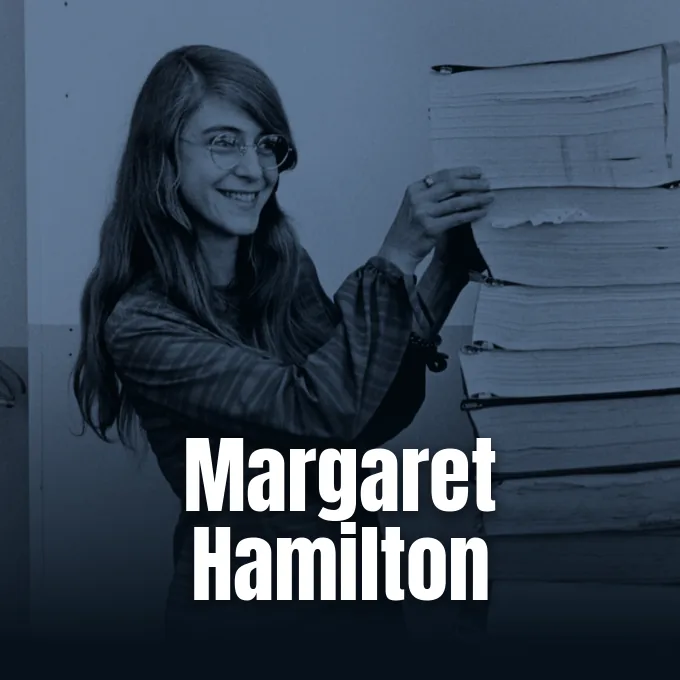
Computer scientist Margaret Hamilton, whose flight code guided NASA astronauts to the moon and helped turn software into a respected engineering field, died on October 8, 2026, at the age of 90. She led the software team at MIT’s Instrumentation Laboratory for NASA’s Apollo program. When she started, managers often treated programming like an afterthought compared with hardware. Her team built the flight software for both the Command Module and the Lunar Module, guiding the crew when Apollo 11 landed on the moon in 1969 [1].
Margaret Hamilton and the Apollo 11 Alarm
In 1969, astronauts Neil Armstrong and Buzz Aldrin guided the Apollo 11 lunar lander toward the moon when the computer triggered a 1202 alarm. The computer alarm read 1202. That warning meant the guidance computer was overloaded with data because a radar switch was set in the wrong position. If the computer halted, the landing couldn’t go on, but Hamilton’s team had planned for overload by creating a priority system that dropped low-priority tasks so core landing math kept running [1].
The computer didn’t crash because the software knew which jobs mattered most during the descent. Instead of stopping every task, the machine dropped the extra radar work and kept computing engine commands and thruster burns. Flight controllers in Houston trusted her code. They told Armstrong to keep going. The lunar lander touched down safely on the moon [1].
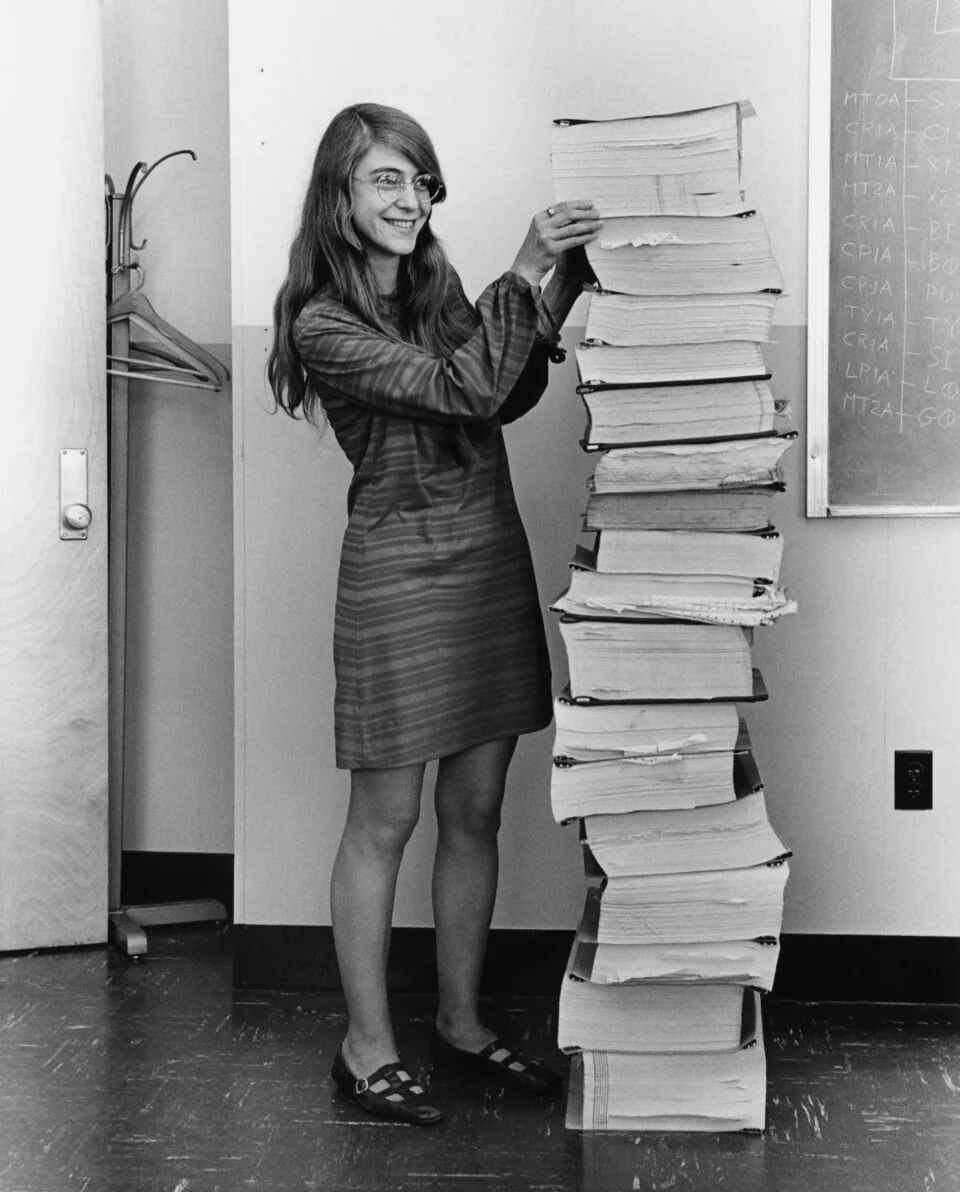
The landing showed that software was more than a list of punch cards. It was a live system that could save human lives in flight. Hamilton had fought for priority scheduling long before NASA managers saw why it mattered. Her recovery design prevented an abort and let the crew land with very little fuel left in the tanks [2].
Flight Simulator Tests and Apollo 8 Safeguards
Hamilton’s focus on error-checking grew out of tests at MIT’s Instrumentation Laboratory, where programmers ran flight code against human mistakes during Apollo guidance simulations. While playing with a flight simulator in the lab, Hamilton’s daughter Lauren touched a switch. Lauren was four years old. She triggered a pre-launch program while the simulation was flying, and the system crashed. Hamilton realized that if a young child could make that error in a simulator, an astronaut working under heavy pressure might do the exact same thing during a real lunar voyage. She argued that computers should never rely on human perfection, urging NASA flight directors to add software safeguards that would block pre-launch routines after takeoff [1].
NASA officials told her that trained astronauts wouldn’t make that kind of slip during flight. Hamilton asked to add a software check that would stop pre-launch programs from running while the craft was moving, but managers said the crew was trained. The problem happened on the Apollo 8 flight to the moon. Astronaut Jim Lovell hit the exact same command Lauren had hit. The computer wiped its navigation data [1].
Hamilton and her MIT team stayed up all night to write and upload an emergency software patch that restored the navigation coordinates, and the fix worked as planned. That quick update prevented an abort and showed that software must catch human slips before they cause harm. Astronauts were flying over lunar impact basins like the craters studied in NASA Moon orbiter missions exploring lunar impact sites, where losing coordinates meant real danger [1].

Establishing Software Engineering at MIT
When Margaret Hamilton led the Apollo flight software group at MIT, computer programming wasn’t seen as an engineering field. Most university departments focused on hardware, treating programming as a clerical job that people wrote after the circuits were wired. Hamilton coined the term “software engineering” to give the work equal standing with other fields, arguing that writing dependable software required the same math and logic as building rocket engines [1].
Some peers at the lab laughed at the name at first. They thought software engineering sounded too grand for writing code. Hamilton defended the name because bad software could destroy a mission just as easily as a broken valve. Her focus on clear rules, automated tests, and careful checks turned programming into a real engineering craft. The name stuck as Apollo flights showed that good code was needed to reach the moon [2].

By the end of the Apollo program, software engineering was taught in schools, and Hamilton’s work at MIT proved that large software jobs needed clear build steps, clean module boundaries, and safety checks [3]. The field she named became the base of modern software work. It shaped how colleges teach coding and how teams build flight computers today.
Commercial Ventures in System Reliability
Hamilton’s work went far beyond NASA into business, where she spent decades as a company founder and chief executive. She founded Higher Order Software and later started Hamilton Technologies to build tools based on her Apollo work [1]. She founded two software firms, where her engineering teams worked to catch software bugs before coders wrote code, building on lessons she explained in an interview with the Computer History Museum [2].
At Hamilton Technologies, she created the Universal Systems Language to help engineers write safe code and lower the total cost of building large software systems for complex aerospace projects. The method used math rules to stop design bugs from entering programs in the first place. Hamilton said normal software projects spent too much cash fixing basic errors that better design rules could stop early. Her tools helped teams in industry build systems that didn’t fail. She argued that preventing errors at the design stage was far cheaper than debugging finished code after deployment, offering a structured framework that simplified complex computing systems for commercial and government clients [1].
During her years as a business leader, Hamilton also spent time helping women enter science, technology, engineering, and math. She showed that a woman could run large engineering teams for government and industry. Her business success proved that the ideas tested during the Apollo moon flights worked for regular business software, setting early standards for reliable computer systems [1].

Presidential Honors for Margaret Hamilton
In 2016, President Barack Obama awarded Margaret Hamilton the Presidential Medal of Freedom, the highest civilian medal in the United States, for her work on the space program and computer software. During the award ceremony, Obama praised her career. “Hamilton defined new forms of software engineering and helped launch an industry that would forever change human history. Her software architecture led to giant leaps for humankind, writing the code that helped America set foot on the moon,” President Obama said [1].
The award honored her not just as the programmer who saved the Apollo 11 lunar landing, but as a pioneer who led the MIT team that built navigation software for the moon flights [1]. At MIT, her team took early computers and built the navigation software that helped land astronauts on the lunar surface. Lindsay Clark of The Register reported that her work helped put humans on the moon [2].
Margaret Hamilton died on October 8, 2026, leaving a lasting mark on space travel and computer science, as tech news outlet HotHardware reported in its coverage of her life [1]. Her priority-driven design and error-checking methods remain part of flight software and operating systems today [2].
Her daughter Lauren survived her, along with a generation of engineers who grew up reading Apollo flight code listings.
- ONLINE NEWS Leong, A. (2026, October 8). Margaret Hamilton Who Saved The Apollo 11 Moon Landing Dies At 90. HotHardware. [Article Link]
- ONLINE NEWS Clark, L. (2026, October 8). Margaret Hamilton, software pioneer who helped put humans on the Moon, dies at 90. The Register. [Article Link]
- ONLINE NEWS R.I.P. Margaret Hamilton, whose code saved the Apollo 11 Moon landing. Ars Technica. [Article Link]


