



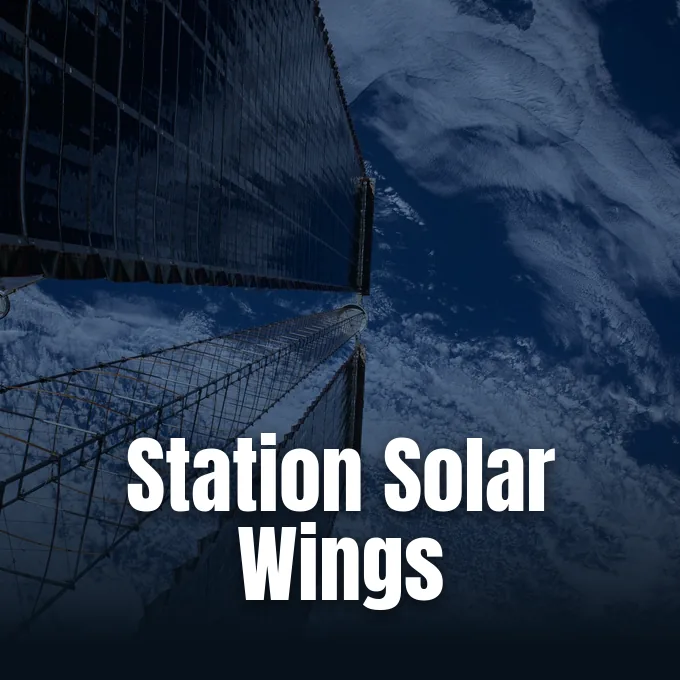
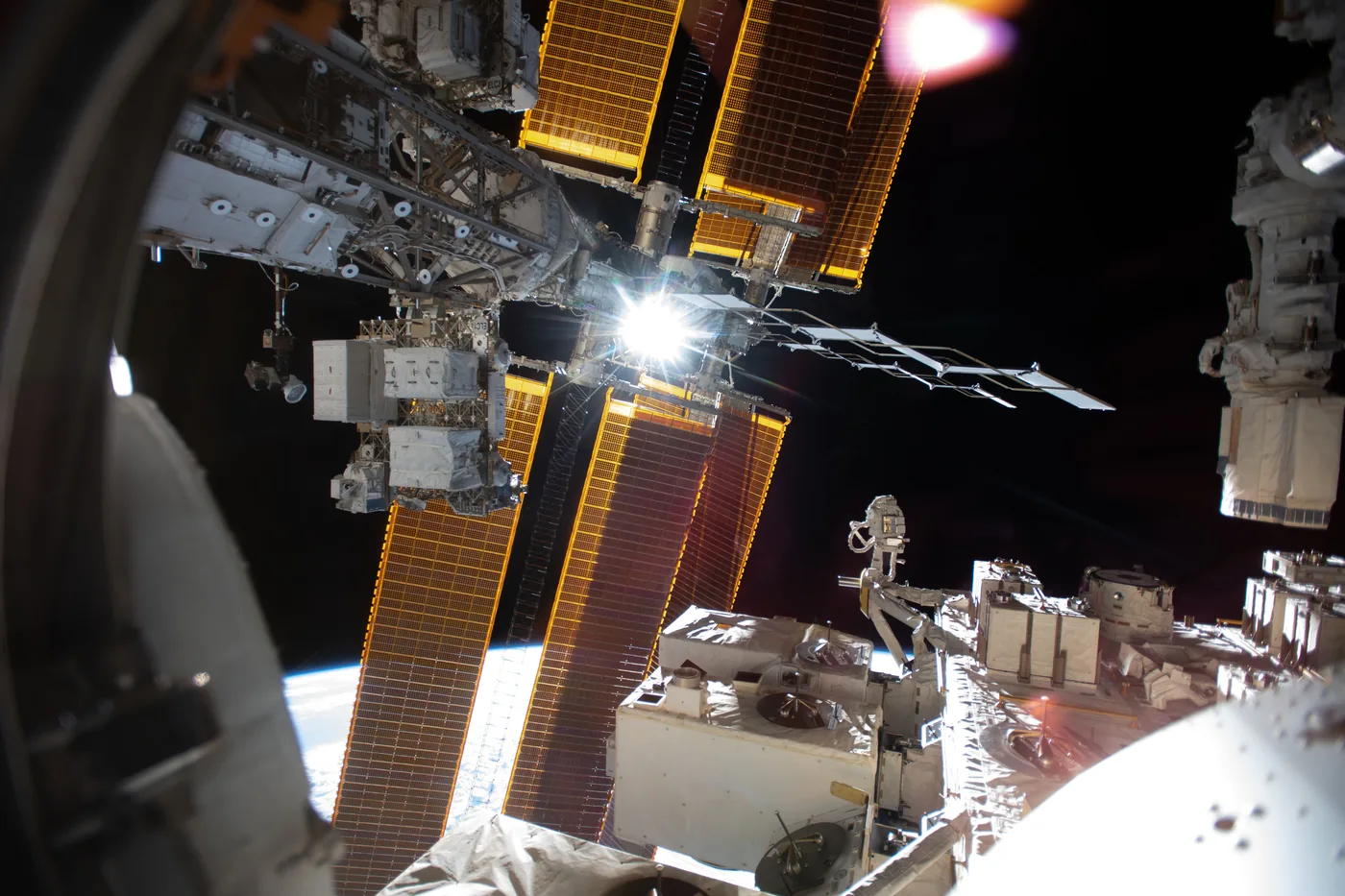
Flexible roll-out solar arrays now supply primary electrical generation aboard the International Space Station after NASA concluded an orbital modernization effort five years in development. The flight hardware arrived inside the unpressurized cargo trunk of a SpaceX Dragon capsule, delivering the final two wings needed to restore aging power channels. Instead of replacing the original solar wings launched decades ago, these compact panels unroll directly in front of them to feed scientific experiments and support daily crew life. With delivery completed on October 13, 2026, the orbiting outpost secured electricity for its final decade in space [1].
Why the Station Needed Roll-Out Solar Arrays
The station legacy solar wings entered service between 2000 and 2009, converting raw sunlight into electricity for life-support systems and pressurized laboratories. Orbiting 250 miles above Earth, the outpost passes through ultraviolet radiation, atomic oxygen erosion, and sharp temperature swings every ninety minutes as it moves in and out of orbital darkness [1]. Those space conditions gradually degraded the silicon solar cells, causing total electricity generation to drop well below original factory specifications [7]. Removing the massive original panels would have required risky spacewalk surgeries on high-voltage channels, so mission managers looked for an upgrade path that could add fresh power without throwing away working truss infrastructure already bolted to the central backbone [6].
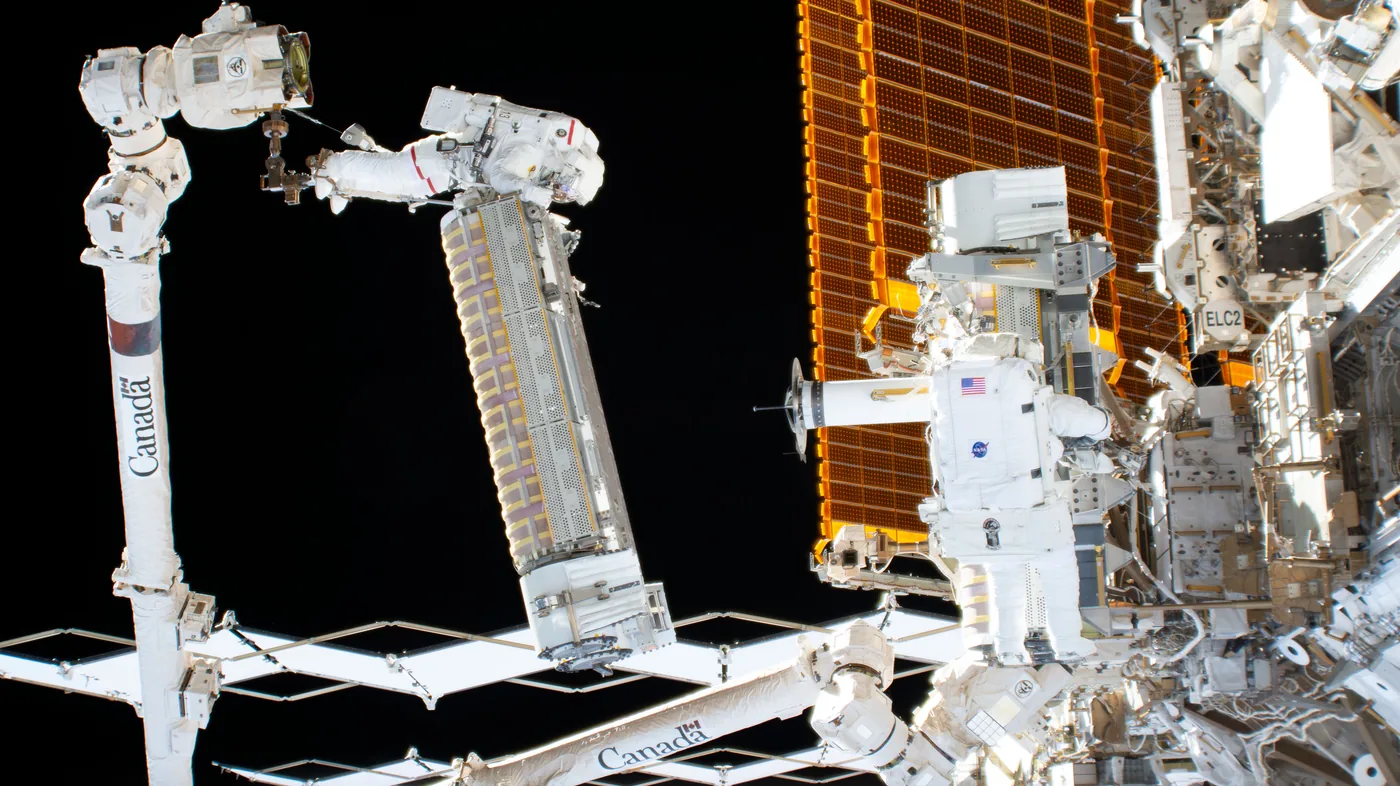
NASA chose an overlay strategy using roll-out solar arrays mounted in front of the existing wings. Each new panel is roughly half the size of a legacy array, shading part of the older hardware while letting unshaded sections continue generating power [2]. Connecting directly into established solar tracking joints avoids building new rotating mechanisms [3]. Michael Salopek, program project manager for the ISS Vehicle Office, said the modification reset the clock 20 years on the station solar arrays [2].
Before the upgrade began, the station generated about 160 kilowatts of usable electricity, which limited scientific capacity [6]. With all eight wings in position, generation climbs to about 215 kilowatts, representing a boost of roughly 30 percent [1]. That net increase of 55 kilowatts gives orbital laboratories ample operating margin [6].
How Stored Energy Deploys iROSA Solar Arrays
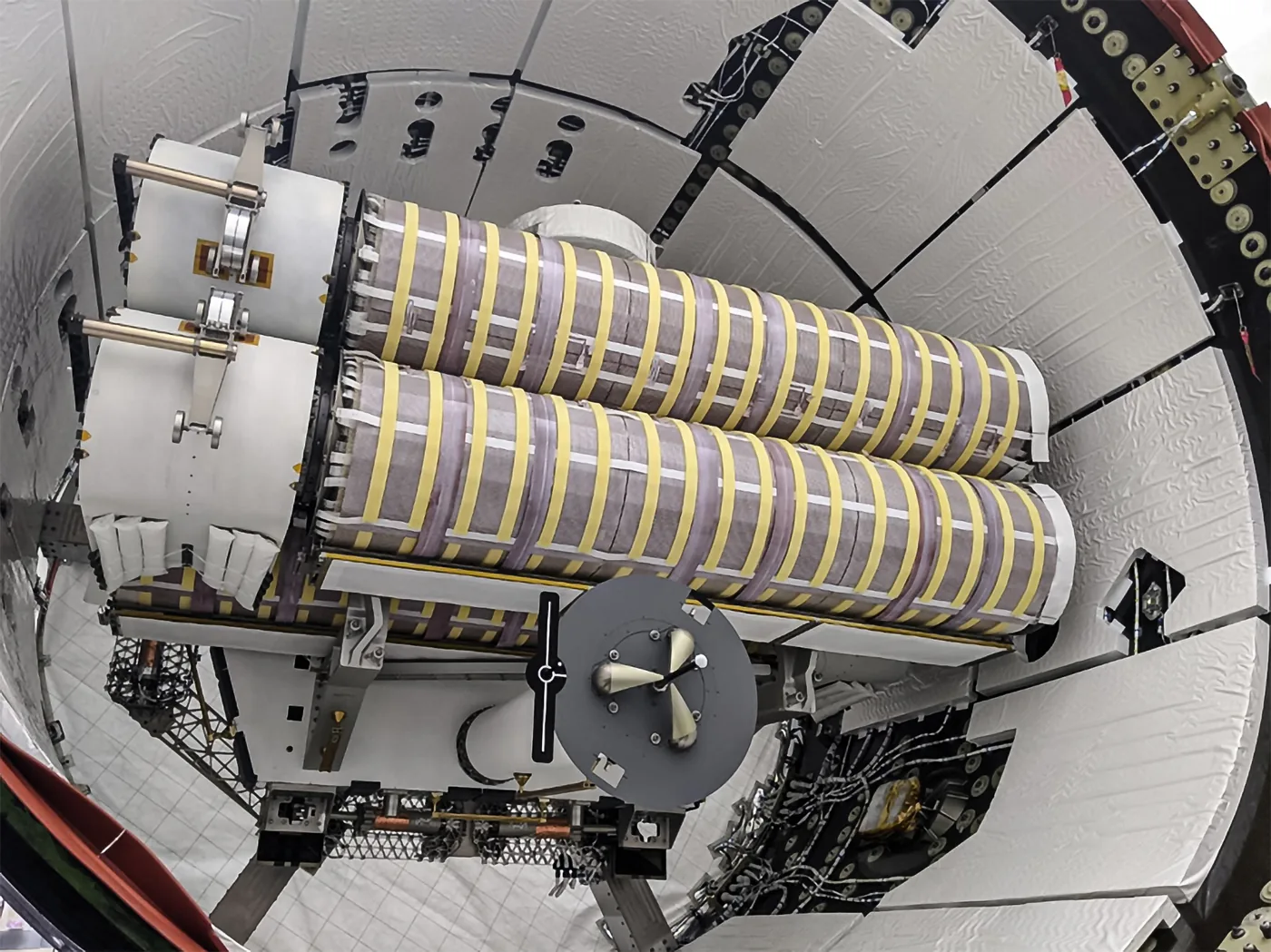
Standard spacecraft arrays depend on electric motors, gearboxes, and explosive bolts to push open heavy metal frames, creating multiple points where moving parts can jam during deployment [2]. In contrast, the iROSA solar arrays deploy without any motors by drawing on stored strain energy in composite booms [7]. Before flight, each flexible blanket rolls tightly around a cylinder like a yoga mat under spring tension [1]. Once astronauts release the launch latches, the carbon-fiber booms unroll under their own energy, pulling the photovoltaic blanket flat across the supporting arms [7].
Matt LaPointe, technical director at Redwire Space, said his engineering group focused on a simple boom mechanism to eliminate drive motors. Ken Steele, Redwire Vice President of Business Development, described the challenge: “You come up with a simple concept, but to get that to space, riding along that controlled explosion is what drives your design” [2]. That approach lets a large solar surface stow inside tight launch dimensions [7].
The technology took shape at Deployable Space Systems with support from NASA Small Business Innovation Research program. In 2009, early awards delivered nearly $850,000 to test the carbon-fiber boom concept [2]. After a 2017 flight test aboard mission CRS-11 proved the hardware on the station robotic arm, Redwire acquired the firm in 2021 [7].
SpaceX CRS-35 Cargo Delivery to Orbit
The final pair of wings departed Florida at 6:33 a.m. EDT on Tuesday, October 13, 2026, when a SpaceX Falcon 9 lifted off from Space Launch Complex 40 at Cape Canaveral Space Force Station. Booster B1096 flew its eighth orbital mission before landing back at Landing Zone 40 eight minutes after launch [7]. Dragon spacecraft C211 carried more than 6,300 pounds (2,722 kilograms) of research gear and the rolled solar hardware inside its unpressurized aft trunk [3].
Dragon separated from the Falcon 9 upper stage ten minutes into flight and began a 51-hour pursuit toward the orbiting laboratory. The capsule was scheduled for autonomous docking at 11 a.m. EDT on Thursday, October 15, at the space-facing zenith port of the station Harmony module. NASA astronaut Anil Menon and Canadian Space Agency astronaut Joshua Kutryk monitored Dragon arrival from the cupola, tracking telemetry during the automated approach [6].
The flight marks the 15th mission under NASA Commercial Resupply Services Phase 2 contract, following CRS-34 in May 2026. Dragon C211 previously completed three resupply trips, including CRS-33 which carried extra propellant to boost station altitude. Its ocean splashdown capability protects delicate returned research samples [7].

Spacewalk Plans for Channel 2A and Channel 3B
NASA managers scheduled a briefing at Johnson Space Center in Houston with Gaurang Patel and Garrett Hehn to preview the upcoming extravehicular activities. Designated U.S. spacewalks 100 and 101, the excursions mark the 285th and 286th spacewalks carried out for station assembly and maintenance. As outlined in earlier spacewalk plans to complete station solar array upgrades, the crew must secure support struts onto the truss before unrolling each solar wing across the older framework [6].
On Thursday, October 29, Anil Menon and Joshua Kutryk will exit the Quest airlock for spacewalk 100 to mount the seventh wing onto power channel 2A. NASA singles out channel 2A because it energizes essential systems for flight control, orbit keeping, and the planned early-2030s safe, controlled deorbit [6]. Gaurang Patel, NASA operations integration manager for the Low Earth Orbit Program, explained the integration challenge: “The legacy arrays are not outfitted to have standard upgrades and so, teams had to go look at ways we could attach these arrays”. Mounting kits attached to older structural brackets bridge the dimensional differences between new and legacy hardware, providing secure anchors along the truss [7].

One week later, on Thursday, November 5, the two astronauts will step outside for spacewalk 101 to install the eighth roll-out wing on channel 3B [6]. Aided by the Canadarm2 robotic arm, the spacewalkers will bolt the canister, plug in electrical connectors, and release the restraining pins [4]. When the composite booms expand in sunlight, the full upgrade campaign that began in June 2021 with CRS-22 will reach completion [7]. That final installation gives every power channel modern generation capacity to support ongoing science [5].
How Station Solar Arrays Power Orbital Science
The electrical boost generated by the station solar arrays provides stable energy for more than forty research projects delivered by SpaceX CRS-35. In biomedical engineering, researchers are running LambdaVision-1, which studies artificial retinas made from bacteriorhodopsin, a light-driven proton-pumping protein. Manufacturing the 200-layer protein films on Earth produces flaws because gravity pulls liquid unevenly across the support membrane. In microgravity, layers settle with uniform thickness, creating prototype implants designed to restore sight for patients with retinitis pigmentosa and macular degeneration [7].
Cell biology investigations also benefit from higher power budgets. The Stellar Spheroids experiment cultures 3D human heart tissue models in weightlessness without using mechanical scaffold matrices. Without gravitational drag, heart cells naturally assemble into three-dimensional balls that develop microvascular channels, giving pharmacologists realistic models to screen cardiovascular drugs before animal or human trials. In addition, multi-donor brain organoid samples called organoid villages will study cellular pathways in Alzheimer’s disease, Parkinson’s disease, and multiple sclerosis. Earlier orbital organoid work on the station identified the HIV drug lamivudine as a candidate treatment for Rett syndrome [7].
Materials science facilities consume energy to melt metals and ceramics without contamination. The ELF-Unconventional Glass 2 study uses electrostatic levitation to suspend heavy-element raw materials without physical containers while melting them with lasers. Dr. Liz Warren, NASA Deputy Chief Scientist, explained the scientific interest: “Unconventional glass is made from heavier elements that aren’t traditionally used to form glass… These unconventional glasses could have remarkable properties, including refractive indices higher than diamond, greater resistance to breaking, and even the ability to contract rather than expand when heated”. Warren said such glasses could improve laser optics on Earth and yield stronger viewing ports for lunar habitats planned under the Artemis campaign [7].
Gateway and Lunar Reach for Deployable Technology
Demonstrating roll-out solar arrays in low Earth orbit proved the structural resilience of flexible arrays before flight planners chose them for deep space exploration [1]. In November 2021, NASA launched the Double Asteroid Redirection Test probe, powered by two roll-out wings that propelled the spacecraft across nearly seven million miles to crash into asteroid Dimorphos. DART substituted some standard cells with solar concentrators to test whether reflective troughs could heat photovoltaic surfaces in weak sunlight, opening pathways for outer solar system journeys [2].
NASA Artemis program is integrating roll-out wings into Gateway, the planned lunar-orbiting station. Gateway Power and Propulsion Element will use two roll-out arrays generating 60 kilowatts to power electric ion thrusters. Related research continues through power lab proposals from NASA Glenn Research Center, evaluating distribution models for lunar temperatures [2].
Commercial aerospace companies have also incorporated deployable wings into geostationary communications satellites. Maxar Technologies adopted modular roll-out arrays to reduce launch mass while freeing volume for extra communications equipment. Eliminating electric drive motors and heavy rigid frames lets satellite operators lower launch costs and lengthen orbital lifespan [2]. For the International Space Station, having all eight wings deployed supplies steady power through its scheduled retirement in the early 2030s, when the final deorbit burn guides the outpost into a remote ocean descent [8].
- PRESS RELEASE Giraldo, C. E., & Garcia-Galan, P. L. (2026, October 15). Power Up: Roll Out Solar Arrays Boost Space Station Power Supply. NASA. [Article Link]
- REPORT Patel, S., & Hall, L. (2022, March 31). Impact Story: Roll-Out Solar Arrays. NASA Space Technology Mission Directorate. [Article Link]
- ONLINE NEWS Aafreen, S. (2026, October 14). Solar Arrays Boost Space Station Power. Electronics For You. [Article Link]
- WEBSITE PressBee. (2026, October 15). Power Up: Roll Out Solar Arrays Boost Space Station Power Supply. PressBee. [Article Link]
- ONLINE NEWS La Primera en Línea. (2026, October 15). Power Up: Roll Out Solar Arrays Boost Space Station Power Supply. La Primera en Línea. [Article Link]
- ONLINE NEWS Cosmic Herald. (2026, October 15). Two Spacewalks to Finish the Station’s Power Upgrade With the Last Roll-Out Solar Arrays. Cosmic Herald. [Article Link]
- ONLINE NEWS Butler, D. (2026, October 13). SpaceX CRS-35 Delivers Final Solar Arrays, Completing ISS Power Upgrade. Tech Times. [Article Link]
- WEBSITE Worldnewsdotcom. (2026, October 15). Power Up: Roll Out Solar Arrays Boost Space Station Power Supply. Worldnewsdotcom. [Article Link]
APA 7: PerEXP Teamworks. (2026, October 16). How Roll-Out Solar Arrays Boost Space Station Power. PerEXP Teamworks. https://perexpteamworks.com/en/roll-out-solar-arrays-space-station/


